
CRE-110 · Lesson 9 of 12 · 25 min
Authenticity, boundaries and privacy
"Be authentic" may be the most common advice given to creators, and one of the least clear. Audiences reward creators who seem genuine: who share real experiences, admit mistakes, and do not pretend to be something they are not. But authenticity does not mean sharing everything. Every creator decides, consciously or not, what parts of their life to show and what to keep private, and those decisions affect their safety, their mental health, their relationships and the people around them. This lesson explores what authenticity means for a personal brand, the difference between a persona and a performance, how to set boundaries about what you share, how to protect your privacy and the privacy of others, special considerations for children and family, and how to stay honest about sponsorships, editing and AI.
What authenticity means
In branding, authenticity has several related meanings: being consistent (what you say matches what you do), being honest (no invented stories, fake results or hidden sponsorships), being transparent about limits (admitting what you do not know), and expressing real personality rather than a manufactured one. Audiences judge authenticity by consistency over time, not by any single confession. A creator who shares little about their personal life but is consistently honest and true to their values is authentic; a creator who overshares dramatic personal stories that turn out to be exaggerated is not.
There is a paradox here: all content is shaped. Choosing what to film, editing out mistakes and lighting a set are not dishonest. The line is crossed when shaping creates a false impression that matters to the audience: faked results, staged "spontaneous" events presented as real, undisclosed paid endorsements, or invented credentials.
Person and persona
Most creators present a persona: a focused, amplified version of themselves suited to their niche and format. A persona is not a lie; it is a selection. A comedian's stage persona is louder than their dinner-table self; a teacher is more structured in class than at home. Problems arise when the persona drifts too far from the person, so that keeping it up becomes exhausting, or when audiences cannot tell the persona from the person and feel betrayed when they discover the difference. Keeping the persona rooted in real traits and values, and occasionally acknowledging that content is a part of your life rather than all of it, keeps the relationship healthy.
The sharing spectrum
It helps to sort information about yourself into zones and decide in advance where each item belongs:
- Public: freely shared in content; part of the brand (your niche expertise, opinions on your topic, general life updates you are comfortable with).
- Selective: shared occasionally, in controlled ways, when it serves the content and you are ready (some health experiences, career history, a partner's first name).
- Private: never shared (home address, children's faces or schools, workplace details, finances, family conflicts, other people's stories without consent).
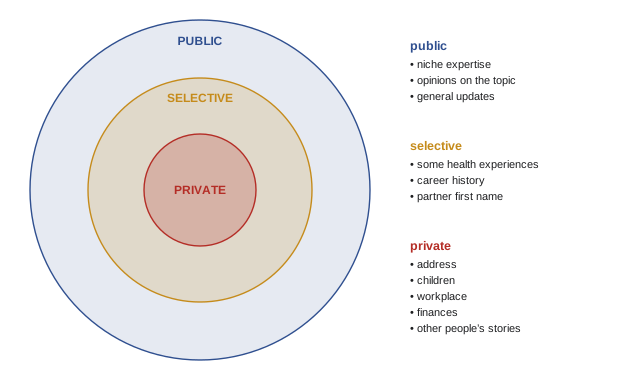
Deciding in advance matters because pressure to share often arrives at bad moments: when a video about a personal struggle goes viral and the audience asks for more, when a sponsor wants to film in your home, or when you are tired and emotional. A written boundary policy, part of your brand plan, lets you answer from a calm decision made earlier.
Many creators also apply a waiting rule for difficult personal topics: share experiences once you have processed them, not while they are raw. Sharing during a crisis can bring support, but it can also bring criticism, unwanted advice and a permanent public record you may later regret, sometimes called a "vulnerability hangover".
Protecting your privacy and safety
Online visibility brings risks of stalking, harassment and doxxing (publishing someone's private information, such as their address). Practical protections include:
- Remove location metadata from photos before posting; many phones embed GPS coordinates in image files.
- Check every frame for identifying details: street signs, house numbers, vehicle licence plates, mail, school uniforms, views from windows, and reflections.
- Post location-based content after you have left a place, not while you are there.
- Use a separate business email, phone number and, where possible, a mailing address such as a post office box or mail service for business correspondence and returns from sponsors.
- Secure accounts with unique passwords, a password manager and two-factor authentication; account takeovers are a common attack on creators.
- Think about how your real name, your creator name and your other accounts link together, and limit what can be found by searching.
- Have a plan for harassment: platform reporting and blocking tools, comment filters, and people you can call on for support. Serious threats should be reported to police.
Other people's privacy
Your content will often include other people: family, friends, colleagues, customers, patients, strangers in public. Their privacy matters as much as yours. Ask permission before featuring identifiable people, and get written releases for anyone who appears prominently, especially in monetized or sponsored content. Respect workplace rules: health care workers, teachers and others usually cannot film patients, students or confidential information. Be careful with stories about others: telling an anecdote about a friend or ex-partner can hurt them even if you change the name, if people who know them can recognize them.
In Canada, privacy laws such as PIPEDA, provincial laws including Quebec's Law 25, and the common law and Quebec Civil Code protections for image and private life can apply to publishing identifiable people; Quebec in particular requires consent to use a person's image in many circumstances.
Children and family
Content featuring children raises special concerns. Children cannot meaningfully consent to having their lives published, and what is cute at four may be humiliating at fourteen; content stays searchable for years. There are also safety risks: images of children can be misused, and details such as names, schools and routines can expose them to harm. Many creators who feature family choose to avoid showing children's faces, use nicknames, never reveal schools or routines, and give older children a veto over what is posted.
When children contribute substantially to monetized content, questions of labour and fair pay also arise.
In Canada, child performers in film and television are protected by provincial rules in some provinces, but children appearing in family social media content are less clearly covered; check your province's employment standards and privacy laws, and consider setting aside a share of income for children who appear regularly.
Honesty about sponsorships, editing and AI
Authenticity also means being honest about how content is made and paid for:
- Sponsorships and gifts: clearly disclose paid partnerships, free products, affiliate links and any material connection to brands, in a way viewers will notice and understand. Disclosure rules are covered in detail in a later course, but the principle belongs to the brand from the start.
- Editing and staging: if something is staged, re-enacted or a dramatization, say so when it matters to the audience's understanding.
- Results: show real results, including failures. Before-and-after comparisons should use the same conditions and should not be edited to exaggerate.
- AI and synthetic media: disclose when realistic images, voices or video have been generated or significantly altered, and follow platform labelling rules. Never create realistic content depicting real people saying or doing things they did not do.
- Credentials: state your qualifications accurately and never imply professional status you do not have.
Writing a boundary and authenticity policy
Worked problem
A boundary policy for Night Shift Kitchen
Jordan is a registered nurse who will discuss food, energy and life on shifts. Draft key points of a boundary and authenticity policy.
Show solution
- Public: nursing role in general terms, shift-work experiences, cooking, opinions on food and fatigue within evidence.
- Selective: personal health experiences only after reflection; partner mentioned by first name only with consent.
- Private: hospital name and unit, colleagues' or patients' details, home location, children's faces and schools.
- Professional: no individual medical advice; general information only, with sources, and encourage viewers to consult their own health professional; follow the regulator's social media guidance.
- Disclosure: every sponsorship, gift and affiliate link disclosed verbally and in text; no sponsors that conflict with health values (for example, energy drinks marketed to shift workers).
- Corrections: mistakes corrected publicly in a pinned comment and the next video.
Answer: A one-page policy covering zones, professional limits, disclosure, sponsor criteria and corrections, reviewed every six months.
Sustaining yourself
Building a personal brand means being visible, and visibility can be draining. Comparison with other creators, the pressure to post, public criticism and the blurring of work and life contribute to burnout among creators. Boundaries about time (days off, no comments after a certain hour), clear separation of personal and creator accounts, and supportive people outside the creator world help. The aim is a brand that is true enough to be sustainable and private enough to be safe.
Handling mistakes publicly
Every creator eventually makes a mistake in public: a factual error, an insensitive joke, an undisclosed sponsorship or a poorly judged comment. How the mistake is handled often matters more to the brand than the mistake itself. Effective corrections are prompt, specific about what was wrong, free of excuses, and accompanied by a clear description of what will change. A pinned comment, an on-screen correction or a short follow-up video can address factual errors. More serious mistakes may need a direct, sincere apology that focuses on the people affected rather than on the creator's own feelings. Audiences generally forgive honest mistakes handled well, and they remember defensiveness or silence.
Authenticity and growth
As a brand grows, maintaining authenticity becomes harder. More sponsors approach, more people ask for personal details, and the team behind the brand may grow. Revisit your boundary policy each time something changes significantly: a new sponsor category, a new platform, a new team member or a big jump in audience size. Ask whether your content still reflects who you are and what you value. Many experienced creators say that the moments they regret most were those where they compromised their values for short-term gains, while the decisions they are proudest of were those where they held to their principles despite pressure.
Authenticity, boundaries and privacy are not one-time decisions but ongoing practices. Schedule a short review of your boundary policy every six months, and whenever a significant event occurs, such as a viral moment, a new sponsor category, a move or a change in your family. Ask whether the zones still reflect what you are comfortable with, whether your privacy protections are working, and whether your disclosures remain clear. Small, regular adjustments prevent the gradual drift that can leave creators sharing more than they intended.
Common mistakes
MistakeTreating authenticity as sharing everything.
InsteadBe consistent and honest while keeping clear boundaries.
MistakeDeciding what to share under pressure.
InsteadWrite a boundary policy in advance.
MistakePosting photos with location data or identifying details.
InsteadStrip metadata and check every frame.
MistakeFeaturing others without permission.
InsteadAsk, get releases, and respect workplace rules.
MistakeHiding sponsorships or AI generation.
InsteadDisclose clearly and accurately.
Summary and key terms
- Authenticity means consistency, honesty, transparency about limits and real personality, not total disclosure.
- Shaping content is normal; creating false impressions that matter is not.
- A persona is a selection rooted in real traits; keep it close to the person.
- Sort information into public, selective and private zones and write a boundary policy.
- Protect privacy with metadata removal, frame checks, delayed posting, separate contacts and account security.
- Respect others' privacy and take special care with children.
- Disclose sponsorships, staging, AI use and credentials honestly, and protect your wellbeing.
- Authenticity
- Consistency between who a creator is, says and does.
- Persona
- A focused, amplified public version of oneself.
- Sharing spectrum
- Public, selective and private zones of information.
- Boundary policy
- A written plan for what will and will not be shared.
- Vulnerability hangover
- Regret or exposure after sharing something raw.
- Doxxing
- Publishing someone's private identifying information.
- Metadata
- Hidden data in files, such as GPS coordinates.
- Release form
- Written permission to use a person's image.
- Material connection
- A relationship with a brand that must be disclosed.
- Synthetic media
- Images, audio or video generated or altered by AI.
Practice problems
Work each problem on paper first, then reveal the answer to check.
Give four meanings of authenticity for creators.
Show answer
Consistency, honesty, transparency about limits, real personality.
When does shaping content become dishonest?
Show answer
When it creates a false impression that matters to the audience.
What is the difference between a persona and a fake identity?
Show answer
A persona is a selection of real traits; a fake identity is invented.
Name the three zones of the sharing spectrum.
Show answer
Public, selective and private.
Why write a boundary policy in advance?
Show answer
Pressure to share arrives at bad moments.
List four privacy protections.
Show answer
Strip metadata, check frames, post after leaving, separate contacts, two-factor authentication.
What should you get from someone who appears prominently in sponsored content?
Show answer
A written release.
Name two ways to protect children in family content.
Show answer
Hide faces, use nicknames, never reveal schools or routines, give older children a veto.
What must be disclosed about AI-generated content?
Show answer
When realistic images, voices or video are generated or significantly altered.
Name two boundaries that help prevent burnout.
Show answer
Days off and no comments after a set hour.
Lesson quiz · 5 questions
Score 60% or more to complete this lesson.
Create a free account to save your progress, take quizzes and earn a certificate.