
CRE-110 · Lesson 10 of 12 · 25 min
Names, handles, bios and protecting your brand
A name is often the first thing people learn about a creator and the last thing they remember. It appears in every search result, every mention, every sponsor contract and every recommendation from one viewer to another. Changing it later is possible but costly: subscribers and links may break, search history is lost, and audiences become confused. So it is worth choosing carefully. This lesson covers the choice between a personal name and a brand name, criteria for good names, how to secure consistent handles and a domain, how to write bios and descriptions that express your positioning, how to create a short pitch for collaborators and sponsors, and the basic legal steps for protecting your brand and avoiding conflicts with others' rights.
Personal name or brand name?
Creators choose between three main options:
- Personal name (for example, "Jordan Lee"): builds a brand around you as a person, flexible if your topics change, and strong for credibility in expertise niches. Drawbacks: less descriptive, harder if your name is common or hard to spell, less privacy, and harder to sell or hand over the brand later.
- Brand name (for example, "Night Shift Kitchen"): describes the niche, easier to grow into a team or business, and offers more privacy. Drawbacks: may restrict you if your niche shifts, and may feel less personal.
- Hybrid (for example, "Jordan Lee | Night Shift Kitchen" or "Night Shift Kitchen with Jordan"): combines a personal presence with a descriptive brand. Many creators use their brand name for the channel and their personal name as the host.
Consider your long-term goals. If you might expand beyond the niche, want to be known as an expert, or plan to speak and consult, a personal name is attractive. If you want privacy, plan to build a team, or may one day sell the business, a brand name is safer.
Criteria for a good name
- Memorable: short, distinctive and easy to recall after hearing it once.
- Easy to say and spell: passes the "radio test", where someone who hears it can type it correctly. Avoid unusual spellings, numbers and underscores unless they are essential.
- Relevant: suggests the niche, value or personality, or at least does not contradict them.
- Extendable: leaves room for growth into related topics.
- Available: not already used by a creator, company or trademark in a related area, and available as handles and a domain.
- Appropriate across languages and cultures: check that the name does not have unfortunate meanings in languages your audience speaks.
- Searchable: not identical to a very common phrase that buries you in search results.
| Name idea | Memorable | Spellable | Relevant | Extendable | Available |
|---|---|---|---|---|---|
| Night Shift Kitchen | Yes | Yes | Yes | Moderately | Check |
| NurseFoodz247 | Somewhat | No (z, numbers) | Yes | Low | Check |
| Jordan Lee Cooks | Somewhat | Yes | Partly | High | Common name: crowded |
| Graveyard Shift Grub | Yes | Yes | Yes | Moderately | Check; tone may not fit health values |
Handles and domains
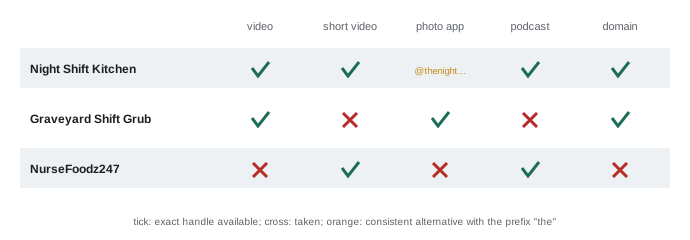
Once you have a shortlist, check availability on every platform you might use, now or later, and register the same handle on each, even if you will not be active there yet. Consistent handles make you easier to find and reduce impersonation. If the exact handle is taken, add a short, consistent modifier ("nightshiftkitchen", "thenightshiftkitchen", "nightshiftkitchentv") rather than different variants on each platform. Avoid underscores and periods, which people often forget or misplace.
Register a domain name matching the brand, even if you only use it for a simple link page or email at first. A domain and a mailing list are assets you own and control, unlike platform accounts, which can be suspended or changed. Use the domain for a professional email address for sponsors.
Bios and descriptions
Bios are short, and each platform allows different lengths, but they all have the same job: tell a visitor in seconds who you help, how, and why they should follow, in your voice. A simple formula is: who it is for + what you do + what makes you different + a reason to follow or a call to action. For example: "Meal prep for nurses and shift workers. Healthy food that fits 12-hour nights, from a night-shift RN. New shift-week plan every Sunday." Longer descriptions, such as a channel "about" section, can add a short story, the content pillars and schedule, a sponsor contact address, and links. Include natural keywords people might search for, but write for humans, not algorithms.
Profile images should be clear at small sizes (a well-lit face or a simple logo), and banners should communicate the brand promise and schedule, with important text kept within the safe area that displays on all devices.
The pitch and media kit
Collaborators, journalists and sponsors need to understand your brand quickly. An elevator pitch is a thirty-second spoken or three-sentence written summary derived from your positioning statement: who you serve, what you do differently, and evidence of results or audience. A media kit, a short document or web page, adds audience size and demographics from your analytics, engagement statistics, content examples, past partners and testimonials, the types of partnerships you offer, and contact details. Keep figures current and accurate; inflating them is dishonest and easily discovered by sponsors who ask for analytics screenshots.
Business registration
If you earn income from your content, you are running a business, even as a sole proprietor, and you may need to register it and report income for tax.
In Canada, a sole proprietor operating under a name other than their own legal name generally must register the business name with their province or territory (for example, through ServiceOntario in Ontario), and must register for GST/HST once revenues exceed $30,000 in four consecutive quarters. Income is reported on the personal tax return; incorporation is an option as income grows.
Trademarks
Copyright does not protect names, titles or short phrases; trademarks do. A trademark protects a name, logo or slogan used to identify the source of goods or services, and prevents others from using confusingly similar marks for related goods or services. Before committing to a name, search the trademark database in your country (and in countries where you have large audiences) for identical or similar marks in related classes such as entertainment services, online video and merchandise. A name that conflicts with an existing trademark can lead to demands to stop using it, loss of accounts and legal costs, sometimes after you have built a large audience.
In Canada, trademarks are registered with the Canadian Intellectual Property Office (CIPO), whose online database can be searched for free. Registration is not mandatory, since rights also arise through use, but it gives stronger, nationwide protection. Applications are examined, which typically takes many months, and fees depend on the number of classes.
For creators whose brand becomes valuable, registering a trademark for the name and logo, particularly before launching merchandise or products, is a sensible investment; a lawyer or registered trademark agent can advise on classes and conflicts.
Worked problem
Running availability checks
Jordan's shortlist is "Night Shift Kitchen" and "Graveyard Shift Grub". What checks should Jordan run before choosing?
Show solution
- Search the platforms and the web for each name to see whether creators or businesses already use it.
- Check handle availability on the planned home platform and three secondary platforms, plus the domain.
- Search the trademark database for identical or similar marks in entertainment, online content and food-related classes.
- Say each name aloud to a few people and ask them to type it (the radio test), and ask how each name feels in tone.
- Check meanings in other languages spoken by the audience.
Answer: If "Night Shift Kitchen" passes the availability and trademark checks and tests well, choose it: it is clear, spellable and fits the health-focused values better than "Graveyard Shift Grub".
Respecting others' brands
Avoid names, logos and visuals that imitate existing brands or creators, even playfully, as they can confuse audiences and invite legal claims. Do not use other companies' logos in your branding or imply endorsements you do not have. When you review or discuss brands in content, using their names to refer to them is generally acceptable, but your own brand assets should be original.
Names in practice
Many creators struggle to choose a name and delay launching as a result. A practical approach is to generate a long list, at least twenty or thirty options, using different strategies: descriptive names that state the niche, evocative names that suggest a feeling, invented words, combinations of your name with a topic, and phrases from your audience research. Remove any that fail the basic criteria, then test the remaining five or six with people in your target audience. Ask which they would remember after a day, which they would trust, and what each suggests about the content. Choose the best available option, check it thoroughly, and launch. A good name that is available and legally clear is better than a perfect name that delays your start for months.
Remember that names gain meaning through use. Many successful brands have names that meant little at first; the content and experience filled them with meaning over time. What matters most is that the name is clear, ownable and does not work against your position.
Keeping records
As your brand grows, keep organized records: the dates when handles and domains were registered and their renewal dates, login details stored securely in a password manager, business registration documents, trademark searches and filings, contracts with designers and collaborators, and licences for fonts, music and images. These records protect you if disputes arise, make it easier to hire help, and are essential if you ever sell or transfer the brand. Set reminders for domain and registration renewals, since letting a domain lapse can allow someone else to acquire it.
International considerations
If your audience spans several countries, consider how your name and brand travel. Check that the name has no unfortunate meanings in major languages spoken by your audience, and that it can be pronounced by people who speak those languages. Trademark rights are generally national, so a registration in one country does not automatically protect you in another; creators with large audiences or product sales abroad may eventually register in key markets. Platform handle availability is global, which makes securing consistent handles early even more important.
Taken together, the name, handles, domain, bios, media kit and legal checks form the practical foundation of the brand. They are rarely exciting work, but problems with any of them can undermine everything built on top. Completing them carefully before launching, and reviewing them each year, saves time, money and stress later, and gives sponsors and collaborators confidence that they are dealing with a professional.
A practical tip is to set up a simple brand folder from day one, containing the logo files, the colour codes, fonts, bios of different lengths, a current headshot and the media kit. When an opportunity arrives, such as a podcast invitation or a sponsor inquiry, you can respond quickly with accurate, consistent materials instead of scrambling to assemble them.
Common mistakes
MistakeChoosing a name with odd spellings and numbers.
InsteadPass the radio test and keep it simple.
MistakeRegistering handles only on one platform.
InsteadSecure consistent handles everywhere and a domain.
MistakeWriting a bio that lists hobbies but not the value.
InsteadState who you help, how, why you, and a call to action.
MistakeSkipping trademark searches.
InsteadSearch the national database before committing.
MistakeInflating media kit numbers.
InsteadReport accurate, current statistics.
Summary and key terms
- Choose between a personal, brand or hybrid name based on long-term goals and privacy.
- Good names are memorable, spellable, relevant, extendable, available, culturally safe and searchable.
- Secure consistent handles on all platforms and a matching domain and email.
- Bios state who you help, what you do, what makes you different and why to follow.
- An elevator pitch and honest media kit help collaborators and sponsors understand you.
- Register business names as required and report income for tax.
- Search and consider registering trademarks; respect other brands.
- Brand name
- A descriptive name for the creator business.
- Handle
- A username on a platform.
- Radio test
- Checking whether a heard name can be spelled correctly.
- Domain name
- An internet address owned by the brand.
- Bio
- A short profile description.
- Elevator pitch
- A thirty-second summary of the brand.
- Media kit
- A document summarizing audience and partnership offers.
- Sole proprietorship
- An unincorporated business owned by one person.
- Trademark
- A protected name, logo or slogan identifying a source of goods or services.
- Trademark class
- A category of goods or services in which a mark is registered.
Practice problems
Work each problem on paper first, then reveal the answer to check.
Give one advantage and one drawback of a personal name.
Show answer
Flexible and credible; less private and harder to sell.
What is the radio test?
Show answer
Whether someone who hears the name can type it correctly.
Why register handles on platforms you will not use yet?
Show answer
Consistency and preventing impersonation.
Why own a domain and mailing list?
Show answer
They are assets you control, unlike platform accounts.
Write the bio formula.
Show answer
Who it is for + what you do + what makes you different + reason to follow.
What does a media kit contain?
Show answer
Audience data, engagement, examples, past partners, offers and contact details.
Does copyright protect a channel name?
Show answer
No; trademarks protect names.
What should you search before choosing a name?
Show answer
Platforms, the web, handles, domains and the trademark database.
Why avoid imitating other brands' logos?
Show answer
It confuses audiences and invites legal claims.
When is registering a trademark particularly worthwhile?
Show answer
When the brand becomes valuable, especially before merchandise or products.
Lesson quiz · 5 questions
Score 60% or more to complete this lesson.
Create a free account to save your progress, take quizzes and earn a certificate.