
CRE-110 · Lesson 6 of 12 · 25 min
Content pillars, formats and series
A niche and a position describe what you stand for; content pillars, formats and series turn that into a practical plan for what you will actually publish week after week. Without this structure, creators often fall into one of two traps: they repeat the same type of video until they and their audience are bored, or they chase whatever topic seems popular that day and lose the focus that made their brand clear. Content pillars define the few themes you return to; formats define the shapes your content takes; series give the audience recurring reasons to come back. This lesson explains each idea, shows how to balance different kinds of content, how to plan around your real production capacity, and how to adapt a core idea across platforms without diluting your brand.
Content pillars
Content pillars are the three to five main themes within your niche that your content consistently covers. They come from your audience research (the main jobs and problems) and your positioning (the angles where you are strongest). Pillars make planning easier, because every idea can be checked against them; they help audiences understand what to expect; and they help platforms classify your content.
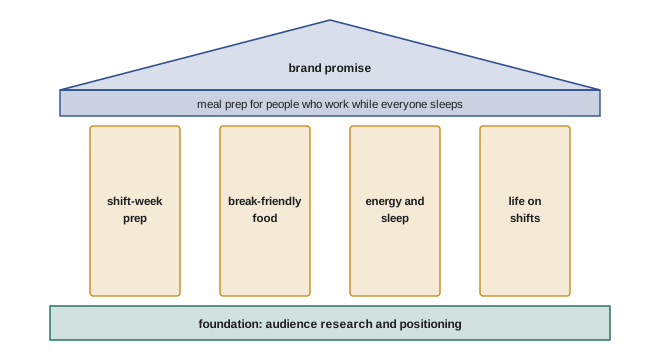
For Night Shift Kitchen, the meal prep channel for shift workers, the pillars might be:
- Shift-week prep: complete plans for a run of night or rotating shifts.
- Break-friendly food: meals and snacks that can be eaten quickly, cold or with a microwave, on a short break.
- Energy and sleep: food choices around sleep, caffeine and fatigue, staying within Jordan's competence and citing reliable sources.
- Life on shifts: honest stories, tips from colleagues, and the social side of working while others sleep.
Every pillar connects to the brand promise, but each serves a different job: practical planning, convenience, wellbeing and belonging. A good test of a pillar is whether you can list at least twenty content ideas for it; if not, it may be too narrow, or better treated as a single series within a broader pillar.
Purposes of content
Beyond themes, content serves different purposes in the relationship with the audience. A widely used framework divides content into three types:
- Discovery content (sometimes called hero or reach content): pieces designed to attract new people, often broader, more surprising or more emotional, and with strong packaging. They are the main source of growth but are harder to make and less predictable.
- Connection content (hub content): recurring pieces for people who already follow you, such as weekly series, behind-the-scenes, community answers and live streams. They deepen the relationship and build habit.
- Utility content (help content): practical, searchable answers to specific questions. They attract steady traffic from search over a long time and establish credibility.
A healthy mix depends on your goals and platforms. A typical starting balance for a growing educational creator might be about 20 % discovery, 30 % connection and 50 % utility; an entertainment creator might shift toward discovery and connection. Review the mix every few months using your analytics.
Formats
A format is the repeatable shape of a piece of content: its length, structure, style and medium. Examples include the tutorial, the listicle ("five mistakes when..."), the review, the comparison, the challenge, the experiment, the reaction, the interview, the vlog, the explainer, the live stream, the short clip, the carousel post, the newsletter essay and the podcast episode. Formats differ in production cost, discoverability and the jobs they do.
| Format | Typical job | Production effort | Discovery |
|---|---|---|---|
| Tutorial | Learn a skill (functional) | Medium | Strong through search |
| Experiment or test | Find out what works; entertainment | High | Strong through recommendations |
| Short clip | Quick tip or moment; reach | Low to medium | Very strong in short feeds |
| Story or vlog | Connection; belonging | Medium | Moderate |
| Interview | Credibility; new perspectives | Medium | Depends on guest |
| Live stream or Q&A | Community; real-time help | Low (but time-bound) | Weak; strong for loyalty |
| Newsletter | Depth; owned relationship | Low to medium | Weak; strong for retention |
Most creators settle on two or three primary formats that suit their strengths and constraints, with occasional experiments. Choosing formats you can produce well and sustainably is more important than covering every format.
Series
A series is a named, recurring set of pieces with a consistent format and premise: "Shift Week Sunday", "Five-Minute Breaks", "Ask a Night Nurse". Series are among the most powerful tools for building a brand, because they:
- Make content recognizable instantly, through consistent titles, thumbnails and intros.
- Build habit: viewers learn when to expect the next episode.
- Make planning easier: the format is fixed, so only the topic changes.
- Create binge potential: viewers who like one episode can watch many.
- Help sponsors, who can sponsor a series rather than a single piece.
A good series has a premise that can generate many episodes, a structure that is easy to repeat, and a name that tells new viewers what it is. Launch with three to five episodes ready, so early viewers can watch more.
Planning around capacity
Ambitious plans fail when they ignore production time. Estimate how long each format really takes from idea to publication, including research, scripting, filming, editing, packaging and community replies, then plan a schedule that fits your weekly hours with a buffer for illness and life.
Worked problem
Fitting a plan to available time
Jordan has 10 hours a week for the channel. A long-form shift-week video takes about 6 hours; a short break-friendly clip takes about 1 hour; a weekly community post and replies take about 1.5 hours. Jordan wants a 20 % buffer. What weekly plan fits?
Show solution
- Usable time after a 20 % buffer: 10 × 0.8 = 8 hours.
- One long-form video: 6 hours, leaving 2 hours.
- Community post and replies: 1.5 hours, leaving 0.5 hours: not enough for a short clip every week.
- Alternative: alternate weeks. Week A: long-form (6) + community (1.5) = 7.5 hours. Week B: three short clips (3) + community (1.5) + idea bank and planning (2) = 6.5 hours.
- Over two weeks: one long-form video, three shorts and two community posts, averaging 7 hours a week, within the 8-hour limit.
Answer: Alternate a long-form week with a shorts-and-planning week. Consistency at a sustainable pace beats an ambitious schedule that collapses after a month.
Batching, doing similar tasks together (filming several shorts in one session, writing several scripts at once), saves setup time. Templates for scripts, thumbnails and descriptions also reduce effort.
The idea bank and calendar
An idea bank is a running list of content ideas, tagged by pillar, format, series and purpose, with notes on the audience question each idea answers. Feed it from audience comments, search data, community questions, competitors' gaps and your own experience. A content calendar then schedules ideas from the bank into specific dates, balancing pillars and purposes and accounting for seasonal moments (exam periods, holidays, awareness days relevant to your niche). Review the calendar monthly, leaving space for timely or reactive pieces.
Adapting across platforms
Most creators have a home platform where they publish their main work, plus secondary platforms where they adapt it. Adapting is more than reposting: each platform has its own norms of length, aspect ratio, pacing, captions and interaction. A twelve-minute tutorial might become a vertical sixty-second tip, an image carousel with the key steps, a newsletter with a printable plan, and a podcast segment discussing the story behind it. The brand must remain recognizable everywhere through the same voice, visual identity and promise, even as formats change. Choose secondary platforms based on where your audience research found your audience, not on where everyone else is.
Balancing evergreen and timely content
Content can also be classified by its lifespan. Evergreen content remains useful for months or years, such as a guide to basic techniques or an explanation of a recurring problem. Timely content responds to current events, trends, product launches or seasonal moments, and its value fades quickly. Evergreen content builds a library that keeps attracting viewers through search and recommendations long after publication, while timely content can bring sudden spikes of attention and show that a creator is current and engaged.
Most creators benefit from a mix weighted toward evergreen content, with timely pieces added when they fit the brand. The key test for timely content is the same as for any other piece: does it serve the audience and reinforce the position? Jumping on a trend unrelated to your niche may bring views from people who will never return, and can blur the signals that tell platforms who your content is for.
Learning from your library
As your library grows, it becomes a source of insight. Every few months, sort your content by performance on several measures: views, retention, subscribers gained, and comments. Look for patterns. Do certain pillars consistently outperform others? Does one format bring subscribers while another brings views but few followers? Do particular series titles or thumbnail styles perform better? Use what you learn to adjust the pillar mix, retire weak series and expand strong ones. Older content can also be refreshed: updating titles, thumbnails and descriptions, or making a new version of a popular piece with improved quality, can bring new life to a library.
Finally, link related pieces together through playlists, end screens, pinned comments and descriptions. A viewer who finishes one tutorial should find the next step easily. Organizing your library around pillars and series makes this natural, and it helps both viewers and recommendation systems understand the structure of your brand.
Collaborations and guest content
Collaborations with other creators fit naturally into a content strategy when they serve a pillar. A guest who brings expertise the creator lacks, such as a dietitian appearing on a meal prep channel, strengthens both credibility and content. Collaborations also introduce each creator to the other's audience. Choose partners whose audiences overlap partly but not completely with yours, and whose values and voice are compatible. Plan the content so it serves both audiences, and agree in advance on who publishes what, how the work is credited and how any sponsorship income is shared.
Audience contributions can become content too: answering viewer questions, featuring viewer results with their permission, or running community challenges. These pieces strengthen connection and often generate ideas for future utility content.
Whatever the source, every piece should still pass the same tests: does it fit a pillar, does it serve a job the audience has, and does it reinforce the brand promise? A clear content strategy makes these decisions faster and helps you say no to opportunities that would pull the brand off course.
Remember that a content strategy is a plan, not a contract. Life events, audience feedback and platform changes will require adjustments. A strategy that is reviewed and updated every quarter, with pillars and series kept or retired according to evidence, remains useful for years; a rigid plan that is never revised quickly becomes irrelevant and is abandoned. Keep the strategy short enough to review in an hour, and record each change with the reason for it.
Many creators keep their content strategy, idea bank and calendar together in a single shared document or project board. Seeing pillars, series, ideas and scheduled dates side by side makes it easier to spot gaps, such as a pillar that has been neglected for a month, and to balance discovery, connection and utility content across the weeks ahead.
Common mistakes
MistakeHaving too many pillars, or pillars unrelated to the brand promise.
InsteadUse three to five pillars tied to audience jobs and positioning.
MistakeMaking only discovery content.
InsteadBalance discovery, connection and utility.
MistakeTrying every format at once.
InsteadMaster two or three formats that fit your strengths.
MistakePlanning more than you can produce.
InsteadEstimate real production time and keep a buffer.
MistakeReposting the same file unchanged on every platform.
InsteadAdapt to each platform while keeping the brand consistent.
Summary and key terms
- Content pillars are three to five themes tied to audience jobs and positioning.
- Discovery, connection and utility content serve different purposes; balance them.
- Formats are repeatable shapes; choose two or three you can produce well.
- Series build recognition, habit and binge potential; launch with several episodes.
- Plan around real production time with a buffer; batch similar tasks.
- An idea bank feeds a calendar balanced by pillar, purpose and season.
- Adapt content to each platform while keeping voice, visuals and promise consistent.
- Content pillar
- A main theme regularly covered within the niche.
- Discovery content
- Content designed to reach new audiences.
- Connection content
- Recurring content for existing followers.
- Utility content
- Practical, searchable answers to specific questions.
- Format
- The repeatable shape of a piece of content.
- Series
- A named, recurring set of pieces with a consistent premise.
- Batching
- Doing similar tasks together to save setup time.
- Idea bank
- A tagged list of content ideas.
- Content calendar
- A schedule of planned content.
- Home platform
- The main platform where the creator publishes core work.
Practice problems
Work each problem on paper first, then reveal the answer to check.
How many content pillars are typical?
Show answer
Three to five.
How can you test whether a pillar is too narrow?
Show answer
Try to list twenty ideas for it.
Name the three purposes of content.
Show answer
Discovery, connection and utility.
Which content type brings steady search traffic?
Show answer
Utility content.
Give three benefits of series.
Show answer
Recognition, habit, easier planning, binge potential, sponsorship.
How many episodes should a new series launch with?
Show answer
Three to five.
A creator has 12 hours a week and wants a 25 % buffer. How many usable hours?
Show answer
9 hours.
What is batching?
Show answer
Grouping similar tasks to save setup time.
Where do idea bank entries come from?
Show answer
Comments, search data, communities, competitor gaps and experience.
How should a creator choose secondary platforms?
Show answer
Based on where research shows the audience is.
Lesson quiz · 5 questions
Score 60% or more to complete this lesson.
Create a free account to save your progress, take quizzes and earn a certificate.