
CRE-110 · Lesson 7 of 12 · 25 min
Voice and tone
Close your eyes and listen to a few seconds of a creator you follow closely: you would probably recognize them even without seeing a face or a logo. That recognition comes from voice, the consistent personality expressed in how a creator speaks and writes: word choice, rhythm, humour, attitude toward the audience, and the way ideas are explained. Voice is one of the strongest and hardest-to-copy parts of a personal brand, because it grows from who you are. Tone is how that voice adapts to different situations: the same creator sounds different announcing good news, apologizing for a mistake, or explaining a serious health topic. This lesson explains the difference between voice and tone, how to discover and describe your voice, how to build a practical voice guide, how voice shows up in scripts, titles, captions and comments, and how to keep it consistent while remaining natural.
Voice versus tone
Voice is stable; tone varies. Voice reflects your personality and values and should be recognizable across every piece and platform. Tone is the emotional colour appropriate to a moment. A useful comparison: you have one voice, but you speak differently at a celebration and at a funeral. A creator whose voice is "warm, plain-spoken and a little nerdy" will sound playful in a light tutorial, steady and careful in a video about a frightening diagnosis, and direct but kind when correcting misinformation. The voice stays warm, plain-spoken and a little nerdy; the tone shifts.
Inconsistent voice confuses audiences: a creator who is gentle and encouraging in videos but sarcastic and dismissive in comment replies sends mixed signals about who they are. Inappropriate tone damages trust: jokes in an apology or hype in a safety warning feel wrong even if the words are accurate.
Discovering your voice
The most durable voice is an amplified version of how you naturally communicate when you are relaxed and talking about something you care about with a friend. Forced voices, imitating a popular creator or adopting an energy level you cannot sustain, are tiring to perform and easy for audiences to detect. To discover your voice:
- Record yourself explaining your topic to a friend, without a script. Listen for your natural words, pace, humour and enthusiasm.
- Collect words others use to describe how you talk and write: in reviews of your work, comments, or by asking friends for three adjectives.
- Review your best-performing and most-praised pieces: what voice do they share?
- Consider your audience and position: your voice should fit the people you serve. Nervous beginners may respond to calm reassurance; experienced enthusiasts may enjoy fast, technical banter.
- Consider your values: a creator who values honesty might have a frank voice that admits uncertainty and failures.
The voice chart
A voice chart describes your voice in three to five traits, each defined by what it is, what it is not, and how to apply it. The "but not" column is essential, because most traits have an overdone version that becomes a weakness.
| Trait | We are... | But not... | In practice |
|---|---|---|---|
| Warm | Encouraging and kind to beginners | Gushing or fake-positive | Acknowledge struggles; celebrate small wins |
| Plain-spoken | Clear, everyday words | Dumbed-down or patronizing | Explain jargon once, then use it |
| Practical | Focused on what works on a real shift | Preachy about perfect eating | Show real fridges, real budgets |
| A little nerdy | Curious about why things work | Lecturing or showing off | One "why" fact per video, briefly |
Add short examples of each trait done well and done badly. The chart becomes part of your brand plan and is especially useful if you later work with editors, writers, community moderators or collaborators who need to speak for the brand.
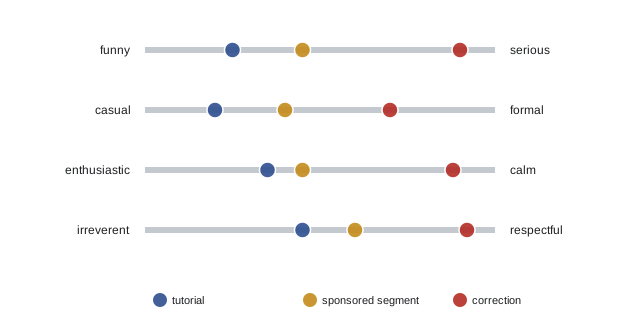
Tone across situations
A tone map lists common situations and how the voice adapts to each. Typical situations for creators include:
- Everyday tutorials and entertainment: the default tone.
- Sponsored content: the same voice, clearly disclosed, without switching into an advertising tone that sounds like someone else.
- Serious or sensitive topics (health, grief, money trouble, discrimination): slower, calmer, careful wording, no jokes at the expense of people affected, and pointers to professional help where appropriate.
- Corrections and apologies: direct, specific, responsible, without defensiveness or humour that minimizes the issue.
- Responding to criticism: calm, curious, focused on the substance, and firm about boundaries where criticism becomes abuse.
- Community celebrations and milestones: warmer and more personal.
Voice in practice
Voice appears everywhere the audience meets you:
- Scripts and speech: word choice, sentence length, how you open and close, how you transition between ideas, and recurring phrases. A signature greeting or sign-off can become part of the brand, but keep it short and natural.
- Titles and thumbnails: the voice must survive compression into a few words. "Meal prep for night shifts (no 3 a.m. food coma)" sounds different from "ULTIMATE NIGHT SHIFT MEAL PREP HACKS!!!"
- Captions and descriptions: the written voice should match the spoken one.
- Comments and messages: replies are one-to-one brand moments seen by everyone. They should sound like you on a good day.
- Collaborations and guest appearances: keep your voice while respecting the host's.
- Emails to sponsors: professional, but still recognizably you.
Worked problem
Rewriting in the brand voice
An intro draft for Night Shift Kitchen reads: "Hey guys, welcome back. Today I'm going to be showing you guys the ultimate insane meal prep that will literally change your life." Rewrite it using the voice chart (warm, plain-spoken, practical, a little nerdy).
Show solution
- Remove hype that breaks "plain-spoken" and "practical" ("ultimate", "insane", "literally change your life").
- Address the specific audience and problem warmly.
- Add one concrete, practical promise for the video.
- Optionally add one brief nerdy hook.
Answer: "If you're heading into three nights in a row, this is for you. In about an hour on your day off, we'll prep five break meals that reheat in two minutes and won't leave you crashing at 4 a.m. And I'll show you the one ingredient swap that keeps you fuller longer, and why it works."
Inclusive and accessible language
A voice that welcomes the whole intended audience uses language that does not exclude or stereotype. Practical habits include: addressing the audience in ways that include everyone (for example, "everyone" or "folks" rather than assuming gender), avoiding slurs and jokes that target groups, using people's own terms for their identities, describing disabilities neutrally, and avoiding assumptions about income, family structure or background. Plain language, short sentences, defined jargon and captions also make content accessible to people with different literacy levels, people learning the language, and people who are deaf or hard of hearing.
Consistency without stiffness
A voice guide is a tool, not a cage. Over-scripted content can sound robotic, and audiences value spontaneity. Use the guide to review drafts and replies, not to memorize lines. Voices also evolve: as creators grow in confidence and expertise, their voice usually becomes more relaxed and distinctive. Review your voice chart once or twice a year against your recent content and audience feedback, and update it to describe who you are now.
When several people produce content for one personal brand, editors, writers or community managers, the voice guide becomes essential. Give them examples, review their work, and decide which channels (such as personal stories) only you will write.
Voice on different platforms
Each platform has its own conventions of speech and writing, and a strong voice adapts to them without losing its identity. Short-form video rewards speed and clarity: a creator with a calm, thoughtful voice may speak a little faster and cut pauses, while keeping their gentle humour. Long-form video and podcasts allow more room for tangents, stories and reflection. Written posts and newsletters reveal voice through sentence length, word choice and structure. Community spaces and live streams show voice in real time, including how a creator handles surprises and difficult questions.
A useful exercise is to take one idea and express it in three formats: a thirty-second spoken clip, a short written post, and a longer newsletter paragraph. Compare them. Do they sound like the same person? If one sounds generic, revise it using the voice chart until all three are recognizably yours.
When voice and audience diverge
Sometimes a creator's natural voice does not match the audience they want to reach. A fast, sarcastic speaker may want to serve nervous beginners who find sarcasm intimidating. In such cases, there are two honest options. The creator can adapt, turning down the traits that put off the audience while keeping their core personality, for example keeping the speed and wit but aiming the jokes at themselves rather than at viewers. Or the creator can reconsider the audience, choosing one that enjoys their natural style. What does not work over the long term is performing a voice that feels foreign. Audiences notice the strain, and creators tire of it.
Feedback helps here. Ask members of your target audience how your voice comes across, and watch for comments that describe your tone. Phrases such as "you make this feel easy" or "I love how honest you are" show which traits are landing.
Writing for the ear and the eye
Many creators write scripts, and writing for speech differs from writing for reading. Spoken scripts work best with short sentences, active verbs, repetition of key points, and signposts that tell listeners where they are ("first", "next", "the last thing"). Written posts can use more complex sentences, lists and headings, because readers can scan and reread. Read every script aloud before filming; awkward phrasing that looks fine on the page often trips the tongue, and reading aloud also reveals where the voice does not sound like you.
Even when speaking without a script, preparing a few key phrases and the opening and closing lines helps maintain the voice while keeping the delivery natural. Over time, a creator's voice often becomes most distinctive in these moments: the way they open, transition and sign off.
Recording a short voice memo before writing can help too. Explaining the idea out loud first, then transcribing and tidying it, often produces a script that sounds more natural than one written from scratch at a keyboard.
Finally, protect your voice from burnout. When creators are tired, their voice often flattens or turns sharp: replies become curt, scripts become generic, and the warmth audiences valued fades. Noticing these changes is an early warning that workload or stress needs attention. Taking breaks, batching work and asking for help with comments or editing are not only good for wellbeing; they also protect one of the brand’s most valuable assets.
Voice is also shaped by what a creator chooses not to say. Avoiding gossip, cheap shots at competitors or exaggerated claims is part of a voice, just as much as signature phrases are. Audiences notice restraint, and over time it becomes one of the reasons they trust a creator, particularly in niches where sensational content is common.
Common mistakes
MistakeImitating a popular creator's voice.
InsteadAmplify how you naturally talk about your topic.
MistakeDescribing voice with vague words like "fun" and "authentic" only.
InsteadDefine traits with "but not" limits and examples.
MistakeUsing the same jokey tone for serious topics and apologies.
InsteadAdapt tone to the situation with a tone map.
MistakeSwitching to a generic ad voice for sponsored segments.
InsteadKeep your voice and disclose clearly.
MistakeReplying to comments in a different voice from the content.
InsteadTreat replies as public brand moments.
Summary and key terms
- Voice is the consistent personality in how you speak and write; tone adapts it to situations.
- The best voice amplifies how you naturally communicate about what you care about.
- Discover voice through recordings, others' descriptions, best work, audience fit and values.
- A voice chart defines three to five traits with "but not" limits and examples.
- A tone map shows how voice adapts to tutorials, sponsors, sensitive topics, corrections and criticism.
- Voice appears in scripts, titles, captions, comments, collaborations and emails.
- Use inclusive, accessible language and review the voice guide regularly.
- Voice
- The consistent personality in a creator's communication.
- Tone
- The emotional colour of the voice in a particular situation.
- Voice chart
- A table defining voice traits with limits and examples.
- Tone map
- A guide to adapting tone across situations.
- Signature phrase
- A recurring greeting, sign-off or expression.
- Hype language
- Exaggerated words such as "ultimate" and "insane".
- Plain language
- Clear, concise wording the audience can easily understand.
- Inclusive language
- Wording that does not exclude or stereotype groups.
- Voice guide
- Documentation that lets others write in the brand voice.
- Brand moment
- Any interaction where the audience experiences the brand.
Practice problems
Work each problem on paper first, then reveal the answer to check.
Distinguish voice and tone.
Show answer
Voice is the stable personality; tone is how it adapts to situations.
Why are forced voices risky?
Show answer
They are tiring to sustain and audiences detect them.
Name three ways to discover your voice.
Show answer
Record unscripted explanations, ask others for adjectives, review best work.
Why include a "but not" column in a voice chart?
Show answer
To prevent traits from being overdone into weaknesses.
How should tone change for a correction?
Show answer
Direct, specific, responsible, without defensiveness or jokes.
Rewrite "INSANE BUDGET HACKS!!!" in a calm, practical voice.
Show answer
Example: "Five small changes that cut my grocery bill by 20 %".
Why are comment replies brand moments?
Show answer
They are public and show how you treat people.
Give two inclusive language habits.
Show answer
Use inclusive forms of address; use people's own identity terms.
How does plain language help accessibility?
Show answer
It helps people with different literacy levels and language learners.
How often should a voice chart be reviewed?
Show answer
Once or twice a year.
Lesson quiz · 5 questions
Score 60% or more to complete this lesson.
Create a free account to save your progress, take quizzes and earn a certificate.