
CON-345 · Lesson 6 of 12 · 25 min
Concrete and reinforcing testing in Canada
Concrete is the material whose quality is tested most routinely on a building site, and for good reason. Its final properties depend on decisions made at the batch plant, in the truck, during placement and during curing, and the most important property, strength, cannot be measured until weeks after the concrete has been placed and covered with more work. The testing system therefore combines checks on the fresh concrete at the point of placement with strength tests on samples, statistical acceptance rules and, when results are low, investigation of the concrete in place. This lesson covers that system and the inspection of reinforcing and post-tensioning on the Larkspur Commons podium and transfer slab.
In Canada, concrete materials and construction are governed by CSA A23.1, with test methods in CSA A23.2, referenced by the building codes and by the project specifications. The edition current at the time of writing is CSA A23.1:24 / A23.2:24. The specification on Larkspur Commons follows these standards, and Okanagan Materials Testing, the owner's testing agency, performs the tests in a laboratory certified for concrete testing.
How concrete is specified
Concrete can be specified by performance, where the owner states the required properties and the producer designs the mix, or by prescription, where the owner states the mix proportions. Most building concrete today is specified by performance: the specification sets the specified compressive strength, the exposure conditions, the maximum aggregate size, the air content where freezing and thawing apply, and any special requirements, and the ready-mix supplier submits a mix design with evidence that it can meet them.
CSA A23.1 organizes these requirements through exposure classes, such as the C classes for concrete exposed to chlorides and freezing, the F classes for freezing without chlorides and the N class for concrete not exposed to either, each with limits on water-cementing materials ratio, minimum strength and air content. It also defines alternative methods for dividing responsibility between the owner, the contractor and the supplier. On Larkspur Commons, the parking garage slab is in a chloride exposure class because vehicles bring de-icing salts in from the street, while the interior podium slabs and the transfer slab are not exposed to freezing.
The specified compressive strengths on the project are 30 MPa at 28 days for the podium slabs and walls, 35 MPa for the transfer slab and 32 MPa with entrained air for the parking garage slab. The submittal review in lesson 4 confirmed that each mix design met its exposure requirements and that the supplier's strength records supported the target strength.
Tests on fresh concrete
When each truck arrives, the delivery ticket is checked against the mix ordered: the mix identification, the volume, the time of batching and any water added. The testing agency's technician then samples the concrete as specified and runs the fresh concrete tests. These results are available within minutes, so the concrete can be accepted or rejected before it is placed.
| Test | What it shows | Typical action if out of range |
|---|---|---|
| Slump (or slump flow for self-consolidating concrete) | Consistency and workability; a sudden change suggests a batching or water problem | Reject the load or, where the specification permits, adjust within limits |
| Air content | Entrained air needed for freeze-thaw durability; too much reduces strength | Reject the load if outside the specified range |
| Concrete temperature | Hot or cold concrete affects setting, strength and cracking | Reject the load or apply hot or cold weather measures (CON-325) |
| Time since batching | Old concrete loses workability and may have been retempered | Reject loads beyond the specified time limit |
| Density (unit weight) | Checks yield and helps detect problems with air or mix proportions | Investigate with the supplier |
Adding water at the site is the most common way fresh concrete is spoiled. Extra water raises the slump and makes placing easier, but it raises the water-cementing materials ratio and lowers strength and durability. Specifications usually allow a limited, measured amount of water to be added at the site within the mix design limits, with the amount recorded on the ticket, and forbid any addition beyond that. Dana's rule on Larkspur Commons is that only the testing technician or Mei may authorize water, and only within the mix design, and that any load in which a crew member adds water without authorization is rejected.
Strength tests
Strength is measured on cylinders cast from the sampled concrete, cured under controlled conditions and crushed at a set age, usually 28 days for acceptance, with earlier breaks at 7 days and sometimes at the age needed for an operation such as stressing tendons or stripping forms. A strength test is the average strength of the cylinders made from one sample and tested at the same age. The number of cylinders in a test and their size are set by the governing standard and the specification.
Cylinders must be handled with care, because a badly made or badly cured cylinder gives a low result that says nothing about the concrete in the structure. The first day matters most: cylinders left on a hot or freezing slab, or knocked around in the back of a truck, can lose much of their apparent strength. The specification requires initial curing within a temperature range for the first day, then transport to the laboratory for standard curing. Separate field-cured cylinders, kept beside the structure under the same conditions, are used to decide when the in-place concrete is strong enough for stressing or stripping, but not for acceptance.
For acceptance, the Larkspur Commons specification follows CSA A23.1: the strength level of each class of concrete is satisfactory when the average of any three consecutive strength tests equals or exceeds the specified strength and no individual strength test falls more than 3.5 MPa below the specified strength. The specification also sets the minimum frequency of strength tests for each class of concrete placed each day, based on the volume placed. Readers should confirm the current clause wording and frequencies in the edition of CSA A23.1 that their project references.
The two rules work together. The individual-test rule catches a bad load or a localized problem; the three-test average catches a mix that is running slightly weak over time. A mix that occasionally produces a test just under the specified strength can still be acceptable, because concrete strength varies and the rules allow for that variation.
# Strength acceptance check, podium slabs, specified strength 30 MPa (illustrative results)
fc = 30.0
tests = [34.8, 33.1, 29.6, 31.9, 36.2, 28.4, 30.1, 27.9, 32.5, 33.7]   # MPa, each the average of one sample's cylinders
low_limit = fc - 3.5
for i, t in enumerate(tests, 1):
    flag = "" if t >= low_limit else "  INDIVIDUAL TEST TOO LOW"
    line = f"test {i:2d}: {t:4.1f} MPa{flag}"
    if i >= 3:
        avg = sum(tests[i - 3:i]) / 3
        line += f"   avg of last 3 = {avg:4.1f} {'ok' if avg >= fc else 'BELOW SPECIFIED STRENGTH'}"
print(line)test 1: 34.8 MPa test 2: 33.1 MPa test 3: 29.6 MPa avg of last 3 = 32.5 ok test 4: 31.9 MPa avg of last 3 = 31.5 ok test 5: 36.2 MPa avg of last 3 = 32.6 ok test 6: 28.4 MPa avg of last 3 = 32.2 ok test 7: 30.1 MPa avg of last 3 = 31.6 ok test 8: 27.9 MPa avg of last 3 = 28.8 BELOW SPECIFIED STRENGTH test 9: 32.5 MPa avg of last 3 = 30.2 ok test 10: 33.7 MPa avg of last 3 = 31.4 ok
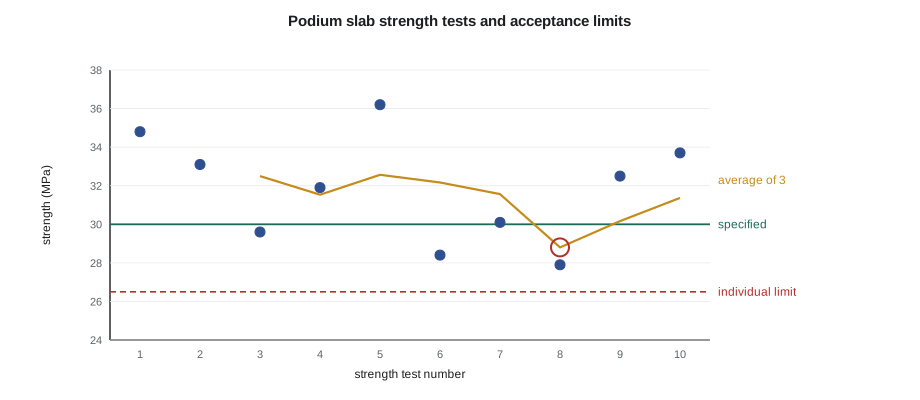
No single test fell below the individual limit, but the average of tests 6 to 8 dipped below the specified strength. That is a warning, not a structural failure. Mei and the supplier reviewed the tickets and found that tests 6 to 8 came from pours on hot afternoons in which the slump had been raised with site water close to the maximum the mix design allowed. The supplier adjusted the mix with a water-reducing admixture so the crews could get the workability they needed without water, and the next results returned above the specified strength. The engineer of record reviewed the results and accepted the concrete, because the individual tests met the minimum and the in-place strength needed by the design was not in doubt.
Required average strength
Because strength varies, a producer cannot aim at exactly the specified strength; about half of the tests would then fall below it. The mix must be designed for a higher average, the required average strength, which depends on how variable the producer's concrete is. A producer with a low standard deviation, achieved through consistent materials and batching, can use a lower margin and therefore a more economical mix.
ACI 318 and ACI 301 give formulas for the required average strength based on the producer's standard deviation, and CSA A23.1 sets out a comparable statistical approach in its requirements for mix designs. The script below uses the ACI form, in which the required average strength for specified strengths up to 5,000 psi (35 MPa) is the larger of the specified strength plus 1.34 standard deviations and the specified strength plus 2.33 standard deviations minus 500 psi (3.5 MPa). It is shown here to explain the idea; designers should use the formulas in the standard and edition their project references.
# Required average strength from the producer's standard deviation (ACI form, illustrative)
fc = 30.0   # MPa
for s in (2.5, 3.5, 4.5):
    a = fc + 1.34 * s
    b = fc + 2.33 * s - 3.5
    fcr = max(a, b)
print(f"s = {s:3.1f} MPa: fc + 1.34s = {a:4.1f}, fc + 2.33s - 3.5 = {b:4.1f} -> required average {fcr:4.1f} MPa")s = 2.5 MPa: fc + 1.34s = 33.4, fc + 2.33s - 3.5 = 32.3 -> required average 33.4 MPa s = 3.5 MPa: fc + 1.34s = 34.7, fc + 2.33s - 3.5 = 34.7 -> required average 34.7 MPa s = 4.5 MPa: fc + 1.34s = 36.0, fc + 2.33s - 3.5 = 37.0 -> required average 37.0 MPa
A producer whose standard deviation falls from the higher to the lower value can lower the target average by several megapascals or several hundred psi, which means less cement and lower cost for the same specified strength. This is one reason quality pays for producers as well as contractors: consistency is cheaper than excess strength.
Low strength results
When an individual test falls below the limit, or the running average falls short, the first step is to check whether the test itself was valid. The technician's records, the cylinder curing records and the laboratory reports are reviewed. If a test was made or cured badly, the result may be discounted with the engineer's agreement. If the test seems valid, the engineer of record evaluates whether the low strength matters for the element in question, often with a structural check using the actual strength.
If the strength of the concrete in place is still in doubt, cores are drilled from the structure in the area represented by the low test and tested. Both CSA A23.1 and ACI 318 give criteria for judging core results, generally treating the concrete in the area as adequate when the average of three cores reaches about 85 percent of the specified strength and no single core falls below about 75 percent, with specific conditions about moisture conditioning and core size. Readers should check the exact criteria in the referenced standard. If cores do not resolve the question, the engineer may require a load test or strengthening. Under most specifications, the contractor pays for coring and testing when the concrete is found deficient, and the owner pays when it is found acceptable.
Reinforcing inspection
Reinforcing steel must be the right size and grade, in the right place, with the right cover and the right laps, and held firmly so that it stays in place during the pour. Mill certificates confirm the grade and are reviewed when the steel is delivered; bundles are tagged and stored off the ground. The field inspection before each pour checks the placement against the placing drawings and the structural drawings.
| Check | How it is done |
|---|---|
| Bar size, grade and count | Compare tags and bar markings with the placing drawings; count bars in each element |
| Spacing | Measure between bars at several locations; check against the drawings and placing tolerances |
| Cover | Measure from the bars to the formwork face, top and bottom; check chair and spacer heights |
| Laps and splices | Measure lap lengths at splices; check staggering where required; check mechanical couplers |
| Support and tying | Check chairs, bolsters and ties hold the bars firmly; walk the mat to test for movement |
| Embeds and openings | Confirm sleeves, embeds and openings are located and bars adjusted around them per the details |
Cover is the most common problem, and the most consequential for durability. Too little cover lets moisture and chlorides reach the steel and start corrosion; too much reduces the effective depth and the element's strength. After the concrete is placed, cover can be checked with an electromagnetic cover meter, which estimates the depth of bars below the surface. The cover problem found at a podium wall, mentioned in lessons 1 and 5, was confirmed this way.
# Cover meter survey of podium wall W-7 after stripping (illustrative)
# Specified cover 40 mm; placing tolerance -10 mm for this element
spec, tol = 40, 10
readings = [44, 41, 38, 36, 29, 27, 31, 39, 42, 45, 33, 28, 26, 37, 40, 43]   # mm, grid of readings
low = [r for r in readings if r < spec - tol]
print(f"readings: {len(readings)}, minimum {min(readings)} mm, mean {sum(readings) / len(readings):.1f} mm")
print(f"below {spec - tol} mm: {len(low)} readings -> {', '.join(str(r) for r in low)}")
print(f"share below limit: {len(low) / len(readings):.0%}")readings: 16, minimum 26 mm, mean 36.2 mm below 30 mm: 4 readings -> 29, 27, 28, 26 share below limit: 25%
A quarter of the readings were below the allowed minimum, concentrated in one area of the wall where the outer mat had been pushed toward the form by a bundle of conduit tied to it. The engineer accepted a repair using a specified protective coating on the exterior face, which faces the parking garage ramp. The initial phase that should have caught the pushed mat before the pour had been done as a quick look rather than a detailed check, which is why lesson 5 makes so much of doing it properly.
Post-tensioning inspection
Post-tensioned slabs add their own checks. Before the pour, tendon profiles are checked against the shop drawings at marked points, usually by measuring chair heights; anchorages are checked for correct placement and support; and sheathing is checked for damage, which would allow the tendon to bond to the concrete or to corrode. After the concrete reaches the stressing strength, each tendon is stressed with a calibrated jack, and the measured elongation is compared with the elongation calculated by the PT supplier's engineer.
Elongation is the main field check that the tendon has the intended force, because friction along the tendon reduces the force at the far end and a blocked or damaged tendon elongates less than expected. Specifications commonly allow measured elongations to differ from the calculated values by a small percentage, often about 7 percent for individual tendons, with any tendon outside the tolerance reported to the engineer. Readers should use the tolerance in their project's specification.
# Stressing record check, transfer slab pour 1 (illustrative; tolerance per specification)
tol = 0.07
tendons = {  # tendon: (calculated elongation mm, measured mm)
    "T01": (178, 182), "T02": (178, 175), "T03": (181, 165), "T04": (181, 186),
    "T05": (176, 179), "T06": (176, 191), "T07": (183, 181), "T08": (183, 184),
}
for t, (calc, meas) in tendons.items():
    dev = (meas - calc) / calc
    flag = "ok" if abs(dev) <= tol else "REPORT TO ENGINEER"
print(f"{t}: calculated {calc} mm, measured {meas} mm, deviation {dev:+.1%} {flag}")T01: calculated 178 mm, measured 182 mm, deviation +2.2% ok T02: calculated 178 mm, measured 175 mm, deviation -1.7% ok T03: calculated 181 mm, measured 165 mm, deviation -8.8% REPORT TO ENGINEER T04: calculated 181 mm, measured 186 mm, deviation +2.8% ok T05: calculated 176 mm, measured 179 mm, deviation +1.7% ok T06: calculated 176 mm, measured 191 mm, deviation +8.5% REPORT TO ENGINEER T07: calculated 183 mm, measured 181 mm, deviation -1.1% ok T08: calculated 183 mm, measured 184 mm, deviation +0.5% ok
Two tendons fell outside the tolerance. T03 elongated less than expected, which can mean extra friction or a blockage; T06 elongated more, which can mean a measurement error, a slipped wedge or a broken strand. Both were reported to the structural engineer and the PT supplier before any tails were cut, which is exactly why the transfer slab ITP has a hold point there. On investigation, T03's low elongation was traced to a profile that had been placed with an extra kink near a sleeve, and the engineer accepted it after checking the slab with the reduced force; T06 had been measured from the wrong reference mark and was re-measured within tolerance. Neither question could have been answered after the tails were cut and the pockets grouted.
Common mistakes
MistakeLetting crews add water to fresh concrete on site.
InsteadAllow only measured additions within the mix design, authorized by the technician or field engineer and recorded on the ticket.
MistakeLeaving test cylinders on a hot or frozen slab overnight.
InsteadProvide controlled initial curing for the first day and careful transport, because bad cylinders give meaningless low results.
MistakeTreating one low strength test as proof the structure is deficient.
InsteadCheck the test's validity, have the engineer evaluate the element, and use cores to test the concrete in place if doubt remains.
MistakeChecking reinforcing with a quick look before the pour.
InsteadMeasure size, spacing, cover, laps and support against the drawings, especially where conduits or embeds are tied to the mat.
MistakeCutting tendon tails before the engineer has reviewed elongations.
InsteadTreat the stressing records as a hold point and report any tendon outside the tolerance before tails are cut.
Summary and key terms
- CSA A23.1 and A23.2 govern concrete in Canada; performance specifications set strength, exposure class and other requirements, and the supplier designs the mix.
- Fresh tests for slump, air, temperature, age and density allow loads to be accepted or rejected before placement; unauthorized site water spoils concrete.
- A strength test is the average of the cylinders from one sample at one age; cylinder making and early curing must be controlled.
- Acceptance requires the average of three consecutive tests to meet the specified strength and no test to be more than 3.5 MPa below it.
- Mixes are designed for a required average strength that depends on the producer's variability; consistency allows more economical mixes.
- Low results are investigated by checking test validity, engineering evaluation and, if needed, cores from the structure.
- Reinforcing inspection checks size, grade, spacing, cover, laps, support and embeds; cover meters check cover after placement.
- Post-tensioning is checked through tendon profiles before the pour and measured elongations after stressing, reviewed before tails are cut.
- Specified compressive strength
- The strength the design requires, usually at 28 days, used for acceptance.
- Strength test
- The average strength of the cylinders made from one sample and tested at the same age.
- Slump
- A measure of the consistency of fresh concrete.
- Air content
- The volume of entrained air in fresh concrete, needed for freeze-thaw durability.
- Required average strength
- The average strength a mix is designed for, above the specified strength to allow for variation.
- Field-cured cylinder
- A cylinder cured beside the structure, used to judge in-place strength for operations such as stressing.
- Cover meter
- An electromagnetic instrument that estimates the depth of reinforcing below a concrete surface.
- Elongation
- The measured extension of a tendon during stressing, compared with the calculated value.
Practice problems
Work each problem on paper first, then reveal the answer to check.
Name four fresh concrete tests and what each shows.
Show answer
Slump (consistency), air content (freeze-thaw durability), temperature (setting and cracking), time since batching (workability and retempering); density checks yield.
In the acceptance example, which part of the rule was not met, and what was the cause?
Show answer
The average of tests 6 to 8 fell below 30 MPa; hot afternoon pours with site water near the mix limit.
Using the ACI form, what is the required average strength for a 30 MPa mix with a standard deviation of 3.5 MPa?
Show answer
The larger of 34.7 and 34.7, about 34.7 MPa.
What is the difference between standard-cured and field-cured cylinders?
Show answer
Standard-cured cylinders are used for acceptance; field-cured cylinders, kept beside the structure, show when the in-place concrete is strong enough for stressing or stripping.
In the cover survey, what share of readings was below the minimum, and what caused it?
Show answer
25 percent; the outer mat had been pushed toward the form by conduit tied to it.
Which tendons were outside tolerance, and why must this be resolved before tails are cut?
Show answer
T03 and T06; after cutting and grouting the force cannot be checked or corrected.
Lesson quiz · 5 questions
Score 60% or more to complete this lesson.
Create a free account to save your progress, take quizzes and earn a certificate.