
CON-345 · Lesson 1 of 12 · 23 min
Quality in construction
Ask ten people on a building site what quality means and you will hear ten answers: a nice finish, no leaks, a happy owner, a passed inspection, work that lasts. All of them matter, but on a construction contract quality has a narrower and more useful meaning. Quality is conformance to the contract documents: the drawings, the specifications and the standards they reference. The owner has already decided, with the design team, what the building should be. The contractor's job is to build exactly that, to show that it has done so, and to fix what does not conform. A beautifully finished wall in the wrong place, or a strong concrete slab that misses the specified air content, is not quality work in the contract sense.
This course follows the quality program on Larkspur Commons, the six-storey rental building of 112 homes over shops that Thornbury Builders is constructing in Kelowna, British Columbia. Earlier courses in the site supervision track looked at leadership (CON-305), field engineering and layout (CON-315), logistics and temporary works (CON-325) and trade coordination (CON-335). Here the focus moves to how the team plans, inspects, tests and records the work so that the finished building matches the documents, and how it deals with the work that does not.
Superintendent Dana Whitfield, field engineer Mei Lin and assistant superintendent Omar Haddad are joined in this course by Lena Park, Thornbury's project quality manager, who supports several projects from the regional office. The owner, the Okanagan Valley Housing Partnership, has hired its own consultants: the architect and engineers of record, a building envelope consultant and, through the structural engineer, an independent testing agency, Okanagan Materials Testing.
Why quality matters on site
Defects cost money twice: once to build the work wrong and again to fix it. Rework also pulls crews off planned work, disturbs the trade train that CON-335 built, damages finished work nearby and erodes trust with the owner and the inspectors. Some defects are worse still because they are hidden. A missing firestop, an unlapped air barrier or a misplaced reinforcing bar can be buried within days, and the cost of finding and fixing it later can be many times the cost of getting it right at the time.
Published estimates of the cost of rework vary widely because studies define rework differently. Research by the Construction Industry Institute in the United States and similar studies elsewhere have put the direct cost of field rework at around 5 percent of construction cost on typical projects, with wide variation between projects. The Get It Right Initiative in the United Kingdom has argued that once indirect costs such as delay, management time and lost productivity are included, avoidable errors cost somewhere between 10 and 25 percent of project cost. These figures come from different methods and samples and should be read as orders of magnitude, not targets, but they explain why owners and contractors invest in quality systems.
On a project the size of Larkspur Commons, about $48 million, even the low estimate of 5 percent is $2.4 million of rework, more than the general contractor's fee on many projects. Lena's goal for the project is not zero defects, which is unrealistic on a building with thousands of components, but to catch defects early, when they are cheap to fix, and to stop the same defect from repeating.
Quality, grade and expectations
Two words are often confused. Grade describes the category or level of the product: a laminate counter and a quartz counter are different grades. Quality describes how well the product meets its requirements. A laminate counter installed level, sealed and with tight seams is high-quality work of a lower grade. The owner chooses the grade through the design; the contractor delivers the quality. When an owner's representative complains that a finish 'looks cheap', the first question is whether the work conforms to the specified product and workmanship. If it does, the issue is grade, a design decision, not quality.
Expectations also matter. Contract documents cannot describe everything, and many disputes arise in the gap between what was written and what each party imagined. Mock-ups and first-work approvals, covered in lessons 4 and 5, exist largely to close that gap before a finish is repeated across 112 homes.
Quality assurance and quality control
Quality assurance and quality control are related but different. Quality assurance (QA) is the set of planned activities that give confidence the work will meet requirements: the quality plan, procedures, training, submittal reviews, preinstallation meetings and audits of the process. Quality control (QC) is the checking of the work itself: inspections, tests, measurements and the records that show whether each item conforms. QA is about the system; QC is about the product.
| Quality assurance | Quality control | |
|---|---|---|
| Focus | The process that produces the work | The work produced |
| Timing | Mostly before and during the work | During and after each activity |
| Examples on site | Quality plan, procedures, training, submittal review, preinstallation meetings, audits | Inspections, tests, measurements, checklists, nonconformance reports |
| Main question | Are we doing the right things to get it right? | Did this piece of work meet the requirement? |
| Typical owner | Quality manager, project manager | Superintendent, foremen, field engineer, testing agency |
On construction projects the terms are also used to describe who does the checking. Contractor quality control means the contractor's own inspections and tests. Owner quality assurance, sometimes called owner verification, means the inspections and tests the owner arranges to confirm the contractor's work, such as the testing agency's concrete tests or the envelope consultant's field reviews. The two are complementary. An owner's tests do not replace the contractor's responsibility to check its own work, and many contracts say so explicitly.
Who is responsible for quality
Responsibility for quality is spread across the project team, and confusion about who checks what is a common cause of defects slipping through. The table below summarizes the roles on Larkspur Commons.
| Party | Main quality responsibilities |
|---|---|
| Owner | Defines requirements through the design team; hires consultants and testing for verification; accepts the work |
| Architect and engineers of record | Design; review submittals for conformance with design intent; field reviews; respond to questions and nonconformances; certify completion |
| Envelope consultant | Reviews envelope submittals and mock-ups; field reviews of air and water barriers, windows and roofing; witnesses tests |
| Testing agency | Samples and tests materials such as concrete and soils; reports results to the engineer and the contractor |
| Authority having jurisdiction | Inspects for code compliance at the stages the permit requires; does not inspect for contract conformance |
| General contractor | Builds to the documents; plans and runs the quality program; inspects its own and its subcontractors' work; corrects nonconforming work |
| Subcontractors and suppliers | Build and supply to the documents; inspect their own work before handoff; provide test reports, certificates and warranties |
Two points in this table are often misunderstood. First, the building inspector checks code compliance, not conformance to the contract. A wall can pass the building inspection and still be wrong under the specifications, for example if it uses the wrong type of board or misses an acoustic sealant the architect specified. Second, consultant field reviews are periodic and do not relieve the contractor of its duty. An engineer who reviews reinforcing in one area of a slab has not approved the reinforcing in every area.
Under the standard Canadian stipulated price contract, CCDC 2, the contractor is responsible for performing the work in accordance with the contract documents and for correcting defective work, whether or not it has been reviewed or paid for, and the consultant's reviews do not relieve the contractor of that responsibility. Thornbury's subcontracts pass the same obligations down to the trades.
The cost of quality on Larkspur Commons
PMP-131 introduced the cost of quality: the money spent on prevention and appraisal to get the work right, plus the money lost through internal failures caught before handover and external failures found by the owner or users afterwards. The idea applies directly on site. Prevention includes training, preinstallation meetings, mock-ups and the time spent preparing inspection and test plans. Appraisal includes inspections, testing and the field engineer's checks. Internal failure is rework, scrap and the delay it causes. External failure is warranty callbacks, owner claims and, in the worst cases, litigation.
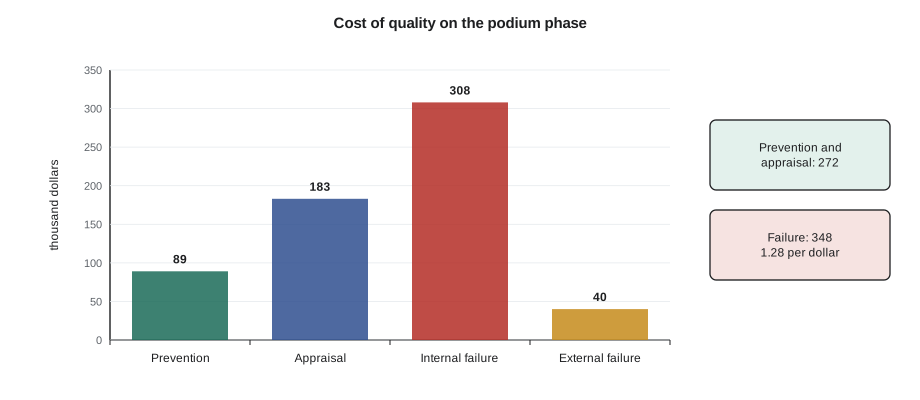
Lena used the podium phase, which was complete when this course begins, to estimate how Thornbury's spending was divided. Her figures come from the cost reports, the nonconformance log and timesheets, with some judgment where costs were not coded separately.
# Cost of quality for the podium phase (illustrative figures, thousand dollars)
costs = {
    "prevention": {"quality plan and procedures": 18, "preinstallation meetings": 22,
                   "mock-ups": 35, "training and orientation": 14},
    "appraisal":  {"contractor inspections": 61, "testing agency (owner-paid, shown for reference)": 74,
                   "field engineer checks": 48},
    "internal failure": {"rework of nonconforming work": 186, "schedule impact of rework": 95,
                         "damaged and replaced materials": 27},
    "external failure": {"warranty allowance for podium work": 40},
}
phase_cost = 14_800  # podium construction cost, thousand dollars
total = 0
for cat, items in costs.items():
    sub = sum(items.values())
    total += sub
    print(f"{cat:17s} {sub:5d}  ({sub / phase_cost:.1%} of phase cost)")
print(f"{'total':17s} {total:5d}  ({total / phase_cost:.1%} of phase cost)")
fail = sum(costs["internal failure"].values()) + sum(costs["external failure"].values())
good = sum(costs["prevention"].values()) + sum(costs["appraisal"].values())
print(f"failure cost per dollar of prevention and appraisal: {fail / good:.2f}")prevention 89 (0.6% of phase cost) appraisal 183 (1.2% of phase cost) internal failure 308 (2.1% of phase cost) external failure 40 (0.3% of phase cost) total 620 (4.2% of phase cost) failure cost per dollar of prevention and appraisal: 1.28
The pattern is common. Prevention was the smallest category, and failure costs were well above prevention and appraisal combined. The single largest item, rework of nonconforming work, came mostly from three problems that later lessons return to: reinforcing placed with too little cover at a podium wall, a waterproofing detail at the parking garage that leaked during the first heavy rain, and storefront anchors installed before the slab edge had been surveyed. Lena's argument to Dana was simple: a modest increase in prevention on the wood frame and envelope phases, which have far more repetition than the podium, should pay for itself many times over.
Defects: where they come from
Defects have causes, and the causes are usually in the process, not in individual carelessness. When Lena grouped the podium nonconformances by cause, she found the same handful of sources that quality studies report across the industry.
- Information problems: the worker built to an outdated drawing, a detail was unclear, or a change was not communicated.
- Coordination problems: one trade's work conflicted with another's, or the sequence left one trade unable to complete its work properly.
- Method and skill problems: the crew did not know the correct method, or the specified product needed a technique the crew had not used before.
- Material problems: the wrong product was delivered or installed, or the product was damaged or stored badly.
- Supervision and checking problems: nobody checked the work before it was covered.
- Schedule pressure: the crew rushed to meet a date, skipped a step or covered work before inspection.
Each cause points to a different prevention. Information problems call for better document control; coordination problems for better sequencing and coordination drawings; method problems for training, mock-ups and preinstallation meetings; material problems for submittal checks and receiving inspections; checking problems for inspection and test plans; and schedule problems for realistic look-aheads that include time for inspection. The rest of this course works through those tools.
Quality and the rest of the project
Quality is not a separate activity bolted onto the schedule and the budget. It is built into them. A look-ahead that leaves no time for inspections encourages crews to cover work early. A subcontract awarded on price alone, with no review of the subcontractor's quality record, invites rework. A logistics plan that stores drywall in the rain guarantees damaged board. Quality also overlaps with safety: many of the same habits, such as planning the task, checking conditions before starting and stopping to ask when something looks wrong, prevent both injuries and defects, and the same leadership behaviours that build a safety culture build a quality culture. CON-355 covers safety leadership.
The table below shows how the main topics of this course connect to the project's stages on Larkspur Commons.
| Stage | Main quality activities | Lesson |
|---|---|---|
| Before construction | Quality plan, inspection and test plans, submittal procedures | 2, 3 |
| Before each new activity | Submittal approval, preinstallation meeting, mock-up, first-work inspection | 4, 5 |
| During the work | Inspections, material tests, special inspections and field reviews | 6, 7, 8, 9 |
| When something is wrong | Nonconformance reports, root cause, corrective action | 10 |
| Near completion and after | Deficiency and punch lists, warranties, latent defects | 11 |
| Throughout | Metrics, culture, continuous improvement | 12 |
Measuring quality: a first look
What gets measured gets attention. Lena tracks a small set of quality measures across Thornbury's projects. The most useful is first-time quality: the share of inspected items that pass the first time, without rework. On the podium, the contractor's own inspections passed 87 percent of items first time. The building official's inspections passed 9 of 11 first time, and the envelope consultant's reviews found deficiencies on 6 of 14 visits. Lesson 12 develops these measures; the point here is that quality, like safety and schedule, can be tracked with numbers that show whether the project is improving.
# First-time pass rates on the podium (illustrative)
records = {
    "contractor inspections":     (412, 358),   # (items inspected, passed first time)
    "building official inspections": (11, 9),
    "envelope consultant reviews":   (14, 8),
}
for who, (n, ok) in records.items():
print(f"{who:31s} {ok:3d} of {n:3d} passed first time = {ok / n:.0%}")contractor inspections 358 of 412 passed first time = 87% building official inspections 9 of 11 passed first time = 82% envelope consultant reviews 8 of 14 passed first time = 57%
None of these numbers is bad in isolation, but the envelope reviews stand out. With the wood frame and the envelope about to start on four floors of repetitive work, an envelope defect repeated across every floor would be expensive. That concern shapes much of the quality plan in the next lesson.
Common mistakes
MistakeTreating quality as how good the work looks.
InsteadDefine quality as conformance to the contract documents, and judge grade and appearance against what the documents specify.
MistakeAssuming the building inspector or the consultant checks everything.
InsteadThe building inspector checks code compliance at set stages and consultants review periodically; the contractor remains responsible for checking all of its work.
MistakeBlaming defects on individual carelessness.
InsteadLook for the process cause, such as missing information, poor coordination, lack of training or schedule pressure, and fix that.
MistakeCutting prevention spending to save money.
InsteadCompare prevention and appraisal costs with failure costs; on repetitive work, prevention usually pays for itself many times over.
MistakeLeaving quality out of the schedule and logistics plans.
InsteadInclude inspection time, mock-ups and material protection in the look-ahead and the logistics plan.
Summary and key terms
- On a construction contract, quality means conformance to the contract documents; grade is a design choice made by the owner.
- Rework estimates range from about 5 percent of cost in direct terms to 10 to 25 percent when indirect costs are included; they are orders of magnitude, not targets.
- Quality assurance concerns the process; quality control checks the work itself. Contractor quality control and owner quality assurance are complementary.
- The owner, consultants, testing agency, authority having jurisdiction, contractor and trades each have defined quality roles; the contractor remains responsible for its work.
- The cost of quality divides into prevention, appraisal, internal failure and external failure; failure costs usually dominate when prevention is thin.
- Defects usually come from information, coordination, method, material, checking or schedule problems, each with its own prevention.
- Quality is built into the schedule, procurement and logistics plans and shares many habits with safety.
- First-time quality, the share of items passing inspection without rework, is a simple and useful measure.
- Quality
- Conformance of the work to the requirements of the contract documents.
- Grade
- The category or level of a product, chosen through the design.
- Quality assurance
- Planned activities that give confidence the work will meet requirements, focused on the process.
- Quality control
- Inspection, testing and measurement of the work to confirm it conforms.
- Owner verification
- Inspections and tests the owner arranges to confirm the contractor's work.
- Rework
- Work done again because the first attempt did not conform.
- Cost of quality
- The total of prevention, appraisal, internal failure and external failure costs.
- First-time quality
- The share of inspected items that pass the first time without rework.
Practice problems
Work each problem on paper first, then reveal the answer to check.
A quartz counter with chipped seams and a laminate counter with tight seams: which is the higher grade and which is the higher quality?
Show answer
The quartz counter is the higher grade; the laminate counter, if it meets its specification, is the higher-quality work.
Give two examples of quality assurance and two of quality control on Larkspur Commons.
Show answer
QA: the quality plan, preinstallation meetings, submittal review, training. QC: inspections, concrete tests, measurements, nonconformance reports.
A wall passed the building inspection but the architect rejects it. How can both be right?
Show answer
The inspector checks code compliance; the architect checks conformance to the contract, which may require more than the code, such as a specific board or acoustic sealant.
In the cost-of-quality example, what was the failure cost per dollar of prevention and appraisal?
Show answer
About 1.28: 348 thousand dollars of failure cost against 272 thousand of prevention and appraisal.
Name the six common sources of defects Lena found.
Show answer
Information, coordination, method and skill, materials, supervision and checking, and schedule pressure.
Why did the envelope review results concern Lena more than the other first-time pass rates?
Show answer
They were the lowest, and envelope work is about to repeat on four floors, so any defect could be repeated many times and is hard to find once covered.
Lesson quiz · 5 questions
Score 60% or more to complete this lesson.
Create a free account to save your progress, take quizzes and earn a certificate.