
CON-345 · Lesson 3 of 12 · 24 min
Inspection and test plans
The requirements register from lesson 2 tells the team what must be inspected and tested. An inspection and test plan (ITP) says how, when and by whom, step by step, for one activity. It is the working document of quality control: the foreman uses it to know what will be checked, the field engineer uses it to arrange inspections, the consultants use it to know when to come, and at the end of the job the signed ITPs and their records are part of the evidence that the building was built as designed.
This lesson explains the structure of an ITP, the meaning of hold, witness and review points, how ITPs connect to the look-ahead, and how inspection records are kept. The examples are the firestopping plan that Mei wrote after the coverage check in lesson 2 and the plan for the post-tensioned transfer slab at level 3.
The structure of an ITP
An ITP lists the steps of an activity in the order they happen, and for each step the check to be made, the standard it is checked against, how often, who does it and what record proves it was done. Most ITPs fit on one or two pages. They are written from the specifications, the drawings, the manufacturer's installation instructions and any code requirements, and they are reviewed by the subcontractor who will do the work, because the subcontractor's crew carries out most of the checks.
| Column | What it contains | Example from the firestopping ITP |
|---|---|---|
| Step | The stage of the activity in sequence | Install firestop at a pipe penetration |
| Inspection or test | What is checked | Annular space, sealant depth, product and system match the listed system |
| Reference | Where the requirement comes from | Specification section 07 84 00; listed system drawing; manufacturer's instructions |
| Acceptance criteria | What counts as a pass | Matches the listed system for that penetration type; no gaps; depth as listed |
| Frequency | How often | Every penetration by the installer; sample by the contractor; all before cover |
| Responsibility | Who performs the check | Installer; Thornbury field engineer; fire consultant; building official |
| Point type | Hold, witness, review or surveillance | Hold point before drywall cover |
| Record | Evidence that the check was done | Installer's labelled photos and log; contractor checklist; consultant's report |
Acceptance criteria deserve care. 'Install properly' is not a criterion. A criterion is something two people would judge the same way: a dimension with a tolerance, a test value, a listed system number, a product name, or a visual standard set by an approved mock-up. When the specification is vague, the ITP should point to the document that defines acceptance, such as the manufacturer's instructions or the approved shop drawing, or the field engineer should ask the consultant for a clear criterion before the work starts rather than argue about it afterwards.
Hold, witness, review and surveillance points
The point types tell everyone how much control a step carries. Terms vary slightly between companies and owners, but the meanings below are widely used.
| Point | Meaning | If the inspector does not attend |
|---|---|---|
| Hold (H) | Work must not proceed past this step until the named party has inspected and released it | Work stops until the release is given or formally waived in writing |
| Witness (W) | The named party must be notified and given the chance to attend; work may proceed if they do not attend after proper notice | Work proceeds; the record notes that notice was given |
| Review (R) | A document, such as a test report or certificate, must be reviewed before or after the step | Work may proceed, but the document must be reviewed and filed |
| Surveillance (S) | The party may inspect at any time without notice | No effect on the work |
Hold points are powerful and expensive, because every hold point can stop a crew. They belong where the consequence of an error is high and the work will be hidden or costly to change once the next step is done: before concrete is placed over reinforcing and tendons, before tendons are cut after stressing, before fire separations are closed, before windows are covered by cladding. Witness points suit steps where the owner's consultant wants the option to see the work but does not need to stop it, such as the start of a membrane installation. Too many hold points slow the job and train everyone to treat them as formalities; too few let critical work be covered unseen.
The release of a hold point must be clear. On Larkspur Commons, a hold point is released only in writing, by a signature on the ITP or a recorded approval in the inspection app, by the party named in the ITP. A verbal 'looks fine' from a consultant walking past does not release a hold point, because six weeks later nobody will remember who said it about which area.
Example: the firestopping ITP
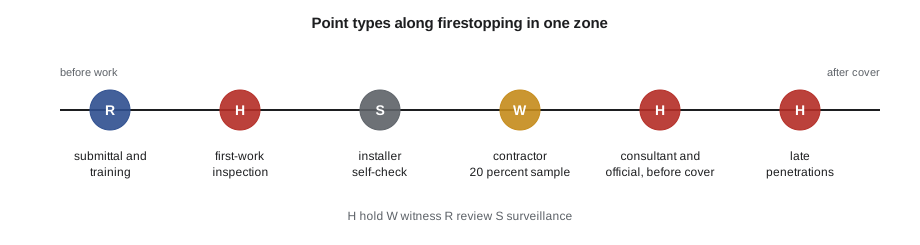
Firestopping in a wood-frame building is a good example of an activity that needs a strong ITP. Every pipe, duct, cable and conduit that passes through a fire-rated wall or floor needs a tested firestop system matched to the penetrating item, the size of the opening and the type of assembly. On a single residential floor of Larkspur Commons there are more than 600 penetrations through fire separations, installed by several trades over several weeks, and almost all of them will be hidden by drywall.
| Step | Check | By | Point |
|---|---|---|---|
| 1. Before work | Firestop submittal approved; listed systems selected for each penetration type; installers trained by the manufacturer's representative | Thornbury, fire consultant | R |
| 2. First zone | First-work inspection of a sample of each penetration type | Thornbury, fire consultant | H |
| 3. Each penetration | Installed to the listed system; labelled with system number, installer and date; photographed | Installer | S |
| 4. Each zone | Contractor inspection of at least 20 percent of penetrations, plus all of any type that failed earlier | Thornbury field engineer | W |
| 5. Each zone before cover | Fire consultant review; building official inspection of fire separations | Fire consultant, building official | H |
| 6. After cover | Penetrations made after drywall (late changes) logged and inspected individually | Installer, Thornbury | H |
The first-work hold point in step 2 matters most. If the first zone is right, the installers have shown they understand the systems and the remaining zones mostly follow. If it is wrong, the error is caught in one zone instead of eight. Lesson 5 returns to first-work inspections. Step 6 handles a classic weakness: penetrations made after the walls are closed, for example when a late change adds a cable, are easy to forget because the zone has already passed its inspection.
Example: the transfer slab ITP
The level 3 transfer slab, introduced in CON-315, is a post-tensioned concrete slab that carries the four wood-frame storeys above and transfers their loads to the podium columns. It is the most critical single pour on the project. Its ITP has more hold points than any other on the job.
Before the first pour, the ITP requires: approved formwork and shoring design (CON-325), surveyed soffit elevations, inspection of mild reinforcing for size, spacing and cover, inspection of tendon profiles against the shop drawings with chair heights checked at marked points, inspection of anchorages and pocket formers, the structural engineer's field review, and the building official's inspection where required. During the pour, the testing agency samples the concrete and the contractor records placement times and temperatures. After the pour, the ITP requires concrete strength results reaching the specified stressing strength, typically about 20 MPa for this slab, before stressing, the stressing records with measured elongations within tolerance of the calculated values, and the engineer's review of those records before the tendon tails are cut and the pockets grouted.
| Step | Point | Released by |
|---|---|---|
| Formwork and shoring installed | H | Temporary works engineer's field review |
| Soffit elevations surveyed | R | Field engineer |
| Bottom reinforcing placed | W | Structural engineer (review), testing agency where required |
| Tendon profiles and anchorages | H | Structural engineer and PT supplier's engineer |
| Top reinforcing, embeds and sleeves | H | Structural engineer; building official where required |
| Concrete placement | W | Testing agency samples; engineer may attend |
| Stressing strength reached | R | Testing agency report reviewed by contractor |
| Stressing and elongations | H | Engineer reviews records before tails are cut |
| Shores removed and reshoring | H | Temporary works engineer |
The pre-pour hold point is where Mei's checklists earn their keep. On the second transfer slab pour, her pre-pour check found three tendon chairs crushed by foot traffic, which would have lowered the tendons by about the height of a chair and reduced the slab's capacity. They were replaced before the engineer's review, and nobody outside the field team ever saw the problem. That is what a good hold point is for: finding problems while they are still cheap.
Notification and the look-ahead
Hold and witness points only work if the right people know when to come. Each ITP states how much notice each party needs: on Larkspur Commons, the structural engineer asks for 48 hours before pre-pour reviews, the envelope consultant 72 hours before mock-up tests, and the building official's inspections are booked through the City's system the day before. CON-335 showed how inspections are placed in the look-ahead as constraints. The ITPs supply the list: every hold point in the next three weeks becomes a line in the look-ahead with its notice period and the person who will book it.
The script below checks the coming week's activities against the ITP hold points and flags any that have not been booked with enough notice.
# Check that hold points in the coming week are booked with enough notice (illustrative)
from datetime import date, timedelta
today = date(2026, 3, 9)  # Monday
holds = [  # (activity, hold point, party, notice in working days, planned date, booked on)
    ("L3 transfer slab pour 2", "pre-pour review", "structural engineer", 2, date(2026, 3, 12), date(2026, 3, 9)),
    ("L3 transfer slab pour 1", "stressing records", "structural engineer", 1, date(2026, 3, 10), date(2026, 3, 6)),
    ("L4 west framing", "shear wall nailing", "structural engineer", 2, date(2026, 3, 13), None),
    ("Podium north wall", "waterproofing before backfill", "envelope consultant", 3, date(2026, 3, 11), date(2026, 3, 9)),
]
def working_days(a, b):
    n, d = 0, a
    while d < b:
        d += timedelta(days=1)
        if d.weekday() < 5:
            n += 1
    return n
for act, hp, party, need, planned, booked in holds:
    if booked is None:
        print(f"NOT BOOKED  {act}: {hp} ({party}), needed {need} working days before {planned}")
        continue
    given = working_days(booked, planned)
    flag = "ok" if given >= need else "SHORT NOTICE"
print(f"{flag:13s}{act}: {hp}, notice {given} of {need} working days")ok L3 transfer slab pour 2: pre-pour review, notice 3 of 2 working days ok L3 transfer slab pour 1: stressing records, notice 2 of 1 working days NOT BOOKED L4 west framing: shear wall nailing (structural engineer), needed 2 working days before 2026-03-13 SHORT NOTICE Podium north wall: waterproofing before backfill, notice 2 of 3 working days
Two problems show up. The shear wall nailing review on level 4 west has not been booked at all, and the envelope consultant was given two working days' notice for a review that needs three. Omar calls the consultant that morning to ask whether the review can still happen on Wednesday; if not, the backfill moves, because backfilling over unreviewed waterproofing would hide it. Finding these conflicts on Monday morning is much cheaper than finding them on Wednesday when the excavator is waiting.
Inspection records
An inspection that is not recorded did not happen, as far as anyone can prove later. Records serve three purposes: they show the work was checked, they allow trends to be analysed (lesson 12) and they protect the contractor if questions arise years later. Good records are specific: the location by gridline, level and suite; the item checked; the result; the name of the inspector; the date; and photographs with enough context to identify where they were taken.
| Weak record | Strong record |
|---|---|
| Firestopping checked level 4, OK | L4W suites 401 to 414: 62 of 304 penetrations inspected (20 percent sample, all types); 60 conform; 2 failed (suite 406, sealant depth short at two PVC drains; installer redone, re-inspected 11 Mar, conform); photos 0412 to 0478 |
| Rebar looks good | L3 transfer slab pour 2, grid 1 to 5 by A to F: bottom bars size and spacing per S-301 rev 4; cover 25 to 35 mm measured at 24 points, all within tolerance; 3 crushed chairs replaced; engineer review 12 Mar, released |
| Roof tested | Roof area R2 flood test 24 h from 08:00 14 Jun; water level 50 mm at drain; no leaks observed at interior; witnessed by envelope consultant; report attached |
Most contractors now keep inspection records in a construction management application on tablets, with checklists built from the ITPs, photos attached automatically and records linked to drawing locations. The software does not make the inspection better by itself, but it makes records easier to complete, harder to lose and possible to analyse. Thornbury's procedure requires that every hold point release be recorded in the application before the next step starts, so the field engineer can see at a glance which zones are released.
Sampling or inspecting everything
Some items must be checked one by one: every hold point release, every anchor bolt group under a steel column, every firestop before the building official's inspection if the official requires it. For repetitive items, inspecting every unit by the contractor may be neither practical nor necessary if the installer checks every unit and the contractor samples. The question is how big the sample should be.
A simple way to think about it is the probability that a sample catches a problem if one exists. If a zone has a certain share of defective items and the inspector checks a random sample, the chance of finding at least one defect rises quickly with the sample size. The script below shows this for firestopping in one zone of 304 penetrations.
# Probability that a random sample finds at least one defect in a zone of 304 penetrations
from math import comb
N = 304
for defect_rate in (0.01, 0.03, 0.05):
    D = round(N * defect_rate)
    row = []
    for n in (10, 30, 61, 100):
        p_none = comb(N - D, n) / comb(N, n)
        row.append(f"n={n:3d}: {1 - p_none:5.1%}")
print(f"{D:2d} defective ({defect_rate:.0%}): " + " ".join(row))3 defective (1%): n= 10: 9.6% n= 30: 26.9% n= 61: 49.1% n=100: 69.9% 9 defective (3%): n= 10: 26.3% n= 30: 61.3% n= 61: 87.1% n=100: 97.4% 15 defective (5%): n= 10: 40.2% n= 30: 79.8% n= 61: 96.8% n=100: 99.8%
With a 20 percent sample of 61 penetrations, the chance of finding at least one defect is about 87 percent if 3 percent of penetrations are defective, and about 97 percent at 5 percent, but only about 49 percent if just three penetrations are bad. That is why Mei's ITP does more than sample. It requires the installer to label and photograph every penetration, it tightens the sample to 100 percent for any penetration type that failed earlier, and it keeps the building official's inspection as a final hold point. Sampling is a tool for finding systemic problems, not a guarantee that every unit is right. Lesson 12 returns to sampling plans.
ITPs and subcontractors
Most of the checks in an ITP are done by the subcontractor's own people. Thornbury's subcontracts on Larkspur Commons require each subcontractor to review the ITP for its scope, to name a person responsible for its quality control, to perform and record its own inspections before calling for the contractor's inspection, and to correct nonconforming work at its own cost. Before each new scope starts, the subcontractor's foreman walks through the ITP with Mei at the preinstallation meeting (lesson 4).
The principle is that each trade inspects its own work first. A contractor's inspector who finds dozens of obvious defects is doing the subcontractor's job, and the contractor's time would be better spent on sampling, hold points and the interfaces between trades, where defects most often hide.
Common mistakes
MistakeWriting vague acceptance criteria such as 'install properly'.
InsteadState criteria two people would judge the same way: dimensions and tolerances, test values, listed systems or an approved mock-up.
MistakePutting hold points everywhere.
InsteadUse hold points where errors are costly and will be hidden; use witness, review and surveillance points elsewhere.
MistakeAccepting a verbal release of a hold point.
InsteadRelease hold points only in writing, by the party named in the ITP, before the next step starts.
MistakeBooking inspections only when the work is ready.
InsteadPut hold points from the ITPs into the look-ahead with their notice periods and check the bookings each week.
MistakeRelying on a small sample to prove every unit conforms.
InsteadUse sampling to find systemic problems; add installer self-checks, full inspection of failed types and final hold points for critical items.
Summary and key terms
- An inspection and test plan lists the steps of an activity with the check, reference, acceptance criteria, frequency, responsibility, point type and record for each.
- Acceptance criteria must be specific enough that two people would agree on the result.
- Hold points stop work until released in writing; witness points require notice; review points require document review; surveillance points allow inspection at any time.
- Hold points belong where errors are costly and will be hidden, such as before concrete placement, tendon cutting and closing fire separations.
- First-work hold points catch errors in one zone instead of many.
- Hold points and their notice periods should be entered in the look-ahead and checked weekly.
- Strong records give location, item, result, inspector, date and photographs; digital tools make them easier to keep and analyse.
- Sampling finds systemic problems but cannot guarantee every unit conforms; subcontractors inspect their own work first.
- Inspection and test plan
- A step-by-step plan of the inspections and tests for one activity, with criteria, responsibilities and records.
- Acceptance criteria
- The measurable standard that work must meet to pass an inspection or test.
- Hold point
- A step that work may not pass until the named party has inspected and released it in writing.
- Witness point
- A step at which a named party must be notified and may attend; work may proceed after proper notice.
- Review point
- A step requiring review of a document such as a test report or certificate.
- Surveillance point
- A step the named party may inspect at any time without notice.
- Listed system
- A firestop or other assembly tested and listed by a recognized laboratory for specific conditions.
- Sample inspection
- Inspection of a selected portion of repetitive items to detect systemic problems.
Practice problems
Work each problem on paper first, then reveal the answer to check.
Rewrite 'install firestop properly' as an acceptance criterion.
Show answer
For example: installed to the listed system for that penetration type, with the listed sealant depth and no gaps, labelled with system number, installer and date.
What is the difference between a hold point and a witness point if the inspector does not attend?
Show answer
At a hold point work stops until released; at a witness point work may proceed after proper notice, and the record shows notice was given.
Why does the firestopping ITP include step 6, after cover?
Show answer
Penetrations added after drywall are easy to forget because the zone has already passed; each must be logged and inspected.
What did Mei's pre-pour check find on the second transfer slab pour, and why did it matter?
Show answer
Three crushed tendon chairs; the tendons would have sat too low, reducing the slab's capacity.
In the notice check, which two problems were found?
Show answer
The level 4 west shear wall review was not booked, and the envelope consultant had only two of three required working days' notice.
With a 61-penetration sample from 304, what is the chance of finding a defect if three penetrations are defective?
Show answer
About 49 percent, which is why sampling is combined with self-checks, full inspection of failed types and a final hold point.
Lesson quiz · 5 questions
Score 60% or more to complete this lesson.
Create a free account to save your progress, take quizzes and earn a certificate.