
CON-320 · Lesson 10 of 12 · 28 min
Taxes and holdbacks in Canada
Tax touches a contractor's finances at every level: income tax on profits, GST/HST and provincial sales taxes on billings and purchases, payroll deductions held in trust for the government, and special rules for the holdback that owners withhold. Holdback itself is not a tax, but its timing drives when income and sales tax become payable, and holdback money is often held in trust under provincial construction legislation. This lesson explains how these rules interact for a general contractor. Tax law changes often and depends on each firm's facts; contractors should work with an accountant who specializes in construction.
Income tax on long-term contracts
Canadian income tax starts from profit computed under well-accepted business principles, which for most contractors means accrual accounting, then adjusts it as the Income Tax Act requires. For long-term contracts, the Canada Revenue Agency has long accepted the percentage-of-completion approach. Its archived Interpretation Bulletin IT-92R2, Income of Contractors, which remains a widely used reference, also allowed a completion method for contracts that can reasonably be expected to be completed within two years of starting, provided it is applied consistently to all such contracts. Under that method, the profit on a short-term contract is reported in the year the work is completed. Because the bulletin is archived, contractors should confirm current CRA practice with an adviser.
Even under the percentage-of-completion approach, tax results can differ from the financial statements. Reserves, such as provisions for future losses, are generally deductible only where the Act specifically allows them, so a loss provision recognized in the financial statements may not be deductible until the loss is incurred. Holdbacks have their own rules, explained below.
| Method | When income is taxed | Typical use |
|---|---|---|
| Percentage of completion | As work progresses | Most long-term contracts |
| Completion method (archived IT-92R2) | When the work is completed | Contracts reasonably expected to be completed within two years, applied consistently |
| Holdback deferral | Holdback receivable taxed when it becomes receivable | Contractors with statutory or contractual holdbacks (see below) |
# Timing of taxable profit: percentage of completion vs completion method
# for an 18-month contract expected to finish within two years (illustrative)
price, cost = 4_800_000, 4_416_000
spend = {"Year 1": 2_650_000, "Year 2": 1_766_000}
cum = 0
for yr, c in spend.items():
    cum += c
    poc_profit = (price - cost) * c / cost
    completion = (price - cost) if cum == cost else 0
    print(f"{yr}: percentage of completion {poc_profit:>9,.0f}   completion method {completion:>9,.0f}")
rate = 0.122   # small business combined rate, illustrative (Ontario)
print(f"Tax deferred in year 1 by the completion method: {rate * (price - cost) * 2_650_000 / cost:,.0f}")Year 1: percentage of completion 230,435 completion method 0 Year 2: percentage of completion 153,565 completion method 384,000 Tax deferred in year 1 by the completion method: 28,113
The total taxable profit is the same; only the timing differs. Deferring tax is valuable because it keeps cash in the business, but the deferred tax still has to be paid, and the financial statements record a deferred tax liability for it. Sureties look at the financial statements, not the tax return, so a contractor's tax strategy does not change its bonding capacity directly; it changes its cash.
Corporate income tax rates and structure
Most private Canadian contractors are Canadian-controlled private corporations. Active business income up to the small business limit, $500,000 federally, is taxed at a low combined rate (federal 9 % plus the provincial small business rate, for example about 12.2 % combined in Ontario); income above the limit is taxed at the general rate, about 26.5 % combined in Ontario. The small business limit is reduced for corporations with large taxable capital or passive investment income. Owners then pay personal tax on salaries and dividends. The choice between paying owners salary, bonus or dividends, and between keeping profits in the company or paying them out, affects both tax and bonding capacity (Lesson 9).
Worked problem
Small business rate and holdback deferral
Kestrel's taxable income in 2025 is about $1.56 million before any holdback deferral. Using illustrative Ontario combined rates of 12.2 % on the first $500,000 and 26.5 % above, what is its tax, and what does it save in the current year if it defers $400,000 of holdback receivable that will not be receivable until next year?
Show solution
- Tax without deferral: 0.122 × 500,000 + 0.265 × 1,060,000 = 61,000 + 280,900 = $341,900.
- Tax with $400,000 deferred: taxable income $1,160,000; 61,000 + 0.265 × 660,000 = 61,000 + 174,900 = $235,900.
- Current-year saving = $106,000, payable next year when the holdback becomes receivable.
Answer: Deferral saves about $106,000 of tax this year, improving cash, but the tax will be due when the holdback is receivable. The financial statements show the full income and a deferred tax liability.
Holdback: what it is and why it matters
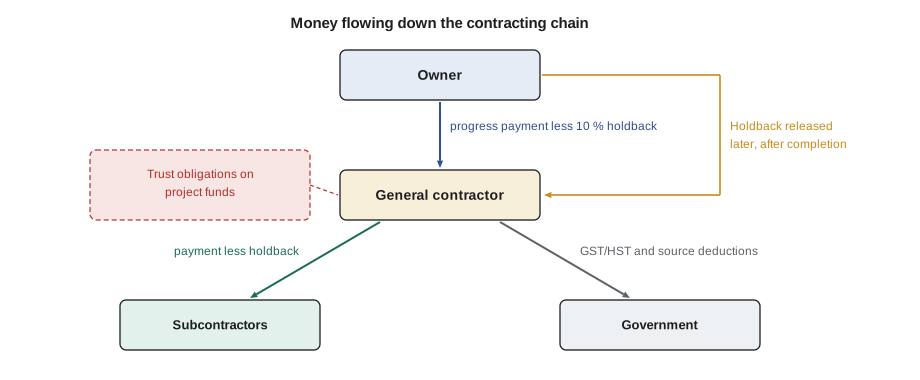
Under provincial construction and lien legislation, owners and contractors must withhold a holdback, usually 10 % of the value of work done, from each payment down the contracting chain. The holdback protects lien claimants: if the contractor fails to pay a subcontractor, the owner's liability is generally limited to the holdback it should have retained. In Ontario, holdback must now be released on an annual or phased basis on longer projects as well as at substantial completion, once the lien period expires (CON-310 Lesson 11 covers the release rules). For the contractor, holdback is a large and slow receivable, and often the largest single amount owed to it on a finished job.
# Cost of carrying holdback for Kestrel (illustrative)
holdback_receivable = 2_700_000
holdback_payable = 2_100_000
net_carried = holdback_receivable - holdback_payable
rate = 0.0625
print(f"Net holdback financed by Kestrel: {net_carried:,}")
print(f"Annual financing cost at {rate:.2%}: {net_carried * rate:,.0f}")
avg_months = 7      # average time from billing to release
print(f"Gross holdback billed per year at 10 %: {0.10 * 58_400_000:,.0f}; "
f"average months outstanding {avg_months}")Net holdback financed by Kestrel: 600,000 Annual financing cost at 6.25%: 37,500 Gross holdback billed per year at 10 %: 5,840,000; average months outstanding 7
Kestrel passes most of the holdback down to its subcontractors, so it carries only the difference, about $600,000, plus the holdback on its self-performed work and markup. A specialty contractor that self-performs most of its work carries much more of its holdback itself.
Income tax on holdbacks
Holdbacks receive special treatment in Canadian income tax. Under the long-standing CRA approach described in IT-92R2, the aggregate holdbacks on a contract become receivable, and must be included in income, at the later of the date of the architect's or engineer's final certificate of completion and the date the lien period expires. Until then, many contractors exclude holdbacks receivable from income; the deferral must be applied consistently from year to year. On the other side, holdbacks the contractor withholds from its subcontractors are generally not deductible until they become payable, for example when the subcontractor's work is certified complete and the lien period has expired. Because the receivable and payable sides move at different times, the net effect is a deferral of the contractor's margin and self-performed work in the holdback.
| Item | Income tax treatment (general) |
|---|---|
| Holdback receivable on progress billings | Commonly excluded from income until it becomes receivable (final certificate and lien expiry), if applied consistently |
| Holdback payable to subcontractors | Deductible when it becomes payable under the subcontract and the legislation |
| Loss provisions in the financial statements | Generally not deductible until the loss is incurred |
| Equipment | Capital cost allowance by class (Lesson 7) |
GST/HST and provincial sales taxes
Contractors register for GST/HST and charge it on their progress billings at the rate for the province where the work is done: 5 % GST, or HST at 13 % in Ontario and 15 % in the Atlantic HST provinces, with Quebec charging QST alongside GST. They claim input tax credits (ITCs) for the GST/HST paid on their purchases and subcontracts. The timing rule that matters most for holdback is in subsection 168(7) of the Excise Tax Act: where a payment is subject to a statutory holdback, GST/HST on the holdback becomes payable only when the holdback is required to be released, not when the progress claim is issued. Contractors who collect the tax earlier must remit it in the period they collect it. On the purchasing side, the contractor can claim ITCs on subcontractor holdback when it is paid or becomes payable. In British Columbia, Saskatchewan and Manitoba, which levy separate provincial sales taxes, contractors generally pay PST on materials they incorporate into real property, as CON-300 Lesson 9 explained.
Worked problem
GST/HST on a progress claim with holdback
Kestrel bills $600,000 of work on an Ontario job in March, with a 10 % statutory holdback. HST is 13 %. How much HST is payable for March, and when is the rest payable?
Show solution
- Amount payable to Kestrel now = 600,000 × 90 % = $540,000; HST on it = 0.13 × 540,000 = $70,200, payable in Kestrel's March reporting period.
- HST on the holdback = 0.13 × 60,000 = $7,800, payable in the period the holdback is required to be released.
- If the progress claim charged HST on the full $600,000 and the owner paid it, Kestrel would have to remit the full $78,000 in March.
Answer: About $70,200 of HST is payable for March; the $7,800 on the holdback waits until the holdback is due for release. Billing practice should follow the rule so that tax is not collected and remitted earlier than necessary.
Payroll remittances and trust funds
Employers deduct income tax, CPP and EI contributions from employees' wages and hold them in trust for the Crown until remitted, along with the employer's share. GST/HST collected is also held in trust. If a corporation fails to remit, its directors can be held personally liable under the Income Tax Act (section 227.1) and the Excise Tax Act (section 323), subject to a due diligence defence. A struggling contractor that uses unremitted payroll deductions or HST to pay suppliers is borrowing from the government on the directors' personal credit. Unremitted source deductions are also deemed trusts that can rank ahead of a bank's security, which is why banks deduct them from the borrowing base (Lesson 9).
Construction trust funds
In several provinces, construction legislation also impresses a trust on money received by owners, contractors and subcontractors for a project. In Ontario, for example, amounts received by a contractor on account of the contract price are held in trust for the subcontractors and others who supplied services or materials to the project, until those parties are paid. Using project funds to pay overhead or other projects' debts while subcontractors on the trust project remain unpaid can be a breach of trust, and directors and officers who assent to it can be held personally liable. The trust rules have accounting consequences: contractors should be able to trace receipts to the subcontractors and suppliers on each job and should not treat cash from one project as freely available for another. CON-220 discusses the legal details.
Managing holdback
| Practice | Benefit |
|---|---|
| Track holdback receivable by job with release dates and conditions | Forecasts cash and flags overdue releases |
| Complete deficiencies, close-out documents and certificates promptly | Holdback release depends on certification and lien expiry |
| Use annual or phased release provisions where available | Releases cash on long projects (CON-310) |
| Release subcontractor holdback in step with receipts | Avoids financing subcontractors' holdback longer than necessary |
| Consider security in place of cash holdback where the law and contract allow | Some jurisdictions permit a letter of credit or holdback repayment bond instead of cash holdback |
| Bill GST/HST on holdback only when it becomes payable | Avoids remitting tax early |
Common mistakes
MistakeAssuming tax and financial statement income are the same.
InsteadHoldback deferral, the completion method for short contracts, non-deductible reserves and CCA all create differences; track them.
MistakeCollecting and remitting tax early because the billing system charges it on the full claim.
InsteadUnder section 168(7) of the Excise Tax Act, GST/HST on statutory holdback becomes payable when the holdback is due for release.
MistakeUsing unremitted payroll deductions to pay suppliers in a cash crunch.
InsteadDirectors can be personally liable; deemed trusts also rank ahead of the bank.
MistakeTreating cash received on one job as freely available for any purpose.
InsteadConstruction trust rules may require it to be used for that job's subcontractors and suppliers first.
MistakeLeaving holdback releases to chance.
InsteadTrack release conditions and dates and finish close-out promptly.
MistakeChoosing an ownership structure or bonus policy for tax alone.
InsteadConsider the effect on working capital, equity and bonding capacity as well.
Summary and key terms
- Long-term contracts are generally taxed on a percentage-of-completion basis; the archived IT-92R2 also allowed a completion method for contracts expected to finish within two years.
- Holdbacks receivable are commonly excluded from income until they become receivable; holdbacks payable are deductible when payable.
- Private corporations benefit from the small business rate on the first $500,000 of active business income.
- GST/HST on statutory holdback becomes payable when the holdback is required to be released; ITCs follow when subcontractor holdback is paid or payable.
- Payroll deductions and GST/HST collected are held in trust, and directors can be personally liable for unremitted amounts.
- Provincial construction trusts may require project receipts to be used for that project's subcontractors and suppliers.
- Holdback is a large, slow receivable that must be tracked and released promptly.
- Holdback
- A percentage of each payment withheld under construction legislation to protect lien claimants.
- Completion method
- Reporting a short-term contract's profit in the year the work is completed.
- Input tax credit
- A credit for GST/HST paid on business purchases.
- Small business deduction
- A reduced corporate tax rate on the first $500,000 of active business income of a CCPC.
- Deferred tax liability
- Tax that will become payable later because taxable income has been deferred.
- Trust funds
- Money held for others, such as payroll deductions or project receipts owed to subcontractors.
- Director liability
- Personal liability of directors for a corporation's unremitted source deductions and GST/HST.
- Lien period
- The period during which lien claims may be registered after completion or last supply.
- Percentage-of-completion method
- Recognizing income on a long-term contract in proportion to progress.
- Construction trust
- A statutory trust over project funds for the benefit of those who supplied labour and materials.
Practice problems
Work each problem on paper first, then reveal the answer to check.
When does holdback receivable become receivable for income tax under the IT-92R2 approach?
Show answer
At the later of the final certificate of completion and the expiry of the lien period.
When is GST/HST on statutory holdback payable?
Show answer
When the holdback is required to be released (ETA s.168(7)).
Kestrel bills $400,000 in Ontario with 10 % holdback. How much HST is payable now?
Show answer
13 % × 360,000 = $46,800.
Why might a contractor defer holdback in income?
Show answer
To defer tax and keep cash in the business until the holdback is collectable.
Who can be personally liable for unremitted payroll source deductions?
Show answer
The corporation's directors, subject to a due diligence defence.
What does a provincial construction trust require?
Show answer
That project receipts be held for the subcontractors and suppliers on that project until they are paid.
Tax on $1,000,000 of income at 12.2 % on $500,000 and 26.5 % above is how much?
Show answer
$61,000 + $132,500 = $193,500.
Why does Kestrel carry only part of its holdback?
Show answer
It withholds holdback from its subcontractors, offsetting much of what owners withhold from it.
Name one way to release holdback cash earlier on a long project.
Show answer
Use annual or phased release provisions where available.
Why does the completion method not change bonding capacity?
Show answer
Sureties use the financial statements, which recognize revenue on percentage of completion.
Lesson quiz · 5 questions
Score 60% or more to complete this lesson.
Create a free account to save your progress, take quizzes and earn a certificate.