
CON-320 · Lesson 10 of 12 · 28 min
Taxes and retainage in the US
Tax touches a contractor's finances at every level: federal and state income tax on profits, sales and use taxes on materials, payroll taxes held in trust for the government, and special rules for the retainage that owners withhold. Retainage itself is not a tax, but its timing can affect when income is taxable, and in some states money received on a project is held in trust for those who supplied labor and materials. This lesson explains how these rules interact for a general contractor. Tax law changes often and varies by state; contractors should work with an accountant who specializes in construction.
Income tax on long-term contracts
US federal income tax has its own rules for long-term contracts in Internal Revenue Code section 460. A contract for building, installation or construction that is not completed in the tax year it starts is a long-term contract, and the general rule is that its income must be reported on the percentage-of-completion method (PCM), using cost-to-cost progress. Under PCM, contractors must also calculate look-back interest when the contract is finished, paying or receiving interest on the tax that was under- or overpaid because earlier estimates of total cost were wrong.
Section 460 has important exceptions. Home construction contracts (dwellings in buildings of four units or fewer) are exempt. The One Big Beautiful Bill Act expanded this to residential construction contracts more generally, including larger multi-unit buildings, for contracts entered into in tax years beginning after 4 July 2025, and extended the small contractor completion period for residential contracts to three years. Small contractors are also exempt for contracts expected to be completed within two years if their average annual gross receipts for the previous three years do not exceed an inflation-adjusted threshold, reported as $31 million for 2025 and $32 million for 2026. Exempt contracts may be reported under other methods, such as the completed contract method (CCM), the exempt-contract percentage-of-completion method or an accrual method, which often defers taxable income.
| Method | When income is taxed | Who may use it |
|---|---|---|
| Percentage of completion (PCM) | As work progresses, with look-back interest | Required for long-term contracts unless an exception applies |
| Completed contract (CCM) | When the contract is completed | Small contractors on contracts of two years or less; home and residential construction contracts |
| Exempt-contract PCM or accrual methods | As work progresses or as billed, with variations | Exempt contracts; some methods allow retainage to be deferred until collectible |
# Timing of taxable income: PCM vs CCM for an exempt small-contractor job (illustrative)
price, cost = 4_800_000, 4_416_000
spend = {"Year 1": 2_650_000, "Year 2": 1_766_000}
cum = 0
for yr, c in spend.items():
    cum += c
    pcm = (price - cost) * c / cost
    ccm = (price - cost) if cum == cost else 0
    print(f"{yr}: PCM {pcm:>9,.0f}   CCM {ccm:>9,.0f}")
rate = 0.21   # federal corporate rate; state tax not included
print(f"Federal tax deferred in year 1 by CCM: {rate * (price - cost) * 2_650_000 / cost:,.0f}")Year 1: PCM 230,435 CCM 0 Year 2: PCM 153,565 CCM 384,000 Federal tax deferred in year 1 by CCM: 48,391
The total taxable profit is the same; only the timing differs. Deferring tax is valuable because it keeps cash in the business, but the deferred tax still has to be paid, and the financial statements record a deferred tax liability for it. Sureties look at the financial statements, not the tax return, so a contractor's tax strategy does not change its bonding capacity directly; it changes its cash.
Corporate income tax rates and structure
US contractors operate as C corporations, S corporations, partnerships or limited liability companies. A C corporation pays federal tax at a flat 21 % plus state tax, and its owners pay tax again on dividends. S corporations, partnerships and most LLCs are pass-through entities: the business pays no federal income tax and its income is taxed on the owners' personal returns, often with the 20 % qualified business income deduction under section 199A, which the One Big Beautiful Bill Act made permanent. Pass-through owners usually take distributions to pay the tax on company income, which reduces the company's equity and working capital and must be planned with the surety and bank (Lesson 9).
Worked problem
Pass-through taxes and working capital
Kestrel's owners are considering converting it to an S corporation. If Kestrel earns $1.56 million of taxable income and the owners face an effective combined personal rate of about 30 % on it after the qualified business income deduction (illustrative), how much cash would they need to distribute to cover their personal tax, and how does that compare with the C corporation's federal tax?
Show solution
- Personal tax on pass-through income ≈ 0.30 × 1,560,000 = $468,000, normally funded by distributions from the company.
- C corporation federal tax = 0.21 × 1,560,000 = $327,600, plus state tax, with further personal tax only if dividends are paid.
- Under either structure, the cash leaving the company reduces working capital; with the S corporation, the distribution is $468,000 every profitable year.
Answer: Converting changes how and when cash leaves the company. A surety will want to know the distribution policy, because tax distributions of nearly half a million dollars a year reduce equity just as dividends do.
Retainage: what it is and why it matters
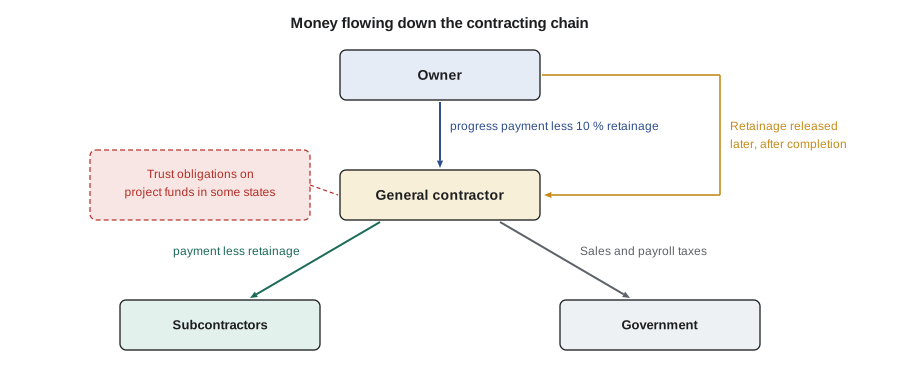
Most construction contracts let the owner withhold retainage, typically 5 % to 10 % of each progress payment, until substantial or final completion, to secure performance and the correction of defects. Many states cap retainage on public and sometimes private work, often at 5 %, require release within a set time after completion, require interest on retained funds, or allow the contractor to substitute securities or a retainage bond. Federal contracts limit retainage to cases of unsatisfactory progress (CON-310 Lesson 11). For the contractor, retainage is a large and slow receivable, and often the largest single amount owed to it on a finished job.
# Cost of carrying retainage for Kestrel (illustrative)
retainage_receivable = 2_700_000
retainage_payable = 2_100_000
net_carried = retainage_receivable - retainage_payable
rate = 0.0625
print(f"Net retainage financed by Kestrel: {net_carried:,}")
print(f"Annual financing cost at {rate:.2%}: {net_carried * rate:,.0f}")
avg_months = 7      # average time from billing to release
print(f"Gross retainage billed per year at 10 %: {0.10 * 58_400_000:,.0f}; "
f"average months outstanding {avg_months}")Net retainage financed by Kestrel: 600,000 Annual financing cost at 6.25%: 37,500 Gross retainage billed per year at 10 %: 5,840,000; average months outstanding 7
Kestrel passes most of the retainage down to its subcontractors, so it carries only the difference, about $600,000, plus the retainage on its self-performed work and markup. A specialty contractor that self-performs most of its work carries much more of its retainage itself.
Income tax on retainage
Under PCM, retainage is part of the contract price and is included in income as the work progresses; there is no separate deferral. Contractors with exempt contracts that use certain accrual methods may be able to defer retainage receivable until it is due and collectible, and to deduct retainage payable to subcontractors when all events have occurred to fix the liability and economic performance has occurred. These rules are technical, and the right treatment depends on the method the contractor has adopted and its contract terms.
| Item | Income tax treatment (general) |
|---|---|
| Retainage receivable under PCM | Included as part of contract revenue as work progresses |
| Retainage receivable under some exempt-contract accrual methods | May be deferred until due and collectible |
| Retainage payable to subcontractors | Deductible when the all-events test and economic performance are met |
| Loss provisions | Under PCM, losses are reflected through the cost estimates; separate reserves are generally not deductible |
| Equipment | MACRS, bonus depreciation and Section 179 (Lesson 7) |
Sales and use taxes
There is no federal sales tax in the United States. Most states and many localities levy sales and use taxes, and how they apply to construction varies widely. In most states, a contractor who improves real property is treated as the consumer of the materials and pays sales tax when buying them (or use tax if the seller did not charge it); in others, the contractor is a retailer who collects tax from the owner on the materials or the whole contract price; a few states, such as Washington, Hawaii and New Mexico, tax the contract price or gross receipts. CON-300 Lesson 9 covered how these taxes are priced in a bid. For accounting, the contractor must track use tax owed on untaxed purchases and remit it, and exemptions for government or nonprofit owners must be documented.
Worked problem
Use tax on an out-of-state purchase
Kestrel buys $85,000 of storefront glazing from an out-of-state supplier that does not charge sales tax, for a job in a state where the contractor is the consumer of materials and the combined state and local rate is 7.25 %. What must Kestrel do?
Show solution
- Use tax owed = 0.0725 × 85,000 = $6,162.50.
- Kestrel accrues use tax payable when the glazing is received and remits it with its use tax return for the period.
- The cost of the glazing in the job cost ledger is $91,162.50, including the use tax.
Answer: Kestrel owes about $6,160 of use tax on the purchase. Failing to self-assess use tax is a common audit finding for contractors buying materials across state lines.
Payroll remittances and trust funds
Employers withhold federal income tax and the employee's share of Social Security and Medicare from wages and hold them in trust for the government until deposited. If they are not paid over, the IRS can assess the trust fund recovery penalty under section 6672 against responsible persons, such as owners and officers who decide which bills to pay, personally. Many states have similar rules for state withholding and for sales tax collected. A struggling contractor that uses withheld payroll taxes to pay suppliers is borrowing from the government on its officers' personal credit, and sureties treat unpaid payroll taxes as a serious warning sign.
Construction trust funds
Some states impose a statutory trust on construction funds. Under New York's Lien Law Article 3-A, for example, money received by a contractor for a project is trust money for the subcontractors, suppliers and workers on that project, and diverting it to other uses can bring personal liability and even criminal charges. Other states have construction trust fund statutes of varying strength, and in some, unpaid subcontractors can pursue officers personally. Even where there is no trust statute, using one project's receipts to pay another's debts while subcontractors go unpaid invites lien and bond claims. Contractors should be able to trace receipts to the subcontractors and suppliers on each job. CON-220 discusses the legal details.
Managing retainage
| Practice | Benefit |
|---|---|
| Track retainage receivable by job with release conditions and dates | Forecasts cash and flags overdue releases |
| Negotiate lower retainage, reductions at 50 % complete or early release for completed trades | Reduces cash tied up |
| Complete punch lists and close-out documents promptly | Retainage release depends on completion |
| Substitute securities or a retainage bond where state law allows | Releases cash in exchange for security |
| Claim statutory interest on late retainage where available | Compensates for delay |
| Release subcontractor retainage in step with receipts and state law | Meets prompt payment obligations without financing them longer than necessary |
Common mistakes
MistakeAssuming tax and financial statement income are the same.
InsteadSection 460 methods, retainage deferral and tax depreciation all create differences; track them.
MistakeCollecting and remitting tax early because the billing system charges it on the full claim.
InsteadKnow whether your state treats you as consumer or retailer and bill or self-assess accordingly.
MistakeUsing unremitted payroll deductions to pay suppliers in a cash crunch.
InsteadResponsible persons can be personally assessed the trust fund recovery penalty.
MistakeTreating cash received on one job as freely available for any purpose.
InsteadConstruction trust rules may require it to be used for that job's subcontractors and suppliers first.
MistakeLeaving retainage releases to chance.
InsteadTrack release conditions and dates and finish close-out promptly.
MistakeChoosing an ownership structure or bonus policy for tax alone.
InsteadConsider the effect on working capital, equity and bonding capacity as well.
Summary and key terms
- Section 460 requires the percentage-of-completion method for most long-term contracts, with look-back interest.
- Small contractors, home construction contracts and, after the One Big Beautiful Bill Act, residential construction contracts may use other methods such as completed contract.
- The small contractor gross receipts threshold is inflation-adjusted, reported as $31 million for 2025 and $32 million for 2026.
- C corporations pay a 21 % federal rate; pass-through owners pay personal tax, often with the permanent section 199A deduction, funded by distributions.
- Sales and use tax treatment of contractors varies by state; contractors must self-assess use tax on untaxed purchases.
- Withheld payroll taxes are trust funds; responsible persons can be personally liable.
- Retainage is a large, slow receivable governed by contract and state law, with some state trust fund statutes on project receipts.
- Retainage
- A percentage of each payment withheld under the contract to secure performance.
- Completed contract method
- Reporting a contract's income when it is completed, available for exempt contracts under section 460.
- Use tax
- Tax a purchaser owes on taxable items bought without paying sales tax.
- Look-back interest
- Interest computed at the end of a PCM contract on tax under- or overpaid because of estimate errors.
- Deferred tax liability
- Tax that will become payable later because taxable income has been deferred.
- Trust funds
- Money held for others, such as payroll taxes withheld or project receipts owed to subcontractors.
- Trust fund recovery penalty
- A personal penalty on responsible persons for unpaid withheld payroll taxes.
- Retainage bond
- Security provided in place of cash retainage where permitted.
- Percentage-of-completion method
- Recognizing income on a long-term contract in proportion to progress.
- Construction trust
- A statutory trust over project funds for the benefit of those who supplied labor and materials.
Practice problems
Work each problem on paper first, then reveal the answer to check.
What is the general rule for long-term contracts under section 460?
Show answer
The percentage-of-completion method with look-back interest.
Name two exceptions that allow the completed contract method.
Show answer
Home or residential construction contracts and small contractors' contracts expected to finish within two years.
What gross receipts threshold applies to the small contractor exception for 2026?
Show answer
About $32 million average over the previous three years (inflation-adjusted).
A contractor buys $40,000 of untaxed materials where the contractor is the consumer and the rate is 8 %. What does it owe?
Show answer
$3,200 of use tax.
Who can be assessed the trust fund recovery penalty?
Show answer
Responsible persons, such as owners and officers who decide which bills are paid.
What does New York's Lien Law Article 3-A do?
Show answer
Makes project receipts trust funds for subcontractors, suppliers and workers on that project.
Why do S corporation owners need distributions?
Show answer
To pay personal tax on the company's income, which reduces company equity.
Why does Kestrel carry only part of its retainage?
Show answer
It withholds retainage from its subcontractors, offsetting much of what owners withhold from it.
Name one way to release retainage cash earlier.
Show answer
Substitute securities or a retainage bond where state law allows, or negotiate reductions at 50 % complete.
Why does choosing CCM for tax not change bonding capacity?
Show answer
Sureties use the financial statements, which recognize revenue over time under ASC 606.
Lesson quiz · 5 questions
Score 60% or more to complete this lesson.
Create a free account to save your progress, take quizzes and earn a certificate.