
CON-320 · Lesson 11 of 12 · 29 min
Bonding capacity, surety and reporting to sureties and lenders
For most commercial and public construction, a contractor cannot even bid without a surety bond, so the amount of bonded work a surety will support, its bonding capacity, often limits the firm's growth more than demand does. Sureties decide that capacity largely from the contractor's financial statements and the schedules behind them. This lesson looks at surety from the financial side: what a surety is underwriting, how it reads and adjusts a contractor's statements, how bonding limits are set, and what information sureties and lenders expect and when. The types of bonds, their claims processes and the insurance that sits alongside them are covered in CON-350; CON-220 covers the contract and legal side.
What a surety does
A surety bond is a three-party agreement. The contractor (the principal) promises the owner (the obligee) to perform the contract or to pay its subcontractors and suppliers, and the surety guarantees that promise. If the contractor defaults, the surety steps in to complete the work or pay the claims, up to the bond amount. Unlike insurance, surety is underwritten on the expectation of no loss: the contractor and, for private firms, its owners sign an indemnity agreement promising to repay the surety for anything it pays out. A surety's real exposure is the risk that the contractor fails and the indemnitors cannot repay.
| Bond | What it guarantees | Typical amount |
|---|---|---|
| Bid bond | That the contractor will enter into the contract and provide the required bonds if its bid is accepted | Often 10 % of the bid price |
| Performance bond | That the contractor will complete the contract according to its terms | Commonly 50 % of the contract price on Canadian public work |
| Labour and material payment bond | That the contractor will pay its subcontractors and suppliers | Commonly 50 % of the contract price |
Standard bond forms used in Canada include CCDC 220 (bid bond), CCDC 221 (performance bond) and CCDC 222 (labour and material payment bond), alongside forms issued by public owners and the Surety Association of Canada. Federal and provincial public owners generally require performance and payment security on contracts above set thresholds.
Because the surety guarantees performance, its underwriters ask the same question a lender asks, can this contractor pay its debts, plus a harder one: can it finish all the work it has taken on, and if it fails, how much would it cost the surety to finish?
The three Cs of surety underwriting
Surety underwriters traditionally summarize what they look for as character, capacity and capital.
| C | Question | Evidence |
|---|---|---|
| Character | Will the contractor and its owners honour their obligations and deal fairly? | Reputation, references, claims and litigation history, how problems were handled, willingness to share bad news early |
| Capacity | Can the firm do the work it bids? | Experience on similar work, key people, systems, equipment, backlog compared with past volume, project management and estimating quality |
| Capital | Does the firm have the financial strength to absorb problems? | Working capital, equity, profitability, cash flow, bank support, personal net worth of indemnitors |
Capital is the part this course can measure, but experienced underwriters weigh all three. A firm with strong capital but a history of disputes and surprises will find its capacity limited; a firm with modest capital but a long record of reliable performance and transparent reporting may be supported beyond what the ratios alone suggest.
How sureties adjust the financial statements
Sureties do not take the balance sheet at face value. They adjust working capital and equity to remove items that might not be available if the firm got into trouble, and to add items that strengthen it. The adjustments vary between sureties, but a typical approach is shown below.
| Adjustment | Reason | Typical treatment (illustrative) |
|---|---|---|
| Receivables over 90 days | May be disputed or uncollectable | Deduct some or all from current assets |
| Underbillings (contract assets) | Revenue not yet billed; may reflect optimistic estimates | Discount heavily or deduct, especially on troubled jobs |
| Prepaid expenses and deposits | Not convertible to cash to pay creditors | Deduct |
| Receivables from related parties and shareholders | May not be collected | Deduct from working capital and often from equity |
| Holdback receivable on troubled jobs | May be offset by back-charges | Deduct or discount |
| Subordinated shareholder loans | Rank behind the surety | Add to equity |
| Lease commitments due within a year | Fixed obligations | Add to current liabilities |
| Loss provisions not yet recorded | Expected losses on jobs | Deduct |
# Kestrel's adjusted working capital as a surety might calculate it (illustrative)
working_capital = 2_450_000
adjustments = {
    "receivables over 90 days (50 %)":            -0.5 * 470_000,
    "underbillings (50 %)":                       -0.5 * 1_150_000,
    "prepaid expenses and deposits":              -350_000,
    "unrecorded loss provision, school addition": -95_696,
    "next-year operating lease payments":         -120_000,
}
adjusted = working_capital + sum(adjustments.values())
for k, v in adjustments.items():
    print(f"{k:45} {v:>11,.0f}")
print(f"{'Adjusted working capital':45} {adjusted:>11,.0f}")
equity_adj = 4_400_000 - 95_696
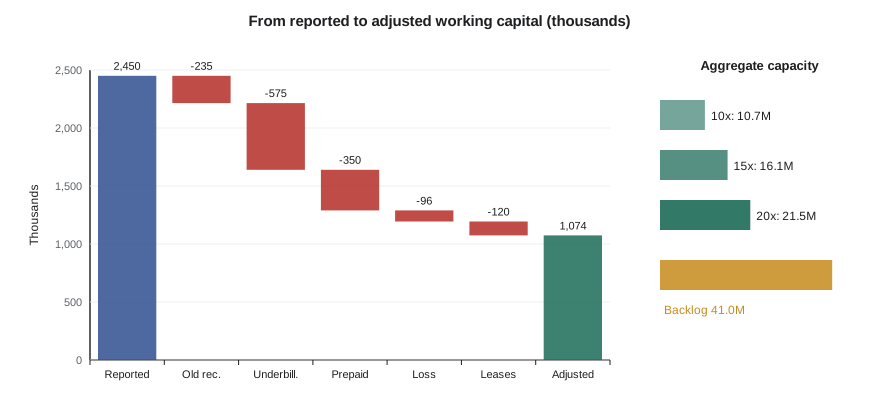
print(f"Adjusted equity: {equity_adj:,.0f}")receivables over 90 days (50 %) -235,000 underbillings (50 %) -575,000 prepaid expenses and deposits -350,000 unrecorded loss provision, school addition -95,696 next-year operating lease payments -120,000 Adjusted working capital 1,074,304 Adjusted equity: 4,304,304
On these adjustments, Kestrel's working capital of $2.45 million becomes about $1.07 million in the surety's eyes, a reduction of more than half. The loss provision for the school addition should already have been recorded (Lesson 5); here it is shown as an adjustment on the assumption that the surety found it during its review. Kestrel's management might dispute some of these adjustments, for example by showing that the underbillings are due to approved changes billed the following week, which is exactly why clear documentation of the WIP schedule matters.
Setting bonding limits
Sureties set two limits. The single-job limit is the largest individual contract they will bond. The aggregate limit is the total value of uncompleted bonded work (and often unbonded work too) they will allow the contractor to carry at one time. Both are commonly related to adjusted working capital and adjusted equity through multiples that depend on the type of work, the firm's history and the surety's appetite. As a broad illustration only, an aggregate program of roughly 10 to 20 times adjusted working capital is often quoted for general contractors, with lower multiples for weaker firms or riskier work and higher multiples for firms with long, reliable records.
adjusted_wc = 1_074_304
for multiple in (10, 15, 20):
    print(f"Aggregate at {multiple}x adjusted working capital: {multiple * adjusted_wc / 1e6:5.1f}M")
backlog_uncompleted = 41_000_000
print(f"Kestrel's uncompleted backlog: {backlog_uncompleted / 1e6:.1f}M")
print(f"Multiple implied by current backlog: {backlog_uncompleted / adjusted_wc:.1f}x")Aggregate at 10x adjusted working capital: 10.7M Aggregate at 15x adjusted working capital: 16.1M Aggregate at 20x adjusted working capital: 21.5M Kestrel's uncompleted backlog: 41.0M Multiple implied by current backlog: 38.2x
Kestrel's backlog of $41 million is about 38 times its adjusted working capital, far beyond the illustrative range. Not all of the backlog is necessarily bonded, and a surety would look at the whole picture, including the founders' personal net worth, the firm's record and its bank line. But the numbers show why the surety would want to talk about Kestrel's growth plans, and why improving working capital, by retaining profits, collecting old receivables and clearing underbillings, would directly increase the work Kestrel can take on.
Worked problem
Raising capacity by retaining profit
Kestrel expects to earn $1.4 million after tax in 2026. If it pays no dividends, collects its old receivables in full, and eliminates its unexplained underbillings, its adjusted working capital might rise to about $2.8 million. At a 15 times multiple, how much aggregate capacity would that support, compared with today?
Show solution
- Today: 15 × 1.07 = about $16.1 million.
- After: 15 × 2.8 = $42.0 million.
- Increase = about $25.9 million of supportable work.
Answer: Retaining a year's profit and cleaning up the balance sheet could more than double the aggregate program a surety would consider. This is why sureties discourage large distributions and why clean, well-documented WIP schedules have real value.
What sureties look for beyond the ratios
| Indicator | What the surety concludes |
|---|---|
| Consistent profit on completed contracts, close to WIP estimates | Estimates are reliable; capacity can grow |
| Profit fade across many jobs | Estimates are optimistic; discount the current WIP |
| Rapid growth in backlog relative to past volume | Capacity and working capital may be stretched |
| A single job large relative to equity | Concentration risk; a single loss could sink the firm |
| New types of work or new regions | Higher risk until the firm has a record there |
| Overbillings exceeding cash | Cash for future work has been spent |
| Unpaid payroll taxes or trust funds | Severe warning; the firm may be in distress |
| Timely, complete reporting and early disclosure of problems | Strong character; more support when problems arise |
A rule of thumb many underwriters apply to job size is that the largest single job should not normally exceed a modest multiple of the largest job the firm has completed successfully, often around one and a half to two times, and should not be so large that a loss on it would exhaust the firm's equity. Kestrel's largest open job, the $21.4 million Riverside co-op, is its biggest ever; the surety will have watched its progress closely.
The information sureties and lenders request
Sureties and banks build their files from a standard set of documents. Delivering them on time and complete is one of the cheapest ways a contractor can increase its credit.
| Document | Frequency (typical) | Notes |
|---|---|---|
| Year-end financial statements at the required level of assurance | Annually, within about 90 to 120 days of year-end | Compiled, reviewed or audited depending on program size (Lesson 3) |
| WIP schedule and schedule of completed contracts | With year-end statements; quarterly or semi-annually for larger programs | Must tie to the financial statements |
| Interim financial statements | Quarterly or semi-annually | Internally prepared, with a WIP schedule |
| Aged receivables and payables, with holdback shown separately | With statements; monthly for the bank | Flag disputed items |
| Bank line confirmation and borrowing base | Annually; monthly for the bank | Shows available liquidity |
| Work-on-hand or backlog report | Quarterly and before large bids | Bonded and unbonded work, percent complete, estimated profit |
| Business plan and budget | Annually | Planned volume, margins, overhead, capital spending |
| Personal financial statements of indemnitors | Annually | Owners' personal assets and liabilities |
| Resumes of key staff and equipment list | At set-up and when changed | Supports capacity |
| Contractor's qualification statement (CCDC 11) | For owners' prequalification | Summarizes experience, financial and safety information |
CCDC 11, the Contractor's Qualification Statement, is a standard form owners use to prequalify contractors, covering company information, experience, key personnel, safety and financial capacity, often with a surety's letter confirming bonding availability.
Worked problem
A surety letter
An owner asks Kestrel for a letter from its surety confirming that it can obtain bonds for a $12 million project. Kestrel's surety has set a single-job limit of $15 million and an aggregate of $45 million, and Kestrel has $36 million of uncompleted bonded work. Can the surety issue the letter?
Show solution
- Single job: $12 million is within the $15 million limit.
- Aggregate after award: 36 + 12 = $48 million, above the $45 million aggregate.
- The surety may still support the bid if some current work will be completed before the new project starts, or if Kestrel provides updated statements showing improved working capital.
Answer: The surety will probably ask for a current work-on-hand report and interim statements before deciding. Contractors should discuss large bids with their surety early, not the day before the bid closes.
Interim reporting and the timing problem
Year-end statements describe a firm that existed months earlier. Sureties therefore rely heavily on interim statements and WIP schedules, which the contractor prepares itself. Their usefulness depends on their quality: interim statements that consistently show higher margins than the year-end statements that follow will be discounted. Contractors that close monthly and produce reliable WIP schedules (Lessons 2 and 5) can provide credible interim information quickly, which pays off whenever they need an increase in their program or support on a troubled job.
When things go wrong
If a job turns bad, the instinct to hide it until it can be fixed is strong and almost always harmful. Sureties and banks have far more options when they learn of a problem early: they can arrange funds, help negotiate with the owner, support a recovery plan or bring in an outside consultant. Learning of the problem from a claim on a bond, or from an unexpected loss in the year-end statements, destroys trust and usually ends the relationship. Early, honest disclosure is part of character, and character is what keeps a surety supporting a contractor through a difficult year.
Common mistakes
MistakeAssuming bonding capacity is set by revenue or backlog.
InsteadIt is set mainly by adjusted working capital, equity, record and character.
MistakeThinking surety is insurance that will absorb losses.
InsteadThe contractor and its owners indemnify the surety and must repay any losses.
MistakeReporting working capital without anticipating surety adjustments.
InsteadExpect old receivables, underbillings, prepaid items and related-party balances to be discounted or deducted, and document why yours are sound.
MistakeBidding a large job without first checking bonding limits.
InsteadDiscuss large bids with the surety early, with a current work-on-hand report.
MistakeDelivering statements late or incomplete.
InsteadTimely, complete reporting is one of the cheapest ways to increase credit.
MistakeHiding a troubled job from the surety and bank.
InsteadDisclose early; they have more ways to help when they know in time.
Summary and key terms
- A surety guarantees the contractor's performance and payment obligations; the contractor and its owners indemnify the surety.
- Underwriters assess character, capacity and capital.
- Sureties adjust working capital and equity for old receivables, underbillings, prepaid items, related-party balances, subordinated loans and lease commitments.
- Single-job and aggregate limits are commonly linked to adjusted working capital and equity, with multiples that vary by firm and work.
- Retaining profits and cleaning up the balance sheet directly increase bonding capacity.
- Sureties and lenders expect timely year-end and interim statements, WIP and completed contract schedules, aged receivables, backlog reports and personal statements.
- Early disclosure of problems preserves support; surprises destroy it.
- Principal
- The contractor whose obligations a bond guarantees.
- Obligee
- The party protected by a bond, usually the owner.
- Indemnity agreement
- An agreement by the contractor and its owners to repay the surety for any losses.
- Bonding capacity
- The amount of bonded work a surety will support.
- Single-job limit
- The largest individual contract a surety will bond for a contractor.
- Aggregate limit
- The total uncompleted work a surety will allow a contractor to carry.
- Adjusted working capital
- Working capital after a surety's deductions and additions.
- Three Cs
- Character, capacity and capital, the basis of surety underwriting.
- Work-on-hand report
- A schedule of uncompleted work with percent complete and expected profit.
- Qualification statement
- A standard form summarizing a contractor's experience, finances and safety for prequalification.
Practice problems
Work each problem on paper first, then reveal the answer to check.
Who are the three parties to a surety bond?
Show answer
The principal (contractor), the obligee (owner) and the surety.
How does surety differ from insurance?
Show answer
Surety is underwritten expecting no loss; the contractor and owners indemnify the surety.
List the three Cs.
Show answer
Character, capacity and capital.
Why might a surety discount underbillings?
Show answer
They may reflect optimistic cost estimates and may never be billed or collected.
Working capital is $3.0 million; the surety deducts $400,000 of old receivables and $300,000 of prepaid items. What is adjusted working capital?
Show answer
$2.3 million.
At a 12 times multiple, what aggregate does $2.3 million of adjusted working capital support?
Show answer
$27.6 million.
How does a subordinated shareholder loan affect a surety's view of equity?
Show answer
It is usually added to equity.
Name four documents sureties request.
Show answer
Year-end statements, WIP and completed contract schedules, aged receivables, backlog report, personal financial statements, business plan.
Why should a contractor talk to its surety before bidding a large job?
Show answer
To confirm single-job and aggregate limits and provide current information.
Why is early disclosure of a troubled job important?
Show answer
The surety and bank can help more when they know early; surprises damage trust.
Lesson quiz · 5 questions
Score 60% or more to complete this lesson.
Create a free account to save your progress, take quizzes and earn a certificate.