
COMP-101 · Lesson 9 of 12 · 22 min
Building a study plan
▶ Video coming soon A video version of this lesson is on the way.
By the ninth session, Noor has a target exam (Tech+), a target month (March 2027), a spreadsheet of the objectives with her confidence ratings, and a nagging worry. "I know what to study," she says. "I don't know when. I work full days, I'm taking an evening class on Tuesdays, and every time I sit down to study I spend twenty minutes deciding where to start." Lorna says that is the most common problem in the cert club, and the cure is a written plan that decides in advance what each session will be. This lesson shows how to estimate the hours you need, divide them by domain, schedule them around a real week, and use study methods that make each hour count.
Estimate the hours honestly
A study plan starts with an estimate of how many hours of focused work you need. There is no official figure, and the right number depends on the exam, your background and how you learn. A broad entry-level exam for someone with some experience might take a few dozen hours; an exam full of new material for someone with none might take a hundred or more. The objectives checklist from lesson 4 is the best tool for a personal estimate. Count the lines you rated 0 or 1, because those need real learning, and the lines rated 2, which need review. Assign a rough time to each kind, add them up, and add a margin for practice tests and review.
Be honest about the margin. Most people underestimate how long learning takes, partly because the first easy topics go quickly and the later hard ones do not. Plan for interruptions too: illness, a busy week at work, a family event. Lorna's rule for the cert club is to add a quarter on top of whatever the first estimate is, and to treat the result as a starting point to revise after the first two weeks, when you will know how fast you are actually going.
Divide the hours by weight and confidence
Once you have a total, divide it among the domains. Two things decide each domain's share: its weight on the exam, and how much you already know about it. A heavily weighted domain where you are weak deserves the most time; a lightly weighted domain where you are already strong deserves the least. A simple way to combine the two is to multiply the weight by a need factor, where a domain you know poorly gets a higher factor, and then share the hours in proportion to the results. Noor does exactly that with her Tech+ ratings.
total_hours = 48
# domain: (weight out of 100, average confidence from 0 to 3)
domains = {
    "IT concepts and terminology": (14, 2.2),
    "Infrastructure": (22, 1.1),
    "Applications and software": (18, 2.6),
    "Software development concepts": (14, 1.4),
    "Data and database fundamentals": (14, 1.6),
    "Security": (18, 1.9),
}
need = {d: w * (3.2 - c) for d, (w, c) in domains.items()}
scale = total_hours / sum(need.values())
for d, n in sorted(need.items(), key=lambda kv: -kv[1]):
print(f"{d:32} {n * scale:4.1f} hours")Infrastructure 15.6 hours Software development concepts 8.5 hours Security 7.9 hours Data and database fundamentals 7.6 hours IT concepts and terminology 4.7 hours Applications and software 3.7 hours
What this code does
It shares 48 study hours among the exam domains according to how much each one needs. A domain's need is its exam weight times the gap between your confidence and full confidence, and the hours are scaled so they add up to 48. The output gives the most hours to Infrastructure, which is heavily weighted and where confidence is lowest.
The script gives infrastructure the biggest share by far, because it is both the heaviest domain and her weakest, and applications and software the smallest, because she already knows it well. The exact numbers do not matter much, and she will round them to whole sessions. What matters is that the plan now reflects her real situation instead of an even split, and that if her confidence ratings change after a few weeks, she can rerun the numbers and rebalance.
Fit the plan to a real week
Hours on paper become a plan only when they are placed on a calendar. Look at a typical week and find the times you can study reliably, not the times you wish you could. Short, regular sessions usually work better than occasional long ones: four sessions of 45 minutes on fixed days are easier to keep than one four-hour block on Sunday that is easily cancelled. Put the sessions in your calendar as appointments, and give each one a specific task from your checklist, so that you never have to decide where to start.
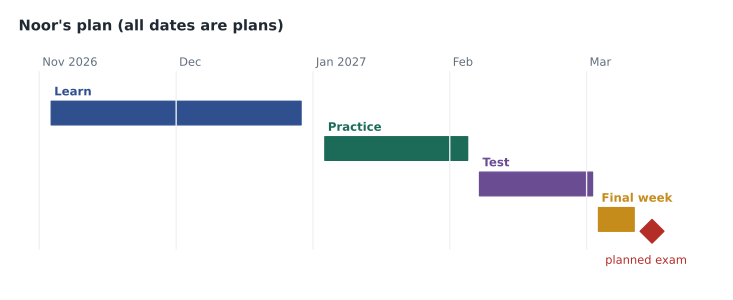
Noor's week has gaps on Monday and Wednesday evenings, Thursday lunch, which is the cert club, and Saturday mornings. She schedules 45 minutes on Monday and Wednesday evenings and 90 minutes on Saturday, about three hours a week, plus the club. At that rate her 48 hours take about sixteen weeks, which runs from mid-November to early March with a little room for the holidays. That matches her target, which tells her the plan is realistic. If it had not, she would have had three choices: find more time, reduce the hours by focusing harder on weak areas, or move the exam date.
Plan in phases
A good plan changes character as the exam approaches. In the first phase, learning, most time goes to new material in the weakest and heaviest domains, through reading, video, notes and labs. In the second phase, practice, the balance shifts to doing: labs, topic quizzes and explaining concepts aloud. In the third phase, testing, full timed practice tests measure readiness and show which areas still need work, with targeted review in between. The final week is light: review notes, rest, and the logistics checklist from lesson 8. Cramming new material in the last few days rarely helps and often adds anxiety.
Study methods that work
How you study matters as much as how long. Research on learning consistently finds that two methods are especially effective. The first is retrieval practice: testing yourself by recalling information without looking, through flashcards, practice questions or explaining a topic from memory. It feels harder than rereading, which is exactly why it works; the effort of recall strengthens memory. The second is spaced practice: returning to a topic several times over days and weeks, rather than studying it once for a long time. A topic reviewed on day 1, day 3, day 7 and day 14 is remembered far better than one studied for the same total time in one sitting.
Other methods help too. Interleaving, which means mixing topics within a session rather than doing one topic at a time, improves your ability to tell similar ideas apart, which is exactly what multiple-choice distractors test. Explaining a concept in your own words, to another person or to an empty room, reveals gaps that reading hides. And making connections, such as linking a security concept to something you have seen at work, gives new knowledge somewhere to attach. Highlighting and rereading, the most popular methods, are among the least effective on their own; they feel productive but build little lasting memory.
| Method | What it means | An example for Tech+ |
|---|---|---|
| Retrieval practice | Testing yourself from memory | Flashcards of storage units, answered before flipping |
| Spaced practice | Revisiting topics over increasing intervals | Reviewing networking on days 1, 3, 7 and 14 |
| Interleaving | Mixing topics within a session | A quiz mixing security, data and infrastructure questions |
| Self-explanation | Explaining concepts in your own words | Telling a colleague how DNS finds a website |
| Hands-on practice | Doing the task the objective describes | Configuring a guest Wi-Fi network on a home router |
Track progress and adjust
A plan is only useful if you check it. Once a week, update your objectives ratings and compare your hours against the plan. If you are ahead, good; if you are behind, decide whether to add a session, trim lower-value topics or move the date, and decide early, not in the final fortnight. Practice-test results in the third phase are the strongest signal: if your scores are steady and comfortably above where you want them, and the same areas are no longer weak, you are ready. If not, the score report from each practice test tells you where to spend the next week.
Studying with others helps many people keep going. The cert club works because its members meet weekly, report what they did, and explain topics to each other. A study partner, a class or an online group can do the same. What matters is regular accountability: someone who will ask, kindly, whether you did what you planned.
Choosing study materials
Most candidates use three kinds of material: a main explanation, such as a book or video course; practice questions; and a lab, described in the next lesson. Choose the main explanation first, and check three things before buying: that it is written for your exact exam code, that it maps its chapters to the objectives, and that recent reviews from other candidates are positive. CompTIA sells its own official study materials, including its CertMaster products, and many independent publishers and instructors produce good alternatives. Libraries are an underused source; Fairhaven's own collection includes study guides for several CompTIA exams, and many public library systems give members free access to online learning platforms that include certification courses.
One main explanation is usually enough. Switching between several books or courses wastes time re-reading the same introductory chapters and can leave the hard later chapters unread in all of them. Use a second source only for specific objectives that the first explains poorly. For practice questions, use at least two sources so that you are not memorizing one provider's style, and prefer sources that explain every answer.
Motivation, rest and wellbeing
Motivation fades, especially in the middle of a long plan when the novelty has gone and the exam still feels distant. Small, visible progress helps: ticking off checklist lines, watching confidence ratings rise, or crossing sessions off a calendar. So does connecting study to real work. Noor finds that the week she studies printers and drivers is the week two branch printers fail, and fixing them with what she has just learned makes the next session feel worthwhile. Lorna encourages the cert club to share these moments, because they are the best reminder of why the plan exists.
Rest is part of the plan, not a break from it. Memory consolidates during sleep, so late-night sessions that cut sleep short can undo their own work. Physical activity, regular meals and time off all support concentration. If you find yourself dreading every session or losing sleep over the exam, reduce the pace, move the date, or talk to someone; a certification is worth having, but not at the cost of your health. Plans that include rest days are more likely to be finished than plans that do not.
Finally, protect the habit rather than the hours. On a bad week, a 15-minute session that keeps the routine alive is worth more than a skipped one, because the routine is what carries the plan through to exam day.
Worked problem
Rescuing a plan that slipped
Four weeks into his Security+ plan, Dez is about six hours behind because a branch network upgrade took over two of his study weeks. His exam is booked for early February, eleven weeks away, and his plan has 40 hours left. What are his options?
Show solution
- At his planned three hours a week, eleven weeks gives 33 hours, seven short of 40.
- Option 1: add a fourth weekly session of about 40 minutes for the next eleven weeks, which covers the gap.
- Option 2: review his confidence ratings and cut time from domains he has improved in faster than expected.
- Option 3: move the exam a few weeks later, checking that the version he is taking does not retire before the new date.
Answer: Dez adds a short fourth session and trims one domain he has already mastered, which covers the gap without moving the date. He decides now rather than in January.
Noor puts her plan on a single page and pins it above her desk at home. It shows the four phases, the weekly sessions and the first task for each. She also adds a line at the bottom, at Lorna's suggestion: "Review this plan every Sunday. Change it if it isn't working."
Common mistakes
MistakePlanning to study "when I have time."
InsteadSchedule specific sessions with specific tasks as calendar appointments.
MistakeSplitting time evenly across domains.
InsteadWeight time by domain weight and by how weak you are in each.
MistakeRereading and highlighting as the main method.
InsteadUse retrieval practice, spacing, interleaving and hands-on work.
MistakeIgnoring a plan that has fallen behind.
InsteadCheck weekly and adjust early: add time, trim, or move the date.
MistakeCramming new material the night before.
InsteadKeep the final week light and rest before the exam.
Summary and key terms
- Estimate study hours from your objectives ratings, then add a margin.
- Divide hours by domain weight and by how much you need each domain.
- Schedule short, regular sessions with specific tasks on a real calendar.
- Plan in phases: learn, practise, test, then a light final week.
- Use retrieval practice, spaced practice, interleaving, self-explanation and hands-on work.
- Check progress weekly and adjust early.
- Retrieval practice
- Strengthening memory by recalling information without looking.
- Spaced practice
- Returning to a topic over increasing intervals.
- Interleaving
- Mixing different topics within a study session.
- Study phase
- A stage of a plan with a particular focus, such as learning or testing.
- Accountability
- Regularly reporting progress to someone else.
Practice problems
Work each problem on paper first, then reveal the answer to check.
Why add a margin to your first estimate of study hours?
Show answer
Because people usually underestimate learning time and life brings interruptions.
Which domain should get the most time?
Show answer
One that is both heavily weighted and weak for you.
At three hours a week, how many weeks do 48 hours take?
Show answer
Sixteen weeks.
Name the four phases of a plan.
Show answer
Learn, practise, test, and a light final week.
Why does retrieval practice work better than rereading?
Show answer
The effort of recalling information strengthens memory more than passive review.
What should you do when a plan falls behind?
Show answer
Decide early whether to add time, trim lower-value topics or move the exam date.
Lesson quiz · 5 questions
Score 60% or more to complete this lesson.
Create a free account to save your progress, take quizzes and earn a certificate.