
COMP-101 · Lesson 2 of 12 · 21 min
Core, infrastructure, cybersecurity, data and Xpert pathways
▶ Video coming soon A video version of this lesson is on the way.
The second cert club session starts with a poster. Lorna has printed CompTIA's career pathway chart, the one that has hung in IT training rooms in various forms for years, and taped it to the whiteboard. It shows columns of certifications rising from left to right, each column labelled with an area of work. Dez traces the infrastructure column with his finger: Network+, then Server+, Linux+ and Cloud+, then CloudNetX at the top. Hana finds her own path in the cybersecurity column. Noor finds Tech+ and A+ at the bottom left and asks the obvious question: "Do I have to pick a column now?" "No," says Lorna. "You have to know the columns exist, so that when you pick one later you know what you're choosing." This lesson explains the pathways, how CompTIA labels them today, and how to read them as a map rather than a set of rules.
Why pathways exist
A single certification answers the question "can this person do this job?" A pathway answers a different question: "where can this job lead?" CompTIA organizes its certifications into pathways so that learners, employers and schools can see how the credentials connect. A pathway groups certifications that build on one another in one area of work, usually from a broad foundation to a narrow specialty. Pathways also make the recommended experience on each exam page easier to understand. When the Security+ page recommends Network+ and two years of experience, it is pointing to the step below on the same pathway.
Pathways are recommendations, not prerequisites. CompTIA does not require you to hold A+ before you can sit Network+, or Network+ before Security+. You can register for any exam as long as you accept its candidate agreement and pay the fee. The recommended experience tells you what CompTIA expects a passing candidate to know already, and skipping a step means teaching yourself that knowledge some other way. Hana skipped A+ entirely when she started in IT, because she had already spent three years fixing computers at a university help desk and knew the material.
The core
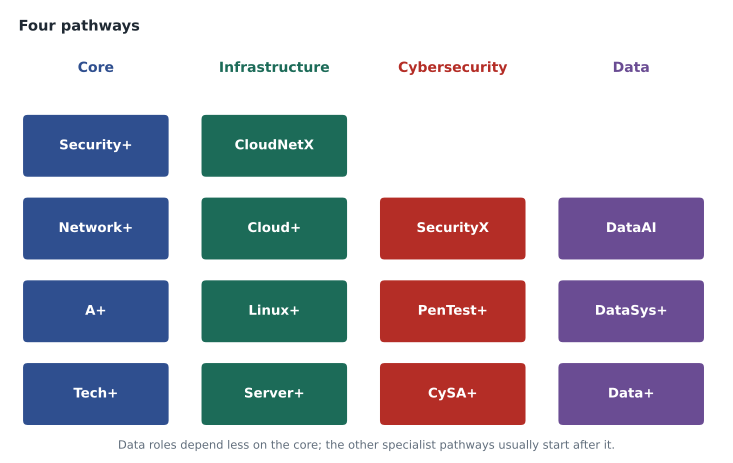
The core pathway is the trunk the others grow from. It starts with Tech+ for people who are exploring IT and continues with A+, Network+ and Security+. Together, these four cover what almost every technology job assumes: how computers and operating systems work, how networks move data, and how to protect systems and information. Many employers ask for one or more of the core three even for roles that are not purely support, because they are a common baseline. Network administrators are expected to understand security; security analysts are expected to understand networks; and everyone is expected to understand how a computer works.
Inside the core, A+ is usually the first credential that employers treat as job-ready. Tech+ is valuable for students and career changers, but it is designed for people with no experience, and it is often used in high schools, colleges and workforce programs to show readiness for further training. The library's makerspace volunteers, Ava and Jun, are high-school students who plan to sit Tech+ through a school program, and Lorna points out that this is exactly what it was designed for. Noor has four years of experience fixing the circulation desk's receipt printers and helping patrons with the public computers, so for her Tech+ will be a quick, structured review before A+.
Infrastructure
The infrastructure pathway is about building and running the systems that everything else depends on. Network+ is its usual entry point. Server+ covers physical and virtual servers: hardware, storage, installation, administration and troubleshooting. Linux+ covers administering Linux systems, which run most of the world's web servers and cloud workloads. Cloud+ covers deploying, securing and operating cloud environments in a vendor-neutral way. At the top, CloudNetX is CompTIA's expert-level credential for designing hybrid networks across on-site and cloud systems.
Dez is a good example of someone on this pathway. He holds Network+ and Cloud+, and his job includes the library's switches, firewalls, Wi-Fi controllers and the small server room at central. He chose Cloud+ because the library's catalogue system moved to a vendor's hosted service two years ago and he wanted to understand what he was now depending on. People on the infrastructure pathway often add vendor certifications too, such as those from Cisco, Microsoft or AWS, because their daily work involves particular products. The vendor-neutral credential teaches the concept; the vendor credential teaches the buttons.
Cybersecurity
The cybersecurity pathway builds on Security+. CySA+ covers security analysis and operations: monitoring logs and alerts, detecting threats, managing vulnerabilities and responding to incidents. PenTest+ covers authorized penetration testing, in which a hired tester looks for weaknesses with written permission so that they can be fixed. At the top, SecurityX is the expert-level credential for security architects and engineers, who design security for whole organizations and make decisions that involve risk, governance and compliance as well as technology.
Hana's career follows this pathway. She earned Security+ after two years in support, CySA+ two years later when she began reviewing the library's firewall and sign-in logs, and she is now thinking about SecurityX. The library needs her skills because public libraries hold personal information about thousands of patrons, run public computers that anyone can use, and offer free Wi-Fi to the public, all of which create security responsibilities. This program's security courses cover the defensive side in depth: protecting, monitoring and responding.
Data
The data pathway is the newest. Data+ covers data analysis: collecting, cleaning, analysing and presenting data, and the governance that keeps it accurate and protected. DataSys+ covers database administration: deploying, maintaining and securing database systems. At the top, DataAI covers advanced analysis and machine learning for experienced data professionals. Unlike the infrastructure and cybersecurity pathways, the data pathway does not depend heavily on the core three. A data analyst needs to understand spreadsheets, databases and statistics more than network cabling, although security and privacy matter in every role that handles personal data.
Marcus, the library's data analyst, is the cert club's data person. He produces the circulation statistics, program attendance reports and branch usage figures that the board uses to make decisions. He has no IT certification and has never needed A+ or Network+. Data+ would match his daily work, and lesson 3 looks at how he decides whether it is worth the effort.
| Pathway | Entry point | Next steps | Expert level |
|---|---|---|---|
| Core | Tech+ | A+, Network+, Security+ | (feeds the other pathways) |
| Infrastructure | Network+ | Server+, Linux+, Cloud+ | CloudNetX |
| Cybersecurity | Security+ | CySA+, PenTest+ | SecurityX |
| Data | Data+ | DataSys+ | DataAI |
How CompTIA labels its certifications today
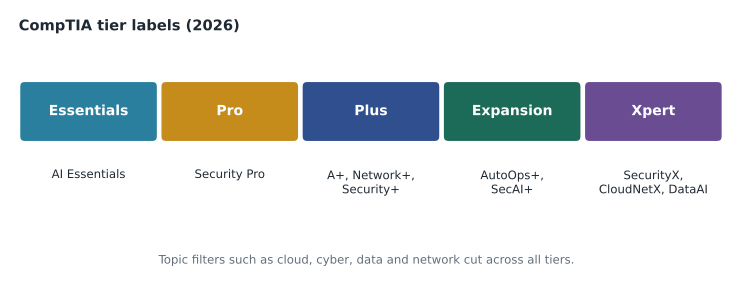
CompTIA's website now organizes its catalogue in more than one way. It groups certifications into topic filters, such as AI, cloud, cyber, data, digital skills, network and tech support. It also labels each credential with a tier. Plus certifications, such as A+, Network+, Security+ and Cloud+, are the familiar job-role credentials. Xpert certifications, such as SecurityX, CloudNetX and DataAI, are the expert level. Expansion certifications, such as AutoOps+ and SecAI+, cover newer specialties like automation and AI security. Essentials and Pro credentials are shorter or more skills-focused, covering topics from AI prompting to office software and soft skills.
The labels and the pathway chart describe the same certifications from different angles. The pathway chart shows how credentials build on each other; the tiers show the level of each credential; the topic filters help you find credentials by subject. When an employer or a teacher talks about the core, the infrastructure pathway or the cybersecurity pathway, they are using the older pathway language, which is still common in training programs and job descriptions. When you browse CompTIA's site, you will see the tiers and filters. Knowing both vocabularies helps you read any certification conversation, and the exact labels may change again, so check the current site.
Stackable certifications
CompTIA also recognizes combinations of certifications with stackable credentials, which are awarded automatically when you hold the right set. Holding A+ and Network+, for example, earns the CompTIA IT Operations Specialist credential; adding Security+ to those two earns the Secure Infrastructure Specialist credential. Holding Network+ and Linux+ earns the Linux Network Professional credential, and Security+ with CySA+ earns the Security Analytics Professional credential. Lesson 11 lists more of them and explains how they relate to renewal. For now, the point is that stackable credentials are another way the pathways show up: they reward people for climbing a column, or for combining columns in a way that matches a real job.
Pathways beyond CompTIA
CompTIA's pathways are not the only map. Vendors publish their own: Cisco has entry, associate, professional and expert levels; Microsoft groups its certifications by role, from fundamentals to associate and expert; AWS and Google Cloud have foundational, associate, professional and specialty levels. Security organizations such as ISC2 and ISACA offer credentials aimed at experienced practitioners and managers. A realistic career plan often mixes these. A typical network administrator might hold Network+ and Security+ from CompTIA alongside a Cisco associate certification, because the employer runs Cisco equipment. A cloud engineer might hold Cloud+ and an AWS or Azure associate credential.
The vendor-neutral and vendor-specific credentials complement each other. CompTIA exams teach why a network needs VLANs or why multifactor authentication matters; vendor exams teach how to set them up in one product. Employers who run one vendor's products often value that vendor's certification highly, while employers who mix products, or who are hiring someone early in their career, often value the vendor-neutral foundation more. This program offers courses for both kinds, and the cert club's roadmaps in lesson 12 include a few vendor credentials alongside the CompTIA ones.
When you compare pathways from different organizations, look at the same three things each time: what job the credential describes, how much experience the organization recommends, and how the credential is kept current. Those three facts tell you more than the name or the logo, and they make it easy to see when two credentials from different organizations cover the same ground.
Lorna adds one more piece of advice before the session ends: do not collect credentials for their own sake. Each one costs money, study time and renewal effort, and a résumé with ten unrelated certifications can look less focused than one with three that clearly fit together. The best pathway is the one that matches the work you actually want to do, which is the subject of the next lesson.
Worked problem
Reading a job posting through the pathways
Lorna hands out a job posting from another library system for a "Systems and Network Technician." It asks for A+ (required), Network+ (preferred) and "willingness to obtain Security+ within 12 months." The duties include supporting staff computers, maintaining branch switches and Wi-Fi, and managing user accounts. Which pathway does the role sit on, and what would a candidate with only Tech+ need?
Show solution
- The duties mix support (computers, accounts) and networking (switches, Wi-Fi), and the posting names the core three. The role sits on the core pathway, with a lean toward infrastructure.
- A+ is required, so a candidate with only Tech+ would need A+ before applying.
- Network+ is preferred, so it would strengthen an application but is not a gate.
- Security+ within 12 months is a commitment the employer expects the new hire to make, so the candidate should have a plan for it.
Answer: The role is on the core pathway. A Tech+ holder would need A+ first, would benefit from Network+, and should expect to earn Security+ in the first year.
Noor reads the posting twice. Two years from now, she thinks, that could be her. She writes the three certifications in her notebook in the order the posting lists them, which happens to be the order of the core pathway.
Common mistakes
MistakeBelieving you must hold every lower certification before sitting a higher one.
InsteadCompTIA recommends experience but does not require prerequisites for most exams.
MistakeAssuming the data pathway requires A+ and Network+.
InsteadData roles depend more on analysis and database skills; the core three are optional for them.
MistakeTreating the pathway chart and the website tiers as competing systems.
InsteadThey describe the same certifications from different angles.
MistakeChoosing a pathway because it looks prestigious.
InsteadChoose by the work you want to do; lesson 3 covers how.
Summary and key terms
- Pathways group certifications that build on one another in one area of work.
- The core is Tech+, A+, Network+ and Security+; the other pathways usually start after it.
- Infrastructure runs from Network+ through Server+, Linux+ and Cloud+ to CloudNetX.
- Cybersecurity runs from Security+ through CySA+ and PenTest+ to SecurityX.
- Data runs from Data+ through DataSys+ to DataAI and depends less on the core.
- CompTIA's website also uses tiers (Essentials, Pro, Plus, Expansion, Xpert) and topic filters.
- Stackable credentials reward specific combinations of certifications.
- Pathway
- A sequence of certifications that build on one another in one area of work.
- Recommended experience
- What CompTIA expects a candidate to know already; not a formal requirement.
- Prerequisite
- A formal requirement that must be met before taking an exam; most CompTIA exams have none.
- Stackable credential
- A credential awarded automatically for holding a specific set of certifications.
- Tier
- CompTIA's label for the level of a credential, such as Plus or Xpert.
Practice problems
Work each problem on paper first, then reveal the answer to check.
Which certification usually starts the cybersecurity pathway?
Show answer
Security+.
Name the expert-level certification at the top of the infrastructure pathway.
Show answer
CloudNetX.
Does CompTIA require Network+ before Security+?
Show answer
No. Network+ is recommended experience, not a prerequisite.
Which pathway depends least on the core three?
Show answer
The data pathway.
What stackable credential do A+ and Network+ earn together?
Show answer
CompTIA IT Operations Specialist.
What are the two ways CompTIA's website groups certifications?
Show answer
By topic filters such as cloud, cyber and data, and by tiers such as Plus and Xpert.
Lesson quiz · 5 questions
Score 60% or more to complete this lesson.
Create a free account to save your progress, take quizzes and earn a certificate.