
COMP-101 · Lesson 6 of 12 · 22 min
Scoring and the scaled score
▶ Video coming soon A video version of this lesson is on the way.
"So 650 out of 900 is about 72 out of 100," says Noor at the sixth session, tapping her calculator, "which means I need to get about 50 of the 70 Tech+ questions right." Lorna smiles, because she made the same calculation before her first exam and it was wrong. "It's a reasonable guess," she says, "but that's not how scaled scores work. The 650 isn't a share of the questions. It's a point on a scale that CompTIA uses so that every version of the exam means the same thing." Marcus, who spends his days with numbers, leans forward. This lesson explains what a scaled score is, why CompTIA uses one, what the score report tells you, and what happens if you do not pass.
Raw scores and scaled scores
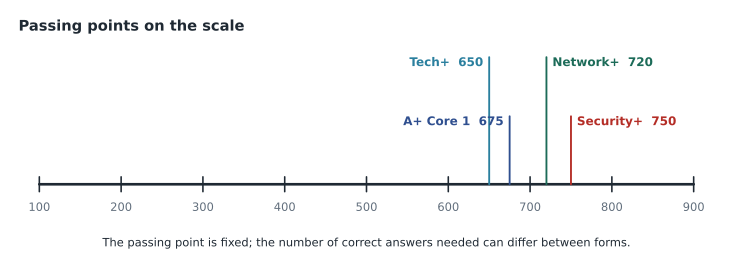
A raw score is the simplest possible measure: the number of points you earned on the questions that counted. A scaled score converts that raw score to a fixed range so that results can be compared across different forms of the same exam. CompTIA reports scores on a scale running up to 900; the Network+ and Security+ pages describe it as a scale of 100 to 900. The passing score is a fixed point on that scale for each exam: 650 for Tech+, 675 for A+ Core 1, 720 for Network+ and 750 for Security+, according to the current certification pages.
The reason for scaling is fairness. An exam is not one fixed set of questions; it is a pool, and each candidate receives a form assembled from it. Some forms will turn out a little harder than others, however carefully they are built. If the passing mark were a fixed number of correct answers, candidates who drew a harder form would be at a disadvantage. Scaling adjusts for those differences, so that a scaled 650 on one form represents the same level of knowledge as a scaled 650 on another. The process of adjusting forms to a common standard is often called equating in the testing world.
The consequence is that you cannot reliably convert a passing score into a number of correct answers. The relationship between raw and scaled scores depends on the form, on how difficult its questions proved to be when they were tested, and on how CompTIA has set the scale, and CompTIA does not publish the conversion. Its testing policies say that passing scores are set using statistical analysis and can change. So Noor's 50 out of 70 is a reasonable rough target for her practice tests, but it is not a rule, and she should not treat a practice score of exactly 50 as safe.
A toy model, and its limits
A simple model can show why a scaled score is not a share of the questions, as long as you remember it is only a model. Suppose an exam scaled raw scores in a straight line from the lowest possible score to the highest, and suppose a hard form and an easy form needed slightly different raw scores to reach the same standard. Marcus writes the model in Python to see how the numbers behave.
def scaled(raw, raw_max, low=100, high=900):
    """A straight-line scale for illustration only. CompTIA does not publish its method."""
    return round(low + (high - low) * raw / raw_max)

raw_max = 70
for raw in (45, 50, 55, 60):
    print(raw, "correct ->", scaled(raw, raw_max))

# Under this toy scale, the raw score that reaches 650:
needed = next(r for r in range(raw_max + 1) if scaled(r, raw_max) >= 650)
print("toy raw score needed for 650:", needed)45 correct -> 614 50 correct -> 671 55 correct -> 729 60 correct -> 786 toy raw score needed for 650: 49
What this code does
It converts raw scores to a 100 to 900 scale with a simple straight-line formula, which is only an illustration because CompTIA doesn't publish its real method. It prints the scaled score for several raw scores out of 70. It then finds the lowest raw score that reaches 650 on this toy scale, which is 49.
In this toy model, 49 correct answers would reach 650. A real exam would not behave so neatly: the scale may not be a straight line, the questions that count may be fewer than the questions shown, and the conversion differs between forms. What the model does show is why 650 out of 900 is not the same as 72 out of 100. The scale starts at 100, not 0, so even the arithmetic of turning it into a fraction is misleading. Lorna's advice is to aim well above any estimated passing level on practice tests from good sources, so that the uncertainty in the conversion does not matter.
Questions that may not count
Many certification programs include some questions that do not count toward the score, because they are being tried out for future exams. The responses show how hard each new question is before it is used for real. If an exam includes such questions, candidates cannot tell which ones they are, so every question deserves the same care. CompTIA's public pages for the exams in this lesson do not describe how many unscored questions, if any, a form contains, so do not plan around a number you have read elsewhere. The sensible strategy does not change: answer every question as if it counts.
The score report
When you finish a CompTIA exam, you receive a score report showing the outcome. It shows whether you passed and your scaled score, and it usually indicates the objectives or areas where you answered questions incorrectly, so that a candidate who does not pass knows where to focus. The report does not show which questions you got wrong or the correct answers, because the questions are confidential and are reused. Keep the report: if you pass, it is a record of the date and score; if you do not, it is the starting point for your next study plan.
Results also appear in your CompTIA certification account, usually within a few days for most exams, and that is where your certificate, digital badge and renewal information live. If you share your certification with an employer, you can usually do it through a verification link or a digital badge rather than sending a copy of the certificate. CompTIA's testing policies include a page on sharing exam results; read it before you share anything.
| Exam | Code | Maximum questions | Length | Passing score |
|---|---|---|---|---|
| Tech+ | FC0-U71 | 70 | 60 minutes | 650 on a scale of 900 |
| A+ Core 1 | 220-1201 | 90 | 90 minutes | 675 on a scale of 900 |
| Network+ | N10-009 | 90 | 90 minutes | 720 on a scale of 100 to 900 |
| Security+ | SY0-701 | 90 | 90 minutes | 750 on a scale of 100 to 900 |
If you do not pass
Not passing is common and recoverable. CompTIA's retake policy says there is no waiting period between a first and second attempt at an exam. After a second failed attempt, you must wait at least 14 calendar days from your last attempt before each further attempt. Every attempt costs the full exam price; CompTIA says it does not offer free retests or retake discounts, although some vouchers sold by training providers include a retake, so read the terms of what you buy. You also cannot retake an exam you have already passed under the same code without CompTIA's permission; to recertify by exam, you take a newer version.
The no-wait rule between the first and second attempts is tempting, but it is rarely wise to rebook for the next day. The score report tells you where you were weak, and that weakness will not have disappeared overnight. A better plan is to update your objectives checklist from the report, spend a week or two on the weak areas with hands-on practice, take a fresh practice test, and rebook when your practice scores are comfortably above where they were. Lorna failed Network+ the first time, years ago, and passed three weeks later after a fortnight of labs on the two areas her report had flagged.
Reading practice-test scores wisely
Practice tests are the closest thing to a real score you can get before exam day, but they need careful reading. Their difficulty varies widely between providers: some are harder than the real exam, some easier, and some are simply badly written. A single practice score tells you little; a trend across several tests from more than one good source tells you a lot. Look for three things. First, is your overall score rising over time? Second, are the same domains weak on every test, which points to a real gap rather than bad luck? Third, are you getting questions right for the right reasons, or guessing?
Guessing is the hidden risk. A practice score that includes several lucky guesses overstates your readiness. A simple habit fixes this: as you answer each practice question, mark it as sure or unsure. When you review, treat an unsure correct answer as half wrong, and study its topic as if you had missed it. Marcus, who likes data, keeps a small spreadsheet of his practice results with a column for unsure answers, and finds that his "sure" accuracy is a much better guide than his overall score.
Repeating the same practice test is another trap. The second time through, you remember answers rather than reasoning, and the score rises without your knowledge rising. Use each practice test once for measurement, then use it again only for review of the explanations. Fresh questions from a different source are a better check of whether your study has worked.
Score validity and exam integrity
CompTIA protects the meaning of its scores. Its testing policies include a candidate agreement that every candidate accepts before the exam, rules about conduct during the exam, and a policy on data forensics, which describes how CompTIA analyses results to detect scores that may not be valid. Candidates agree not to share exam questions, and the questions themselves are confidential. Using so-called brain dumps, which are collections of real exam questions shared illegally, breaks the candidate agreement and can lead to results being invalidated, certifications being revoked and a ban from future exams.
Beyond the rules, there is a practical reason to avoid them. A certification earned by memorizing leaked questions proves nothing about your ability, and the first week of a job built on it will show that. Employers increasingly test candidates in interviews with practical tasks for exactly this reason. Lorna tells the cert club that she once interviewed a candidate with four certifications who could not explain what a default gateway was. She hired someone else with one certification who could. Honest preparation is slower, but it is the only kind that pays off after the exam.
If you ever see something on exam day that seems wrong, such as a question that will not display properly or a simulation that does not respond, tell the proctor or test centre staff straight away and ask them to record it. CompTIA's policies describe how candidates can raise concerns about an exam, and a problem reported at the time is much easier to resolve than one reported days later.
Worked problem
Using a score report
Dez takes a practice Security+ test from his study guide and scores well overall, but the report shows weak results in two areas: security architecture and security operations. His real exam is booked in five weeks. How should he use the result?
Show solution
- Overall, the score is encouraging, but the report shows that two areas are pulling it down.
- He updates his objectives checklist, lowering his confidence ratings for the objectives in those two areas.
- He moves more study time to those areas for the next three weeks, using labs for the scenario objectives.
- He takes a different practice test in week four to see whether the weak areas have improved, and keeps the booking if they have.
Answer: Treat the report as a map: update the checklist, shift time to the two weak areas, practise hands-on, then retest before the real exam.
By the end of the session, Noor has crossed out her 50-out-of-70 calculation and written a new target in its place: "practice tests consistently in the high 50s, from at least two good sources." It is less precise, Marcus points out, but it is more honest.
Common mistakes
MistakeTreating the passing score as a share of the questions.
InsteadA scaled score is a point on a scale; the raw score needed can differ between forms.
MistakeAssuming every question counts the same and planning around a published number of unscored items.
InsteadAnswer every question carefully; CompTIA does not publish these details for its exams.
MistakeRebooking the day after a failed attempt.
InsteadUse the score report to study the weak areas first, then rebook.
MistakeBelieving a passed exam can be retaken for a better score.
InsteadYou cannot retake a passed exam under the same code without CompTIA's permission.
Summary and key terms
- A raw score counts correct points; a scaled score converts it to a fixed range so forms can be compared.
- Passing points: Tech+ 650, A+ Core 1 675, Network+ 720, Security+ 750.
- CompTIA sets passing scores statistically and does not publish the raw-to-scaled conversion or pass rates.
- The score report shows the result and the areas to improve, but not the questions.
- No wait between first and second attempts; at least 14 calendar days after a second failure; full price each attempt.
- Aim well above any estimated passing level on practice tests from good sources.
- Raw score
- The number of points earned on the questions that count.
- Scaled score
- A score converted to a fixed range so results can be compared across forms.
- Equating
- Adjusting different forms of an exam to a common standard.
- Score report
- The document showing an exam result and areas for improvement.
- Retake policy
- CompTIA's rules on when and how an exam can be attempted again.
Practice problems
Work each problem on paper first, then reveal the answer to check.
What is the passing score for Tech+?
Show answer
650 on a scale of 900.
Why does CompTIA use scaled scores?
Show answer
So that results on different forms of an exam mean the same thing.
Is 650 out of 900 the same as answering about 72 out of every 100 questions correctly?
Show answer
No. A scaled score is not a share of the questions, and the conversion is not published.
How long must you wait after a second failed attempt?
Show answer
At least 14 calendar days from the last attempt.
Does the score report show which questions you got wrong?
Show answer
No. It shows the result and the areas where you missed questions.
Which exam has the highest passing score of the four in this lesson?
Show answer
Security+, at 750.
Lesson quiz · 5 questions
Score 60% or more to complete this lesson.
Create a free account to save your progress, take quizzes and earn a certificate.