
CMP-499 · Lesson 6 of 12 · 21 min
Risk management and failure modes and effects analysis
Every capstone project faces two kinds of risk. Project risks threaten the team's ability to deliver: a part on backorder, a teammate who falls ill, a supplier who stops answering email. Product risks threaten the system's ability to work safely and reliably once delivered: a battery that swells in the cold, a gasket that leaks, a firmware update that bricks a node. Experienced engineers manage both deliberately, because hope is not a plan. This lesson covers the risk register for project and technical risks, and failure modes and effects analysis (FMEA) for the product.
What a risk is
A risk is an uncertain event or condition that, if it occurs, affects an objective. It has two dimensions: likelihood (how probable it is) and consequence (how bad it would be). A risk is not an issue. An issue has already happened and needs a fix; a risk might happen and needs a plan. Good risk statements follow a cause, event and effect form: because the radar module has a single supplier with a 12-week lead time (cause), the module may arrive after the alpha build date (event), which would delay integration by up to four weeks (effect). That form makes the risk specific enough to act on.
The risk management cycle
Standards such as ISO 31000 describe risk management as a continuing cycle rather than a one-time exercise. For a capstone team, the practical version has five steps, repeated at every weekly meeting and in depth at each design review.
- Identify: brainstorm risks from the requirements, the architecture, the schedule, the team and past projects. Professor Osei gave the team a list of the most common capstone risks from previous years; nearly all of them applied.
- Analyze: estimate likelihood and consequence, each on a scale of 1 to 5 with defined anchors, and place the risk on a matrix.
- Plan responses: decide how to treat each significant risk.
- Implement: assign each response an owner and a date, and do it.
- Monitor: review the register weekly, update scores, close risks that have passed, and add new ones.
There are four classic responses. Avoid the risk by changing the plan so it cannot occur, as the team did by buying a radar module instead of designing a radar. Mitigate it by reducing its likelihood or consequence, such as ordering two modules from two distributors. Transfer it to someone better able to handle it, such as having Northway's network team own gateway coverage. Accept it, with a contingency plan if it occurs, when the cost of treatment exceeds the expected harm.
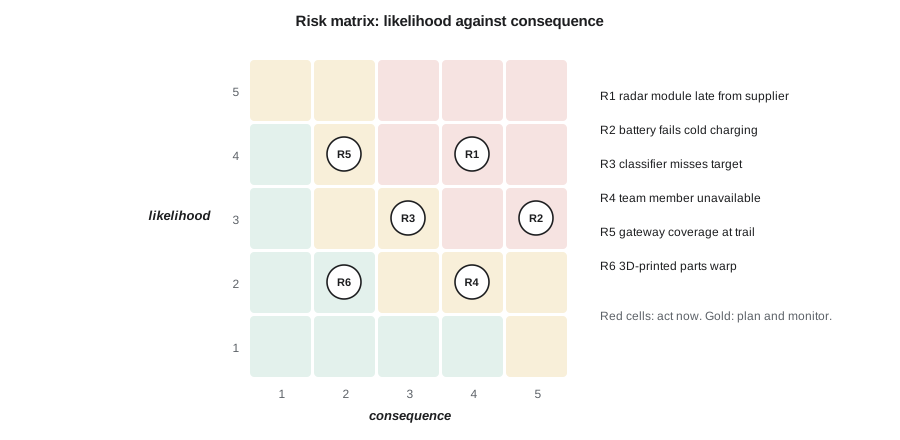
The TrailCount risk register
| ID | Risk | L | C | Response | Owner |
|---|---|---|---|---|---|
| R1 | Radar module arrives after the alpha build | 4 | 4 | Mitigate: order in week 6 from two distributors; develop with the evaluation kit meanwhile | Jonah |
| R2 | Battery damaged by charging below freezing | 3 | 5 | Mitigate: charger temperature cutoff, heater and insulation; cold-chamber test | Keisha |
| R3 | Classifier misses the accuracy target | 3 | 3 | Mitigate: record field data early; tune on recordings; fall back to speed-only rules | Amira |
| R4 | A team member is unavailable for several weeks | 2 | 4 | Mitigate: pair each subsystem lead with a backup; keep documentation current | Lucas |
| R5 | Gateway coverage weak at the trail | 4 | 2 | Transfer: Northway to place a gateway if range test fails; store and forward 30 days | Lucas |
| R6 | Printed mounting parts warp in summer heat | 2 | 2 | Accept: use printed parts only on prototypes; machined plate for pilot units | Keisha |
The register is a living document. At the preliminary design review, R1 sat in a red cell. By week 12 both radar modules had arrived, and the risk was closed. R3 rose in week 15, when the first field recordings showed runners being classified as cyclists, and fell again in week 19 after Amira added a speed-spread feature. Watching scores move tells the team, and its reviewers, where attention is needed.
Failure modes and effects analysis
FMEA is a structured, bottom-up method for finding how a product can fail and what to do about it before it fails in the field. It was developed for military and aerospace systems and is now standard in automotive, medical and industrial products. A design FMEA examines the product's design; a process FMEA examines how it is made. For TrailCount the team did a design FMEA.
For each item, such as a component, subsystem or function, the team asks: how could it fail to do its job (failure mode)? What would happen (effect)? Why would it happen (cause)? What in the current design prevents the cause or detects the failure? Then it rates three things on scales of 1 to 10, using tables agreed in advance.
- Severity (S) of the effect: 1 for no noticeable effect, up to 9 or 10 for effects involving safety or regulatory non-compliance.
- Occurrence (O) of the cause: 1 for extremely unlikely, up to 10 for almost certain, given the current prevention controls.
- Detection (D): how likely the current controls are to detect the cause or failure before the product reaches the user. Here the scale is reversed: 1 means almost certain detection, 10 means no chance of detection.
The traditional summary is the risk priority number, the product of the three ratings: RPN = S × O × D, ranging from 1 to 1,000. Teams sort by RPN and act on the highest.
# Design FMEA for the TrailCount node: rank by RPN, then apply a severity-first rule
fmea = [  # item, failure mode, effect, S, O, D
    ('Battery charger', 'Charges LiFePO4 below 0 C', 'Lithium plating, capacity loss, swelling', 9, 6, 4),
    ('Radar firmware', 'Two walkers side by side counted as one', 'Undercount on busy days', 5, 7, 5),
    ('Enclosure seal', 'Gasket leaks at cable gland', 'Corrosion, node stops', 7, 4, 6),
    ('Solar input', 'Panel covered by snow for days', 'Battery drains, data gap', 6, 6, 2),
    ('LoRa link', 'Gateway out of range after leaves grow', 'Counts held, sent late', 4, 4, 3),
    ('Bootloader', 'Power fails during firmware update', 'Node will not start, site visit', 8, 3, 7),
    ('Clock', 'RTC drifts 2 s per day', 'Hourly bins slightly shifted', 3, 8, 3),
    ('Mounting', 'Bracket loosens, radar tilts', 'Missed detections far side', 6, 3, 5),
]
rows = [(s * o * d, s, o, d, item, mode, eff) for item, mode, eff, s, o, d in fmea]
print('By RPN = S x O x D')
for rpn, s, o, d, item, mode, eff in sorted(rows, reverse=True):
    print(f"{rpn:4d}  S{s} O{o} D{d}  {item}: {mode}")

def priority(s, o, d):
    """A simple severity-first rule in the spirit of action priority tables."""
    if s >= 9 or (s >= 7 and o >= 4) or (s >= 7 and d >= 7): return 'High'
    if s >= 5 and (o >= 5 or d >= 6): return 'Medium'
    return 'Low'
print('\nSeverity-first priority')
for rpn, s, o, d, item, mode, eff in sorted(rows, key=lambda r: ('High', 'Medium', 'Low').index(priority(*r[1:4]))):
print(f"{priority(s, o, d):6s} RPN {rpn:3d} {item}: {mode}")By RPN = S x O x D 216 S9 O6 D4 Battery charger: Charges LiFePO4 below 0 C 175 S5 O7 D5 Radar firmware: Two walkers side by side counted as one 168 S8 O3 D7 Bootloader: Power fails during firmware update 168 S7 O4 D6 Enclosure seal: Gasket leaks at cable gland 90 S6 O3 D5 Mounting: Bracket loosens, radar tilts 72 S6 O6 D2 Solar input: Panel covered by snow for days 72 S3 O8 D3 Clock: RTC drifts 2 s per day 48 S4 O4 D3 LoRa link: Gateway out of range after leaves grow Severity-first priority High RPN 216 Battery charger: Charges LiFePO4 below 0 C High RPN 168 Enclosure seal: Gasket leaks at cable gland High RPN 168 Bootloader: Power fails during firmware update Medium RPN 175 Radar firmware: Two walkers side by side counted as one Medium RPN 72 Solar input: Panel covered by snow for days Low RPN 48 LoRa link: Gateway out of range after leaves grow Low RPN 72 Clock: RTC drifts 2 s per day Low RPN 90 Mounting: Bracket loosens, radar tilts
Why RPN alone is not enough
Sorting by RPN put the cold-charging failure first with 216, which nobody disputed. But second place went to the side-by-side walkers, with 175, ahead of the bootloader and enclosure failures at 168. Is a modest undercount on busy days really a higher priority than a node that will not start after a failed firmware update and needs a site visit, or a gasket that lets water in and kills the electronics? Most engineers would say no.
RPN has well-known weaknesses. Multiplying ordinal scores is mathematically dubious: a 3 on one scale is not three times a 1. Very different risks produce the same RPN, as the clock drift and snow on the panel both score 72. And a high-severity failure can hide behind a low RPN if it is rare and easy to detect. For these reasons, the AIAG and VDA FMEA handbook published in 2019 for the automotive industry replaced RPN with action priority, a lookup table that gives severity the most weight, then occurrence, then detection, and assigns each combination a high, medium or low priority.
The script's second ranking applies a simple severity-first rule in that spirit. It is not the handbook's table, which is larger and more detailed, but it captures the idea: anything with severity 9 or above is high priority regardless of the other scores, and severity 7 or above combined with moderate occurrence or poor detection is also high. Under this rule the enclosure seal and the bootloader join the cold-charging failure at the top, and the side-by-side walkers move to medium. The team agreed that this ordering matched its engineering judgment, and adopted it.
Worked problem
Recomputing a rating after a design change
The bootloader failure has S = 8, O = 3, D = 7 (RPN 168). The team adds a dual-bank flash layout: the new image is written to a second bank and verified before the boot pointer switches, and a failed boot falls back to the old image. A test that pulls power at random points during 200 updates is added. Estimate the new ratings and RPN.
Show solution
- Severity does not change: if the failure happened, a site visit would still be needed. S stays 8.
- Occurrence falls sharply, because power loss during an update no longer leaves the node without a valid image. The team rates O = 1.
- Detection improves, because the power-pull test is designed to reveal exactly this failure before release. The team rates D = 3.
- \[\text{RPN} = 8 \times 1 \times 3 = 24\]
- Under the severity-first rule, S = 8 with O = 1 and D = 3 is now low priority.
Answer: S = 8, O = 1, D = 3, RPN = 24; severity is unchanged, but the risk is now low priority because the cause is prevented and testing would catch a regression.
The example illustrates a principle that the handbooks emphasize: the order of preference for actions is to reduce severity first (by design changes that make the effect less harmful), then occurrence (by preventing the cause), and only then detection (by better testing). Detection alone never makes a product safer in the field; it only catches problems before shipment.
Acting on the TrailCount FMEA
The three high-priority items each led to design changes, owners and verification steps, recorded in the FMEA's action columns.
- Cold charging (S9 O6 D4): a charger with temperature inputs that blocks charging below 0 °C, a 2 W heater pad on the cell controlled by firmware and powered only from panel surplus, an insulated battery compartment, and a cold-chamber test at −30 °C with the panel simulated by a bench supply. Severity cannot fall, because damage to a lithium cell is a safety matter, but occurrence falls to 2 and detection to 3.
- Enclosure seal (S7 O4 D6): a cable gland rated for the cable's diameter, a drip loop, a breathable vent membrane to stop pressure changes from pumping moist air through the seals, and an ingress test to IP66 on the beta enclosure before the field trial.
- Bootloader (S8 O3 D7): the dual-bank update design in the worked example, with signature verification of each image, discussed further in lesson 10.
Medium-priority items received actions too, but with later dates. The side-by-side walkers became a firmware improvement in the tracker and a specific test case in the verification plan. Snow on the panel led to a steeper mounting angle, which sheds snow and improves winter harvest, and to a status flag that shows a solar deficit on the dashboard.
FMEA and the rest of the project
FMEA connects to almost everything else in the course. Its failure modes become test cases in the verification plan. Its causes become derived requirements, such as the charger temperature cutoff. Its detection controls become manufacturing tests for the pilot units. And its severity ratings feed the safety analysis in lesson 10. A related top-down method, fault tree analysis, starts from an undesired top event, such as the node stops reporting, and works down through logical AND and OR gates to the basic causes. FMEA finds failures you did not think to ask about; fault trees show how combinations of failures produce the outcome you care about most. Larger projects use both.
An FMEA is only as good as the people in the room. The team held two sessions of about two hours each, with all four members, Professor Osei for the first half hour and, for the power section, a Northway technician who had serviced outdoor equipment for years. The technician added two failure modes the team had not considered: spiders nesting in vent openings, and installers overtightening the cable gland and cracking it.
Common mistakes
MistakeTreating risk management as a one-time document for the proposal.
InsteadReview and update the risk register at every weekly meeting and in depth at each design review.
MistakeWriting vague risks such as the hardware might not work.
InsteadUse a cause, event and effect statement that is specific enough to plan a response.
MistakeRanking FMEA items by RPN alone.
InsteadGive severity priority, as action priority tables do, and examine high-severity items regardless of RPN.
MistakeRelying on more testing as the main response to a severe failure mode.
InsteadReduce severity or prevent the cause by design first; better detection only catches problems before shipment.
MistakeRunning the FMEA with only the designers present.
InsteadInclude people with field, manufacturing or service experience, who know failure modes designers do not.
Summary and key terms
- Risks are uncertain events with likelihood and consequence; issues are risks that have occurred.
- Manage risks in a continuing cycle: identify, analyze, plan responses, implement and monitor.
- Responses are avoid, mitigate, transfer or accept with contingency, each with an owner and a date.
- Design FMEA rates severity, occurrence and detection for each failure mode; RPN = S × O × D.
- RPN has weaknesses, so modern practice prioritizes by severity first, as in the 2019 AIAG and VDA action priority approach.
- Preferred actions reduce severity, then occurrence, then improve detection; FMEA outputs feed requirements, tests and safety analysis.
- Risk
- An uncertain event or condition that, if it occurs, affects a project or product objective.
- Risk register
- A list of identified risks with their ratings, responses, owners and status.
- Mitigation
- Action that reduces a risk's likelihood or consequence.
- Failure mode
- The way an item fails to perform its intended function.
- Severity
- The seriousness of a failure's effect, rated on an agreed scale.
- Occurrence
- The likelihood that a failure's cause happens, given current prevention controls.
- Detection
- The ability of current controls to find a cause or failure before the product reaches users.
- Risk priority number (RPN)
- The product of severity, occurrence and detection ratings in a traditional FMEA.
Practice problems
Work each problem on paper first, then reveal the answer to check.
A failure mode has S = 6, O = 5, D = 4. What is its RPN?
Show answer
6 × 5 × 4 = 120.
Two failure modes have RPN 120: one with S = 10, O = 2, D = 6 and one with S = 4, O = 6, D = 5. Which deserves attention first, and why?
Show answer
The first, because its severity of 10 indicates a safety or regulatory effect; equal RPNs hide very different risks.
Classify the response: the team asks Northway to install a gateway if the range test fails.
Show answer
Transfer, because another party better placed to handle the risk takes ownership.
Rewrite as a cause, event and effect statement: the battery might be a problem.
Show answer
Because LiFePO4 cells can be damaged when charged below freezing, the cell may lose capacity during the first winter, which would shorten autonomy below 5 days.
Lesson quiz · 5 questions
Score 60% or more to complete this lesson.
Create a free account to save your progress, take quizzes and earn a certificate.