
CMP-499 · Lesson 11 of 12 · 21 min
Standards, regulation, intellectual property and professional ethics
A device that works is not yet a product that may be sold, installed or even switched on in public. Electronic products must meet radio and electromagnetic compatibility rules, electrical safety standards and environmental requirements before they reach the market. The designs, code and data a team creates belong to someone, and others' designs and code come with conditions. And engineers carry professional obligations that go beyond any rule: to protect the public, to be honest about what they know, and to act with integrity when interests conflict. This lesson covers how the TrailCount team dealt with all three.
Standards and regulations
A standard is a document, usually developed by consensus in a standards organization, that specifies requirements or methods: how to measure emissions, what an enclosure must withstand to earn a rating, how to format a radio frame. Standards are voluntary in themselves. A regulation is a legal requirement issued by a government authority, and it often makes particular standards mandatory by referencing them. Customers can also make standards mandatory through contracts: a city might require that equipment on its property carry an ingress protection rating. Engineers need to know which documents apply, and why.
Standards save engineers enormous effort. TrailCount relies on dozens of them without the team writing a line: the LoRaWAN specification and regional parameters for the radio protocol, the I2C and SPI conventions for the buses, IEC 60529 for the meaning of IP66, IEC 62262 for IK impact ratings, the UN Manual of Tests and Criteria (section 38.3) for lithium battery transport tests, and the standards for measuring radiated emissions. Accreditation bodies expect capstone designs to incorporate appropriate engineering standards, and reviewers ask which ones apply and how the design meets them.
Radio and emissions rules
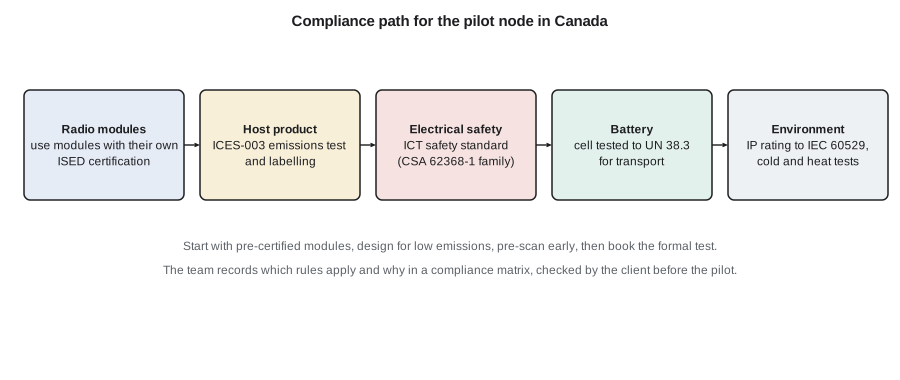
In Canada, Innovation, Science and Economic Development Canada (ISED) regulates radio apparatus and equipment that can cause interference. A product like TrailCount has two kinds of concern. Its radio transmitters (the radar and the LoRa radio) are intentional radiators that need certification against the applicable radio standards specifications, such as RSS-Gen for general requirements and RSS-247 for devices like the LoRa radio in the 902 to 928 MHz band. Its digital electronics are unintentional radiators that must meet the interference-causing equipment standard ICES-003, for information technology equipment, with labelling that states compliance.
The team's most important regulatory decision was made in lesson 4, when it chose pre-certified radio modules. A module that already holds its own certification can be integrated into a host product without recertifying the radio, provided the host follows the module's conditions: the specified antenna, the specified power settings, and labelling on the host that identifies the module. That saved months and thousands of dollars of radio testing. It did not remove the need to test the host product's own unintentional emissions, because the microcontroller, the switching regulators and the radar module's clocks all radiate.
Pre-compliance testing
Formal emissions testing at an accredited laboratory is expensive, and failing it means paying again. Teams therefore run pre-compliance tests early, with less precise equipment, to find problems while fixes are cheap. Lucas rented half a day in a pre-compliance chamber and measured the beta board's radiated emissions at 1 m with a peak detector, then scaled the results to the 3 m distance of the Class B limits.
import math
# Radiated-emissions pre-scan: compare peaks with Class B limits at 3 m
limits = [(30, 88, 40.0), (88, 216, 43.5), (216, 960, 46.0), (960, 6000, 54.0)]  # MHz, dBuV/m at 3 m
def limit(f):
    return next(l for lo, hi, l in limits if lo <= f < hi)
# peaks measured at 1 m in a rented pre-compliance chamber (pre-scan, peak detector)
peaks_1m = [(48.0, 47.1), (96.0, 52.8), (144.0, 49.0), (240.0, 50.2), (480.0, 57.9), (720.0, 45.1)]
corr = 20 * math.log10(1 / 3)     # inverse-distance scaling from 1 m to 3 m (far field assumed)
print(f"Distance correction 1 m -> 3 m: {corr:.1f} dB")
for f, e in peaks_1m:
    e3 = e + corr
    m = limit(f) - e3
    flag = 'investigate' if m < 6 else 'ok'
    print(f"{f:6.1f} MHz: {e3:5.1f} dBuV/m at 3 m, limit {limit(f):4.1f}, margin {m:+5.1f} dB  {flag}")
# 96, 144, 240, 480 and 720 MHz are all harmonics of the 48 MHz radar-module clockDistance correction 1 m -> 3 m: -9.5 dB 48.0 MHz: 37.6 dBuV/m at 3 m, limit 40.0, margin +2.4 dB investigate 96.0 MHz: 43.3 dBuV/m at 3 m, limit 43.5, margin +0.2 dB investigate 144.0 MHz: 39.5 dBuV/m at 3 m, limit 43.5, margin +4.0 dB investigate 240.0 MHz: 40.7 dBuV/m at 3 m, limit 46.0, margin +5.3 dB investigate 480.0 MHz: 48.4 dBuV/m at 3 m, limit 46.0, margin -2.4 dB investigate 720.0 MHz: 35.6 dBuV/m at 3 m, limit 46.0, margin +10.4 dB ok
The limits in the script are the Class B radiated limits at 3 m in FCC section 15.109. ICES-003 permits manufacturers to demonstrate compliance using test methods and limits that align closely with the FCC rules, so many North American teams use a single table for pre-compliance; the formal test must follow the referenced standard exactly.
The result was a clear warning. Every peak sat on a harmonic of the radar module's 48 MHz clock, and the 480 MHz harmonic exceeded the limit by 2.4 dB, with 96 MHz only 0.2 dB under. The team's rule was to investigate anything within 6 dB of the limit, because pre-compliance measurements carry several decibels of uncertainty and units vary. A near-field probe scan found the source: the clock trace from the module connector ran over a gap in the ground plane, forming a small antenna. Keisha rerouted the trace on a reworked board, added a series resistor to slow the clock edges and added a ferrite on the module's supply. The rescan showed all peaks at least 7 dB under the limits.
The inverse-distance correction of 20 log(1/3) ≈ −9.5 dB is itself an approximation. It assumes far-field conditions, which hold only when the distance is large compared with the wavelength. At 48 MHz the wavelength is 6.25 m, so a 1 m measurement is in the near field and the scaled value is uncertain. The team noted this and treated the low-frequency results with extra caution.
Worked problem
Converting a field strength between distances
A peak measures 52.8 dBµV/m at 1 m. Estimate its level at 3 m and its margin against a 43.5 dBµV/m limit, assuming far-field inverse-distance behaviour.
Show solution
- Field strength falls in proportion to 1/d in the far field, so in decibels
- \[E_3 = E_1 + 20\log_{10}\frac{1}{3} = 52.8 - 9.54 \approx 43.3\ \text{dB}\mu\text{V/m}\]
- \[\text{margin} = 43.5 - 43.3 = 0.2\ \text{dB}\]
- A margin of 0.2 dB is far too small given pre-compliance uncertainty, so the emission must be reduced.
Answer: About 43.3 dBµV/m at 3 m, a margin of only 0.2 dB, which calls for a design fix.
Safety and environmental standards
Product safety standards for information and communication technology equipment, such as the CSA C22.2 No. 62368-1 family harmonized with IEC 62368-1, use a hazard-based approach: identify energy sources, classify them, and show safeguards between each source and people. Battery-powered products at a few volts fall into the lowest electrical energy class, but the stored energy of the cell, the risk of fire and the mechanical hazards still need safeguards. Equipment installed on city property is often required by the city or the electrical authority to carry a certification mark from an accredited body. For the pilot, Northway decided to have its usual certification body review the design before production, and the team's hazard analysis from lesson 10 went into that review.
Lithium cells are dangerous goods for transport, so the cells must have passed the UN 38.3 tests, and shipping them, including inside a finished node, follows dangerous-goods rules for packaging and labelling. Keisha discovered this when a supplier refused to ship replacement cells by air; the team switched to ground shipping and added a week to the beta schedule.
Lucas kept a compliance matrix listing every regulation and standard considered, whether it applies and why, how the design meets it, the evidence, and the status. The matrix included the ones that do not apply, such as functional safety standards, with the reason. When Ines reviewed it before the pilot, she added one item the team had missed: the city's own requirements for equipment on its posts, which specify a maximum mass and a breakaway mounting.
Intellectual property
Intellectual property (IP) law gives creators rights over certain kinds of creations. Engineers meet four kinds. Patents protect inventions: new, useful and non-obvious processes, machines or compositions, for a limited term in exchange for public disclosure. Copyright protects original expression, including source code, documentation and drawings, automatically from creation. Trade secrets protect confidential business information for as long as it stays secret, which is why Northway's NS-5 designs are confidential. Trademarks protect names and logos that identify the source of products.
Both Canada and the United States award patents to the first inventor to file, and in both countries a public disclosure by the inventor, such as a demo-day poster or a published report, starts a grace period of about a year in which the inventor can still file. Many other countries have no such grace period, so a public disclosure can destroy patent rights abroad. If a capstone team thinks it has invented something patentable, it should talk to the university's technology transfer office and the client before presenting it publicly.
Who owns a capstone's results depends on the university's policy and the project agreement. Some universities let students own their work; others share ownership with the sponsor; many sponsor agreements assign IP to the sponsor in exchange for funding and support. The TrailCount agreement, signed by the team, the department and Northway before the project started, gave Northway a licence to use the results, let the students keep the right to show their work in portfolios, and required Northway's review of the final report before publication to protect its confidential information. Reading and understanding that agreement was the team's first legal task, and Professor Osei made sure everyone did.
Software licences deserve particular care. The team's firmware used an open-source real-time scheduler under a permissive licence, a LoRaWAN stack from the radio maker under its own licence, and a cryptographic library under another. Permissive licences, such as MIT and Apache 2.0, allow use in closed products with attribution; copyleft licences, such as the GPL, require that derived works be distributed under the same licence, which can conflict with a client's plans. Amira kept a list of every third-party component, its version and its licence, a simple software bill of materials, and Ines's legal team reviewed it. Copying code from forums or other projects without checking its licence is a common capstone mistake that can make a client unable to use the work.
Professional ethics
Engineering in Canada is a regulated profession. Each province and territory has a regulator, such as Professional Engineers Ontario (PEO), Engineers and Geoscientists British Columbia and APEGA in Alberta, that licenses engineers, protects the title, and enforces a code of ethics. In Ontario, the code of ethics is set out in a regulation under the Professional Engineers Act; its duties include regarding the welfare of the public as paramount, acting with fairness and loyalty to employers and clients, disclosing conflicts of interest, and practising only within one's competence. Graduates are not yet licensed engineers; they typically register as engineers-in-training or the equivalent, gain supervised experience, pass a professional practice exam, and then apply for licensure. Many also take part in the Ritual of the Calling of an Engineer and wear the iron ring as a reminder of their obligations.
Codes of ethics are short; applying them takes judgment. The TrailCount project raised several ethical questions that are typical of capstones, and the team discussed each in its decision log.
- Conflict of interest. Jonah's past employment at Northway, discussed in lesson 1, was disclosed in the charter and managed by keeping confidential NS-5 information out of the project. Disclosure and management, not concealment, is what the codes require.
- Honesty about results. The field trial showed systematic biases. The team reported them plainly, with the data, even though the requirement passed. Overstating accuracy to impress the client would have misled the city's planning decisions.
- Privacy and the public. Trail users never agreed to be counted. The team's design choices, no images and only aggregated counts, plus the sign at the field trial, respected their interests. The team also considered whether counts could reveal individuals at very quiet times, and recommended that the city publish data only in hourly totals.
- Competence. When the CDR raised questions about the battery's behaviour in the cold, Keisha did not guess. She consulted the cell maker's application engineer and a Northway power engineer, and documented their advice. Working within one's competence includes knowing when to ask.
- Credit. The final report credits the Northway technician who contributed failure modes, the open-source projects the firmware uses, and the students who volunteered as observers.
- Environmental responsibility. The team chose a long-life cell chemistry, designed the cell to be replaceable rather than glued in, and wrote an end-of-life section recommending battery recycling through the city's hazardous-waste program.
Common mistakes
MistakeAssuming a pre-certified radio module makes the whole product compliant.
InsteadFollow the module's integration conditions and still test the host product's own unintentional emissions.
MistakeRunning the first emissions test at the accredited laboratory.
InsteadPre-scan early, investigate anything within about 6 dB of the limits, and fix problems before formal testing.
MistakePresenting a possibly patentable idea publicly without thinking.
InsteadCheck the project agreement and talk to the technology transfer office and client before public disclosure.
MistakeCopying code without checking its licence.
InsteadKeep a software bill of materials with each component's licence, and have it reviewed against the client's plans.
MistakeTreating ethics as a separate topic from design.
InsteadRecognize ethical questions in design choices, such as privacy, honesty in reporting and conflicts of interest, and record the reasoning.
Summary and key terms
- Standards are consensus documents; regulations are legal requirements that often reference standards; contracts can also make standards mandatory.
- Radio transmitters need certification against ISED's radio standards, and digital electronics must meet ICES-003; pre-certified modules save radio testing.
- Pre-compliance scans find emissions problems early; the far-field distance correction is approximate at low frequencies.
- Product safety, battery transport and environmental standards apply even to low-voltage products; a compliance matrix records what applies and why.
- Patents, copyright, trade secrets and trademarks protect different things; project agreements and open-source licences decide what a team may do with its work.
- Codes of ethics put public welfare first and require honesty, competence, disclosure of conflicts and fairness to clients.
- Standard
- A consensus document specifying requirements, methods or guidelines.
- Regulation
- A legal requirement issued by a government authority.
- Intentional radiator
- A device that deliberately emits radio frequency energy, such as a transmitter.
- Unintentional radiator
- A device that generates radio frequency energy internally but is not intended to emit it, such as digital electronics.
- Pre-compliance testing
- Early, less formal testing to find compliance problems before accredited testing.
- Compliance matrix
- A table of applicable regulations and standards with how each is met and the evidence.
- Software bill of materials
- A list of the third-party software components in a product with their versions and licences.
- Conflict of interest
- A situation in which personal interests could improperly influence professional judgment.
Practice problems
Work each problem on paper first, then reveal the answer to check.
A peak measures 57.9 dBµV/m at 1 m. What is the estimated level at 3 m, and the margin against 46.0 dBµV/m?
Show answer
57.9 − 9.5 = 48.4 dBµV/m; the margin is 46.0 − 48.4 = −2.4 dB, so it fails.
Why does a team still need emissions testing when both radios are pre-certified modules?
Show answer
The host's own digital circuits, regulators and clocks radiate as unintentional emissions, which the module certifications do not cover.
Classify: Northway's NS-5 schematics, the TrailCount firmware source, a new tracking method, and the TrailCount name.
Show answer
Trade secret, copyright, possibly a patent, and a possible trademark.
The field trial shows a 4 % pedestrian undercount. A teammate suggests reporting only the weekly average. What does the code of ethics suggest?
Show answer
Report the daily results and the systematic bias honestly; selective reporting could mislead the client's decisions.
Lesson quiz · 5 questions
Score 60% or more to complete this lesson.
Create a free account to save your progress, take quizzes and earn a certificate.