
CMP-499 · Lesson 2 of 12 · 23 min
Client needs and measurable requirements
Every later decision in a capstone traces back to the requirements. If they are vague, the team cannot choose between concepts, cannot design to a target, and cannot prove at the end that the system works. If they are wrong, the team can build a perfect system that nobody wants. This lesson follows the TrailCount team from the city's one-sentence request to a baseline of twelve system requirements, each measurable, each traced to a need, and each with a planned way of proving it.
Needs are not requirements
A need is a statement of what a stakeholder wants to achieve, in their own language. A requirement is a statement of what the system must do or be, written so that an engineer can design to it and a tester can check it. The gap between the two is where most capstone projects go wrong. Clients rarely state needs completely, they often describe a solution instead of a need, and different stakeholders want different things.
The team's first step was to find all the stakeholders, not just the client. Ines Carvalho at Northway owns the product idea and will maintain the units. The City of Kingston's active transportation office is the end user of the data. City operations staff will mount the nodes on posts and will not tolerate frequent visits. Trail users are affected even though nobody asked them: they will walk past a box that watches them. Dana Okoye runs Northway's fleet dashboard and will receive the data. Professor Osei and the course itself are stakeholders too, with deadlines and assessment criteria.
Eliciting needs
Elicitation means drawing needs out of people who may not know how to state them. The team used four methods, and each found something the others missed.
- Interviews. Jonah and Lucas held a one-hour interview with the city's planner, using open questions: what decisions would you make with better counts, what do you use now, what went wrong with it, what would make a counter useless to you? The answer to the last question was revealing: a counter that cannot tell walkers from cyclists is almost useless, because the two groups need different infrastructure.
- Site visit. Keisha and Amira walked the counting site with a tape measure and a phone. The trail is 3.5 m wide, with a post 1.2 m from its edge, no power within 300 m, tree cover on the south side and snow clearing only on the trail surface. In summer, several hundred people pass on a weekend day; in January, a few dozen.
- Existing solutions. The team read the city's past reports. Counts came from short manual surveys twice a year and from a borrowed pneumatic tube counter that missed pedestrians entirely and was damaged by a snowplow.
- Observation. Jonah stood at the site for two hours on a Saturday and recorded every passage by hand. He saw groups walking side by side, cyclists overtaking pedestrians, dogs, strollers, runners and a mobility scooter. That list became the team's catalogue of hard cases.
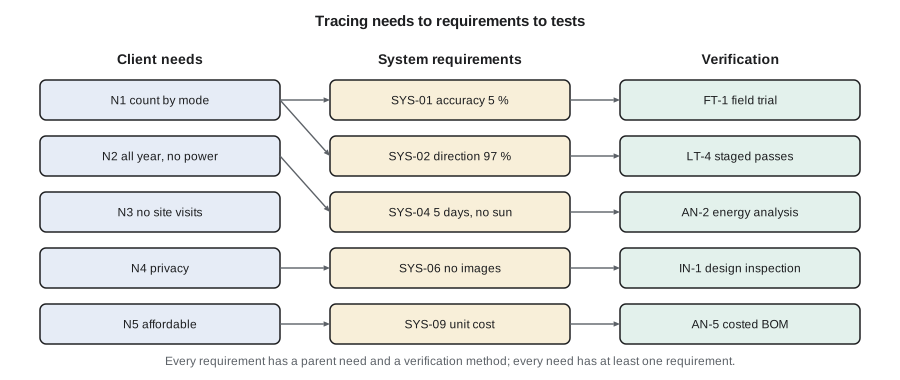
From these sources the team wrote five needs, in plain language and without solutions: count people walking and cycling separately (N1); work all year at a trail site with no power (N2); send counts to the city without site visits (N3); protect the privacy of trail users (N4); and be affordable enough to deploy at about 40 sites (N5). Each need was confirmed with Ines and the city before the team went further.
What a good requirement looks like
Requirement-writing guides, such as the international standard for requirements engineering, ISO/IEC/IEEE 29148, and systems engineering handbooks, list similar characteristics. A good individual requirement is necessary (removing it would leave a need unmet), unambiguous (only one reading), verifiable (a finite, objective test, analysis, inspection or demonstration can show it is met), feasible (within the technology, budget and schedule), singular (one requirement per statement) and implementation-free (it says what, not how, unless the how is truly a constraint). A good set of requirements is complete, consistent and traceable.
Most teams adopt a consistent form: The [system or subsystem] shall [verb] [object] [measurable condition]. The word shall marks a binding requirement; should marks a goal; will marks a statement of fact or intent. Consistent use of these words matters because readers, including a client signing an acceptance, read them literally.
| Weak statement | Problem | Rewritten requirement |
|---|---|---|
| The node shall count people accurately. | Accurately is not measurable | The node shall report daily totals of pedestrians and of cyclists within 5 % of a manual count. |
| The node shall send counts quickly. | Quickly is not measurable | The node shall make each 15-minute count available on the dashboard within 30 minutes of the interval ending. |
| The enclosure shall be robust. | Robust is undefined | The enclosure shall meet IP66 and withstand an IK08 impact. |
| The node shall use LoRaWAN. | Names a solution, not a need | The node shall transmit data without a wired connection from a site up to 2 km from a gateway. |
| The node shall work in winter and be cheap. | Two requirements, both vague | Split into an operating temperature requirement and a unit cost requirement, each with a number. |
The fourth row needs judgment. Sometimes a solution really is a constraint. Northway already runs a network for its sensors, and the client might legitimately require that new products use it. If so, the requirement should say that and say why, so that later readers know it is a deliberate constraint, not an accident. The team asked, and Ines said Northway's network was preferred but not mandatory. The requirement stayed solution-free, and the team's trade study in lesson 3 decided how to meet it.
Kinds of requirements
Requirements fall into a few families, and checking each family is a quick way to find gaps.
- Functional requirements say what the system does: count, classify, record direction, aggregate into 15-minute bins, transmit, report health.
- Performance requirements say how well: accuracy, latency, range, speed span of targets.
- Environmental and physical requirements: temperature range, ingress protection, mounting, size, mass.
- Interface requirements: data formats, radio bands, power inputs, the dashboard's expected fields.
- Constraints: cost, schedule, regulations, standards, the client's preferred suppliers.
- Quality attributes, sometimes called non-functional requirements: reliability, maintainability, security, privacy, usability for installers.
Privacy deserves particular attention in this project. The city's need N4 became a constraint that shaped every concept: the node shall not capture, store or transmit images, and shall transmit only aggregated counts and health data. That single requirement removed camera-based concepts unless the team could show, to the client's satisfaction, that images never leave a sealed processor, and it gave the team a strong argument at every public presentation.
The TrailCount requirements baseline
| ID | Requirement (abridged) | Need | Method |
|---|---|---|---|
| SYS-01 | Daily totals of pedestrians and cyclists within 5 % of a manual count | N1 | Test |
| SYS-02 | Direction of travel correct for at least 97 % of passages | N1 | Test |
| SYS-03 | Operate from −30 °C to +50 °C ambient | N2 | Test |
| SYS-04 | Run 5 days with no solar input from a full battery | N2 | Analysis and test |
| SYS-05 | Each 15-minute count on the dashboard within 30 minutes of the interval ending | N3 | Test |
| SYS-06 | Capture, store and transmit no images | N4 | Inspection |
| SYS-07 | Enclosure meets IP66 and withstands IK08 impact | N2 | Test |
| SYS-08 | Report battery, temperature and fault flags in every uplink | N3 | Test |
| SYS-09 | Bill of materials at most $450 (Canadian) per unit at 100 units | N5 | Analysis |
| SYS-10 | Installable by two people in under 45 minutes | N5 | Demonstration |
| SYS-11 | Accept authenticated firmware updates over the radio link | N3 | Test |
| SYS-12 | Classify passages at speeds from 2 to 40 km/h | N1 | Test |
The last column assigns a verification method to each requirement. The four classic methods are test (operate the system under controlled conditions and measure), analysis (calculation or simulation, used when testing is impractical, such as five days of darkness in summer), inspection (examine the design, drawings or code), and demonstration (operate the system and observe a qualitative result). Assigning the method while writing the requirement is a powerful check: if nobody can say how a requirement would be verified, it is not yet a requirement.
Traceability
Traceability is the ability to follow each requirement backward to the need it serves and forward to the design elements and tests that satisfy it. It answers three questions that come up constantly. Why does this requirement exist? (Follow it back.) If the client changes this need, what else changes? (Follow it forward.) Have we proved everything we promised? (Check that every requirement has a passing verification.) A traceability matrix, often just a spreadsheet, holds these links.
Lucas wrote a small script that reads the requirement list and flags common problems before each review. It is no substitute for careful reading, but it catches mechanical errors quickly, and its rules mirror the characteristics above.
import re
# A small requirements linter and traceability check for the TrailCount node
VAGUE = ['fast', 'user-friendly', 'robust', 'easy', 'as needed', 'approximately',
         'sufficient', 'minimal', 'etc', 'and/or', 'reliable', 'quickly']
needs = {'N1': 'Count people walking and cycling separately',
         'N2': 'Work all year at a trail with no power',
         'N3': 'Send counts to the city without site visits',
         'N4': 'Protect the privacy of trail users',
         'N5': 'Affordable enough to deploy at 40 sites'}
reqs = [  # id, parent need, text, verification method (T, A, I, D)
    ('SYS-01', 'N1', 'The node shall classify each passage as pedestrian or cyclist with daily-total error within 5 % of a manual count.', 'T'),
    ('SYS-02', 'N1', 'The node shall record direction of travel for each passage.', 'T'),
    ('SYS-03', 'N2', 'The node shall operate from -30 C to +50 C ambient.', 'T'),
    ('SYS-04', 'N2', 'The node shall run 5 days with no solar input from a full battery.', 'A'),
    ('SYS-05', 'N3', 'The node shall send counts quickly to the dashboard.', 'D'),
    ('SYS-06', 'N4', 'The node shall not capture or store images.', 'I'),
    ('SYS-07', 'N2', 'The enclosure shall be robust.', ''),
    ('SYS-08', None, 'The node shall display a status LED.', 'I'),
]
problems = 0
for rid, parent, text, ver in reqs:
    issues = []
    words = [w for w in VAGUE if re.search(r'\b' + re.escape(w) + r'\b', text.lower())]
    if words: issues.append('vague: ' + ', '.join(words))
    if ' shall ' not in text: issues.append('no "shall"')
    if not re.search(r'\d', text) and ver in ('T', 'A'): issues.append('no measurable value')
    if not ver: issues.append('no verification method')
    if parent not in needs: issues.append('not traced to a need')
    problems += bool(issues)
    print(f"{rid}: {'OK' if not issues else '; '.join(issues)}")
covered = {p for _, p, _, _ in reqs}
print()
for n, text in needs.items():
    print(f"{n} {'covered' if n in covered else 'NOT COVERED'}: {text}")
print(f"\n{problems} of {len(reqs)} requirements need rework")SYS-01: OK SYS-02: no measurable value SYS-03: OK SYS-04: OK SYS-05: vague: quickly SYS-06: OK SYS-07: vague: robust; no verification method SYS-08: not traced to a need N1 covered: Count people walking and cycling separately N2 covered: Work all year at a trail with no power N3 covered: Send counts to the city without site visits N4 covered: Protect the privacy of trail users N5 NOT COVERED: Affordable enough to deploy at 40 sites 4 of 8 requirements need rework
The script was run on an early draft, and it found four problems. SYS-05 used the word quickly. SYS-07 said robust and had no verification method. SYS-08 traced to no need at all: someone had added a status LED because it seemed useful. And need N5, affordability, had no requirement, so nothing in the design would ever have been checked against cost. One flag was a false alarm: SYS-02 contains no number, but direction is a binary outcome, and the team later added the 97 % figure anyway, because a direction requirement with no accuracy target cannot fail. The rewritten requirements are the ones in the baseline table above, with SYS-08 changed to a health-reporting requirement traced to N3.
Worked problem
Turning a need into a measurable accuracy requirement
The city wants counts good enough to compare weekday and weekend use and to detect a 15 % change in cycling after a new crossing opens. Manual counts by trained observers disagree with each other by about 2 %. What daily-total accuracy should SYS-01 require?
Show solution
- The requirement must be tight enough that a real 15 % change is not hidden by measurement error, but there is no point demanding accuracy better than the reference used to check it.
- If the counter's error on any day is within ±e, a comparison between two periods can be off by up to 2e in the worst case.
- \[2e \le \tfrac{1}{2}(15\ \%) \Rightarrow e \le 3.75\ \%\]
- That worst-case bound is strict. Errors on different days partly cancel, and the city compares averages over weeks, so the planner accepted 5 % on any single day as adequate, while asking that the mean bias over a week be within 3 %.
- The 2 % disagreement between manual observers means that a test cannot resolve errors much smaller than about 2 %, so 5 % is also comfortably verifiable.
Answer: Within 5 % on daily totals, with a weekly mean bias goal of 3 %; tighter limits would exceed what the reference counts can verify.
Agreeing and controlling the baseline
In week 7 the team sent Ines and the city a requirements document with the baseline, the needs, the traceability and a short rationale for each number. They met, discussed SYS-09 (the city thought $450 was low; Northway thought it was high, and the team kept it as a target with an explicit review at the critical design review) and SYS-11 (Ines wanted over-the-air updates; the team warned that it was the riskiest requirement in the list). Both parties then agreed the baseline by email, and Lucas put it under change control.
Change control does not mean requirements never change. It means changes are deliberate. A change request states what changes, why, and its effect on cost, schedule, risk and verification. The team, the advisor and the client agree before the baseline is updated, and the document records a revision number and history. Without this, requirements drift silently, often through casual requests in meetings, and at the end nobody can say what the system was supposed to do.
Derived requirements
System requirements are only the top level. As the architecture develops, each system requirement is allocated to subsystems, producing derived requirements. SYS-04 (five days without sun) becomes requirements on battery capacity, average power, regulator efficiency and night-mode behaviour. SYS-01 becomes requirements on the radar module's detection probability and on the classifier's error rate. Derived requirements trace to their parents, so that if SYS-04 changes, the team can find every battery and power requirement that depends on it. Lesson 4 shows these allocations as part of the architecture.
Common mistakes
MistakeWriting requirements with words such as fast, robust, user-friendly or sufficient.
InsteadReplace each with a measurable quantity and a condition, and check that a test, analysis, inspection or demonstration could verify it.
MistakeStating a design solution as a requirement without saying it is a constraint.
InsteadState the need; if a solution really is required, label it a constraint and record why.
MistakeTalking only to the client contact.
InsteadIdentify all stakeholders, including end users, installers, maintainers and people affected by the system, and elicit needs from each.
MistakeAdding features that trace to no need.
InsteadEvery requirement must trace to a need; untraced items are either missing needs or gold plating.
MistakeLetting requirements change through casual conversation.
InsteadPut the agreed baseline under change control and evaluate every change request for cost, schedule, risk and verification.
Summary and key terms
- Needs describe what stakeholders want in their language; requirements describe what the system shall do, measurably and verifiably.
- Elicit needs from all stakeholders with interviews, site visits, review of existing solutions and direct observation.
- Good requirements are necessary, unambiguous, verifiable, feasible, singular and implementation-free, written with shall.
- Each requirement gets a verification method: test, analysis, inspection or demonstration.
- Traceability links needs to requirements to design and tests, and a matrix or script can check coverage and common faults.
- An agreed baseline goes under change control; derived requirements allocate system requirements to subsystems.
- Stakeholder
- Anyone who affects or is affected by the system, including clients, end users, installers, maintainers and the public.
- Need
- A stakeholder's goal stated in their own terms, without a design solution.
- Requirement
- A verifiable statement of what the system shall do or be.
- Constraint
- A requirement that restricts the design, such as a cost limit, a regulation or a mandated interface.
- Verification method
- The way a requirement will be shown to be met: test, analysis, inspection or demonstration.
- Traceability matrix
- A table linking needs, requirements, design elements and verification activities.
- Baseline
- An agreed version of the requirements that changes only through a controlled process.
- Derived requirement
- A lower-level requirement allocated from a system requirement to a subsystem.
Practice problems
Work each problem on paper first, then reveal the answer to check.
Rewrite: The battery shall last a long time without sun.
Show answer
For example: The node shall operate for at least 5 days with no solar input, starting from a fully charged battery at −10 °C.
Which verification method suits SYS-06 (no images), and why?
Show answer
Inspection of the hardware and firmware design: there is no camera and no image path, which is easier to show by examination than by testing.
A requirement says: The node shall classify passages and report them every 15 minutes. What is wrong?
Show answer
It combines two requirements; split it into a classification requirement and a reporting-interval requirement.
A need has no requirement tracing to it. What are the two possible explanations?
Show answer
A requirement is missing, or the need was not actually agreed; either way the team must resolve it with the client.
Lesson quiz · 5 questions
Score 60% or more to complete this lesson.
Create a free account to save your progress, take quizzes and earn a certificate.