
CISSP-112 · Lesson 8 of 12 · 28 min
Cryptography I: symmetric and asymmetric encryption and the cryptographic life cycle
Sub-domain 3.6 asks you to select and determine cryptographic solutions. Cryptography is the toolset that protects confidentiality and integrity when data is stored or travels across networks you do not control, and it underpins authentication and nonrepudiation. The CISSP does not expect you to do the mathematics of modern ciphers, but it does expect you to know what each kind of algorithm is for, how keys are managed, which algorithms and key lengths are current, and why most cryptographic failures come from people and processes rather than broken mathematics. This lesson covers symmetric and asymmetric encryption and the life cycle of cryptographic choices; lesson 9 covers hashing, signatures and public key infrastructure; and lesson 10 covers attacks and post-quantum cryptography.
Core ideas
Encryption transforms readable plaintext into unreadable ciphertext using an algorithm, also called a cipher, and a key; decryption reverses the process. Kerckhoffs's principle, from the nineteenth century, says a cryptosystem should remain secure even if everything about it except the key is public. Modern practice follows it: algorithms such as AES are published and scrutinized worldwide, and security rests entirely on keeping keys secret. The strength of a well-designed algorithm against brute force depends on its key space, the number of possible keys. A key of n bits has 2 to the power n possible values, and an attacker trying keys at random will on average find the right one after trying half of them.
Classic ciphers illustrate two building blocks still used inside modern algorithms. Substitution replaces each symbol with another, as in the Caesar cipher, which shifts each letter a fixed number of places. Transposition rearranges the order of symbols. Both are easily broken alone, but modern block ciphers apply many rounds of substitution and permutation to achieve what Claude Shannon called confusion, hiding the relationship between key and ciphertext, and diffusion, spreading the influence of each plaintext bit across the whole ciphertext. The one-time pad, which combines the message with a truly random key as long as the message and never reused, is the only cipher proven unbreakable, but its key distribution problem makes it impractical for almost all uses.
rate = 10**12  # keys tested per second (a large, well-funded attacker)
year = 365.25 * 24 * 3600
for bits in (56, 80, 128, 256):
    avg_years = (2**bits / 2) / rate / year
print(f"{bits}-bit key: about {avg_years:.3g} years on average")56-bit key: about 0.00114 years on average 80-bit key: about 1.92e+04 years on average 128-bit key: about 5.39e+18 years on average 256-bit key: about 1.83e+57 years on average
Symmetric encryption
Symmetric, or secret key, cryptography uses the same key to encrypt and decrypt. It is fast and suitable for bulk data, which is why it protects disks, databases, backups and the data inside network sessions. Its weakness is key distribution and scale: both parties must already share the key securely, and every pair of parties needs its own key. For n people who all need to communicate privately, the number of keys is n times n minus 1, divided by 2. Ten people need 45 keys; a thousand people need 499,500. Symmetric cryptography provides confidentiality and, with the right modes, integrity, but it cannot provide nonrepudiation, because anyone who holds the shared key could have produced the message.
The Advanced Encryption Standard, AES, is the dominant symmetric algorithm. It was selected by NIST in 2001 from the Rijndael submission by two Belgian cryptographers after an open international competition, and is published as FIPS 197. AES uses a block size of 128 bits and keys of 128, 192 or 256 bits, with 10, 12 or 14 rounds respectively. Its predecessor, the Data Encryption Standard, DES, used a 56-bit key, which was publicly broken by brute force in 1998; Triple DES, which applies DES three times, has now been retired by NIST, with its use for encryption disallowed after 2023. ChaCha20, a stream cipher, is widely used with the Poly1305 authenticator in TLS and on mobile devices that lack AES hardware support. Older ciphers you may see in study materials include Blowfish, Twofish, IDEA, RC4, now prohibited in TLS, and RC5 and RC6.
Block ciphers encrypt fixed-size blocks and need a mode of operation to handle longer messages. Electronic codebook mode, ECB, encrypts each block independently, so identical plaintext blocks give identical ciphertext, revealing patterns; it should not be used for data. Cipher block chaining, CBC, mixes each block with the previous ciphertext using an initialization vector. Counter mode, CTR, turns a block cipher into a stream cipher by encrypting a counter. Galois/counter mode, GCM, adds authentication to counter mode, providing both confidentiality and integrity in one operation; this kind of authenticated encryption is now the default choice in TLS 1.3. A common implementation failure is reusing an initialization vector or nonce with the same key, which in counter-based modes can expose plaintext.
Asymmetric encryption
Asymmetric, or public key, cryptography uses a key pair: a public key that can be shared with anyone and a private key that the owner keeps secret. What one key encrypts, only the other can decrypt. Encrypting with the recipient's public key provides confidentiality, because only the recipient's private key can decrypt. Encrypting, or more precisely signing, with the sender's private key provides authentication, integrity and nonrepudiation, because anyone can verify with the sender's public key that only the sender could have produced it. Each participant needs only one key pair, so n people need 2n keys in total, which solves the scaling and key distribution problems of symmetric cryptography. The trade-off is speed: asymmetric operations are hundreds to thousands of times slower than symmetric ones.
RSA, published by Rivest, Shamir and Adleman in 1977, bases its security on the difficulty of factoring the product of two large primes. Current guidance calls for keys of at least 2,048 bits, with 3,072 bits giving security roughly equivalent to 128-bit symmetric keys. Elliptic curve cryptography, ECC, bases its security on the elliptic curve discrete logarithm problem and achieves similar strength with much smaller keys: a 256-bit elliptic curve key is roughly as strong as a 3,072-bit RSA key, which makes ECC attractive for phones, smart cards and high-traffic servers. Diffie-Hellman key exchange, published in 1976, lets two parties agree on a shared secret over an open channel without ever sending it. It provides no authentication on its own, so it is vulnerable to man-in-the-middle attacks unless combined with signatures or certificates. Its ephemeral forms, DHE and ECDHE, create fresh keys for each session, giving forward secrecy: stealing a server's long-term key later does not decrypt past sessions. ElGamal and the Digital Signature Algorithm are related discrete logarithm schemes.
# Toy RSA with tiny primes -- for illustration only, completely insecure
p, q = 61, 53
n = p * q                 # modulus
phi = (p - 1) * (q - 1)
e = 17                    # public exponent
d = pow(e, -1, phi)       # private exponent
m = 65                    # message as a number smaller than n
c = pow(m, e, n)          # encrypt with the public key (e, n)
print('n =', n, ' d =', d)
print('ciphertext =', c)
print('decrypted =', pow(c, d, n))n = 3233 d = 2753 ciphertext = 2790 decrypted = 65
# Toy Diffie-Hellman -- insecure sizes, for illustration only
p, g = 23, 5              # public prime modulus and generator
a, b = 6, 15              # private values chosen by Alice and Bob
A = pow(g, a, p)          # Alice sends A in the open
B = pow(g, b, p)          # Bob sends B in the open
print('public values:', A, B)
print('Alice computes', pow(B, a, p), ' Bob computes', pow(A, b, p))public values: 8 19 Alice computes 2 Bob computes 2
Hybrid cryptography
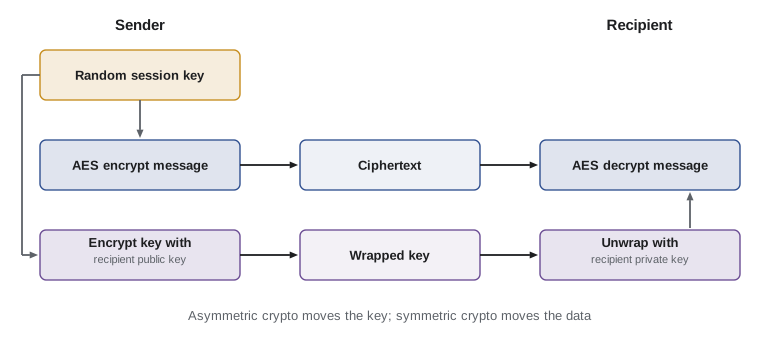
Real systems combine both kinds. In a hybrid system, asymmetric cryptography establishes or protects a symmetric session key, and the fast symmetric cipher encrypts the bulk data. TLS works this way: the client and server use ECDHE to agree on keys, authenticate the server with a certificate and signature, and then encrypt the session with AES-GCM or ChaCha20-Poly1305. Encrypted email such as S/MIME or PGP encrypts the message with a random symmetric key and encrypts that key with each recipient's public key. This combination gives the scalability of public keys and the speed of symmetric ciphers.
| Property | Symmetric | Asymmetric |
|---|---|---|
| Keys | One shared secret key | Public and private key pair |
| Keys for n users | n(n − 1)/2 | 2n |
| Speed | Fast, suits bulk data | Slow, suits small data and key exchange |
| Services | Confidentiality, integrity with authenticated modes | Confidentiality, authentication, integrity, nonrepudiation |
| Examples | AES, ChaCha20, retired DES and 3DES | RSA, ECC, Diffie-Hellman, DSA |
| Typical key size for about 128-bit strength | 128 bits | RSA 3,072 bits or ECC 256 bits |
The cryptographic life cycle
Cryptographic choices age. Algorithms that were strong become weak as computing power grows and new attacks appear, so organizations need to manage cryptography through a life cycle: select algorithms and key lengths from current guidance, implement them in validated libraries and modules, operate and monitor them, and plan their retirement. NIST describes algorithm status in SP 800-131A with terms such as acceptable, deprecated, disallowed and legacy use. Crypto agility is the design property that lets algorithms be replaced without rebuilding whole systems, for example by keeping algorithm choices in configuration rather than hard-coding them. A cryptographic inventory, a list of where and how cryptography is used across the organization, is the starting point for any migration, including the move to post-quantum algorithms covered in lesson 10.
Export controls also apply. Canada's Export Control List, under the Export and Import Permits Act, includes information security items in Group 1, Category 5 Part 2, following the international Wassenaar Arrangement. Exporters of strong encryption products may need permits, although many mass-market products benefit from exemptions. Check with Global Affairs Canada before exporting or sharing controlled cryptographic technology.
Worked problem
Counting keys
A company of 200 employees wants every pair to be able to communicate privately. How many keys are needed with symmetric cryptography alone, and how many with asymmetric cryptography?
Show solution
- Symmetric: n(n − 1)/2 = 200 × 199 / 2 = 19,900 keys.
- Asymmetric: 2n = 2 × 200 = 400 keys, one public and one private for each person.
- In practice, hybrid encryption uses the 400 asymmetric keys to set up temporary symmetric session keys as needed.
Answer: 19,900 symmetric keys versus 400 asymmetric keys. Public key cryptography solves the scaling problem of pairwise shared secrets.
Worked problem
Choosing algorithms
Choose suitable algorithms for: (a) encrypting a 2 TB backup; (b) letting a browser agree on a session key with a website; (c) a smart card with very limited memory that must sign transactions; (d) replacing a legacy application still using 3DES.
Show solution
- (a) AES-256 in an authenticated mode such as GCM, with keys in a key management service.
- (b) ECDHE key agreement in TLS 1.3, authenticated by the server's certificate.
- (c) Elliptic curve signatures, such as ECDSA or EdDSA, because of their small keys.
- (d) Migrate to AES, and design for crypto agility so the next change is easier.
Answer: AES-GCM for bulk data, ECDHE for key agreement, elliptic curve signatures for constrained devices and AES to replace retired 3DES.
Thinking like a manager
When a question asks which cryptography provides nonrepudiation, the answer is asymmetric, through digital signatures. When it asks how to encrypt large amounts of data efficiently, the answer is symmetric. When it describes a scaling or key distribution problem, public key cryptography or a key distribution centre is usually the fix. And when it describes an old algorithm still in use, the managerial answer is a planned migration based on an inventory and crypto agility, not ignoring it or rewriting everything at once.
Common mistakes
MistakeUsing ECB mode because it is simple.
InsteadECB leaks patterns; use an authenticated mode such as GCM.
MistakeClaiming symmetric encryption provides nonrepudiation.
InsteadAnyone with the shared key could have created the message; signatures need asymmetric keys.
MistakeEncrypting large files directly with RSA.
InsteadUse hybrid encryption: RSA or ECDHE for the key, AES for the data.
MistakeKeeping algorithm choices hard-coded everywhere.
InsteadDesign for crypto agility and keep an inventory of cryptographic use.
MistakeTreating secret algorithms as more secure than published ones.
InsteadFollow Kerckhoffs's principle: rely on secret keys and well-studied public algorithms.
Summary and key terms
- Encryption uses an algorithm and a key; Kerckhoffs's principle says only the key should be secret.
- An n-bit key has 2^n possible values; each extra bit doubles brute-force effort.
- Symmetric encryption is fast but needs n(n − 1)/2 keys and cannot provide nonrepudiation.
- AES with 128, 192 or 256-bit keys is the standard; DES is broken and 3DES is retired.
- Asymmetric encryption uses key pairs, needs 2n keys and supports signatures, but is slow.
- Hybrid systems such as TLS use asymmetric key agreement and symmetric bulk encryption.
- Manage cryptography through its life cycle with current guidance, inventories, crypto agility and export compliance.
- Kerckhoffs's principle
- A cryptosystem should be secure even if everything except the key is public.
- Key space
- The number of possible keys, 2^n for an n-bit key.
- Confusion and diffusion
- Hiding the key-ciphertext relationship and spreading plaintext influence.
- One-time pad
- A truly random, never reused key as long as the message; unbreakable but impractical.
- AES
- The Advanced Encryption Standard, a 128-bit block cipher with 128, 192 or 256-bit keys.
- GCM
- Galois/counter mode, an authenticated encryption mode.
- RSA
- A public key algorithm based on the difficulty of factoring large numbers.
- Elliptic curve cryptography
- Public key cryptography giving strong security with small keys.
- Forward secrecy
- Protection of past sessions even if a long-term key is later compromised.
- Crypto agility
- The ability to replace algorithms without redesigning systems.
Practice problems
Work each problem on paper first, then reveal the answer to check.
How many possible keys does a 128-bit key space have?
Show answer
2^128.
How many symmetric keys do 10 people need for pairwise communication?
Show answer
45.
What block size does AES use?
Show answer
128 bits.
Why should ECB mode be avoided?
Show answer
Identical plaintext blocks produce identical ciphertext, revealing patterns.
What does GCM add to counter mode?
Show answer
Authentication, giving integrity as well as confidentiality.
Which key encrypts a message for confidentiality in public key cryptography?
Show answer
The recipient's public key.
What problem does RSA rely on?
Show answer
The difficulty of factoring the product of two large primes.
What weakness does plain Diffie-Hellman have?
Show answer
No authentication, so it is open to man-in-the-middle attacks.
What gives forward secrecy in TLS?
Show answer
Ephemeral key exchange such as ECDHE.
What is the first step in migrating away from weak algorithms?
Show answer
Building a cryptographic inventory.
Lesson quiz · 5 questions
Score 60% or more to complete this lesson.
Create a free account to save your progress, take quizzes and earn a certificate.