
CISSP-112 · Lesson 11 of 12 · 27 min
Site and facility design: site selection, CPTED and layered physical security
Sub-domain 3.8 asks you to apply security principles to site and facility design. Every digital control ultimately depends on physical security: an attacker who can walk into a server room, plug a device into a network port or carry away a backup tape can defeat the best encryption and authentication. Physical security also protects the most important asset of all, people. This lesson covers how to choose a site, how crime prevention through environmental design shapes buildings and grounds, and how layered physical controls work from the property line to the server rack. Lesson 12 covers the specific controls for server rooms, media storage, utilities, environment and fire.
Principles first: life safety and layers
Two principles run through physical security. First, the safety of people always comes first. Fire exits must open, evacuation routes must stay clear and security measures must never trap people in an emergency, as lesson 1 noted. Building and fire codes set minimum requirements, and security designs must meet them. Second, physical security uses defence in depth, often described as concentric rings or zones: the site perimeter, the building exterior, the building interior and public areas, restricted areas, and the most sensitive rooms and cabinets. Each ring should deter, detect, delay and allow a response. Deterrence discourages attempts; detection notices them; delay slows an intruder long enough for guards or police to respond; and response stops the intrusion. A good design ensures that the delay at each layer is longer than the time needed to respond.
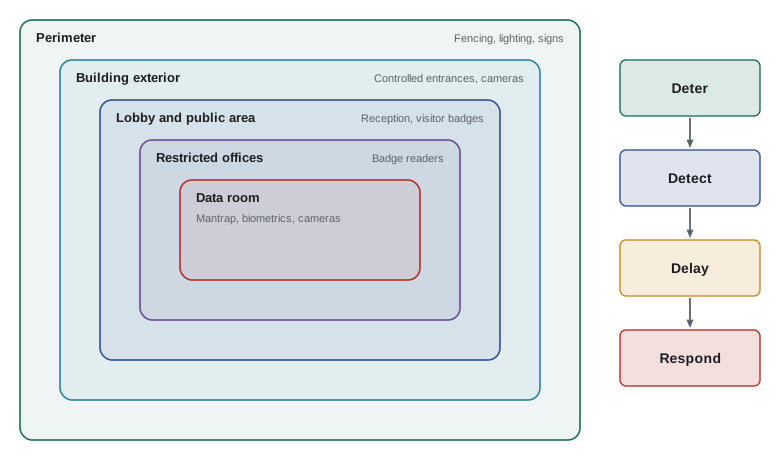
Site selection
Security begins with the choice of site, and the most effective time to influence it is before the lease is signed or the foundation is poured. Planners consider natural hazards, such as flood plains, earthquake zones, wildfire risk, hurricane or tornado exposure and severe winter weather; man-made hazards, such as nearby chemical plants, rail lines carrying dangerous goods, airports and high-crime areas; access to utilities, with diverse routes for electricity, water and telecommunications; proximity to emergency services, transport and staff; visibility, since a prominent sign announcing a data centre attracts attention; and the political, legal and regulatory environment, which affects data sovereignty. For critical facilities, a second site far enough away not to share the same disasters supports business continuity. Data centre operators often choose discreet, unmarked buildings set back from roads, with space for perimeter controls.
Crime prevention through environmental design
Crime prevention through environmental design, CPTED, uses the design of buildings and landscapes to discourage crime. It was developed in the 1970s by criminologist C. Ray Jeffery and architect Oscar Newman, among others, and rests on a few principles. Natural surveillance arranges spaces so that people can easily see and be seen, for example with windows overlooking parking areas, good lighting and low landscaping that offers no hiding places. Natural access control guides people towards controlled entrances using walkways, landscaping, fences and lighting, so that it is obvious where visitors should go and suspicious when someone goes elsewhere. Territorial reinforcement uses clear boundaries, signs and design features to show that space belongs to someone and is cared for, which encourages legitimate users to challenge strangers. Maintenance, sometimes linked to the broken windows idea, keeps the site in good repair, because neglect signals that nobody is watching.
CPTED works best combined with other measures. For example, a car park might have clear sight lines from a staffed reception, bright and even lighting, a single controlled vehicle entrance, signage and cameras. The design deters casual crime cheaply, and the technical controls handle determined attackers. Second-generation CPTED adds social factors such as community engagement, which matters for campuses and shared buildings.
Perimeter and exterior controls
At the perimeter, fences mark boundaries and delay intruders. Rough guidance often cited in study materials is that a fence about 1 metre or 3 to 4 feet high deters casual trespassers, about 2 metres or 6 to 7 feet is too high to climb easily, and about 2.4 metres or 8 feet topped with barbed or razor wire deters determined intruders. Gates, bollards and vehicle barriers stop vehicles; crash-rated barriers are tested against vehicles of specified weight and speed. Lighting should be continuous and even, avoiding dark patches and glare, and placed to support cameras. Security guards provide judgement, deterrence and response that technology cannot, but are expensive and need training and supervision; dogs are sometimes used at high-security sites. Signs warning of surveillance and prosecution add deterrence.
Building exteriors should limit the number of entrances, protect ground-floor windows, secure roof access and utility openings, and place sensitive rooms in the interior rather than against exterior walls. Loading docks are often the weakest point, because doors stay open and deliveries arrive constantly; they need separate controls, cameras and procedures so that delivery staff cannot wander into the building.
Entry control and doors
Entry control decides who may enter which areas. Badge systems using smart cards or mobile credentials grant access by zone and time and log every entry. Biometric readers, using fingerprints, hand geometry, iris or face, add strong assurance for sensitive areas and are discussed further in the identity domain. Mantraps, also called access control vestibules, have two interlocking doors so that only one person passes at a time and the second door opens only after the first closes and the person is verified. Turnstiles and security gates do a similar job for high-traffic lobbies. Tailgating or piggybacking, following an authorized person through a door, is the most common way to defeat entry control, and is addressed with mantraps, turnstiles, guards and staff training to challenge strangers.
Locks come in many forms: mechanical key locks, combination and cipher locks, and electronic locks controlled by the access system. Key control matters as much as the lock: who holds keys, whether they can be copied and what happens when they are lost. Electronic locks may be fail-safe, unlocking when power fails, which suits exit doors for life safety, or fail-secure, staying locked, which suits doors to sensitive rooms that are not on escape routes. Doors themselves should match their purpose: solid-core or metal doors, hinges on the secure side or with pins that cannot be removed, strike plates resistant to prying, and fire-rated doors where codes require them. A strong lock on a hollow door in a flimsy frame protects little.
| Control | Deters | Detects | Delays |
|---|---|---|---|
| Fencing and gates | Yes | No | Yes |
| Lighting | Yes | Supports cameras and guards | No |
| Guards | Yes | Yes | Yes, with response |
| Cameras | Yes | Yes, when monitored | No |
| Intrusion alarms | Somewhat | Yes | No |
| Locks and solid doors | Yes | No | Yes |
| Mantraps | Yes | Yes, with logging | Yes |
Surveillance and intrusion detection
Video surveillance, often still called closed-circuit television, deters crime, supports investigations and allows remote monitoring. Designers decide what each camera must achieve: detection of a person, recognition of a known individual or identification of a stranger, each needing more pixels on the target. Modern systems use network cameras with analytics that can alert on movement in restricted areas, and they must be secured like any other networked device, with changed default credentials, current firmware and segmentation, given the IoT risks described in lesson 7. Recordings must be retained long enough to support investigations and protected against tampering. Privacy law limits surveillance: cameras must not intrude where people have a reasonable expectation of privacy, and signs and policies should explain their use.
Intrusion detection systems for buildings use sensors such as magnetic door contacts, glass-break detectors, passive infrared motion sensors, vibration sensors and photoelectric beams. They raise alarms at a monitoring station, which dispatches guards or police. False alarms are a persistent problem; too many lead to alarms being ignored or to police charging for responses, so sensors must be well chosen and maintained. Alarm systems need backup power and protected communication paths so an intruder cannot defeat them by cutting a wire.
In Canada, building design must meet the National Building Code and National Fire Code as adopted, sometimes with changes, by each province and territory, and security features such as locked exit doors must comply with their rules on egress, including requirements for electromagnetic locks to release on fire alarm and power failure. Privacy commissioners have published guidance on video surveillance by organizations under PIPEDA and provincial laws, emphasizing a clear purpose, minimal intrusion and signs. The Canadian Centre for Cyber Security and Public Safety Canada publish guidance on physical security for critical infrastructure.
Worked problem
Checking delay against response time
An intruder must cross a fence (30 seconds), force an exterior door (90 seconds), cross a corridor (20 seconds) and defeat a server room door (120 seconds). Alarms trigger at the fence. Guards need 3 minutes to reach the server room. Is the design adequate, and what if the fence alarm is disabled so detection only happens at the exterior door?
Show solution
- With detection at the fence, remaining delay after detection = 30 + 90 + 20 + 120 = 260 seconds, more than the 180-second response: adequate.
- If detection starts at the exterior door, remaining delay = 90 + 20 + 120 = 230 seconds, still more than 180: adequate but with less margin.
- If detection only occurred at the server room door, remaining delay would be 120 seconds, less than 180: inadequate.
- Detection must happen early enough that the delay that remains exceeds response time.
Answer: Adequate in both cases given, with margins of 80 and 50 seconds. The principle is that detection must come early, so that delay after detection exceeds response time.
Worked problem
Applying CPTED to an entrance
A company's side entrance is hidden behind tall hedges, poorly lit, and used by smokers who prop the door open. Suggest CPTED and other improvements.
Show solution
- Natural surveillance: trim hedges below about 1 metre and add even lighting so the entrance is visible from reception and the street.
- Natural access control: guide visitors to the main entrance with paths and signs and make the side door exit-only for staff.
- Territorial reinforcement: mark the area as private staff space.
- Technical and administrative: add a door-held-open alarm and camera, and move the smoking area away from the door.
Answer: Improve visibility and lighting, steer visitors to the main entrance, mark the space as private and add a door-held alarm. CPTED removes the hiding places and the open door that made the entrance attractive.
Thinking like a manager
When a question asks for the most important consideration in physical security, the answer is almost always human safety. When it asks about the best time to address physical security, choose site selection and design rather than retrofits. When a scenario describes strangers following employees through doors, think mantraps, turnstiles and staff awareness. And remember that deterrence, detection and delay only work if someone can respond in time.
Common mistakes
MistakeLocking emergency exits to stop theft.
InsteadExits must allow escape; use alarms and cameras instead of locks that trap people.
MistakeTreating cameras as a delaying control.
InsteadCameras deter and detect but do not delay; pair them with barriers and response.
MistakePlacing the server room against an exterior wall by a loading dock.
InsteadLocate sensitive rooms in the building interior, away from entrances and hazards.
MistakePutting a strong lock on a weak door and frame.
InsteadDoors, frames, hinges and locks must all resist attack together.
MistakeLeaving network cameras with default passwords.
InsteadSecure physical security devices like any other networked system.
Summary and key terms
- Life safety always comes first, and security designs must meet building and fire codes.
- Physical security uses concentric layers that deter, detect, delay and allow response.
- Site selection weighs natural and man-made hazards, utilities, services, visibility and law.
- CPTED uses natural surveillance, natural access control, territorial reinforcement and maintenance.
- Fences, barriers, lighting, guards and secured exteriors and loading docks form the outer layers.
- Badges, biometrics, mantraps, locks and solid doors control entry; tailgating is the main threat.
- Surveillance and intrusion detection need good design, secure devices, privacy compliance and backup power.
- Concentric zones
- Layers of physical protection from perimeter to the most sensitive room.
- Deter, detect, delay, respond
- The functions physical controls perform together.
- CPTED
- Crime prevention through environmental design.
- Natural surveillance
- Designing spaces so people can easily see and be seen.
- Territorial reinforcement
- Design that shows space is owned and cared for.
- Mantrap
- A vestibule with interlocking doors that admits one person at a time.
- Tailgating
- Following an authorized person through a controlled entrance.
- Fail-safe lock
- A lock that unlocks when power fails, protecting life safety.
- Fail-secure lock
- A lock that stays locked when power fails.
- Passive infrared sensor
- A motion detector that senses changes in heat in its field of view.
Practice problems
Work each problem on paper first, then reveal the answer to check.
What is the top priority in physical security?
Show answer
The safety of people.
Name the four functions of physical controls.
Show answer
Deter, detect, delay and respond.
When is the best time to influence physical security?
Show answer
During site selection and design.
Name two man-made hazards to consider in site selection.
Show answer
Nearby chemical plants and rail lines carrying dangerous goods; others include airports and high crime.
What are the four classic CPTED principles?
Show answer
Natural surveillance, natural access control, territorial reinforcement and maintenance.
Roughly what fence height deters determined intruders?
Show answer
About 2.4 metres, or 8 feet, with barbed or razor wire.
Why are loading docks a weak point?
Show answer
Doors stay open and many outsiders arrive, so access is hard to control.
What does a mantrap prevent?
Show answer
Tailgating, by admitting one verified person at a time.
Should a server room door on no escape route be fail-safe or fail-secure?
Show answer
Fail-secure.
What three levels of camera image detail do designers specify?
Show answer
Detection, recognition and identification.
Lesson quiz · 5 questions
Score 60% or more to complete this lesson.
Create a free account to save your progress, take quizzes and earn a certificate.