
CISSP-112 · Lesson 2 of 12 · 28 min
Secure design principles II: zero trust, privacy by design and shared responsibility
The principles in lesson 1 are decades old. The ones in this lesson are newer responses to how computing has changed: users who work from anywhere, applications that live in several clouds, partners who connect directly to internal systems, and personal information that regulators expect to be protected by default. The 2024 exam outline names them explicitly in sub-domain 3.1: zero trust, privacy by design, trust but verify, shared responsibility and secure access service edge. Each answers a question that the old perimeter model could not.
The end of the trusted perimeter
For many years network security followed a castle-and-moat model. A strong perimeter of firewalls separated the trusted internal network from the untrusted internet, and anything inside was largely trusted. The model failed for three reasons. Attackers learned to get inside through phishing, stolen credentials and compromised suppliers, and once inside they moved laterally with little resistance. Users and data left the castle, to laptops at home, mobile phones and cloud services that the perimeter never covered. And the network itself became too large and porous to defend as one trusted zone. Many major breaches of the past fifteen years followed the same pattern: an initial foothold through a phished account or a vendor connection, followed by weeks of quiet movement across a flat internal network.
Zero trust
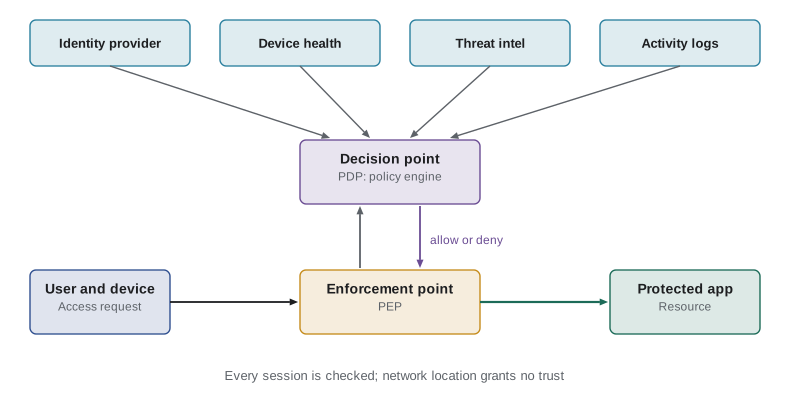
Zero trust replaces location-based trust with explicit verification. Its core idea is never trust, always verify: no user, device or workload is trusted simply because it is on the corporate network. Every request for access is evaluated on its own merits, using as much context as possible, and access is granted with least privilege for a limited session. The United States National Institute of Standards and Technology describes the architecture in Special Publication 800-207. A policy decision point, made up of a policy engine and a policy administrator, decides whether to allow each request; a policy enforcement point, such as a gateway or proxy in front of the resource, carries out the decision. Inputs to the decision include the identity of the user, the health and management status of the device, the sensitivity of the resource, the time and location of the request, threat intelligence and behaviour analytics.
Zero trust is not a product that can be bought in one box, despite marketing claims. It is a strategy that is usually adopted over years. Common building blocks include strong identity with phishing-resistant multifactor authentication, device inventory and health checks, micro-segmentation that limits which workloads can talk to each other, encryption of all traffic including internal traffic, continuous monitoring, and automation that can revoke a session the moment risk rises. Maturity models help organizations plan the journey. The US Cybersecurity and Infrastructure Security Agency publishes a Zero Trust Maturity Model organized around identity, devices, networks, applications and workloads, and data. The Canadian Centre for Cyber Security publishes guidance encouraging Government of Canada departments and other organizations to adopt zero trust principles in the same way.
Trust but verify
Trust but verify is an older phrase that the outline lists alongside zero trust. It describes granting trust where it is needed to get work done, then checking that the trust is not abused. Examples include logging and reviewing administrator actions, auditing a vendor's controls through a SOC 2 or ISO 27001 report, reconciling financial transactions and reviewing access rights periodically. Zero trust can be seen as the strict end of the same spectrum: it verifies before granting access, every time, while trust but verify relies more on after-the-fact detection. Real organizations use both. A finance system might require strong verification at login and then also review unusual payments afterwards.
Privacy by design
Privacy by design was developed in the 1990s by Ann Cavoukian when she was Information and Privacy Commissioner of Ontario, and it has since spread worldwide. It rests on seven foundational principles: be proactive, not reactive; make privacy the default setting; embed privacy into the design; keep full functionality, so that privacy and other goals are positive-sum rather than trade-offs; provide end-to-end security across the life cycle; maintain visibility and transparency; and respect the user by keeping their interests central. The European Union's General Data Protection Regulation turned the idea into a legal duty in Article 25, data protection by design and by default, and Canadian and US privacy regulators expect it too.
For an architect, privacy by design becomes concrete decisions. Collect only the data the purpose needs. Pseudonymize or aggregate data as early in the pipeline as possible. Set the most privacy-protective option as the default, so that users who do nothing are protected. Separate identifying data from other data so that a breach of one store does not reveal everything. Build in deletion from the start, because retrofitting deletion into a system that copies data everywhere is very hard. And carry out a privacy impact assessment when a design processes personal information in new ways.
Shared responsibility
Shared responsibility describes how security duties are divided between a cloud provider and its customer. The provider is always responsible for security of the cloud: the physical data centres, hardware, hypervisors and the global network. The customer is always responsible for security in the cloud for the parts it controls, and always for its own data, identities and access decisions. Where the line falls depends on the service model. With infrastructure as a service, the customer manages the operating system, middleware, applications and data. With platform as a service, the provider also manages the operating system and runtime. With software as a service, the provider runs almost everything and the customer manages users, configuration and data.
Misunderstanding the model is a leading cause of cloud breaches. Storage buckets left open to the internet, unpatched virtual machines and administrator accounts without multifactor authentication are customer failures, not provider failures. Contracts, the provider's responsibility matrix and independent assurance reports tell the customer exactly which controls it inherits and which it must operate. The same idea applies outside the cloud, to managed service providers and outsourcers, and lesson 7 returns to cloud architectures in detail.
| Layer | On premises | IaaS | PaaS | SaaS |
|---|---|---|---|---|
| Data and access | Customer | Customer | Customer | Customer |
| Application | Customer | Customer | Customer | Provider |
| Runtime and middleware | Customer | Customer | Provider | Provider |
| Operating system | Customer | Customer | Provider | Provider |
| Virtualization | Customer | Provider | Provider | Provider |
| Hardware and facility | Customer | Provider | Provider | Provider |
Secure access service edge
Secure access service edge, or SASE, is an architecture that delivers networking and security together as a cloud service close to where users are. The term was coined by the analyst firm Gartner in 2019. It combines software-defined wide area networking with security functions such as a secure web gateway, cloud access security broker, zero trust network access and firewall as a service. Instead of sending a remote user's traffic back to headquarters to pass through a central firewall, a practice called backhauling that adds delay, SASE inspects the traffic at the nearest point of presence of the provider and applies the same policy everywhere. Security service edge, or SSE, is the security half of SASE without the networking. For the exam, remember that SASE supports zero trust by applying identity-aware policy at the edge for users wherever they are.
Worked problem
Placing a control in the shared responsibility model
A company runs its customer database on a virtual machine in an infrastructure-as-a-service cloud. An auditor finds that the operating system has not been patched for six months and the storage volume is not encrypted. Who is responsible for each finding, and what should happen?
Show solution
- Under IaaS, the customer manages the guest operating system, so patching is the customer's duty.
- Encryption of the customer's data is always the customer's decision; the provider supplies the encryption feature but the customer must turn it on and manage keys or delegate key management.
- The provider remains responsible for the hypervisor and physical security, which the auditor did not question.
- Actions: adopt automated patching for the virtual machines and enable encryption at rest with a managed key service, then record the controls in the shared responsibility matrix.
Answer: Both findings belong to the customer. Under IaaS the provider secures the cloud itself, while the customer secures everything it builds and stores in it.
Worked problem
Scoring a zero trust access request
A policy engine scores each request out of 100 and allows access to the payroll application only at 70 or above. Points: phishing-resistant MFA 30, password only 10; managed and patched device 30, unmanaged device 0; usual country 20, new country 5; normal behaviour 20, anomaly detected 0. Score two requests: (a) MFA, managed device, usual country, normal behaviour; (b) password only, unmanaged device, new country, normal behaviour.
Show solution
- (a) 30 + 30 + 20 + 20 = 100, which is at least 70, so access is allowed.
- (b) 10 + 0 + 5 + 20 = 35, which is below 70, so access is denied.
- The engine can also offer a step-up: if request (b) completes phishing-resistant MFA, its score rises to 30 + 0 + 5 + 20 = 55, still below 70, so access is still denied until the device is enrolled.
Answer: Request (a) scores 100 and is allowed; request (b) scores 35 and is denied. Zero trust decisions combine several signals rather than relying on network location.
Thinking like a manager
When a scenario describes attackers moving freely once inside a network, the answer usually involves zero trust or segmentation. When it describes a new system collecting personal information, the answer often involves privacy by design or a privacy impact assessment before launch. When it describes a cloud breach caused by a misconfiguration, remember that configuration in the cloud is the customer's responsibility. And when an answer promises to deliver zero trust by buying a single product, be sceptical: zero trust is a strategy and an architecture, built step by step.
Adopting zero trust in stages
Most organizations cannot rebuild everything at once, so zero trust programs are usually phased around the protect surface: the small set of critical data, applications, assets and services that matter most. A typical first phase strengthens identity, moving all staff to single sign-on with phishing-resistant multifactor authentication such as FIDO2 security keys or passkeys, and building an inventory of devices with health checks. A second phase segments the network around the protect surface, so that payroll servers, for example, accept connections only from the payroll application tier and from administrators coming through a hardened access gateway. Later phases replace traditional virtual private networks with zero trust network access, which connects a user to a single application rather than to the whole network, encrypt internal traffic and automate responses, such as ending a session when a device falls out of compliance.
Measuring progress matters as much as buying tools. Useful indicators include the share of logins using phishing-resistant authentication, the share of devices that report health before connecting, the number of flat network zones remaining and the time taken to revoke access when an employee leaves. Leaders should expect some friction: legacy applications that cannot use modern authentication may need to sit behind a proxy, and operational technology in factories often cannot run agents at all. A realistic roadmap records these exceptions with compensating controls rather than pretending they do not exist.
Common mistakes
MistakeBelieving a single product can deliver zero trust.
InsteadZero trust is a strategy built from identity, device, network, application and data controls over time.
MistakeAssuming the cloud provider is responsible for customer data security.
InsteadData, identities and access always remain the customer's responsibility.
MistakeTreating privacy as a feature to add after launch.
InsteadPrivacy by design embeds protection from the start and makes it the default.
MistakeTrusting all traffic on the internal network.
InsteadVerify every request explicitly, whatever network it comes from.
MistakeConfusing SASE with a single firewall product.
InsteadSASE combines networking and several security services delivered from the cloud edge.
Summary and key terms
- The castle-and-moat perimeter failed as attackers got inside and users and data moved outside.
- Zero trust verifies every request explicitly, using identity, device health and context, and grants least privilege per session.
- NIST SP 800-207 describes policy decision points and policy enforcement points; CISA's maturity model guides adoption.
- Trust but verify grants needed trust and then checks it through logs, audits and reviews.
- Privacy by design, from Ontario's privacy commissioner, makes privacy proactive, embedded and the default.
- In the cloud the provider secures the cloud; the customer secures what it puts in it, always including data and access.
- SASE delivers networking and security together from the cloud edge to support zero trust for users anywhere.
- Zero trust
- A security model that never grants trust based on network location and verifies every request.
- Policy decision point
- The component that decides whether a request is allowed.
- Policy enforcement point
- The component that carries out the decision in front of a resource.
- Micro-segmentation
- Fine-grained separation of workloads to limit lateral movement.
- Trust but verify
- Granting trust where needed and checking it afterwards.
- Privacy by design
- Embedding privacy into systems from the start, with privacy as the default.
- Shared responsibility model
- The division of security duties between a cloud provider and its customer.
- Backhauling
- Routing remote traffic through a central site for inspection.
- SASE
- Secure access service edge: networking and security delivered as a cloud service.
- SSE
- Security service edge: the security functions of SASE without the networking.
Practice problems
Work each problem on paper first, then reveal the answer to check.
Why did the perimeter model fail?
Show answer
Attackers got inside and moved laterally, and users and data moved outside the perimeter.
What NIST publication describes zero trust architecture?
Show answer
SP 800-207.
Name four signals a zero trust policy engine might use.
Show answer
User identity, device health, location and time, behaviour analytics or threat intelligence.
How does trust but verify differ from zero trust?
Show answer
It relies more on checking after access is granted, while zero trust verifies before every access.
Who developed privacy by design?
Show answer
Ann Cavoukian, as Information and Privacy Commissioner of Ontario.
Which GDPR article requires data protection by design and by default?
Show answer
Article 25.
Under SaaS, what is the customer still responsible for?
Show answer
Its data, user accounts, access decisions and configuration.
Under IaaS, who patches the guest operating system?
Show answer
The customer.
What problem does SASE solve for remote users?
Show answer
It avoids backhauling traffic to headquarters by inspecting it at the nearest edge.
What is SSE?
Show answer
The security service functions of SASE without the networking component.
Lesson quiz · 5 questions
Score 60% or more to complete this lesson.
Create a free account to save your progress, take quizzes and earn a certificate.