
CINE-302 · Lesson 2 of 12 · 25 min
VFX breakdowns, budgets and bidding
Visual effects are expensive, and their cost depends less on how spectacular they look than on how many shots there are and how much work each shot demands. A single invisible fix can cost more than a dramatic explosion if it requires weeks of frame-by-frame paint. For this reason, productions plan visual effects through a structured process: a breakdown of the script, an estimate of the shots and their complexity, bids from vendors, and continuous tracking of shot counts and costs as the film evolves. Cinematographers rarely set VFX budgets, but their choices on set strongly influence them, and understanding the process helps a cinematographer make decisions that save money and protect quality. This lesson covers the VFX breakdown, shot complexity, bidding and vendor selection, how photography affects cost, incentives and tax credits, and tracking shots through production.
The VFX breakdown
The VFX breakdown begins when the VFX supervisor and producer read the script and identify every moment that might need visual effects. Each scene is listed with a description of the work, an estimated number of shots, and notes on methods: green screen, set extension, CG creature, crowd replication, wire removal, digital makeup and so on. As the director develops the film through storyboards, previs and location scouts, the breakdown is refined into a shot-by-shot list. Breakdowns also flag hidden work: a scene set in the 1950s on a modern street implies sign replacement and car removal; a night scene with fireworks may need digital fireworks for safety; a scene with a baby may require composite takes for working-hour limits. Cinematographers can contribute by noting where their approach changes the work, for example a long lens that compresses a background enough to avoid an extension, or a camera move that will require a 3D track.
Shot complexity
Vendors estimate the effort for each shot by complexity. Common factors include the duration of the shot in frames; whether the camera is locked off, panning on a tripod (a nodal move), or moving freely in space; the amount of roto and keying around hair, motion blur and transparent objects; whether CG elements are rigid, deforming or simulated; interaction such as shadows, reflections and splashes; the amount of the frame that changes; and the number of revisions expected. Many vendors group shots into tiers, from simple cleanup to hero shots with full CG characters. A locked-off two-second sign replacement might take a compositor a day, while a moving five-second shot with a creature interacting with water might take many artists several weeks.
| Tier | Typical work | Indicative effort |
|---|---|---|
| 1: simple | Locked-off cleanup, monitor replacement, small paint fixes | Hours to a few days |
| 2: moderate | Moving camera cleanup, green screen comps, sky replacement | Several days |
| 3: complex | Set extensions with 3D tracking, crowd tiling, digital makeup | One to several weeks |
| 4: hero | CG characters, simulations, full CG environments | Weeks to months, many artists |
Bidding and vendor selection
With a breakdown in hand, the VFX producer sends a bid package to several vendors. It typically includes the script pages or sequence descriptions, the shot list, storyboards or previs, reference images, the delivery format and colour pipeline, and the schedule. Each vendor returns a bid, usually broken down by shot or by sequence, with assumptions about methods, number of revisions, and what the production will supply, such as plates shot with certain data. The production compares bids for cost, schedule, quality and capacity, and often awards different sequences to different vendors according to their strengths: one company for creatures, another for environments, a third for cleanup. Large films may work with a dozen or more vendors. Bids are revisited as the film changes; shots are added, removed, re-scoped or merged, and contracts allow for these changes through rates and change orders.
Worked problem
Estimating a sequence budget
A sequence contains 30 shots: 12 tier 1 cleanups at an average of 1.5 artist days, 14 tier 2 green screen composites at 5 artist days, and 4 tier 3 set extensions at 15 artist days. A vendor charges a blended rate of $700 per artist day and adds 20 % for supervision, production management and review. Estimate the cost.
Show solution
- Tier 1: 12 × 1.5 = 18 artist days.
- Tier 2: 14 × 5 = 70 artist days.
- Tier 3: 4 × 15 = 60 artist days.
- Total: 148 artist days × $700 = $103,600.
- Add 20 %: $103,600 × 1.2 = $124,320.
Answer: About $124,000 for the sequence, with the four set extensions accounting for about 40 % of the artist time.
How photography drives cost
Many of the most effective VFX savings happen on set. Choices that typically reduce cost include:
- Locking off the camera or using nodal pans when movement is not important to the story, avoiding a full 3D track.
- Shooting clean plates and reference passes.
- Keeping green screen evenly lit, at a suitable level, and far enough from actors to avoid spill (Lesson 5).
- Avoiding unnecessary detail crossing the area to be replaced, such as fine hair or smoke in front of a screen, unless it is wanted.
- Using a shutter angle and frame rate agreed with the VFX team, so that motion blur matches CG.
- Capturing complete data: lens, focus distance, height, tilt, HDRIs and surveys (Lesson 7).
- Building enough of the set for actors to touch and stand on, so that interaction is real.
Conversely, choices that add cost include heavy smoke or rain in front of screens, wide lenses with strong distortion and no lens grids, shallow depth of field across a keyed edge without documentation, flares and flicker that must be recreated in CG, and improvised moves on scenes planned as locked-off. None of these are forbidden: a cinematographer may choose them for strong creative reasons, but should do so knowingly and in discussion with the VFX supervisor, so that the budget can absorb them.
Incentives and tax credits
Where visual effects work is done affects its cost, because many jurisdictions offer incentives for production and post-production labour. These incentives shape where films shoot and where VFX vendors build studios.
In Canada, productions may combine federal and provincial tax credits. The federal Film or Video Production Services Tax Credit is a refundable credit based on qualified Canadian labour, and the Canadian Film or Video Production Tax Credit applies to certified Canadian content productions; both are administered by the Canadian Audio-Visual Certification Office (CAVCO) and the Canada Revenue Agency. Several provinces add their own credits, and some include specific credits for digital animation and visual effects labour, such as the Ontario Computer Animation and Special Effects Tax Credit (OCASE), Quebec's credit for computer-aided special effects and animation, and British Columbia's Digital Animation, Visual Effects and Post-Production (DAVE) credit. These programs have helped make Vancouver, Montreal and Toronto major international VFX centres. Rates, eligibility rules and caps change with provincial and federal budgets, so producers verify current details with the program administrators and tax advisers.
For the cinematographer, the practical effect is that the VFX team may be spread across several countries and time zones, making clear documentation and consistent colour pipelines even more important.
Tracking shots through production
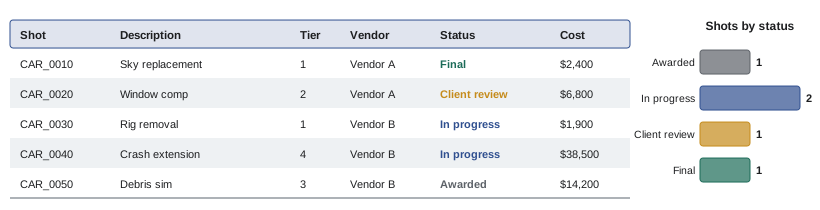
Once a film is in production, the VFX team maintains a shot tracking database, often in dedicated software such as ShotGrid (formerly Shotgun), ftrack or similar tools. Each shot has a unique identifier, usually combining sequence and shot numbers, such as "CAR_0040"; a description; a status; the assigned vendor; the plates, frame ranges and metadata; notes from reviews; and the bid and actual cost. On set, the VFX data team logs which takes belong to which shots and links camera reports, lens data, HDRIs and photographs. Cinematographers and camera assistants support tracking by slating clearly, marking VFX takes on camera reports, and communicating any changes in lenses, filters or frame rates. When the edit changes, the VFX producer updates shot counts and budgets, and the VFX supervisor reviews new cuts for shots that have become VFX shots unexpectedly, such as a take chosen for performance that contains a visible light stand.
Contingency and change
VFX budgets almost always change. Directors discover new ideas in the edit, performances are combined from different takes, test screenings prompt reshoots, and some shots prove harder than expected. Productions hold a contingency, and VFX producers forecast the final cost regularly. Late changes are especially expensive because they compress schedules, requiring more artists working overtime. Cinematographers can help by helping the director make decisions on set rather than deferring them to post ("we will fix it later"), by shooting alternatives where a VFX approach is uncertain, and by documenting enough data that a shot can be revisited later without a reshoot.
Reading a VFX bid as a cinematographer
Reading the assumptions in a VFX bid is useful preparation. Bids often specify the camera format and resolution, lens types, frame rates, whether plates will include clean passes, whether lens grids and HDRIs will be supplied, how many revisions are included, and the colour pipeline. If the cinematographer plans to use anamorphic lenses, high frame rates, heavy diffusion, practical smoke or handheld cameras on VFX shots, the bid should reflect that. Discussing the bid assumptions with the VFX supervisor before the shoot avoids surprises when shots arrive at vendors that do not match what was priced.
Scheduling effects work
VFX schedules run backwards from delivery. Once the release or broadcast date is fixed, producers work back through the final grade, the conform, the last VFX deliveries, the review cycles and the vendor's production time to find the date by which the edit must be locked for each sequence. Effects-heavy sequences are often edited first so that turnovers can begin early, and shots with long build times, such as creatures or fully digital environments, are started on assets during or even before principal photography. The shooting schedule is affected too: VFX-heavy days run slower because of data capture, reference passes and screen setups, and productions that underestimate this lose time on the day. A useful rule in planning is to add time for every effects setup, perhaps fifteen to thirty minutes, for clean plates, references and data, and to schedule the VFX data team's own work, such as LiDAR scans, after the shooting crew has wrapped a set.
Change orders and creative changes
Bids describe the work as it is understood at the time of the award. When directors change their minds, for example adding a creature to a shot, extending a sequence or changing a design after approval, vendors issue change orders that add cost and time. Cinematographers can help limit changes by testing looks early, getting approval on key frames before vendors commit to final rendering, and photographing plates that leave room for reasonable creative adjustment, for example by framing slightly wider than the final composition so that the shot can be repositioned. Clear records of what was approved, and when, protect both the production and the vendor.
Questions to ask before a bid is final
- Which shots share assets, environments or methods, and can they be bid together?
- Are the plates expected to need heavy cleanup, and could a change in photography reduce that?
- What data will be captured on set, and who pays for the data team?
- How many review rounds are included before changes become billable?
When comparing bids from several vendors, line up the same shots and the same assumptions side by side. A bid that seems much cheaper may assume fewer review rounds, simpler methods or plates delivered in better condition than the shoot can guarantee. Ask each vendor to state its assumptions in writing.
Common mistakes
MistakeAssuming spectacular shots are the most expensive.
InsteadRemember duration, camera movement and roto drive cost.
MistakeImprovising moves on shots bid as locked-off.
InsteadDiscuss changes with the VFX supervisor first.
MistakeIgnoring bid assumptions about data and plates.
InsteadRead them and deliver what was promised.
MistakeDeferring decisions to post.
InsteadDecide on set or shoot clear alternatives.
MistakeUnclear slates and camera reports on VFX takes.
InsteadMark VFX shots clearly to support tracking.
Summary and key terms
- VFX cost depends on shot count and complexity more than spectacle.
- The breakdown lists every VFX moment and is refined into a shot list.
- Complexity tiers reflect duration, camera movement, roto and CG work.
- Vendors bid on packages; productions often award work to several vendors.
- Photographic choices on set strongly affect VFX cost.
- Tax credits and incentives shape where VFX work is done.
- Shot tracking and contingency planning manage change through production.
- VFX breakdown
- List of all visual effects work in a script.
- Shot count
- Number of VFX shots in a film or sequence.
- Complexity tier
- Category of shot difficulty used for bidding.
- Bid package
- Information sent to vendors for pricing.
- Artist day
- One day of an artist's work, a unit for estimates.
- Nodal pan
- Camera rotation around the lens entrance pupil without parallax.
- Vendor
- A company that performs VFX work.
- Shot ID
- Unique identifier for a VFX shot.
- Shot tracking
- Database of VFX shots, status and data.
- Contingency
- Budget reserved for changes and overruns.
Practice problems
Work each problem on paper first, then reveal the answer to check.
What does a VFX breakdown contain?
Show answer
Each VFX moment, estimated shots and methods.
Name three factors in shot complexity.
Show answer
Duration, camera movement, roto, CG type, interaction.
Why award different sequences to different vendors?
Show answer
To match vendor strengths and capacity.
Cost of 50 artist days at $650 plus 15 %?
Show answer
$37,375.
Name two photographic choices that reduce cost.
Show answer
Locked-off or nodal moves, clean plates, even screens, full data.
Name two choices that add cost.
Show answer
Smoke in front of screens, strong distortion without grids, unplanned moves.
Which office certifies Canadian film tax credits?
Show answer
CAVCO.
Who sets production incentives in the US?
Show answer
Individual states.
What is a shot ID?
Show answer
A unique code such as CAR_0040.
Why are late changes expensive?
Show answer
They compress schedules and require overtime.
Lesson quiz · 5 questions
Score 60% or more to complete this lesson.
Create a free account to save your progress, take quizzes and earn a certificate.