
CINE-202 · Lesson 2 of 12 · 25 min
Measuring light: meters, grey cards and calculations
Before digital monitors made it possible to see an image on set, film cinematographers relied entirely on light meters, experience and calculation to know how a scene would be recorded. Digital tools such as waveforms and false colour have changed the job, but meters remain essential: they measure light independently of the camera's settings and monitoring chain, allow lighting to be planned and balanced before the camera is even set up, and give consistent, repeatable numbers that a whole crew can understand. This lesson covers incident and reflected metering, spot meters, units of light, the exposure equation, grey cards and reference charts, contrast and lighting ratios, metering for different situations, and how meters and in-camera tools complement each other.
Incident and reflected light
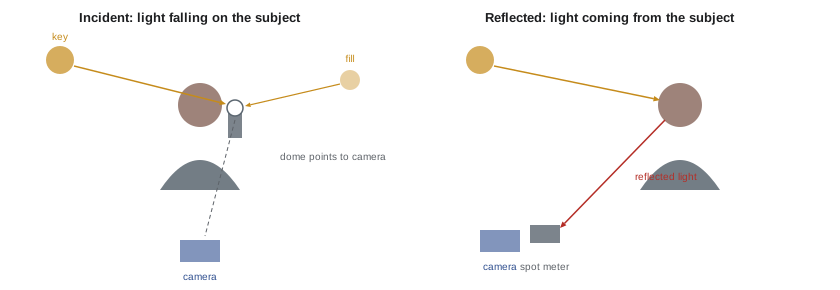
There are two fundamentally different ways to measure light. Reflected light meters measure the light coming from the subject toward the camera, which depends on both the illumination and the subject's reflectance: a black coat and a white wall in the same light give very different readings. Camera metering systems, and all in-camera exposure tools, are reflected measurements. Incident light meters measure the light falling on the subject, using a white translucent dome or flat disc placed at the subject's position and pointed toward the camera or the light source. Because incident readings ignore the subject's reflectance, they tell you the exposure that will render a middle grey subject as middle grey, so that dark subjects appear dark and light subjects appear light, as they should.
Incident metering is the traditional foundation of cinema exposure, because it measures the lighting that the cinematographer and gaffer control, and it gives consistent results regardless of costume, set dressing or skin tone. A hemispherical dome integrates light from a wide angle, roughly as a three-dimensional face would receive it; a flat disc measures light from one direction and is used to compare individual sources, such as key and fill.
Spot meters
A spot meter is a reflected meter with a very narrow angle of view, typically 1 degree, viewed through an eyepiece. It measures the brightness of a small area from a distance, such as a face across a street, the sky through a window, a practical lamp shade or a background wall. Cinematographers use spot meters to measure the brightness range of a scene: by spot-metering the brightest and darkest important areas and comparing them in stops, they can decide whether the range fits within the camera's latitude and where to place exposure. Spot readings must be interpreted: the meter suggests an exposure that would render the metered area as middle grey, so a reading from a white wall must be adjusted by about 2.5 stops to keep the wall white. Many modern meters combine incident and spot functions, display readings directly in T-stops for a set frame rate, shutter angle and EI, and can measure flash, colour temperature and flicker.
Units of light
Illuminance, the amount of light falling on a surface, is measured in lux (lumens per square metre) in the SI system and in foot-candles (lumens per square foot) in the traditional North American film industry. One foot-candle equals about 10.76 lux. Luminance, the brightness of a surface or a display as seen by the viewer or camera, is measured in candelas per square metre, also called nits, or in foot-lamberts in cinema projection. Typical values help build intuition:
| Situation | Illuminance (lux) | Foot-candles |
|---|---|---|
| Direct summer sun | 100,000 | About 9,300 |
| Overcast day | 1,000–10,000 | 93–930 |
| Bright office | 500 | About 46 |
| Typical living room | 50–200 | 5–19 |
| Street at night | 5–20 | 0.5–2 |
| Full moon | 0.1–0.3 | About 0.01–0.03 |
Lighting manufacturers specify fixture output in lux or foot-candles at a given distance, allowing gaffers to calculate how far a light can be from the subject for a desired exposure.
The exposure equation
An incident meter calculates exposure from the illuminance, the sensitivity and the exposure time using a standard relationship:
Here \(N\) is the T-stop, \(E\) the illuminance in lux, \(S\) the ISO or exposure index, \(t\) the exposure time in seconds and \(C\) a calibration constant, typically about 250 for incident meters with a flat receptor and between about 250 and 340 for domes, depending on the manufacturer. A useful rule of thumb in foot-candles is that at ISO 100 and an exposure time of about 1/50 s, roughly 100 foot-candles of incident light gives an exposure of about T2.8.
Worked problem
Calculating the stop for a lighting setup
A key light provides 1,600 lux on an actor's face. The camera is at EI 800, 24 fps with a 180-degree shutter (1/48 s). Using \(C = 250\), what T-stop gives a correct exposure? How would the stop change if the light were moved to double the distance?
Show solution
- Compute \(N^2 = (1600 \times 800 \times 1/48) / 250 = 26{,}667 / 250 \approx 107\).
- So \(N \approx 10.3\), about T10, a third of a stop under T11.
- Doubling the distance from a small source reduces illuminance to a quarter (inverse square law), which is 2 stops less light.
- The new stop would be about T5.
Answer: About T10 at the original distance, and about T5 at double the distance.
The inverse square law
For a small light source, illuminance falls with the square of distance: doubling the distance between light and subject reduces the light to a quarter, a loss of two stops; moving it 1.4 times farther loses one stop. This explains why a light close to a subject falls off quickly across a room, creating dark backgrounds, while a light farther away illuminates the subject and background more evenly. Large sources, such as big soft boxes and windows, deviate from the law at close range, and the sun is so far away that its intensity is effectively constant across a set. Gaffers use the law to set ratios, choose fixtures and control the relationship between subject and background brightness.
Grey cards and charts
A grey card, a flat card with a carefully controlled 18 % neutral reflectance, provides a reference for exposure and white balance. Placed in the scene at the subject's position and filmed at the start of a setup, it shows the colourist exactly how middle grey was recorded under that light, allowing accurate balancing in grading. On a waveform, the grey card should fall at the camera's published middle grey value for its log curve when exposure matches the meter. Colour charts, such as the X-Rite ColorChecker or DSC Labs charts, add patches of known colours and greys, used to check colour reproduction and match cameras. Many productions film a chart at the start of each lighting setup or scene so that grading and visual effects teams have a reliable reference. Charts must be lit evenly by the key light, without glare, and filled the frame sufficiently to be measured.
Contrast and lighting ratios
Lighting contrast is described by ratios between the key light and the fill, or between lit and shadow sides of a face. A ratio of 2:1, one stop of difference, gives soft, gentle modelling typical of commercials and comedies; 4:1, two stops, gives more definition and drama; 8:1 or more, three stops or more, gives strong, moody contrast associated with film noir and thrillers. Cinematographers measure ratios with incident meters using flat discs, or with spot readings of each side of the face. Ratios are planned with the camera's latitude and the intended grade in mind: a high-contrast look can be lit on set, created partly in the grade, or both. Other important ratios include the brightness of the background relative to the subject, the brightness of windows relative to interiors, and the brightness of practical lamps.
| Key-to-fill ratio | Stops | Typical feel |
|---|---|---|
| 1:1 | 0 | Flat, even |
| 2:1 | 1 | Soft, bright |
| 4:1 | 2 | Defined, natural drama |
| 8:1 | 3 | Moody, strong contrast |
| 16:1 | 4 | Very dramatic, low key |
Metering in practice
Typical metering practices include:
- Metering the key light on the actor's face with an incident dome pointed toward the camera, then setting the stop accordingly, adjusted for any creative intent.
- Measuring fill, back light and background separately with a flat disc or spot meter, to set ratios.
- Spot-metering windows, skies and practical lamps to decide whether they will clip and whether to add ND gels to windows or dim practicals.
- Walking the set with an incident meter to check evenness, for example across a wide shot or a dolly move, so that actors do not move through dark or hot areas unintentionally.
- Keeping a record of key readings for continuity, so that pickups and later scenes can be matched.
Meters must be set to the same frame rate, shutter angle and EI as the camera, and the camera's filters, such as ND and diffusion, must be accounted for. Some filters, particularly strong ND, have slight transmission differences from their nominal value, and diffusion filters and matte boxes can lose light.
Meters and in-camera tools together
With waveforms and false colour on every monitor, why use meters at all? Each tool has strengths. In-camera tools show exactly how the image is being recorded, including the effect of filters, lens transmission and camera settings, and they measure everything in the frame at once. Meters measure light independently of camera settings and monitoring LUTs, allow lighting to be set before the camera is ready or when it is moving between setups, and give a language for gaffers and electricians: "bring the key up to T4" or "the background needs another stop". Meters help predict exposure for situations that are hard to monitor, such as large sets, night exteriors where the camera will move, or multiple cameras. Many cinematographers light with a meter and confirm with false colour or a waveform, catching any surprises in the monitoring chain.
Common metering errors
Meter readings can mislead when the meter is held in the wrong place, such as near a reflective surface or shaded by the operator's body; when the dome points the wrong way; when settings do not match the camera; when light sources flicker; or when the colour of the light differs significantly from what the meter assumes. Spot readings mislead when the reflectance of the metered area is misjudged. Regular calibration checks, for example comparing the meter with the camera's waveform on a grey card, keep meters and cameras in agreement.
Metering colour temperature and flicker
Many modern meters measure more than brightness. Colour meters and spectrometers measure the colour temperature and tint of light sources, showing whether an LED panel, a tungsten lamp and daylight through a window match, and recommending gel corrections such as CTO (colour temperature orange) or CTB (colour temperature blue) and plus or minus green. Spectrometers also display the full spectrum and colour rendering metrics such as CRI, TLCI and TM-30, revealing sources with poor colour quality that may render skin unpleasantly even when they appear white to the eye. Flicker meters measure the rate and depth of brightness fluctuation in artificial lights, warning of sources that will cause banding at the chosen frame rate and shutter angle. These measurements are especially useful when mixing LED fixtures from different manufacturers, practical lamps and existing location lighting.
Metering for multiple cameras and moving shots
When several cameras shoot simultaneously from different angles, each sees a different side of the actors and set, so the lighting must work for every angle. Metering from each camera position, and checking key-to-fill ratios as seen from each, helps balance the setup. For moving shots, such as dolly moves and Steadicam walks, cinematographers meter along the path to find bright and dark areas, and gaffers add or remove light so that the actor's face stays at a consistent level, or changes deliberately as they move from one pool of light to another.
Common mistakes
MistakeUsing spot readings of white walls as exposure directly.
InsteadAdjust by about 2.5 stops for white surfaces.
MistakeForgetting the inverse square law when moving lights.
InsteadExpect two stops loss at double the distance.
MistakeMeter settings not matching the camera.
InsteadSet the same frame rate, shutter and EI.
MistakeSkipping the grey card or chart.
InsteadFilm references at each setup for grading.
MistakeRelying on meters alone.
InsteadConfirm with waveforms and false colour.
Summary and key terms
- Reflected meters measure light from the subject; incident meters measure light falling on it.
- Spot meters measure small areas to assess scene brightness range.
- Illuminance is measured in lux or foot-candles; luminance in nits or foot-lamberts.
- The exposure equation relates T-stop, illuminance, EI and time.
- Illuminance from a small source falls with the square of distance.
- Grey cards and charts give grading references.
- Lighting ratios in stops describe contrast and mood.
- Incident meter
- Meter measuring light falling on the subject.
- Reflected meter
- Meter measuring light coming from the subject.
- Spot meter
- Reflected meter with a narrow angle, usually 1 degree.
- Lux
- SI unit of illuminance.
- Foot-candle
- Imperial unit of illuminance, about 10.76 lux.
- Nit
- Candela per square metre, a unit of luminance.
- Inverse square law
- Illuminance falls with the square of distance.
- Grey card
- Card with 18 % neutral reflectance.
- Lighting ratio
- Ratio between key and fill light levels.
- Calibration constant
- Meter constant relating light to exposure.
Practice problems
Work each problem on paper first, then reveal the answer to check.
Why are incident readings independent of costume colour?
Show answer
They measure light falling on the subject, not reflected from it.
What angle does a typical spot meter use?
Show answer
About 1 degree.
How many lux is 50 foot-candles?
Show answer
About 538 lux.
Rule of thumb for T2.8 at ISO 100 and 1/50 s?
Show answer
About 100 foot-candles.
What happens to illuminance at double the distance?
Show answer
It falls to a quarter, 2 stops.
How far must a light move to lose one stop?
Show answer
About 1.4 times farther.
What does a grey card help the colourist do?
Show answer
Balance exposure and colour accurately.
Stops in a 4:1 ratio?
Show answer
2 stops.
Name two uses of a spot meter on set.
Show answer
Windows, skies, practicals, scene brightness range.
Why use meters with monitors?
Show answer
Independent of camera settings, plan lighting early, common language.
Lesson quiz · 5 questions
Score 60% or more to complete this lesson.
Create a free account to save your progress, take quizzes and earn a certificate.