
CHEM-211 · Lesson 2 of 12 · 28 min
Measurement, units and the laboratory balance
Classical analysis rests on two measurements, mass and volume. A titration is only as good as the mass of primary standard weighed to make the titrant and the volumes delivered by the burette and pipette; a gravimetric result is only as good as the weighings of sample and precipitate. This lesson examines the tools that make these measurements, how to use them, how to correct their small systematic errors, and how a number measured in an ordinary teaching laboratory connects, through an unbroken chain of comparisons, to the international definitions of the kilogram and the metre.
SI units and traceability
The International System of Units (SI) defines seven base units. Since the 2019 redefinition, all seven are fixed by assigning exact values to constants of nature: the kilogram through the Planck constant, the mole through the Avogadro constant (exactly 6.022 140 76 × 10²³ per mole), the kelvin through the Boltzmann constant, and so on. The mole is no longer tied to the mass of carbon-12, although for practical chemistry the difference is far below anything you will ever measure.
Traceability means that a measurement result can be related to a reference, usually an SI unit, through a documented, unbroken chain of calibrations, each with a stated uncertainty. Your laboratory balance is calibrated with test weights; the weights are calibrated against heavier-duty standards at a calibration laboratory; those are compared with national standards held by the national metrology institute; and the national standards are realized from the SI definition. When a laboratory reports 0.1023 M NaOH, traceability is what lets a regulator in another country trust the number.
In Canada the national metrology institute is the National Research Council (NRC), which also produces certified reference materials, and Measurement Canada regulates trade measurement.
The analytical balance
An analytical balance weighs up to about 100 to 200 g with a readability of 0.1 mg (0.0001 g); semi-micro balances read to 0.01 mg and microbalances to 1 µg. Modern balances use electromagnetic force restoration: the pan is held in place by a coil in a magnetic field, and the current needed to balance the load is proportional to its weight. Because the balance actually measures force, it must be calibrated with known masses at its location, and many balances contain an internal calibration weight that is applied automatically.
Good weighing practice is simple but easy to neglect:
- Level the balance with its bubble indicator and keep it on a heavy, vibration-free bench, away from drafts, doors and heating vents. Close the draft-shield doors before reading.
- Let objects reach room temperature before weighing. A warm crucible creates convection currents that make it read light, and a cold one condenses moisture and reads heavy.
- Handle dried objects with tongs or tissue, not fingers, because fingerprints add oil and moisture of tens of micrograms.
- Never weigh chemicals directly on the pan; use a weighing boat, paper or bottle, and clean up spills at once.
- Weigh hygroscopic or volatile substances in a closed weighing bottle and use weighing by difference.
Weighing by difference
To transfer an accurately known mass of a solid, weigh a capped bottle containing the solid, tip some solid into the receiving flask, and weigh the bottle again. The mass transferred is the difference. This method avoids errors from material left on a weighing paper and from moisture picked up during the transfer, because the material weighed is exactly the material delivered. Taring, by contrast, sets the display to zero with a container on the pan; it is convenient for routine work but each reading still has its own uncertainty.
Worked problem
Weighing by difference
A weighing bottle with potassium hydrogen phthalate (KHP) weighs 18.4316 g. After tipping solid into a flask it weighs 17.9184 g. What mass of KHP was transferred, and what is its uncertainty if each reading is uncertain by ±0.0001 g?
Show solution
- Mass transferred = 18.4316 − 17.9184 = 0.5132 g.
- For a difference, absolute uncertainties combine in quadrature (lesson 3): √(0.0001² + 0.0001²) = 0.00014 g.
Answer: 0.5132 ± 0.0001 g (0.5132 g with an uncertainty of about 0.14 mg).
Buoyancy
A balance is calibrated with dense steel weights (about 8.0 g/cm³), but most samples are much less dense. Every object on the pan is buoyed up by the weight of air it displaces. A low-density object displaces more air than the steel weights that would balance it, so it reads light. The correction is
where m′ is the balance reading, d_a is the density of air (about 0.0012 g/cm³ near sea level and room temperature), d_w is the density of the calibration weights (8.0 g/cm³) and d is the density of the object. For water (1.00 g/cm³) the true mass is about 0.1 % larger than the reading; for a dense metal it is negligible. Buoyancy matters when calibrating glassware with water and when weighing primary standards for the most accurate work; for most titrations its effect cancels or is far below other errors. Winnipeg and Minneapolis lie at modest elevations, so the air density there is close to the sea-level value, but at high altitude it is noticeably lower.
def true_mass(reading, d_obj, d_air=0.0012, d_wt=8.0):
    """Correct a balance reading (g) for air buoyancy."""
    return reading * (1 - d_air / d_wt) / (1 - d_air / d_obj)

items = [('water', 1.00), ('KHP solid', 1.636), ('sodium carbonate', 2.54), ('NaCl', 2.16), ('gold', 19.3)]
for name, d in items:
    m = true_mass(10.0000, d)
print(f"{name:17s} d = {d:5.2f} g/cm3 reading 10.0000 g -> true {m:.4f} g ({(m - 10) / 10 * 100:+.3f} %)")water d = 1.00 g/cm3 reading 10.0000 g -> true 10.0105 g (+0.105 %) KHP solid d = 1.64 g/cm3 reading 10.0000 g -> true 10.0058 g (+0.058 %) sodium carbonate d = 2.54 g/cm3 reading 10.0000 g -> true 10.0032 g (+0.032 %) NaCl d = 2.16 g/cm3 reading 10.0000 g -> true 10.0041 g (+0.041 %) gold d = 19.30 g/cm3 reading 10.0000 g -> true 9.9991 g (-0.009 %)
Volumetric glassware
Three kinds of glassware measure volume accurately. A volumetric flask contains a stated volume when filled to its etched mark at a stated temperature (usually 20 °C); it is used to prepare solutions of known concentration. A transfer (volumetric) pipette delivers a single fixed volume. A burette delivers variable, measured volumes and is the heart of a titration. Graduated cylinders, beakers and Erlenmeyer flasks are not measuring devices for analytical purposes; their marks are rough guides.
Glassware is marked TC (to contain) or TD (to deliver). A volumetric flask is TC: it holds the stated volume, but if you pour it out some liquid stays on the walls. A transfer pipette is TD: it is calibrated to deliver its volume when drained under gravity with the tip touched to the wall, leaving a small, reproducible drop in the tip that must not be blown out. Glassware is made in two tolerance classes; Class A is about twice as accurate as Class B and is used for analytical work.
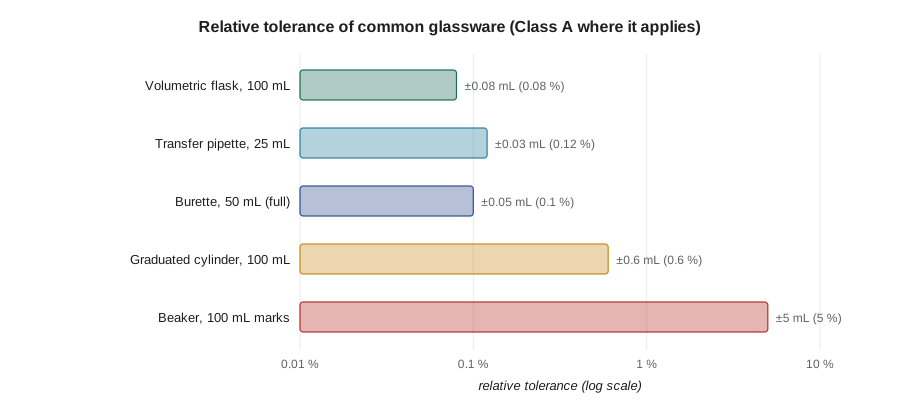
| Class A item | Volume | Typical tolerance | Relative |
|---|---|---|---|
| Volumetric flask | 100 mL | ±0.08 mL | 0.08 % |
| Volumetric flask | 250 mL | ±0.12 mL | 0.05 % |
| Transfer pipette | 10 mL | ±0.02 mL | 0.2 % |
| Transfer pipette | 25 mL | ±0.03 mL | 0.12 % |
| Burette | 50 mL | ±0.05 mL | 0.1 % at full scale |
Reading a burette
The surface of an aqueous solution in a glass tube curves downward to form a meniscus. Read the bottom of the meniscus with your eye level with it to avoid parallax. A burette is graduated in 0.1 mL divisions; estimate to 0.01 mL by interpolating between marks, and record every reading to two decimal places, including the initial reading (which should not be assumed to be 0.00). A card with a dark stripe held just behind and below the meniscus makes it much easier to see. Before use, rinse the burette with several small portions of the titrant, check that the stopcock does not leak, and remove the air bubble from the tip, because a bubble that escapes during the titration adds its volume to the reading.
A burette reading has a random uncertainty of about ±0.02 mL, and the delivered volume is the difference of two readings, so its uncertainty is about ±0.03 mL. A drop from a burette is about 0.05 mL. For a relative uncertainty of 0.1 % from reading alone, the titrant volume should be at least 30 mL, which is why titrations are designed to use most of a 50 mL burette.
Calibrating glassware
The tolerance is a manufacturer's guarantee, not the actual volume. For the most accurate work, glassware is calibrated by weighing the water it contains or delivers. Because water's density depends on temperature, and because the glass expands slightly when warm, tables give the volume of 1 g of water at each temperature, corrected for buoyancy and referred to 20 °C. At 20 °C, 1.0000 g of water read on a balance occupies 1.0029 mL; at 25 °C it occupies 1.0040 mL.
Worked problem
Calibrating a pipette
A 25 mL pipette delivers water that weighs 24.9563 g (balance reading) at 22 °C, where 1.0000 g of water occupies 1.0033 mL (buoyancy-corrected, referred to 20 °C). What volume does the pipette deliver?
Show solution
- Volume = 24.9563 g × 1.0033 mL/g = 25.0387 mL.
- Repeat at least three times; the mean is the calibrated volume, and the standard deviation shows how reproducibly you drain the pipette.
Answer: 25.039 mL, within the ±0.03 mL tolerance of a Class A pipette.
# Density of air-saturated water (g/mL) by a standard fit, valid about 5-40 C
def water_density(t):
    return 0.999974 - (t - 3.983) ** 2 * (t + 301.797) / (522528.9 * (t + 69.348))

def volume_per_gram(t, d_air=0.0012, d_wt=8.0, glass_alpha=1.0e-5):
    rho = water_density(t)
    mass_true = (1 - d_air / d_wt) / (1 - d_air / rho)    # buoyancy-corrected mass of a 1 g reading
    v_t = mass_true / rho                                   # volume at t
    return v_t * (1 - glass_alpha * (t - 20))               # refer the glass volume to 20 C

readings = [24.9563, 24.9581, 24.9549]
t = 22.0
f = volume_per_gram(t)
vols = [r * f for r in readings]
mean = sum(vols) / len(vols)
sd = (sum((x - mean) ** 2 for x in vols) / (len(vols) - 1)) ** 0.5
print(f"density at {t} C = {water_density(t):.5f} g/mL; 1 g reading -> {f:.4f} mL at 20 C")
print("volumes (mL):", ", ".join(f"{x:.4f}" for x in vols))
print(f"calibrated pipette volume = {mean:.3f} mL, s = {sd:.4f} mL")density at 22.0 C = 0.99777 g/mL; 1 g reading -> 1.0033 mL at 20 C volumes (mL): 25.0379, 25.0397, 25.0365 calibrated pipette volume = 25.038 mL, s = 0.0016 mL
Temperature and volumetric solutions
Liquids expand when warmed. Dilute aqueous solutions expand by about 0.02 % per degree near room temperature, so a solution prepared at 20 °C and used at 25 °C has a concentration about 0.1 % lower. In most teaching laboratories this is smaller than other errors, but in a laboratory that is cold in winter and warm in summer it can be significant, and organic solvents expand three to five times more than water. Glass expands much less (borosilicate glass about 0.001 % per degree) and is usually negligible.
Primary standards and standard solutions
A standard solution has a known concentration. It can be prepared directly by dissolving an accurately weighed amount of a primary standard and diluting to the mark in a volumetric flask, or indirectly by preparing an approximate solution and standardizing it by titration against a primary standard.
A primary standard is a compound pure enough to be weighed and used directly. It should be at least 99.9 % pure (with a certified purity), stable in air and on drying, not hygroscopic, readily soluble, of high molar mass so that weighing errors are relatively small, and react stoichiometrically and quickly with the analyte or titrant.
| Primary standard | Formula | Molar mass (g/mol) | Used to standardize |
|---|---|---|---|
| Potassium hydrogen phthalate (KHP) | KHC₈H₄O₄ | 204.22 | NaOH and other bases |
| Sodium carbonate | Na₂CO₃ | 105.99 | HCl and other strong acids |
| Tris(hydroxymethyl)aminomethane (TRIS) | (HOCH₂)₃CNH₂ | 121.14 | Strong acids |
| Calcium carbonate | CaCO₃ | 100.09 | EDTA |
| Sodium chloride | NaCl | 58.44 | Silver nitrate |
| Sodium oxalate | Na₂C₂O₄ | 134.00 | Potassium permanganate, cerium(IV) |
| Potassium iodate | KIO₃ | 214.00 | Sodium thiosulfate (via iodine) |
Sodium hydroxide is the classic example of a reagent that is not a primary standard. Its pellets absorb water and carbon dioxide from the air, so their mass does not correspond to a known amount of NaOH. A NaOH titrant is made approximately and then standardized against weighed KHP. Hydrochloric acid is similarly standardized against sodium carbonate or TRIS.
Worked problem
Preparing a standard directly
How much dried sodium chloride is needed for 250.0 mL of 0.05000 M NaCl, and what is the concentration if 0.7321 g is actually weighed?
Show solution
- Target: 0.2500 L × 0.05000 mol/L × 58.443 g/mol = 0.7305 g.
- Weigh close to this amount, but record the exact mass; it need not be exactly 0.7305 g.
- Actual: 0.7321 g ÷ 58.443 g/mol = 0.012527 mol; ÷ 0.2500 L = 0.05011 M.
Answer: Weigh about 0.73 g; the solution is 0.05011 M.
Drying and desiccators
Primary standards and samples for gravimetry are dried to constant mass, usually in an oven at 105 to 120 °C for a few hours, then cooled in a desiccator, a closed container holding a drying agent such as anhydrous calcium sulfate or silica gel. Constant mass means that successive heating and cooling cycles change the mass by no more than a small amount, typically 0.2 to 0.3 mg. Hot objects should be allowed to cool partly before going into the desiccator, and the lid should be slid rather than lifted.
Significant figures and rounding
Significant figures show the precision of a number: all certain digits plus the first uncertain one. A balance reading of 0.5132 g has four significant figures; a burette reading of 23.47 mL has four. In calculations, keep at least one or two extra digits until the final result and round only at the end; rounding intermediate results adds error. For a logarithm such as pH, only the digits after the decimal point are significant: [H⁺] = 2.0 × 10⁻³ M (two significant figures) gives pH 2.70. Lesson 3 replaces significant-figure rules with explicit uncertainties, which are more honest, but significant figures remain the everyday shorthand.
Common mistakes
MistakeAssume the burette starts at 0.00 mL.
InsteadAlways record the initial reading to two decimals; volume delivered is final minus initial.
MistakeBlow out the last drop from a transfer pipette.
InsteadA TD pipette is calibrated to leave that drop; touch the tip to the wall and let it drain.
MistakeWeigh NaOH pellets to make a standard base.
InsteadNaOH absorbs water and CO₂; make it approximately and standardize against KHP.
MistakeWeigh a warm crucible.
InsteadConvection makes it read light; cool it in a desiccator first.
MistakeUse a graduated cylinder to measure an aliquot for titration.
InsteadIts tolerance is several times worse; use a transfer pipette.
MistakeRound each step of a calculation.
InsteadCarry extra digits and round only the final result.
Summary and key terms
- SI units are now defined by fixed constants; traceability links results to SI through an unbroken chain of calibrations.
- The analytical balance reads to 0.1 mg; weighing by difference transfers an accurately known mass.
- Air buoyancy makes low-density objects read light, by about 0.1 % for water.
- Volumetric flasks contain, transfer pipettes deliver, and burettes deliver variable volumes; Class A tolerances are about 0.1 %.
- Glassware is calibrated by weighing water and converting with temperature-dependent tables.
- Primary standards are pure, stable, non-hygroscopic and of high molar mass; NaOH and HCl are standardized against them.
- Keep extra digits through calculations and round only at the end.
- Traceability
- The property of a result that relates it to a reference through documented calibrations with stated uncertainties.
- Weighing by difference
- Weighing a container before and after removing a portion of its contents.
- Buoyancy correction
- Adjustment of a balance reading for the air displaced by the object and the calibration weights.
- TC and TD
- To contain and to deliver: how a piece of glassware is calibrated.
- Class A
- The tighter tolerance class of volumetric glassware.
- Primary standard
- A pure, stable compound weighed directly to make a solution of known concentration or to standardize a titrant.
- Standardization
- Finding the exact concentration of a titrant by titrating a known amount of a primary standard.
- Constant mass
- The condition reached when repeated drying changes the mass by no more than a set small amount.
Practice problems
Work each problem on paper first, then reveal the answer to check.
A weighing bottle weighs 21.0874 g before and 20.6312 g after removing sodium carbonate. How many moles were removed?
Show answer
0.4562 g ÷ 105.99 g/mol = 4.304 × 10⁻³ mol.
Correct a reading of 25.0000 g of water for buoyancy (d_a = 0.0012, d_w = 8.0 g/cm³).
Show answer
m = 25.0000 × (1 − 0.00015)/(1 − 0.0012) = 25.0263 g.
A 10 mL pipette delivers 9.9688 g of water at 21 °C, where 1 g occupies 1.0030 mL. What is its volume?
Show answer
9.9688 × 1.0030 = 9.9987 mL.
Why is KHP preferred to oxalic acid dihydrate as a primary standard for NaOH?
Show answer
KHP is non-hygroscopic, stable on drying, monoprotic and has a high molar mass; oxalic acid dihydrate can gain or lose water of crystallization.
What is the minimum titrant volume if burette reading error (±0.03 mL for a delivered volume) is to be under 0.1 %?
Show answer
0.03/V ≤ 0.001, so V ≥ 30 mL.
Give the pH of a solution with [H⁺] = 3.47 × 10⁻⁵ M to the correct number of digits.
Show answer
pH = 4.460 (three significant figures give three decimal places).
Lesson quiz · 5 questions
Score 60% or more to complete this lesson.
Create a free account to save your progress, take quizzes and earn a certificate.