
CHE-446 · Lesson 5 of 12 · 21 min
Sizing vessels, columns and heat exchangers
A cost estimate is built from an equipment list, and an equipment list is built from sizes. Every vessel needs a volume and a diameter, every column a diameter and a height, every heat exchanger an area, every pump a flow and a head. In FEL-3 these sizes do not need to be final, because the detailed engineering contractor will refine them, but they need to be good enough that the cost of each item is known to within about 20 %. That calls for shortcut methods: quick, well-tested rules and correlations that give a size from the heat and material balance in minutes rather than days.
Lucia, the estimator, explains to Theo what she needs. For a vessel, the volume, the diameter, the design pressure and temperature and the material; from those she can estimate the shell weight, and the cost of a vessel scales roughly with its weight. For a column, the same, plus the type and volume of internals. For an exchanger, the area, the type, the materials of the shell and tubes and the design pressure. For a pump, the flow, head and power, and the material of the casing. She does not need nozzle schedules or support details yet, but she does need the materials right, because stainless steel costs several times as much as carbon steel.
Materials of construction
Materials are decided early because they drive cost. In the ester line, acetic acid is the corrosive component. Hot acetic acid attacks carbon steel quickly, so every item that sees acid above room temperature, including the pre-reactor, the reactive column and its reboiler, the acid recycle lines and the acid feed system, is specified in austenitic stainless steel, usually type 316L. The ester column, which sees only ester, ethanol and a little water, could in principle be carbon steel, but traces of acid carried over from the reactive column would cause corrosion and rust would contaminate the product. The team specifies 304L stainless for the ester column and the product system, a choice Dev in the laboratory also supports because it keeps iron out of the product. Storage tanks for the product are stainless or lined carbon steel; the acid tanks are stainless and heated.
Vessels and drums
Process vessels such as reflux drums, decanters, knock-out drums and surge tanks are sized from hold-up time. The designer decides how long the vessel should hold its liquid flow, so that the control system and the operators have time to react to a disturbance, and how full it should normally run. A reflux drum is commonly sized for about five minutes of liquid flow at half full; a feed surge drum for a column might hold ten to twenty minutes; a product rundown tank for several hours. Horizontal drums are used when liquid hold-up matters and vapour flow is modest; vertical drums when vapour disengagement matters. A length-to-diameter ratio of about 3 to 5 is usual for horizontal drums.
# Shortcut sizing of vessels, a column and heat exchangers for the ester line (illustrative data)
import math
# Reflux drum: liquid hold-up for 5 min at half full, horizontal, L/D = 3
L_m3_h = 6.0                      # reflux plus distillate liquid, m3/h
hold = L_m3_h * 5 / 60            # m3 of liquid in 5 min
V = hold / 0.5                    # vessel volume at half full
D = (4 * V / (math.pi * 3)) ** (1 / 3); Ld = 3 * D
print(f"reflux drum: hold-up {hold:.2f} m3, volume {V:.2f} m3, D {D:.2f} m, L {Ld:.2f} m")
# Ester column: diameter from CHE-350 flooding result, height from stages and packing HETP
stages, HETP = 20, 0.45           # structured packing
height = stages * HETP + 1.5 + 1.2 + 2.0   # packing + top disengagement + distributor + sump
print(f"ester column: packing {stages*HETP:.1f} m, overall about {height:.1f} m tangent to tangent, D 1.0 m")
# Shell-and-tube exchangers: A = Q / (U * F * LMTD)
def lmtd(th1, th2, tc1, tc2):
    d1, d2 = th1 - tc2, th2 - tc1
    return (d1 - d2) / math.log(d1 / d2) if abs(d1 - d2) > 1e-9 else d1
duties = [("product cooler, ester 78->35 C, water 25->35 C", 138, 78, 35, 25, 35, 450, 0.95),
          ("feed/effluent exchanger, 100->60 C vs 30->58 C", 52, 100, 60, 30, 58, 350, 0.90),
          ("ester column condenser, 72 C vs water 25->35 C", 925, 72, 71, 25, 35, 900, 1.00),
          ("reactive column reboiler, steam 143 C vs 97 C", 1450, 143, 143, 96, 98, 1100, 1.00)]
print("\nexchanger                                            Q kW   LMTD   U W/m2K   area m2")
for name, Q, a, b, c, d, U, F in duties:
    lm = lmtd(a, b, c, d); A = Q * 1000 / (U * F * lm)
    print(f"  {name:50s} {Q:5.0f}  {lm:5.1f}   {U:5.0f}    {A:6.1f}")
# Heuristics check: vessel volume, column L/D
print(f"\nester column height/diameter ratio {height/1.0:.0f} (keep below about 30)")reflux drum: hold-up 0.50 m3, volume 1.00 m3, D 0.75 m, L 2.25 m ester column: packing 9.0 m, overall about 13.7 m tangent to tangent, D 1.0 m exchanger Q kW LMTD U W/m2K area m2 product cooler, ester 78->35 C, water 25->35 C 138 22.6 450 14.3 feed/effluent exchanger, 100->60 C vs 30->58 C 52 35.7 350 4.6 ester column condenser, 72 C vs water 25->35 C 925 41.3 900 24.9 reactive column reboiler, steam 143 C vs 97 C 1450 46.0 1100 28.7 ester column height/diameter ratio 14 (keep below about 30)
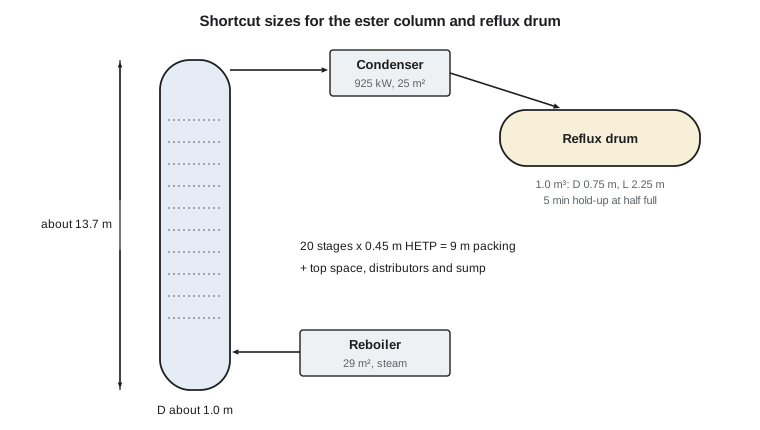
The ester column's reflux drum handles about 6 m³/h of liquid, reflux plus distillate. Five minutes of hold-up is 0.5 m³; at half full, the drum must hold 1 m³, which with a length to diameter ratio of 3 gives a drum about 0.75 m in diameter and 2.25 m long. That is a small vessel, and Theo spends no more time on it. The decanter needs more thought, because its job is to separate two liquid phases; in CHE-350 he used the settling velocity of droplets to find the area needed, and he carries that size, about 6 m³ with internals to help coalescence, into the equipment list.
Columns
Column diameter is set by the vapour flow. Too much vapour for a given area and the column floods, carrying liquid upward; too little and a tray column weeps or a packed column loses efficiency. In CHE-350 Theo used the Fair flooding correlation to find the diameter of the recovery column at 80 % of flooding. For the ester column, the vendor of the structured packing has supplied a capacity estimate, and the diameter comes out at about 1.0 m. Column height is the number of equilibrium stages times the height equivalent to a theoretical plate, HETP, for packing, or the number of real trays times the tray spacing, plus allowances. For structured packing of the type chosen, an HETP of about 0.45 m is typical in this service. Twenty stages need about 9 m of packing, and adding space above the packing for vapour disengagement, room for liquid distributors and redistributors, and a sump at the bottom brings the column to about 13.7 m tangent to tangent.
A useful check is the ratio of height to diameter. Tall, thin columns become difficult to support against wind and earthquakes, and above a ratio of about 30 the design usually needs special attention. The ester column's ratio is about 14, comfortably low. The reactive column is larger, about 1.3 m in diameter and about 18 m tall, because it holds both the catalytic packing of the reaction zone and the separation stages above and below it. Its size and the licensed packing make it the single most expensive item in the line.
Heat exchangers
The basic equation for exchanger sizing is the rate equation, \(Q = U A F \Delta T_{lm}\), where \(Q\) is the duty from the energy balance, \(U\) the overall heat transfer coefficient, \(A\) the area, \(\Delta T_{lm}\) the log mean temperature difference and \(F\) a correction factor for exchangers that are not in pure countercurrent flow. For shortcut design, \(U\) comes from tables of typical values for each service: roughly 300 to 900 W/(m² K) for organic liquids against water, about 800 to 1,500 for condensing organic vapours against water, and about 1,000 to 1,500 for steam heating a boiling organic liquid. These ranges are wide, and the estimator usually adds a margin, but they are good enough to set the area within the accuracy needed for FEL-3.
The code sizes four exchangers. The product cooler, which takes 138 kW from the ester while warming cooling water from 25 to 35 °C, has a log mean temperature difference of about 23 K and needs about 14 m². The feed and effluent exchanger, a small duty at a generous temperature difference, needs less than 5 m². The ester column condenser, 925 kW at a mean difference of about 41 K, needs about 25 m². The reactive column reboiler, 1,450 kW heated by steam condensing at about 143 °C, needs about 29 m². Theo notes that the steam pressure sets the reboiler's temperature difference: a lower-pressure steam main would need a larger reboiler, a trade-off between the cost of steam pressure and the cost of area.
Worked problem
Condenser area
The ester column condenser removes 925 kW at about 72 °C. Cooling water enters at 25 °C and leaves at 35 °C. With \(U = 900\) W/(m² K) and \(F = 1\), what area is needed?
Show solution
- \(\Delta T_1 = 72 - 35 = 37\) K; \(\Delta T_2 = 71 - 25 = 46\) K.
- \(\Delta T_{lm} = (46 - 37)/\ln(46/37) = 41.3\) K.
- \(A = 925{,}000 / (900 \times 41.3) = 24.9\) m².
Answer: About 25 m²; the estimator would add a margin and price a standard size.
Design margins
Every shortcut size carries uncertainty, and designers add margins. There are good reasons to do so: physical property data are uncertain, fouling reduces heat transfer over time, feed compositions vary, and the plant may later be pushed above nameplate. There are also bad reasons. If every engineer in a chain adds 10 or 20 % to be safe, the margins compound, and the plant ends up much larger and more expensive than it needs to be. Ingrid's rule is that margins are stated explicitly in the design basis, applied once, and justified. For the ester line, the design basis applies 10 % to heat exchanger areas for fouling, 20 % to pump flows for control, and no extra margin on column diameter beyond operating at 80 % of flooding.
Turndown is the other side of the margin question. A column sized with a large margin may not operate well at low rates; a pump sized for 120 % of design flow runs far from its best efficiency point at 70 %. Theo checks the main items at the 70 % first-year rate from lesson 3 and finds no problems except one: the product cooler, at 70 % of duty, would cool the ester well below the required temperature, which is harmless, and the cooling water control valve would run nearly closed, which is acceptable.
| Item | Size | Material | Basis |
|---|---|---|---|
| Pre-reactor | 2.9 m³ bed, 1.07 m diameter | 316L | CHE-345 design |
| Reactive column | About 1.3 m diameter, about 18 m tall | 316L | Vendor concept and CHE-350 |
| Ester column | 1.0 m diameter, about 13.7 m tall | 304L | Packing capacity and 20 stages |
| Water stripper | About 0.5 m diameter, 8 stages | 316L | CHE-350 |
| Decanter | About 6 m³ | 316L | Droplet settling, CHE-350 |
| Exchangers | Six, 5 to 30 m² each | 316L or 304L tubes | Rate equation with typical \(U\) |
| Reboilers | Three, about 10 to 30 m² | 316L | Steam at about 143 °C |
The equipment list is the bridge between the process design and the cost estimate. Each line carries a tag number, a description, the key size, the material, the design pressure and temperature, and a reference to the calculation or vendor quote behind it. Lucia will price each line in lesson 7. Theo's job is to make sure that nothing is missing. A common error in early estimates is to price the obvious equipment and forget the rest: the spare pumps, the sample coolers, the vent condensers, the nitrogen blanketing system, the tank heaters for the acid storage. Ingrid has him walk through the PFD stream by stream and ask, for each one, what equipment touches it.
Common mistakes
MistakeSpecifying carbon steel for hot acetic acid service.
InsteadHot acid corrodes carbon steel; stainless steel is needed, and it raises the cost.
MistakeStacking margins at every step.
InsteadState margins in the design basis and apply each one once.
MistakeSizing only the main equipment.
InsteadSpares, small coolers, vents and heaters belong on the equipment list too.
MistakeIgnoring height to diameter for tall columns.
InsteadAbove about 30, wind and seismic loads need special attention.
Summary and key terms
- FEL-3 sizes need to be good enough to price each item to about 20 %.
- Vessels are sized from hold-up time; columns from vapour capacity and stage count; exchangers from the rate equation.
- The ester column is about 1.0 m in diameter and 13.7 m tall; its condenser needs about 25 m².
- Materials of construction are fixed early because stainless steel costs several times as much as carbon steel.
- Margins should be explicit, justified and applied once.
- Hold-up time
- The time a vessel can hold its normal liquid flow, used to size drums.
- HETP
- The height of packing equivalent to one theoretical stage.
- Log mean temperature difference
- The effective temperature driving force in a countercurrent exchanger.
- Overall coefficient
- The heat transfer rate per unit area per kelvin, \(U\), including all resistances.
- Equipment list
- The list of every item of equipment with size, material and design conditions.
- Tangent to tangent
- The height of a vessel between the seams where the heads join the shell.
Practice problems
Work each problem on paper first, then reveal the answer to check.
How large is a reflux drum for 6 m³/h of liquid, 5 min hold-up, half full?
Show answer
About 1 m³.
Why is the ester column specified in stainless steel even though it sees little acid?
Show answer
Traces of acid would corrode carbon steel and rust would contaminate the product.
How tall is a packed section of 20 stages at an HETP of 0.45 m?
Show answer
9 m.
What happens to reboiler area if a lower-pressure steam main is used?
Show answer
The temperature difference falls, so the area rises.
Why should margins not be added at every step?
Show answer
They compound and make the plant larger and more expensive than needed.
Name three items often forgotten in early equipment lists.
Show answer
Spare pumps, sample coolers, vent condensers, nitrogen blanketing, tank heaters.
Lesson quiz · 5 questions
Score 60% or more to complete this lesson.
Create a free account to save your progress, take quizzes and earn a certificate.