
CHE-446 · Lesson 4 of 12 · 21 min
Heat integration and pinch analysis
With the balance in hand, Theo can list every stream that needs heating and every stream that needs cooling. In the first draft of the PFD, each of them has its own utility: steam for every heater and reboiler, cooling water for every cooler and condenser. That is simple, but it wastes energy whenever a hot stream that is being cooled could have heated a cold stream instead. Heat integration is the systematic search for those opportunities, and pinch analysis is the method most engineers use to find the best that can be achieved before designing any exchanger.
Energy matters for the ester line because it is the largest cost after raw materials. Steam at Sarnia costs the plant about 12 Canadian dollars per gigajoule in the illustrative cost basis, and the line's reboilers use about 2.4 MW. Running 8,400 hours a year, that is about 74,000 GJ and close to 0.9 million Canadian dollars a year. It is also most of the line's direct carbon dioxide emissions, because the steam comes from natural gas boilers.
Hot streams, cold streams and the minimum approach
Pinch analysis starts with stream data. A hot stream is one that must be cooled, from a supply temperature to a target temperature; a cold stream is one that must be heated. For each stream, the analysis needs the supply and target temperatures and the heat capacity flow rate, \(CP\), the mass flow times the specific heat, in kW per kelvin. A condensing or boiling stream is treated as a stream with a very large \(CP\) over a narrow temperature range. Heat can only flow from hot to cold, and to keep exchangers to a reasonable size, the designer chooses a minimum temperature difference, \(\Delta T_{min}\), that every match must respect. For liquid services in this kind of plant, 10 K is a common starting value.
Theo extracts eight streams from the balance. The hot streams are the ester product, cooled from 78 to 35 °C before storage; the stripper bottoms water, cooled from 100 to 40 °C before it leaves; the overhead vapour of the reactive column, condensed at about 70 to 72 °C; and the ester column overhead, condensed at about 71 to 72 °C. The cold streams are the reactor feed, heated from 30 to 75 °C; the reactive column reboiler at about 96 to 98 °C; the ester column reboiler at about 80 to 81 °C; and the stripper feed, preheated from 45 to 95 °C.
The problem table
The problem table algorithm, developed by Bodo Linnhoff and co-workers in the late 1970s, finds the minimum heating and cooling that any network can achieve. Hot stream temperatures are shifted down by half of \(\Delta T_{min}\) and cold stream temperatures up by the same amount, so that a hot and a cold stream at the same shifted temperature are exactly \(\Delta T_{min}\) apart. The shifted temperatures divide the range into intervals. In each interval, the heat surplus or deficit is the sum of hot \(CP\) minus cold \(CP\), times the interval width. Cascading the surpluses from the top down shows where heat must be added. The largest deficit is the minimum hot utility, and the point where the cascade has zero heat flow is the pinch.
# Problem table algorithm for the ethyl acetate line (illustrative stream data, dTmin = 10 K)
# (name, supply C, target C, CP kW/K); hot streams cool, cold streams heat
streams = [("H1 ester product",          78, 35, 3.2),
           ("H2 stripper bottoms water", 100, 40, 1.3),
           ("H3 reactive column vapour", 72, 70, 370.0),
           ("H4 ester column condenser", 72, 71, 925.0),
           ("C1 reactor feed",           30, 75, 3.9),
           ("C2 reactive column reboiler", 96, 98, 725.0),
           ("C3 ester column reboiler",  80, 81, 950.0),
           ("C4 stripper feed",          45, 95, 1.4)]
dTmin = 10.0
def shifted(s):
    n, a, b, cp = s
    hot = a > b
    d = -dTmin / 2 if hot else dTmin / 2
    return n, a + d, b + d, cp, hot
sh = [shifted(s) for s in streams]
temps = sorted({t for s in sh for t in (s[1], s[2])}, reverse=True)
cascade, heat = [], 0.0
for hi, lo in zip(temps, temps[1:]):
    net = 0.0
    for n, a, b, cp, hot in sh:
        top, bot = max(a, b), min(a, b)
        if top >= hi and bot <= lo: net += cp if hot else -cp
    heat += net * (hi - lo); cascade.append((hi, lo, heat))
qh = max(0.0, -min(h for *_, h in cascade))
qc = cascade[-1][2] + qh
pinch = [lo for hi, lo, h in cascade if abs(h + qh) < 1e-6]
total_hot = sum(cp * (a - b) for n, a, b, cp in streams if a > b)
total_cold = sum(cp * (b - a) for n, a, b, cp in streams if b > a)
print(f"total heating demand {total_cold:7.0f} kW, total cooling demand {total_hot:7.0f} kW")
print(f"minimum hot utility  {qh:7.0f} kW")
print(f"minimum cold utility {qc:7.0f} kW")
print(f"pinch (shifted)      {pinch[0] if pinch else 'none'} C  -> hot {pinch[0]+dTmin/2 if pinch else ''} C / cold {pinch[0]-dTmin/2 if pinch else ''} C")
print(f"heat recovered at minimum utilities {total_cold-qh:7.0f} kW")total heating demand 2646 kW, total cooling demand 1881 kW minimum hot utility 2441 kW minimum cold utility 1676 kW pinch (shifted) 67.0 C -> hot 72.0 C / cold 62.0 C heat recovered at minimum utilities 204 kW
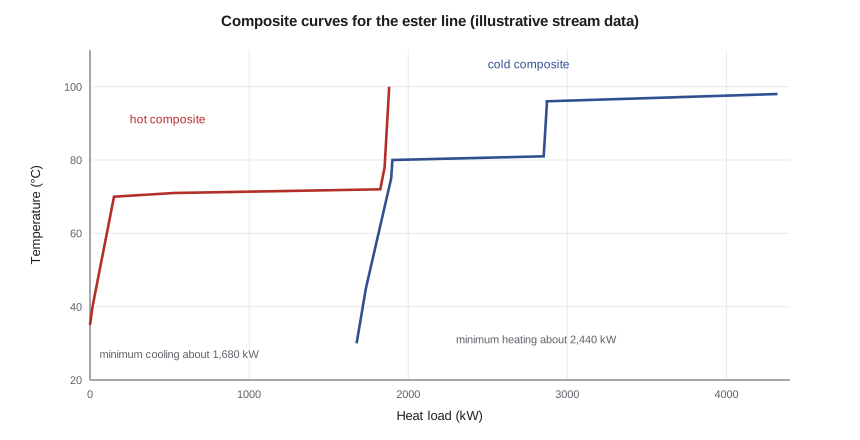
The result is sobering. The line needs 2,646 kW of heating and rejects 1,881 kW of cooling. The best possible network, with a 10 K approach, still needs 2,441 kW of steam and 1,676 kW of cooling water. Only about 200 kW can be recovered. The pinch sits at 72 °C on the hot side and 62 °C on the cold side. Almost all the heat available from hot streams is in the column condensers at 70 to 72 °C, and almost all the heat demand is in the reboilers at 80 to 98 °C. The heat that is rejected is too cold to supply the heat that is needed.
Composite curves and the three rules
The same information can be seen in the composite curves. The hot composite curve is built by adding the heat loads of all hot streams over each temperature interval and plotting temperature against cumulative heat; the cold composite curve is built the same way for the cold streams. Sliding the cold curve horizontally until it is \(\Delta T_{min}\) below the hot curve at the closest point shows the pinch, the heat that can be recovered where the curves overlap, the minimum hot utility at the top right and the minimum cold utility at the bottom left. For the ester line the curves barely overlap, which is the picture of a process whose heat is degraded through distillation.
The pinch divides the problem in two. Above the pinch, the process is a net heat sink; below it, a net heat source. Three rules follow, and they are among the most useful ideas in process design. Do not transfer heat across the pinch, from above to below, because every kilowatt transferred must be supplied again as extra steam and removed again as extra cooling. Do not use cold utility above the pinch. Do not use hot utility below the pinch. A network that breaks any of these rules uses more utility than the minimum, by exactly the amount of the violation.
Worked problem
A cross-pinch violation
The first draft of the PFD heats the stripper feed from 45 to 95 °C entirely with low-pressure steam. The stripper feed has \(CP = 1.4\) kW/K and the cold-side pinch is at 62 °C. How much steam is used below the pinch, and what does that cost the design?
Show solution
- Heat below the pinch: \(1.4 \times (62 - 45) = 23.8\) kW.
- That heat could have come from hot streams below the pinch, which otherwise go to cooling water.
- Using steam there adds about 24 kW to the steam use and 24 kW to the cooling water.
Answer: About 24 kW of steam is wasted; preheating the feed with the stripper bottoms water fixes it.
Designing the network
With the targets known, the network is designed in two parts, above and below the pinch. Above the pinch, cold streams are heated by hot streams or by steam; below it, hot streams are cooled by cold streams or by cooling water. Near the pinch, matches must obey a simple condition so that the temperature difference does not shrink below \(\Delta T_{min}\): above the pinch, a hot stream may only be matched with a cold stream whose \(CP\) is at least as large; below it, the reverse. For the ester line the network is small. The stripper bottoms preheat the stripper feed in a feed and effluent exchanger, and the hot ester product preheats part of the reactor feed. The remaining heating is steam and the remaining cooling is water. Two exchangers recover about 200 kW, which matches the target.
Pinch analysis is also a guide to choosing \(\Delta T_{min}\). A smaller approach recovers more heat but needs larger exchangers. Plotting total annual cost, the energy cost plus the annualized cost of the exchangers, against \(\Delta T_{min}\) gives an optimum, usually between 5 and 20 K for liquid services. For the ester line the recoverable heat is so small that the choice hardly matters, so the team keeps 10 K.
When exchange is not enough: changing the process
The composite curves say that the ester line cannot reduce its steam use much by rearranging exchangers. To do better, the process itself must change so that the heat rejected in the condensers is hot enough to be used. Pinch analysis suggests the options. One is to raise the pressure of a column so that its condenser runs hotter than another column's reboiler, which is called heat integration by pressure shifting. Another is a heat pump, such as mechanical vapour recompression, MVR, which compresses the overhead vapour of a column so that it condenses at a temperature high enough to boil the bottoms of the same column. In CHE-350 Theo estimated that compressing the ester column overhead from about 101 to 337 kPa would need about 45 kW of isentropic work for nearly 1 MW of reboiler duty, a coefficient of performance of about 8.
The third option looks beyond the ester line to the whole site. Kingfisher Bioenergy's ethanol plant heats large flows of process water and mash from about 30 °C up to the cooking temperature. Heat at 70 °C, useless inside the ester line, is valuable there. A loop of hot water could carry heat from the ester condensers to the cook-water heater, cutting both the ester line's cooling and the ethanol plant's steam. Analysing the whole site this way is called total site integration. Theo lists both ideas, MVR and the site water loop, as options to be costed in lesson 12, because each saves energy but adds capital and operating complexity.
| Option | Steam saved | Extra equipment | Comment |
|---|---|---|---|
| Feed and effluent exchangers | About 200 kW | Two small exchangers | Included in the base design |
| MVR on the ester column | About 950 kW, using about 60 kW of power | Compressor and drive | Costed as an option in lesson 12 |
| Hot water loop to the cook area | Up to about 1 MW at site level | Loop, exchangers, pumps | Depends on ethanol plant operation; studied after sanction |
| Raise reactive column pressure | Limited | Thicker column, higher reboiler temperature | Resin and packing temperature limits; rejected |
A final caution concerns operability. Every heat integration link couples two parts of the plant. If the ester line's condensers heat the ethanol plant's cook water, then a trip of the ester line becomes a disturbance in the cook area, and a shutdown of the cook area takes away the ester line's cooling. Integrated plants need backup utilities, bypasses and control strategies that keep each section running when the other is not. Carla points out that the ethanol plant has a planned shutdown every year, and the ester line would need full cooling water capacity then anyway. That does not kill the idea, but it means the cooling water system cannot be downsized to take credit for the integration.
Common mistakes
MistakeDesigning exchangers before setting energy targets.
InsteadTargets from the problem table show what is possible before any equipment is drawn.
MistakeTransferring heat across the pinch.
InsteadEvery kilowatt across the pinch adds a kilowatt of both heating and cooling.
MistakeExpecting exchangers to recover heat from low-temperature condensers.
InsteadWhen rejected heat is colder than demand, change the process: heat pumps, pressure shifts or site integration.
MistakeIgnoring operability of integrated units.
InsteadCoupled units need backups so each can run when the other is down.
Summary and key terms
- Pinch analysis finds the minimum hot and cold utilities from stream data before any network is designed.
- The problem table shifts temperatures by half of the minimum approach and cascades interval surpluses.
- For the ester line the minimum steam is about 2,440 kW and only about 200 kW can be recovered by exchange.
- Do not transfer heat across the pinch, use cold utility above it or hot utility below it.
- Heat pumps and site integration can do what exchangers cannot when rejected heat is too cold.
- Pinch
- The point of closest approach between the hot and cold composite curves, which limits heat recovery.
- Composite curve
- A plot of temperature against cumulative heat load for all hot or all cold streams.
- Minimum approach
- The smallest temperature difference allowed between hot and cold streams in an exchanger.
- Problem table
- An algorithm that calculates minimum utilities by cascading heat through temperature intervals.
- Heat pump
- A device that uses work to raise heat to a higher temperature, such as vapour recompression.
- Total site integration
- Heat integration across several plants on the same site.
Practice problems
Work each problem on paper first, then reveal the answer to check.
What does \(CP\) mean in pinch analysis?
Show answer
The heat capacity flow rate, mass flow times specific heat, in kW/K.
Why are hot temperatures shifted down and cold temperatures up by half of \(\Delta T_{min}\)?
Show answer
So that streams at the same shifted temperature are exactly \(\Delta T_{min}\) apart.
What happens if 50 kW is transferred across the pinch?
Show answer
Steam and cooling water both rise by 50 kW.
Why can the ester line recover so little heat by exchange?
Show answer
Its rejected heat is in condensers at about 70 °C, below the reboilers that need heat.
Name two ways to use condenser heat that is too cold for the reboilers.
Show answer
Vapour recompression and integration with the ethanol plant's cook water.
Why can the cooling water system not be downsized for site integration?
Show answer
The ester line still needs full cooling when the ethanol plant is shut down.
Lesson quiz · 5 questions
Score 60% or more to complete this lesson.
Create a free account to save your progress, take quizzes and earn a certificate.