
CHE-446 · Lesson 2 of 12 · 22 min
Flowsheet synthesis
Before anyone sizes a vessel, the team has to agree on what the plant is: which reactions, in what kind of reactor, followed by which separations, with which streams recycled. That set of choices is the flowsheet, and the activity of choosing it is called flowsheet synthesis or process synthesis. In FEL-2 the team at Kingfisher Bioenergy compared several flowsheets and chose one. Ingrid wants Theo to understand how that choice was made, because the FEL-3 report must defend it and because the same reasoning will be needed whenever the design changes.
The number of possible flowsheets for even a simple process is very large. There are choices of raw materials, catalysts, reactor types, operating conditions, separation methods, sequences of columns, recycle structures and energy integration schemes, and each choice multiplies the others. No team can design and cost them all. Flowsheet synthesis is therefore a set of methods for cutting the problem down: rules of thumb, hierarchical decision procedures and quick economic screens that eliminate poor options early and leave a few promising ones for detailed study.
The onion model
A useful picture of the structure of a process is the onion model. At the centre is the reactor, because the reaction determines what has to be separated. Around it is the separation and recycle system, which recovers the product and returns unconverted reactants. Around that is the heat recovery network, which matches hot streams that must be cooled with cold streams that must be heated. The outer layer is the utility system, which supplies whatever heating, cooling and power the inner layers still need, together with the offsites: storage, loading, effluent treatment and the services that connect the plant to the rest of the site.
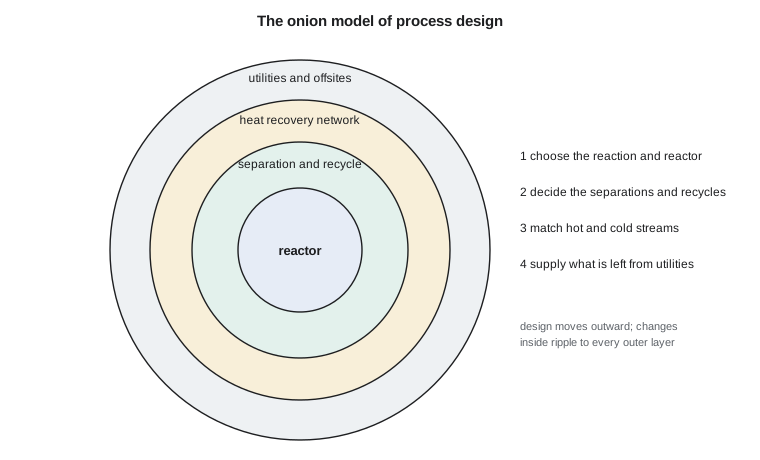
The onion model explains the order in which decisions are usually made. Change the reactor conversion and the separation duties change, which changes the heat loads, which changes the utilities. It also warns against optimizing the outer layers too early. Theo once spent a week on a heat exchanger network for a version of the purification train that was abandoned the following month. The heat exchangers had to be redone. The lesson is to fix the inner layers first, at least approximately, before refining the outer ones.
A hierarchy of decisions
A widely taught method for conceptual design is a hierarchical procedure associated with James Douglas, who described it in the 1980s. The designer works through a series of levels. At the first level, the choice is between a batch and a continuous process. At the second, the input and output structure of the flowsheet is fixed: which feeds enter, which products and by-products leave, and whether reactants are recycled or purged. At the third, the reactor and recycle structure is chosen. At the fourth, the separation system is designed. At the fifth, heat integration is added. At each level, the designer estimates the economic potential, the profit that remains after the costs identified so far, and drops options whose economic potential is already negative.
For the ester line, the first level is quick. At about 19,000 t/yr, continuous operation is the obvious choice: batch esterification is used for small specialty volumes, but at this scale continuous plants have lower labour and energy costs per tonne. The second level begins with stoichiometry. One acetic acid reacts with one ethanol to give one ethyl acetate and one water. Water is the only by-product of the main reaction, and small amounts of diethyl ether and other by-products are formed in side reactions.
The economic potential at the second level is the value of the products minus the cost of the raw materials, both per tonne of product. It ignores capital and utilities and so is an upper bound on what the plant can earn. If the second-level economic potential is negative, no amount of clever design will make the process profitable, and the study stops. If it is positive, the question becomes whether it is large enough to pay for capital and operating costs.
# Douglas level-2 economic potential: product value minus raw materials, versus overall acid yield
# Prices are illustrative (dollars per tonne); stoichiometry: acetic acid + ethanol -> ethyl acetate + water
M = {'acid': 60.05, 'eth': 46.07, 'ester': 88.11, 'water': 18.02}
price = {'acid': 700, 'eth': 750, 'ester': 1450}
print("atom economy", round(M['ester'] / (M['acid'] + M['eth']), 3))
def ep2(yield_acid, yield_eth):
    # per tonne of ester: tonnes of each raw material needed
    acid = M['acid'] / M['ester'] / yield_acid
    eth = M['eth'] / M['ester'] / yield_eth
    return price['ester'] - price['acid'] * acid - price['eth'] * eth, acid, eth
print("\noverall yields (acid, ethanol)   acid t/t  ethanol t/t   EP2 per t ester")
for ya, ye in [(1.00, 1.00), (0.989, 0.993), (0.99, 0.98), (0.98, 0.97), (0.95, 0.93), (0.90, 0.85)]:
    e, a, b = ep2(ya, ye)
    print(f"   {ya:.3f} {ye:.3f}                     {a:.3f}     {b:.3f}          {e:7.0f}")
# Three flowsheet alternatives: count of major columns and a rough relative capital index
alts = [("A  pre-reactor + reactive distillation + decanter + stripper", 3, 1.00),
        ("B  reactor + four-column conventional train", 5, 1.35),
        ("C  buy crude ester and purify only", 2, 0.55)]
print("\nalternative                                                  columns  relative capital")
for n, c, r in alts: print(f" {n:62s} {c} {r:.2f}")atom economy 0.83 overall yields (acid, ethanol) acid t/t ethanol t/t EP2 per t ester 1.000 1.000 0.682 0.523 581 0.989 0.993 0.689 0.527 573 0.990 0.980 0.688 0.534 568 0.980 0.970 0.695 0.539 559 0.950 0.930 0.717 0.562 526 0.900 0.850 0.757 0.615 459 alternative columns relative capital A pre-reactor + reactive distillation + decanter + stripper 3 1.00 B reactor + four-column conventional train 5 1.35 C buy crude ester and purify only 2 0.55
The atom economy of esterification is 83 %: of the mass of the two reactants, 83 % ends up in the product and 17 % in the water. With perfect yields, the raw materials for one tonne of ester cost about 870 Canadian dollars at the illustrative prices, leaving an economic potential of about 580 per tonne. The design achieves overall yields of about 98.9 % on acid and 99.3 % on ethanol, which lowers the potential only to about 573. Poorer yields cost real money: at 95 % and 93 %, the potential falls to about 526 per tonne, which across 19,000 tonnes a year is about a million Canadian dollars a year less. That is the reason so much effort in CHE-350 went into recovering acid and ethanol rather than sending them to wastewater.
Worked problem
Raw material cost per tonne
With overall yields of 98.9 % on acid and 99.3 % on ethanol, how many tonnes of each are needed per tonne of ethyl acetate, and what do they cost at 700 and 750 Canadian dollars per tonne?
Show solution
- Acid: \(60.05 / 88.11 / 0.989 = 0.689\) t/t; cost \(0.689 \times 700 = 482\).
- Ethanol: \(46.07 / 88.11 / 0.993 = 0.527\) t/t; cost \(0.527 \times 750 = 395\).
- Total raw materials \(\approx 877\) per tonne of ester.
Answer: About 0.69 t of acid and 0.53 t of ethanol, costing about 877 Canadian dollars per tonne of product.
Reactor and recycle structure
Esterification is limited by equilibrium. In CHE-345 Theo found that with a 1.2 to 1 ratio of ethanol to acid the equilibrium conversion of acid is only about 72 %. A once-through reactor therefore leaves a quarter or more of the acid unreacted, and the flowsheet has to recover and recycle it. There are three ways to deal with an equilibrium limit. The first is to use a large excess of one reactant, which drives conversion of the other but means a large recycle of the excess. The second is to remove a product as it forms, which shifts the equilibrium. The third is to accept a modest conversion per pass and recycle the unreacted feed. Most real flowsheets combine them.
The flowsheet chosen in FEL-2 uses the second and third ideas together. A small fixed-bed pre-reactor packed with acidic ion-exchange resin takes the feed most of the way to equilibrium. Its effluent goes to a reactive distillation column, in which a catalytic packing holds the reaction zone. Ethyl acetate, ethanol and water leave the top as the low-boiling ternary azeotrope, removing products from the reaction zone and driving conversion further, while acetic acid, the heaviest component, stays low in the column and keeps reacting. The overhead splits into two liquid layers in a decanter. The ester-rich layer goes to the ester column, which makes product from the bottom and returns an azeotropic mixture to the reaction section. The water-rich layer goes to a stripper that recovers dissolved ester and ethanol and sends clean water out.
Choosing between alternatives
In FEL-2 three alternatives survived the first screens. Option A is the flowsheet just described. Option B is a conventional design: a larger reactor followed by a train of four ordinary distillation columns to separate acid, ethanol, water and ester. Option C is to buy crude ethyl acetate from another producer and purify it to the customers' specification. The code output shows the number of major columns and a relative capital index for each, based on the FEL-2 factored estimates.
Option C has the lowest capital, but it fails the second-level test once a realistic crude ester price is used, because the margin between crude and refined ester is thin and the supply is uncertain. It also does nothing for the company's strategy, which is to add value to its own ethanol. Option B is a proven design that many plants use, but it needs more columns, more energy and about a third more capital. Option A is more compact and uses less energy, but reactive distillation is harder to design and to control, and its catalytic packing comes from a single licensor. The team chose Option A and recorded the reasons, including the technical risk, in the FEL-2 report. Part of FEL-3 is to confirm that risk is acceptable, with pilot data and a vendor guarantee for the packing.
| Criterion | A reactive distillation | B conventional train | C buy crude ester |
|---|---|---|---|
| Major columns | 3 | 5 | 2 |
| Relative capital | 1.00 | About 1.35 | About 0.55 |
| Energy use | Lowest | Highest | Low |
| Technical risk | Moderate: licensed packing, complex control | Low: proven design | Low technically, high commercially |
| Fit with strategy | Uses own ethanol | Uses own ethanol | Does not use own ethanol |
Heuristics that guide synthesis
Experienced designers carry a stock of rules of thumb. Remove corrosive or hazardous components early. Separate the largest component first if it is easy. Do the easiest separations first and the hardest last. Avoid separations that need extreme temperatures or pressures. Favour sequences that remove products as distillates rather than as bottoms where purity matters. Recycle reactants rather than purging them unless they are cheap or the recycle would build up inerts. These rules do not replace calculation, but they reduce the number of options to calculate. The ester flowsheet follows several of them: acid, the corrosive component, is confined to the reaction section and recycled within it, and the product is taken from a column whose job is a single clean split.
Recycle loops need a purge whenever a component enters with the feed or is made in the plant and has no other way out. Without a purge it accumulates until the plant cannot run. In the ester line, small amounts of diethyl ether and heavier esters form in side reactions; if they had no exit, they would build up in the recycle. The flowsheet sends them out with a small purge from the ester column, at a cost in lost ethanol that lesson 3 calculates. Inert impurities in the feeds, such as small amounts of water in the acid or higher alcohols in the ethanol, are handled the same way. Deciding where every component leaves the plant is one of the simplest and most useful checks on a flowsheet.
The flowsheet is drawn at this stage as a block flow diagram and then as a process flow diagram, a PFD, which shows each major item of equipment, the main lines and the key control loops, with a stream table listing flows, compositions, temperatures and pressures. Theo's PFD for the ester line has about forty numbered streams. Its stream table is generated from the material and energy balances in lesson 3, and every other discipline on the project, from piping to instrumentation, will work from it.
Common mistakes
MistakeOptimizing the heat exchanger network before the reactor and separations are settled.
InsteadInner layers of the onion drive the outer ones; fix them first.
MistakeSkipping the second-level economic check.
InsteadIf products are worth less than raw materials, nothing downstream can save the process.
MistakeForgetting a purge.
InsteadEvery component that enters or is made must have a way out, or it accumulates.
MistakeChoosing a flowsheet on capital alone.
InsteadEnergy, risk, raw material yield and strategy also count.
Summary and key terms
- Flowsheet synthesis chooses the reactions, reactor, separations and recycles that make up a process.
- The onion model orders design from the reactor outward to separations, heat recovery and utilities.
- A hierarchical procedure screens options level by level with economic potential.
- The ester line's second-level economic potential is about 573 Canadian dollars per tonne at the design yields.
- Reactive distillation was chosen over a conventional train for lower capital and energy, at some technical risk.
- Flowsheet
- The arrangement of reactors, separations and recycles that makes up a process.
- Onion model
- A picture of process structure with the reactor at the centre and utilities outside.
- Economic potential
- Product value minus the costs identified so far in a hierarchical design.
- Atom economy
- The fraction of reactant mass that ends up in the desired product.
- Purge
- A small stream removed from a recycle to stop components from accumulating.
- Process flow diagram
- A drawing of the major equipment and streams with a stream table.
Practice problems
Work each problem on paper first, then reveal the answer to check.
What is the atom economy of esterification of acetic acid with ethanol?
Show answer
About 83 %: \(88.11/(60.05 + 46.07)\).
Why is the reactor at the centre of the onion model?
Show answer
The reaction determines what has to be separated, recovered and heated or cooled.
Name three ways to deal with an equilibrium-limited reaction.
Show answer
Excess reactant, removing a product, and modest conversion with recycle.
Why did Option C fail?
Show answer
The margin between crude and refined ester is thin and supply uncertain, and it does not use the company's ethanol.
Why does the ester line need a purge?
Show answer
Side products such as diethyl ether would build up in the recycle without an exit.
What does a stream table show?
Show answer
Flows, compositions, temperatures and pressures for each numbered stream.
Lesson quiz · 5 questions
Score 60% or more to complete this lesson.
Create a free account to save your progress, take quizzes and earn a certificate.