
CHE-260 · Lesson 8 of 12 · 22 min
Atomic spectroscopy: AAS, ICP-OES and ICP-MS
Copper is limited in fuel ethanol to 0.1 milligrams per kilogram, one part in ten million. Copper catalyses oxidation of gasoline and leads to gums that foul fuel injectors, so the limit matters, and the plant's distillation and storage equipment contains enough brass and bronze fittings that copper can find its way in. Feed buyers also ask for the mineral content of distillers grains: phosphorus, sulfur, calcium, sodium, potassium and trace elements such as zinc and selenium. And the effluent permit lists metals that must be monitored. All of these are measured by atomic spectroscopy, which turns a sample into free atoms or ions and measures the light they absorb or emit, or counts the ions directly by mass.
Atomic spectra
Molecules absorb over broad bands because each electronic transition is smeared out by many vibrational and rotational levels. Free atoms have no vibrations or rotations, so they absorb and emit at sharp, narrow lines, each a fraction of a picometre wide and characteristic of one element. Sodium's bright yellow pair of lines near 589 nm is the familiar example. Because lines are narrow and element-specific, atomic spectroscopy can measure one element in the presence of many others with few spectral overlaps. The challenge is producing free atoms from a sample, which requires heat: a flame, an electrically heated graphite tube or a plasma.
Atomic absorption spectroscopy
In flame atomic absorption spectroscopy (AAS), a solution is sprayed as a fine mist into an air-acetylene flame at about 2300 °C, or a hotter nitrous oxide-acetylene flame for elements that form stable oxides, such as aluminium and silicon. The flame evaporates the solvent, breaks up the salts and produces free ground-state atoms. Light from a hollow cathode lamp, whose cathode is made of the element being measured, passes through the flame. The lamp emits the element's own narrow lines, exactly matched to the atoms' absorption, and the atoms absorb in proportion to their concentration, following the Beer-Lambert law from Lesson 6.
Flame AAS is simple, robust and inexpensive, and it is still widely used for elements at milligram-per-litre levels, such as calcium, magnesium, iron and zinc in water. Its limits are that it measures one element at a time, with a different lamp for each, and that most atoms pass through the flame in a few milliseconds, which limits sensitivity. Graphite furnace AAS solves the sensitivity problem by placing a few microlitres of sample in a small graphite tube heated electrically in stages: drying, ashing to remove the matrix, then atomizing at up to about 2700 °C. The atoms stay in the light path much longer, and detection limits improve by a factor of a hundred or more, reaching micrograms per litre.
Interferences in atomic spectroscopy
| Type | Cause | Remedy |
|---|---|---|
| Chemical | Analyte forms a stable compound that does not atomize, such as calcium phosphate | Hotter flame, releasing agent such as lanthanum |
| Ionization | Easily ionized elements such as sodium and potassium lose electrons in hot sources | Add an excess of another easily ionized element |
| Spectral | Another element's line or a molecular band overlaps the analyte line | Choose another line, correct for background |
| Matrix | Viscosity, dissolved solids or organic solvent change how much sample reaches the source | Matrix-matched standards, internal standards, standard additions |
Background absorption from smoke, particles and molecular species in the flame or furnace adds to the analyte signal. AAS instruments correct for it with a continuum source, a deuterium lamp whose broad emission measures the background alone, or with the Zeeman effect, in which a magnetic field splits the atomic line so that the analyte and background can be measured separately.
Inductively coupled plasma optical emission spectrometry
An inductively coupled plasma (ICP) is a stream of argon gas heated by a radio-frequency coil until it ionizes and forms a plasma, a glowing gas of ions and electrons at about 6,000 to 10,000 K, far hotter than any flame. The sample is nebulized into a fine mist, a spray chamber removes the larger droplets, and the remaining aerosol is carried into the centre of the plasma. At these temperatures almost every molecule breaks apart, most elements are atomized and ionized, and many of the atoms and ions are excited and emit light at their characteristic lines.
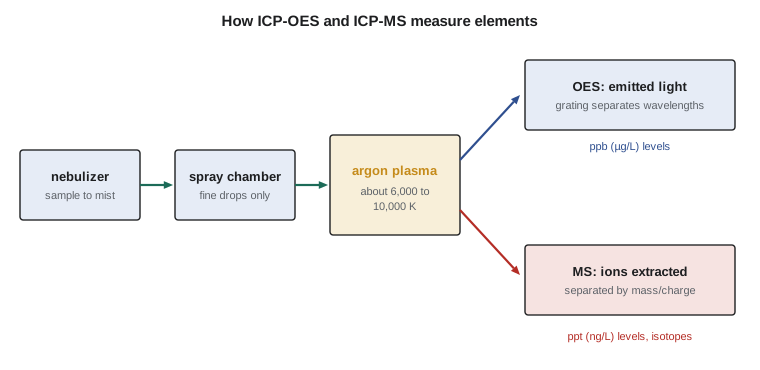
In ICP optical emission spectrometry (ICP-OES), the emitted light is dispersed by a grating spectrometer onto a solid-state detector that records many lines at once. The result is simultaneous measurement of 20 to 60 elements in a minute or two, with detection limits around a microgram per litre for many elements. The plasma's high temperature reduces chemical interferences, and the calibration is linear over four to six orders of magnitude, so major and trace elements can be measured in the same run. The plasma can be viewed side-on (radially), which tolerates difficult matrices, or end-on (axially), which gathers more light and gives lower detection limits.
ICP-OES is the plant's workhorse for minerals in distillers grains and for metals in water. Organic solvents such as ethanol can be introduced directly, but they load the plasma heavily, so methods for fuel ethanol use reduced sample flow, a chilled spray chamber and an added oxygen flow to burn off carbon, or they dilute the sample in a more tolerant solvent.
Inductively coupled plasma mass spectrometry
In ICP mass spectrometry (ICP-MS), the ions formed in the plasma are drawn through small apertures in a pair of cones into a high-vacuum mass spectrometer, which separates them by their mass-to-charge ratio and counts them. Detection limits reach nanograms per litre, parts per trillion, for most elements, about a thousand times lower than ICP-OES, and individual isotopes can be measured, which allows isotope dilution, one of the most accurate calibration methods known.
ICP-MS has its own interferences. Polyatomic ions formed from argon, the sample matrix and the solvent can have the same nominal mass as an analyte: argon chloride at mass 75 overlaps arsenic, and argon oxide at mass 56 overlaps the main iron isotope. Modern instruments use a collision or reaction cell, a chamber filled with helium or a reactive gas placed before the mass analyzer, that breaks up or shifts the polyatomic ions while letting the analyte through. ICP-MS is also less tolerant of dissolved solids than ICP-OES, so samples are usually diluted more.
| Technique | Typical detection limits | Elements per run | Typical use at the plant |
|---|---|---|---|
| Flame AAS | About 1 to 100 µg/L | One | Quick checks of calcium, magnesium and iron in water |
| Graphite furnace AAS | About 0.01 to 1 µg/L | One | Trace lead or cadmium in a few samples |
| ICP-OES | About 0.1 to 10 µg/L | Many at once | Minerals in grains, metals in water, copper in ethanol |
| ICP-MS | About 0.001 to 0.1 µg/L | Many at once | Ultra-trace metals, selenium, arsenic |
Preparing samples for atomic spectroscopy
Atomic spectroscopy needs the sample in solution, free of particles that would block the nebulizer. Water samples for dissolved metals are filtered and acidified; for total metals, they are digested with acid. Solid samples such as distillers grains are digested with nitric acid, often with hydrogen peroxide, in sealed vessels heated by microwaves. The closed vessels reach temperatures well above nitric acid's normal boiling point, destroying organic matter in under an hour while preventing losses of volatile elements such as mercury and selenium. Every batch includes digestion blanks to catch contamination and a certified reference material, such as a feed or plant tissue standard, to check recovery.
Calibration by standard additions
When the sample matrix affects the signal, standards made in pure acid may not match the sample. Ethanol, for example, changes how efficiently the nebulizer produces fine droplets. The method of standard additions solves this by calibrating in the sample itself. Equal portions of the sample are spiked with increasing known amounts of analyte and diluted to the same volume. The signal is plotted against the added concentration, and the line is extrapolated back to zero signal. The magnitude of the x-intercept is the concentration of analyte in the measured solution:
where a is the intercept and b the slope. Because every point contains the same matrix, matrix effects that change the slope affect the standards and the sample equally and cancel. An alternative is the internal standard method, in which an element not present in the samples, often yttrium or scandium, is added to every sample and standard, and the analyte signal is divided by the internal standard signal to correct for drift and matrix effects.
Worked problem
Copper in fuel ethanol by standard additions
Four 10.0 mL portions of a fuel ethanol sample are spiked with 0, 1, 2 and 3 mL of a 0.100 mg/L copper standard and made to 20.0 mL. The ICP-OES signals are 1520, 3040, 4580 and 6070 counts. Find the copper in the sample.
Show solution
- Added copper in each flask: \(0, 0.005, 0.010, 0.015\) mg/L (for example, \(1.0 \times 0.100/20.0 = 0.005\)).
- A least-squares fit gives slope 303,800 counts per mg/L and intercept 1524 counts.
- x-intercept: \(1524/303{,}800 = 0.0050\) mg/L in the flask.
- The flask contains a twofold dilution of the sample: \(0.0050 \times 20.0/10.0 = 0.010\) mg/L.
Answer: The sample contains about 0.010 mg/L copper, or about 0.013 mg/kg using the ethanol density, roughly one-eighth of the 0.1 mg/kg limit.
The program below repeats this calculation and estimates the method's detection limit from ten blank readings.
# Standard additions for copper in fuel ethanol by ICP-OES, and a detection-limit check
# Four 10.0 mL aliquots of sample, spiked with 0, 1, 2 and 3 mL of 0.100 mg/L Cu, made to 20.0 mL
spike_mL = [0.0, 1.0, 2.0, 3.0]
std_conc = 0.100      # mg/L
final_mL, aliquot_mL = 20.0, 10.0
added = [v * std_conc / final_mL for v in spike_mL]     # mg/L added in each flask
signal = [1520, 3040, 4580, 6070]                       # emission counts at 324.754 nm
n = len(added); xm = sum(added) / n; ym = sum(signal) / n
b = sum((x - xm) * (y - ym) for x, y in zip(added, signal)) / sum((x - xm) ** 2 for x in added)
a = ym - b * xm
x_int = a / b                       # magnitude of the x-intercept, mg/L in the flask
sample = x_int * final_mL / aliquot_mL
print(f"slope = {b:,.0f} counts per mg/L, intercept = {a:,.0f} counts")
print(f"copper in flask = {x_int * 1000:.1f} ug/L, in sample = {sample:.3f} mg/L")
print("meets 0.1 mg/kg limit (density 0.79):", sample / 0.79 < 0.1)

# Detection limit from ten blank readings
blanks = [42, 55, 38, 61, 47, 50, 44, 58, 39, 53]
m = sum(blanks) / len(blanks)
s = (sum((x - m) ** 2 for x in blanks) / (len(blanks) - 1)) ** 0.5
print(f"blank s = {s:.1f} counts, LOD = {3 * s / b * 1000:.2f} ug/L in solution")slope = 303,800 counts per mg/L, intercept = 1,524 counts copper in flask = 5.0 ug/L, in sample = 0.010 mg/L meets 0.1 mg/kg limit (density 0.79): True blank s = 8.0 counts, LOD = 0.08 ug/L in solution
Standard additions has a cost: each sample needs several measurements, and the extrapolation magnifies errors, so the precision is somewhat worse than for an external calibration. The lab uses it for difficult matrices and to validate external calibrations, then switches to external calibration with an internal standard for routine samples once it has shown the two agree.
Sulfur and other elements by other routes
Not every element in the fuel specification is measured by atomic spectroscopy. Sulfur in fuel ethanol, limited to 10 mg/kg in the US and controlled under similar low limits in Canada, is usually measured by ultraviolet fluorescence: the sample is burned in oxygen, the sulfur becomes sulfur dioxide, and ultraviolet light makes the sulfur dioxide fluoresce in proportion to its amount. X-ray fluorescence is another option for sulfur and many metals in solids and liquids, needing almost no sample preparation. Inorganic chloride and sulfate in ethanol are measured by ion chromatography, covered in Lesson 10.
Common mistakes
MistakeUsing standards in dilute acid to calibrate copper in undiluted ethanol.
InsteadMatch the matrix, use an internal standard, or use standard additions.
MistakeAssuming ICP-MS results are free of interferences because it measures mass.
InsteadPolyatomic ions can overlap analyte masses; use collision or reaction cells and check isotopes.
MistakeDigesting grains in open beakers for selenium and mercury.
InsteadUse closed-vessel microwave digestion to prevent losses of volatile elements.
MistakeForgetting the dilution in a standard additions calculation.
InsteadThe x-intercept gives the concentration in the measured flask; multiply by the dilution factor.
Summary and key terms
- Free atoms absorb and emit at narrow, element-specific lines, so atomic spectroscopy is highly selective.
- Flame AAS measures one element at a time at milligram-per-litre levels; graphite furnace AAS reaches micrograms per litre.
- An argon plasma at 6,000 to 10,000 K atomizes and excites nearly every element.
- ICP-OES measures many elements at once by their emission lines; ICP-MS counts ions and reaches parts per trillion.
- Chemical, ionization, spectral and matrix interferences are controlled by method design and calibration choice.
- Standard additions and internal standards correct for matrix effects.
- Hollow cathode lamp
- A lamp whose cathode contains the analyte element, emitting its characteristic narrow lines for AAS.
- Atomic absorption spectroscopy
- Measuring the absorption of element-specific light by free ground-state atoms in a flame or furnace.
- Inductively coupled plasma
- An argon plasma sustained by a radio-frequency field, used to atomize, excite and ionize samples.
- ICP-OES
- Inductively coupled plasma optical emission spectrometry, which measures light emitted by excited atoms and ions.
- ICP-MS
- Inductively coupled plasma mass spectrometry, which separates and counts ions by mass-to-charge ratio.
- Polyatomic interference
- An ion formed from several atoms that has the same nominal mass as an analyte isotope.
- Standard additions
- Calibration by adding known amounts of analyte to portions of the sample itself.
- Internal standard
- An element or compound added in a known amount to all samples and standards to correct for drift and matrix effects.
Practice problems
Work each problem on paper first, then reveal the answer to check.
Why are atomic absorption lines much narrower than molecular absorption bands?
Show answer
Free atoms have no vibrational or rotational levels to broaden their electronic transitions.
Why does a hollow cathode lamp need to be made of the analyte element?
Show answer
So that it emits lines exactly matched to the analyte's narrow absorption lines.
Name one advantage of ICP-OES over flame AAS.
Show answer
It measures many elements at once over a wide linear range with fewer chemical interferences.
Why can argon chloride interfere with arsenic in ICP-MS?
Show answer
Both have a nominal mass of 75, so the mass spectrometer cannot separate them without a collision or reaction cell.
A standard additions plot has intercept 2.10 and slope 140 per mg/L. The sample was diluted fivefold. What is the sample concentration?
Show answer
\(2.10/140 = 0.0150\) mg/L in the flask; \(0.0150 \times 5 = 0.075\) mg/L.
Why use closed-vessel microwave digestion for distillers grains?
Show answer
It destroys organic matter quickly at high temperature while preventing losses of volatile elements.
Lesson quiz · 5 questions
Score 60% or more to complete this lesson.
Create a free account to save your progress, take quizzes and earn a certificate.