
CHE-260 · Lesson 4 of 12 · 26 min
Titration: acid-base, redox, complexometric and Karl Fischer
Some of the most important numbers on a fuel ethanol certificate come from one of the oldest techniques in chemistry. The acidity of the ethanol, which tells customers how corrosive it will be in their tanks, is measured by titration with sodium hydroxide. The water content, which must stay below 1.0 percent by volume under CAN/CGSB-3.516, is measured by Karl Fischer titration. The hardness of the boiler feedwater is measured by titration with EDTA. Titration needs little more than a burette, a balance and good technique, and done well it is accurate to a few parts per thousand. This lesson shows Theo how it works and where it goes wrong.
The idea of a titration
In a titration, a solution of accurately known concentration, the titrant, is added from a burette to the sample until the reaction between them is just complete. The point at which exactly enough titrant has been added to react with all the analyte is the equivalence point. The point the analyst actually detects, from a colour change or a jump in a measured signal, is the end point. A good method makes the end point coincide closely with the equivalence point. From the volume of titrant used, its concentration and the reaction stoichiometry, the amount of analyte follows:
where a and t are the stoichiometric coefficients of the analyte and titrant in the balanced equation. For a reaction to be useful in titration it must be fast, go essentially to completion, have known stoichiometry and have a way of detecting the end point.
Glassware, standards and standardization
Volumetric work relies on class A glassware: burettes, volumetric pipettes and volumetric flasks made to tight tolerances. A 50 mL class A burette is accurate to about ±0.05 mL, so a titration should use at least 20 mL of titrant to keep that error below 0.25 percent. Glassware is calibrated at a stated temperature, usually 20 °C, and drains correctly only when clean, so a burette that leaves droplets on its walls is cleaned before use. Readings are taken at eye level at the bottom of the meniscus, estimating to the nearest 0.01 mL.
The titrant's concentration must itself be known accurately. A primary standard is a substance pure enough, stable enough and of high enough molar mass to be weighed out directly and used to fix a concentration. Potassium hydrogen phthalate (KHP) is the classic primary standard for bases, sodium carbonate or tris(hydroxymethyl)aminomethane for acids, and pure zinc or calcium carbonate for EDTA. Sodium hydroxide solutions cannot be made up by weight, because the solid absorbs water and carbon dioxide from the air, so they are standardized against KHP and restandardized regularly.
Worked problem
Standardizing sodium hydroxide with KHP
A 0.5104 g portion of dried KHP (molar mass 204.22 g/mol) needs 24.87 mL of sodium hydroxide to reach the phenolphthalein end point. What is the NaOH concentration?
Show solution
- Moles of KHP: \(0.5104/204.22 = 2.4993 \times 10^{-3}\) mol.
- KHP and NaOH react 1 : 1, so moles of NaOH are the same.
- Concentration: \(2.4993 \times 10^{-3}/0.02487\ \text{L} = 0.1005\) mol/L.
Answer: The NaOH is 0.1005 mol/L. The lab repeats the standardization in triplicate and accepts the mean if the results agree within about 0.2 percent.
Acid-base titrations
In an acid-base titration the pH changes slowly at first, then very rapidly near the equivalence point, then slowly again. The shape depends on the strengths of the acid and base. A strong acid titrated with a strong base gives a large, sharp jump centred on pH 7. A weak acid, such as the acetic acid that makes up most of the acidity in fuel ethanol, gives a smaller jump centred above pH 7, because the acetate ion formed is a weak base. Halfway to the equivalence point of a weak acid, the pH equals the acid's pKa, which is one way of measuring pKa.
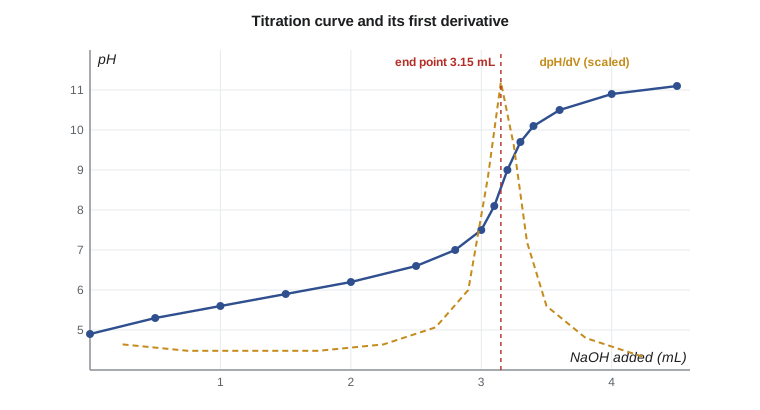
End points can be found with an indicator, a weak acid whose two forms have different colours, chosen so that its colour change falls within the steep part of the curve. Phenolphthalein, which turns pink between about pH 8.2 and 10, suits weak acids titrated with strong base. More reliable, and required by many standard methods, is a potentiometric end point: a pH electrode follows the titration and the end point is located where the curve is steepest, the maximum of the first derivative. Automatic titrators do this themselves, adding titrant in small steps near the end point and recording the curve.
Titrations in ethanol need care. Ethanol is not water: the pH electrode responds differently, indicator colours shift, and carbon dioxide from the air dissolves and adds acidity. The standard method for acidity of fuel ethanol specifies the sample volume, the titrant concentration, the indicator or electrode and a blank titration of the solvent, so that labs everywhere get the same answer. The related pHe measurement, a pH-like reading of the ethanol taken with a specified electrode, is not a true pH but is controlled because low values correlate with corrosion in engines.
Redox titrations
Redox titrations use oxidation-reduction reactions. Potassium permanganate is a strong oxidant that is its own indicator: its intense purple colour disappears while it reacts and persists as a faint pink once the analyte is used up. It is used for iron(II), hydrogen peroxide and oxalate. Iodometry uses iodine and thiosulfate. An oxidizing analyte, such as dissolved oxygen in boiler water after a fixing step, or residual chlorine, liberates iodine from excess iodide, and the iodine is titrated with sodium thiosulfate using starch, which forms a deep blue complex with iodine, as the indicator. Redox end points can also be followed potentiometrically with a platinum electrode, whose potential tracks the ratio of oxidized to reduced forms through the Nernst equation from CHE-250.
Complexometric titrations
EDTA (ethylenediaminetetraacetic acid) forms strong 1 : 1 complexes with most metal ions, which makes it the standard titrant for water hardness. Total hardness, the sum of calcium and magnesium, is titrated at pH 10 with an ammonia buffer and an indicator such as Eriochrome Black T, which is wine-red when bound to magnesium and blue when free. When all the calcium and magnesium have been complexed by EDTA, the indicator is released and the colour turns blue. Hardness is reported as milligrams per litre of calcium carbonate, regardless of which ions are actually present.
Worked problem
Hardness of boiler makeup water
A 100.0 mL water sample needs 6.42 mL of 0.0100 mol/L EDTA to reach the blue end point at pH 10. Express the hardness as mg/L CaCO3 (molar mass 100.09 g/mol).
Show solution
- Moles of EDTA: \(0.0100 \times 0.00642 = 6.42 \times 10^{-5}\) mol, equal to moles of calcium plus magnesium.
- As CaCO3: \(6.42 \times 10^{-5} \times 100.09 = 6.43 \times 10^{-3}\) g = 6.43 mg.
- Per litre: \(6.43\ \text{mg}/0.100\ \text{L} = 64.3\) mg/L.
Answer: The hardness is 64 mg/L as CaCO3, moderately hard water that must be softened before it feeds the boilers to prevent scale.
Precipitation titrations
Precipitation titrations form an insoluble product. The most important is the titration of chloride with silver nitrate, which forms silver chloride. In the Mohr method, chromate is added as an indicator: once all the chloride has precipitated, the next drop of silver forms red silver chromate. The Volhard method works the other way, adding excess silver and titrating what is left with thiocyanate. Modern labs usually follow silver titrations with a silver electrode, which gives a sharp potentiometric end point even in coloured or cloudy samples.
Chloride matters at the plant for two reasons. Inorganic chloride is limited in fuel ethanol, at only a few milligrams per litre, because it promotes corrosion in fuel systems. At that level, titration is too insensitive, and the lab uses ion chromatography instead (Lesson 10). In cooling water, chloride is present at tens to hundreds of milligrams per litre, where a potentiometric silver titration works well, and it tells the operators how many times the water has been concentrated by evaporation in the cooling tower. A rising chloride ratio between tower water and makeup water means fewer blowdowns and a higher risk of scale and corrosion.
Worked problem
Chloride in cooling tower water
A 25.00 mL sample of cooling tower water needs 7.85 mL of 0.0500 mol/L silver nitrate to reach the potentiometric end point. What is the chloride concentration in mg/L (molar mass of Cl 35.45 g/mol)?
Show solution
- Moles of silver: \(0.0500 \times 0.00785 = 3.925 \times 10^{-4}\) mol, equal to moles of chloride.
- Mass of chloride: \(3.925 \times 10^{-4} \times 35.45 = 0.01391\) g = 13.91 mg.
- Per litre: \(13.91/0.02500 = 557\) mg/L.
Answer: The chloride is about 557 mg/L. If the makeup water contains 110 mg/L, the tower is running at about five cycles of concentration.
Karl Fischer titration for water
Water is the property most often measured in a fuel ethanol lab, and the method of choice is Karl Fischer (KF) titration. It relies on a reaction in which iodine oxidizes sulfur dioxide in the presence of water, a base and an alcohol. Each mole of water consumes one mole of iodine, so the amount of iodine used measures the water. The end point is detected electrochemically: two small platinum electrodes sense the first excess of free iodine.
There are two forms. In volumetric KF, a titrant containing iodine is added from a burette, and its strength, the titer or factor, is expressed as milligrams of water per millilitre and checked daily with a water standard or pure water. Volumetric KF suits samples with more than about 0.1 percent water, such as fuel ethanol. In coulometric KF, the iodine is generated electrically at an anode, and the charge passed, through Faraday's law, gives the amount of water directly. It is extremely sensitive and suits samples with parts per million of water, such as dry solvents. Both need tightly sealed cells, because moisture from the room drifts in; the instrument measures this drift and corrects for it.
The program below finds the end point of the acidity titration from Theo's pH data and calculates the acidity, then works up a volumetric Karl Fischer result and converts it from mass percent to volume percent, the unit the specification uses.
# Finding a titration end point from pH data, then a Karl Fischer water result
# 1. Acidity of fuel ethanol: titrate 50.0 mL with 0.0100 mol/L NaOH, pH recorded
V = [0.0, 0.5, 1.0, 1.5, 2.0, 2.5, 2.8, 3.0, 3.1, 3.2, 3.3, 3.4, 3.6, 4.0, 4.5]
pH = [4.9, 5.3, 5.6, 5.9, 6.2, 6.6, 7.0, 7.5, 8.1, 9.0, 9.7, 10.1, 10.5, 10.9, 11.1]
# first derivative dpH/dV at interval midpoints; the end point is where it peaks
mids, d1 = [], []
for i in range(len(V) - 1):
    mids.append((V[i] + V[i + 1]) / 2)
    d1.append((pH[i + 1] - pH[i]) / (V[i + 1] - V[i]))
k = max(range(len(d1)), key=lambda i: d1[i])
Vep = mids[k]
print(f"steepest rise between {V[k]} and {V[k + 1]} mL, end point about {Vep:.2f} mL")
mol_acid = 0.0100 * Vep / 1000
acetic_mg_L = mol_acid * 60.05 * 1000 / 0.0500
print(f"acidity = {acetic_mg_L:.0f} mg/L as acetic acid")

# 2. Volumetric Karl Fischer: titrant factor 5.012 mg water per mL
F = 5.012
sample_g = 2.035
titrant_mL = 1.42
water_mg = F * titrant_mL
water_mass_pct = water_mg / (sample_g * 1000) * 100
# convert mass % to volume % for the spec (densities at 15.56 C, approximate)
rho_sample, rho_water = 0.791, 0.999
water_vol_pct = water_mass_pct * rho_sample / rho_water
print(f"water = {water_mg:.2f} mg = {water_mass_pct:.3f} mass% = {water_vol_pct:.3f} vol%")steepest rise between 3.1 and 3.2 mL, end point about 3.15 mL acidity = 38 mg/L as acetic acid water = 7.12 mg = 0.350 mass% = 0.277 vol%
The acidity of 38 mg/L as acetic acid is below the typical specification limit of 56 mg/L, and the water at about 0.28 percent by volume is well below 1.0 percent. Note the conversion between mass and volume percent: because ethanol is less dense than water, a mass percent of water is a larger number than the corresponding volume percent, and comparing a mass result with a volume limit would be a serious error.
Common mistakes
MistakeUsing less than about 20 mL of titrant from a 50 mL burette.
InsteadChoose sample size or titrant strength so the titration uses most of the burette; reading error is then a small fraction.
MistakeAssuming the label concentration of a sodium hydroxide solution.
InsteadStandardize it against a primary standard such as KHP, and repeat regularly.
MistakeChoosing an indicator that changes colour far from the equivalence point.
InsteadMatch the indicator's range to the steep part of the curve, or use a potentiometric end point.
MistakeComparing a mass percent water result with a volume percent limit.
InsteadConvert using the densities before comparing.
Summary and key terms
- A titration adds titrant of known concentration until the reaction with the analyte is complete; the end point should match the equivalence point.
- Class A glassware, primary standards and regular standardization make titrations accurate.
- Acid-base end points are found with indicators or, better, from the maximum slope of a potentiometric curve.
- Redox titrations use permanganate, iodine and thiosulfate; complexometric titrations use EDTA, as in water hardness.
- Karl Fischer titration measures water: volumetric for percent levels, coulometric for parts per million.
- Watch units: hardness is reported as CaCO3, and fuel water limits are in volume percent.
- Titrant
- A solution of accurately known concentration added from a burette.
- Equivalence point
- The point at which exactly enough titrant has been added to react with all of the analyte.
- End point
- The point detected experimentally, by colour or signal change, that marks the end of a titration.
- Primary standard
- A pure, stable substance weighed directly to establish an accurate concentration.
- Standardization
- Determining the exact concentration of a titrant by titrating a primary standard.
- Potentiometric titration
- A titration in which an electrode follows the reaction and the end point is found from the steepest change in potential or pH.
- EDTA
- A chelating agent that forms 1 : 1 complexes with metal ions, used as a titrant.
- Karl Fischer titration
- A titration based on the reaction of iodine and sulfur dioxide with water, used to measure water content.
Practice problems
Work each problem on paper first, then reveal the answer to check.
A 0.4012 g sample of KHP needs 19.62 mL of NaOH. What is the NaOH concentration?
Show answer
\(0.4012/204.22 = 1.9645 \times 10^{-3}\) mol; \(1.9645 \times 10^{-3}/0.01962 = 0.1001\) mol/L.
Why does a weak acid titration have an equivalence point above pH 7?
Show answer
The conjugate base formed, such as acetate, is a weak base that makes the solution slightly alkaline.
What indicator signals the end point in an iodometric titration?
Show answer
Starch, which forms a blue complex with iodine.
A 50.0 mL water sample needs 4.10 mL of 0.0100 mol/L EDTA. Find the hardness as mg/L CaCO3.
Show answer
\(4.10 \times 10^{-5}\) mol × 100.09 g/mol = 4.10 mg; per litre 82 mg/L.
When would a lab choose coulometric rather than volumetric Karl Fischer?
Show answer
For very low water contents, around parts per million, where coulometric KF is more sensitive.
A KF titrant has a factor of 4.98 mg/mL and a 1.50 g sample uses 1.20 mL. What is the water in mass percent?
Show answer
\(4.98 \times 1.20 = 5.98\) mg; \(5.98/1500 \times 100 = 0.40\) mass percent.
Lesson quiz · 5 questions
Score 60% or more to complete this lesson.
Create a free account to save your progress, take quizzes and earn a certificate.