
CHE-260 · Lesson 5 of 12 · 23 min
Gravimetric analysis and moisture
Gravimetric analysis measures an analyte by weighing. It is one of the oldest quantitative methods, and in some ways still the most fundamental: a well-run gravimetric determination needs no calibration against other standards, because mass is measured directly against the kilogram through the balance's own calibration. At Kingfisher Bioenergy, gravimetry is everywhere, though it rarely goes by that name. Every moisture result for corn and distillers grains, every ash and suspended solids result, the gum residue in fuel ethanol and the sulfate in process water rest on careful weighing.
Theo's task this week is the moisture of wet distillers grains, the wet cake sold to local feedlots, and a sulfate check on the process water that feeds the cooling tower. Both are simple in principle. Both fail if the weighing is careless.
The analytical balance
The analytical balance is the most important instrument in the lab. A typical model reads to 0.1 mg with a capacity of about 200 g; semi-micro balances read to 0.01 mg. Modern balances use electromagnetic force restoration: a coil generates a force that exactly balances the load, and the current needed is proportional to the mass. The balance is calibrated with certified weights, either internal weights it applies automatically or external weights traceable to national standards, and it is checked daily with a reference weight.
Good weighing technique matters more than the balance's specification. The balance sits on a solid bench away from drafts, doors and vibration, and is levelled with its bubble indicator. Samples and containers are weighed at room temperature, because a warm crucible sets up convection currents that make it read light. Hygroscopic samples and dried crucibles are cooled in a desiccator, a closed vessel with a drying agent, so they do not pick up moisture before weighing. Containers are handled with tongs or gloves, because fingerprints add oil and moisture. Weighing by difference, recording the container with sample and then without, avoids errors from material left behind.
For the highest accuracy, buoyancy matters. Air pushes up on the sample and on the balance's calibration weights by different amounts if their densities differ. For a sample with a density near that of water weighed against steel calibration weights, the true mass is about 0.1 percent larger than the reading. Most routine work ignores this, because it cancels when samples and standards are similar, but it matters when preparing primary standards for the most demanding work.
Precipitation gravimetry
In precipitation gravimetry, the analyte is converted to an insoluble compound of known composition, which is filtered, washed, dried or ignited, and weighed. Sulfate is precipitated as barium sulfate by adding barium chloride to an acidified sample. Chloride can be precipitated as silver chloride, nickel as its dimethylglyoxime complex, and phosphate as magnesium ammonium phosphate, ignited to magnesium pyrophosphate.
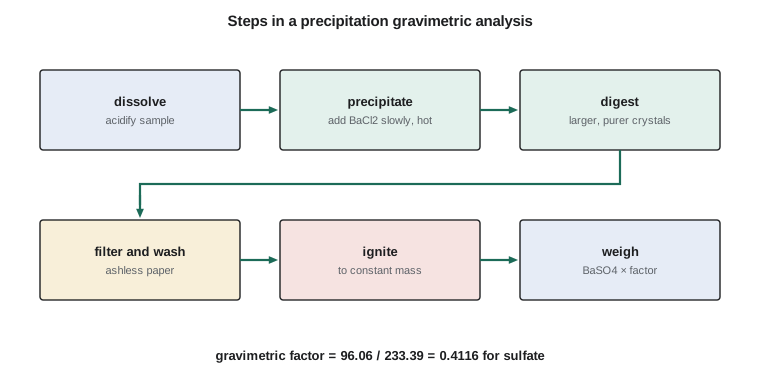
A good precipitate is pure, easy to filter and of exactly known composition. Particle size depends on how supersaturated the solution is when the solid forms. High supersaturation causes many tiny nuclei to form at once, giving a fine precipitate that clogs filters and passes through them. Low supersaturation favours growth of fewer, larger crystals. So precipitating agents are added slowly, with stirring, to hot, dilute solutions, which keeps supersaturation low. The precipitate is then digested, left in the hot mother liquor for an hour or more, during which small particles dissolve and larger ones grow, and trapped impurities escape.
Impurities are the main source of error. Coprecipitation carries otherwise soluble substances down with the precipitate, by adsorption on the surface, by inclusion in the crystal lattice or by occlusion in pockets as crystals grow. Barium sulfate readily coprecipitates nitrate, chloride and iron, which is why the sample is acidified, the barium chloride added slowly and the precipitate washed thoroughly with hot water. Washing continues until a test of the washings shows no more chloride.
The precipitate is collected on ashless filter paper, which burns away leaving negligible residue, or in a sintered glass or porcelain filter crucible. It is then dried or ignited in a muffle furnace to convert it to a stable weighing form, and heated, cooled in a desiccator and weighed repeatedly until two weighings agree within a set tolerance, typically 0.3 mg. This is heating to constant mass, and it is the gravimetric analyst's proof that all the water and volatile matter are gone.
The gravimetric factor
The mass of precipitate is converted to the mass of analyte with the gravimetric factor, the ratio of the analyte's molar mass to the precipitate's, multiplied by the ratio of moles of analyte per mole of precipitate:
For sulfate weighed as barium sulfate, one mole of each, the factor is \(96.06/233.39 = 0.4116\). For phosphorus weighed as \(\text{Mg}_2\text{P}_2\text{O}_7\), with two phosphorus atoms per formula unit, the factor is \(2 \times 30.97/222.55 = 0.2783\).
Worked problem
Sulfate in process water
A 250.0 mL sample of process water is acidified, and sulfate is precipitated with barium chloride. After filtering, ignition and heating to constant mass, the barium sulfate weighs 72.1 mg. What is the sulfate concentration?
Show solution
- Gravimetric factor: \(96.06/233.39 = 0.4116\).
- Mass of sulfate: \(72.1 \times 0.4116 = 29.7\) mg.
- Concentration: \(29.7\ \text{mg}/0.2500\ \text{L} = 119\) mg/L.
Answer: The process water contains about 119 mg/L sulfate. Sulfate matters because it can feed sulfate-reducing bacteria in the cooling system and contributes to the sulfur content of distillers grains.
Volatilization gravimetry: moisture, ash and solids
Volatilization methods weigh a sample before and after driving off a component by heat. Moisture is the commonest. A test portion is weighed into a dried, tared dish, heated in an oven at a specified temperature for a specified time, cooled in a desiccator and reweighed. The loss in mass is taken as moisture. The result is method-defined: different temperatures and times give somewhat different answers, because some volatile organic compounds leave with the water and some bound water stays behind. That is why feed and grain labs follow official methods exactly, such as oven drying at 135 °C for two hours for many animal feeds, and why a moisture result is meaningless without the method.
Ash is the residue left after burning off organic matter in a muffle furnace, typically at 550 to 600 °C. It measures the total mineral content of a feed. Loss on ignition is a related measurement used for soils and solids. Total suspended solids in the plant's effluent are measured by filtering a known volume through a pre-weighed glass fibre filter, drying it at 103 to 105 °C and weighing the residue. Solvent-washed gum in fuel ethanol is measured by evaporating a sample under controlled conditions and weighing the residue after washing it with a solvent; high gum values warn of contamination that can leave deposits in engines.
| Measurement | Typical conditions | Reported as |
|---|---|---|
| Moisture in feed | Oven at about 135 °C for 2 h, or method specified | Percent loss in mass |
| Ash | Muffle furnace at 550 to 600 °C | Percent residue |
| Total suspended solids | Filter, dry at 103 to 105 °C | mg/L |
| Solvent-washed gum in ethanol | Evaporate under air jet, wash residue | mg per 100 mL |
| Sulfate as BaSO4 | Precipitate, ignite to constant mass | mg/L |
Thermogravimetric analysis (TGA) automates volatilization gravimetry. A tiny sample sits on a microbalance inside a furnace, and its mass is recorded continuously as the temperature rises. Steps in the mass curve show water loss, decomposition of organic matter and finally the ash. TGA is used in research and for characterizing materials, though routine moisture testing uses ovens or faster moisture analyzers that combine a balance with an infrared or halogen heater.
Extraction gravimetry: fat in distillers grains
Some gravimetric methods remove the analyte with a solvent rather than heat. Crude fat in feeds is measured by extracting a dried, ground sample with a nonpolar solvent such as petroleum ether or hexane, evaporating the solvent from the extract and weighing the oily residue. The classic apparatus is the Soxhlet extractor, which repeatedly washes the sample with freshly condensed solvent for several hours. Faster automated extractors do the same with hot solvent under pressure. The result is again method-defined, because different solvents dissolve slightly different mixtures of fats, waxes and pigments.
Fat matters commercially at the plant because many dry-grind ethanol plants extract corn oil from the thin stillage and sell it, mostly for biodiesel and renewable diesel. Every point of oil removed lowers the fat in the distillers grains, so the lab's fat results are watched by both the oil sales team and the feed sales team. Solvent extraction also has its own hazards: hexane and petroleum ether are highly flammable, so extraction runs in a fume hood with spark-free heating and the evaporated solvent is recovered.
Worked problem
Crude fat by extraction
A 3.0125 g sample of dried distillers grains is extracted with hexane. The extraction flask weighs 112.4518 g empty and 112.7302 g after the solvent is evaporated and the flask dried and cooled. What is the crude fat, and what is it on a dry basis if the sample contained 9.6 percent moisture?
Show solution
- Mass of fat: \(112.7302 - 112.4518 = 0.2784\) g.
- Fat as-is: \(0.2784/3.0125 \times 100 = 9.24\) percent.
- Dry basis: \(9.24/(1 - 0.096) = 10.2\) percent.
Answer: Crude fat is 9.2 percent as-is, or 10.2 percent on a dry basis, typical of grains from a plant that extracts some of its corn oil.
Dry basis and as-is results
Feed composition is reported two ways. As-is (or as-fed) results describe the material as it is, water included. Dry-basis results describe the material with the water removed, which allows fair comparison between products of different moisture. Wet cake at 65 percent moisture and dried grains at 10 percent moisture have very different as-is protein values even though their dry matter is nearly identical. Converting between them uses the dry matter fraction:
The program below works up Theo's sulfate result and his duplicate moisture determinations on wet cake, then converts an as-is protein result to a dry basis. It also checks that the barium sulfate really reached constant mass before using the result.
# Gravimetric sulfate in process water and moisture in wet distillers grains
# 1. Sulfate precipitated as barium sulfate
sample_mL = 250.0
crucible_empty = 21.4385        # g, constant mass after ignition
crucible_full = [21.5121, 21.5108, 21.5106]   # successive heatings to constant mass
M_BaSO4, M_SO4 = 233.39, 96.06
final = crucible_full[-1]
assert abs(crucible_full[-1] - crucible_full[-2]) <= 0.0003, "not yet at constant mass"
m_ppt = final - crucible_empty
GF = M_SO4 / M_BaSO4                      # gravimetric factor
sulfate_mg_L = m_ppt * GF * 1000 / (sample_mL / 1000)
print(f"BaSO4 = {m_ppt * 1000:.1f} mg, gravimetric factor = {GF:.4f}")
print(f"sulfate = {sulfate_mg_L:.0f} mg/L")

# 2. Oven moisture of wet cake: dish, wet sample, dry sample (g)
for dish, wet, dry in [(2.1053, 7.1480, 3.8721), (2.0987, 7.0915, 3.8402)]:
    w = wet - dish
    moisture = (wet - dry) / w * 100
    print(f"moisture = {moisture:.2f} %, dry matter = {100 - moisture:.2f} %")

# 3. Convert a protein result from as-is to dry basis
protein_as_is = 10.6     # % in wet cake
dm = 34.8                 # % dry matter
print(f"protein, dry basis = {protein_as_is / dm * 100:.1f} %")BaSO4 = 72.1 mg, gravimetric factor = 0.4116 sulfate = 119 mg/L moisture = 64.96 %, dry matter = 35.04 % moisture = 65.12 %, dry matter = 34.88 % protein, dry basis = 30.5 %
The duplicates agree within 0.16 percent moisture, inside the method's repeatability. The as-is protein of 10.6 percent becomes 30.5 percent on a dry basis, which matches the protein of the dried grains and confirms that the two products share the same composition apart from water. A feed buyer comparing the two must use dry-basis numbers or be badly misled.
Common mistakes
MistakeWeighing a crucible while it is still warm.
InsteadCool it in a desiccator to room temperature; convection makes warm objects read light.
MistakeAdding the precipitating agent quickly to a cold, concentrated solution.
InsteadAdd it slowly to a hot, dilute solution to keep supersaturation low and grow filterable crystals.
MistakeReporting a moisture result without the method conditions.
InsteadMoisture is method-defined; state the temperature and time or cite the method.
MistakeComparing as-is protein in wet cake with dried grains.
InsteadConvert both to a dry basis first.
Summary and key terms
- Gravimetry measures an analyte by weighing and needs no calibration against other standards.
- Weigh at room temperature, cool in a desiccator, avoid drafts and fingerprints, and weigh by difference.
- Precipitate slowly from hot, dilute solution, digest, wash away coprecipitated impurities and heat to constant mass.
- The gravimetric factor converts precipitate mass to analyte mass.
- Moisture, ash and suspended solids are volatilization methods whose results depend on the stated conditions.
- Dry-basis results divide as-is results by the dry matter fraction.
- Gravimetric analysis
- Determining an analyte by measuring the mass of the analyte or a compound containing it.
- Desiccator
- A closed container with a drying agent used to cool and store samples without moisture uptake.
- Supersaturation
- A state in which a solution holds more solute than its equilibrium solubility, driving precipitation.
- Digestion
- Holding a precipitate in hot mother liquor so small particles dissolve and larger, purer crystals grow.
- Coprecipitation
- Carrying down of normally soluble impurities with a precipitate.
- Constant mass
- Repeated heating and weighing until successive masses agree within a set tolerance.
- Gravimetric factor
- The ratio that converts the mass of a weighed compound to the mass of the analyte.
- Dry basis
- A composition expressed relative to the sample with its moisture removed.
Practice problems
Work each problem on paper first, then reveal the answer to check.
What is the gravimetric factor for chloride weighed as AgCl (molar masses 35.45 and 143.32)?
Show answer
\(35.45/143.32 = 0.2474\).
A precipitate of 0.2153 g of AgCl came from a 50.00 mL sample. Find chloride in mg/L.
Show answer
\(215.3 \times 0.2474 = 53.3\) mg; \(53.3/0.0500 = 1065\) mg/L.
Successive weighings of a crucible are 21.5121, 21.5108 and 21.5106 g. Has it reached constant mass at a 0.3 mg tolerance?
Show answer
Yes; the last two differ by 0.2 mg.
A 5.000 g sample dries to 4.512 g. What is its moisture?
Show answer
\((5.000 - 4.512)/5.000 = 9.76\) percent.
Dried grains with 9.8 percent moisture contain 27.5 percent protein as-is. What is the dry-basis protein?
Show answer
\(27.5/0.902 = 30.5\) percent.
Why is barium chloride added to sulfate samples slowly and hot?
Show answer
To keep supersaturation low, giving larger, purer crystals that filter well.
Lesson quiz · 5 questions
Score 60% or more to complete this lesson.
Create a free account to save your progress, take quizzes and earn a certificate.