
CHE-260 · Lesson 1 of 12 · 23 min
The analytical laboratory and lab safety
Every railcar of fuel ethanol that leaves the Kingfisher Bioenergy plant in Sarnia carries a certificate of analysis. Before the car is released, the quality control laboratory has measured its ethanol and methanol content, its water, its acidity, its sulfur and a handful of other properties, and compared each result with the limits in CAN/CGSB-3.516. The same lab tests the corn coming in, the distillers grains going out to feed buyers, the process water and the cooling water, and samples from every fermenter several times a day. If the lab gets a number wrong, the plant may ship fuel that fails specification, sell feed with the wrong protein value, or run a fermenter blind while bacteria take over. Analytical chemistry is how a chemical plant knows what it is making.
Theo Laurent, the co-op student who spent the last two terms on thermodynamics and physical chemistry with process engineer Ingrid Solheim, has moved into the QC lab for this term under lab supervisor Marisol Ortega. His first week is not spent at an instrument. It is spent learning how the lab keeps people safe and how a result travels from a sample bottle to a certificate. This course follows Theo through the lab's main techniques: sampling, statistics and calibration, titration, gravimetry, spectroscopy, chromatography and mass spectrometry, ending with how the lab reports results that customers and regulators can trust.
What an analytical laboratory does
Analytical chemistry answers two kinds of question. Qualitative analysis asks what is present: is there methanol in this ethanol, which sugar is left in this fermenter, what is the unknown peak in this chromatogram? Quantitative analysis asks how much: 0.32 volume percent methanol, 14 grams per litre of glucose, 119 milligrams per litre of sulfate. Most of the plant's work is quantitative, and most of it is routine: the same methods, run the same way, many times a day. The value of the lab lies in doing routine work reliably and in noticing when something is not routine.
Every analysis follows the same chain of steps, and an error at any step ruins the result. The problem is defined first: what decision depends on this number, and how accurate must it be? Then a sample is taken that represents the material, the sample is prepared (dissolved, diluted, filtered, dried or extracted), the measurement is made with a calibrated method, the data are evaluated, and the result is reported with its uncertainty. Students often think the measurement is the hard part. In practice, sampling and sample preparation cause more errors than the instrument does, which is why Lesson 2 is devoted to them.
| Sample | Typical tests | Why it matters |
|---|---|---|
| Incoming corn | Moisture, starch, mycotoxins, foreign material | Price, yield and feed safety |
| Fermenter beer | Ethanol, sugars, organic acids, pH | Process control and contamination |
| Fuel ethanol | Ethanol, methanol, water, acidity, sulfur, chloride, copper, pHe | Shipping specification |
| Distillers grains | Moisture, protein, fat, fibre, sulfur | Feed sales and labelling |
| Process and cooling water | pH, hardness, iron, sulfate, chloride, conductivity | Corrosion and scale control |
| Effluent and stormwater | Biochemical oxygen demand, suspended solids, phosphorus | Environmental permit |
Hazards in a chemical laboratory
An analytical lab concentrates many hazards in a small space. There are flammable liquids (ethanol, hexane, methanol, acetone), corrosives (concentrated acids and bases), toxic reagents (the Karl Fischer reagent contains imidazole and methanol; some classic methods use mercury or chromium compounds, which modern labs avoid), compressed gases (helium, hydrogen and nitrogen for the gas chromatographs, argon for the plasma instrument), hot surfaces (muffle furnaces at 800 °C, drying ovens, hot plates), high voltages inside instruments, glassware that breaks and cuts, and biological material in fermenter samples. The plant's chemistry is gentle compared with a research lab, but the most serious lab injuries come from ordinary hazards handled carelessly: a flask of ethanol near a hot plate, a cylinder left unchained, acid added to water the wrong way round.
The legal framework in Ontario rests on Ontario's Occupational Health and Safety Act and its regulations, including the designated substances regulation. Hazard communication follows WHMIS 2015 under the Hazardous Products Regulations and Ontario's WHMIS regulation. Every hazardous product in the lab must carry a supplier label with pictograms, signal words and hazard statements, and the lab must hold a current safety data sheet for each one, readily available to every worker. Workers must be trained to read labels and safety data sheets before they use the products. When Theo decants methanol into a smaller bottle, the bottle needs a workplace label naming the product, how to handle it safely and where to find the safety data sheet.
Section 2 of a safety data sheet gives the hazard classification and label elements, section 7 gives handling and storage, section 8 gives exposure controls and personal protective equipment, and section 13 gives disposal considerations. Theo's first assignment is to read the safety data sheets for the twenty products he will use most often and note, for each one, the main hazard, the glove material and the waste stream. Nitrile gloves suit most of the plant's reagents, but not all: dichloromethane passes through nitrile in minutes, and the safety data sheet says so.
The hierarchy of controls in the lab
The same hierarchy of controls taught in the safety courses applies at the bench. Elimination and substitution come first: the lab replaced a mercury-based chemical oxygen demand method with a mercury-free one, and it uses ready-made titrant solutions instead of preparing them from concentrated stock. Engineering controls come next, and the most important is the fume hood. Administrative controls include written procedures, training, labelling, limits on quantities at the bench and rules such as never working alone with hazardous chemicals after hours. Personal protective equipment is the last line of defence: safety glasses with side shields at all times in the lab, splash goggles and a face shield for corrosives, a lab coat, closed shoes and the right gloves.
Fume hoods
A chemical fume hood is a ventilated enclosure that draws room air in across its open face and exhausts it, with any vapours or fumes, through a duct to a fan on the roof. It protects the user only if air moves inward across the whole face at a steady speed. Most labs aim for an average face velocity of about 0.4 to 0.6 m/s (80 to 120 ft/min). Too slow, and vapour escapes on eddies; too fast, and turbulence around the user's body can pull vapour out of the hood.
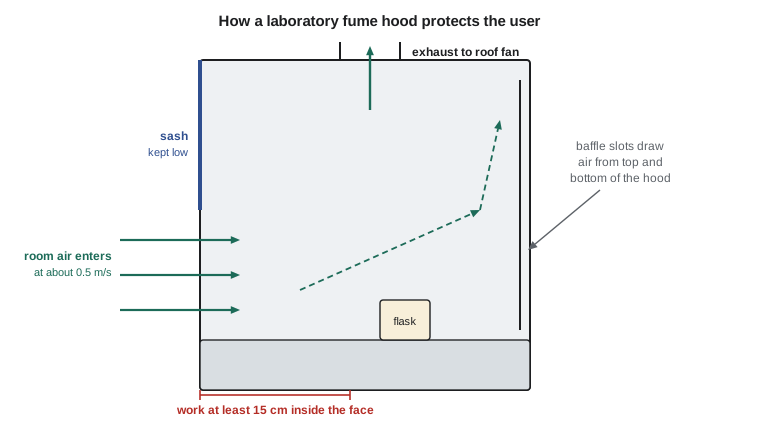
Good practice keeps the sash as low as the work allows, ideally at the marked operating height; places equipment at least 15 cm (6 in) inside the face; avoids cluttering the hood with stored bottles, which block the baffle slots; and keeps heads out of the hood. Every hood carries a label with its last test date and face velocity, and the lab checks the airflow monitor before each use. Hoods are tested at least once a year by measuring face velocity on a grid of points across the opening, and many labs also do smoke tests to look for backflow.
Worked problem
Checking a fume hood test report
A technician measures face velocity at nine points across a hood opening with the sash at its operating height: 0.48, 0.52, 0.55, 0.50, 0.46, 0.51, 0.49, 0.53 and 0.47 m/s. The lab's acceptance criteria are an average between 0.4 and 0.6 m/s and no single point below 80 percent of the average. Does the hood pass?
Show solution
- Average: the nine readings sum to 4.51 m/s, so the average is 4.51/9 = 0.50 m/s.
- The average lies between 0.4 and 0.6 m/s.
- Lowest point: 0.46 m/s. Eighty percent of the average is 0.40 m/s, and 0.46 is above it.
Answer: The hood passes. A single low reading near one corner would still be worth investigating, because it often means the baffle slots are blocked or the room supply air is blowing across the face.
Flammable liquids, gases and electrical equipment
Ethanol is the plant's product, and it is also the lab's most common fire hazard. Its flash point is about 13 °C, so at room temperature it gives off enough vapour to ignite. Flammable liquids belong in approved safety cans or the flammable storage cabinet, with only the amount needed for the day at the bench. They should never be heated on an open flame or an ordinary hot plate whose thermostat sparks; heating mantles, water baths and spark-free hot plates are used instead. Refrigerators that hold flammable samples must be designed for the purpose, because the light switch and thermostat in a household refrigerator can ignite vapour inside.
Compressed gas cylinders must be secured upright with chains or straps, capped when not in use, and moved only on a cylinder cart. Hydrogen, used as a carrier and fuel gas in the gas chromatographs, is flammable over a very wide range of concentrations, so its lines are leak-tested and many labs now generate hydrogen on demand rather than storing cylinders. Argon and nitrogen are not toxic, but a large leak in a small room can displace enough oxygen to asphyxiate; the room with the plasma instrument has an oxygen monitor.
The program below makes three quick safety calculations Theo meets in his first week: checking a hood test, estimating the worst-case airborne ethanol concentration if a 500 mL bottle breaks in a small lab, and estimating how long room ventilation takes to clear it.
# Lab safety checks for the Kingfisher QC lab
import math

# 1. Fume hood face velocity from a grid of anemometer readings (m/s)
readings = [0.48, 0.52, 0.55, 0.50, 0.46, 0.51, 0.49, 0.53, 0.47]
avg = sum(readings) / len(readings)
low = min(readings)
print(f"average face velocity = {avg:.2f} m/s, lowest point = {low:.2f} m/s")
print("hood status:", "pass" if 0.4 <= avg <= 0.6 and low >= 0.8 * avg else "investigate")

# 2. Ethanol spill: worst-case airborne concentration if the whole spill evaporates
#    into the room air before ventilation removes any of it
spill_mL = 500
rho = 0.789            # g/mL
M = 46.07              # g/mol
room = 6 * 5 * 3       # m3
T = 293.15             # K
P = 101325             # Pa
mol = spill_mL * rho / M
gas_m3 = mol * 8.314 * T / P
ppm = gas_m3 / room * 1e6
print(f"spill = {mol:.2f} mol ethanol, gas volume = {gas_m3:.3f} m3")
print(f"room average = {ppm:,.0f} ppm = {ppm / 1e4:.2f} vol%")
LFL = 3.3   # vol%, lower flammable limit of ethanol (approximate)
print(f"fraction of LFL (room average) = {ppm / 1e4 / LFL:.2f}")

# 3. Time for room ventilation to clear the ethanol to 10 percent (well-mixed room)
ach = 6.0   # air changes per hour
t = math.log(10) / ach * 60
print(f"time to fall to 10 percent at {ach:.0f} air changes per hour = {t:.0f} min")average face velocity = 0.50 m/s, lowest point = 0.46 m/s hood status: pass spill = 8.56 mol ethanol, gas volume = 0.206 m3 room average = 2,289 ppm = 0.23 vol% fraction of LFL (room average) = 0.07 time to fall to 10 percent at 6 air changes per hour = 23 min
Even if the whole spill evaporated into the room at once, the average concentration would be only about 7 percent of the lower flammable limit. That sounds comfortable, but it is an average. Near the floor, where the heavier-than-air vapour pools close to the spill, the concentration can exceed the flammable limit locally. The response to a spill is therefore the same whatever the room average: remove ignition sources, absorb the liquid with spill pads, ventilate and report.
Chemical waste
Laboratory waste must be segregated, labelled and disposed of according to Ontario's hazardous waste rules under Regulation 347, including generator registration. The lab keeps separate, labelled containers for non-halogenated solvents (ethanol, methanol, hexane), halogenated solvents, aqueous acid waste, aqueous base waste, heavy-metal waste (such as copper and iron standards from the plasma instrument), and Karl Fischer waste, which contains methanol and iodine compounds. Incompatible wastes must never share a container: acids and cyanides release hydrogen cyanide, oxidizers and organics can react violently, and acids and bases generate heat. Waste containers stay closed except when adding waste, and each has a log of what went in.
Many routine wastes are small. Dilute acid and base wastes may be neutralized and discharged to the plant's process sewer only if the plant's permit allows it and the waste contains nothing else regulated. Biological samples from fermenters are not infectious, but they can grow and smell, so they are disposed of promptly. Broken glass goes in a dedicated box, never in the regular garbage, where it can cut the people who empty it.
Emergency equipment and response
Every lab has eyewash stations and safety showers within a few seconds' walk of any bench where corrosives are used, kept clear and tested weekly by running them. A chemical splash to the eye calls for flushing at the eyewash for at least 15 minutes, holding the eyelids open, then medical attention. A large splash to the body calls for the safety shower and removing contaminated clothing. The lab also has fire extinguishers suitable for flammable liquids and electrical equipment, spill kits for solvents, acids and bases, and a first aid kit. Theo learns where each item is on his first day, and he learns the rule that matters most: report every incident and near miss, including small spills and cuts, so the lab can fix the cause.
Common mistakes
MistakeStoring bottles and equipment in the fume hood.
InsteadClutter blocks the baffle slots and disturbs airflow. Keep only the current work in the hood.
MistakeAssuming nitrile gloves protect against every solvent.
InsteadCheck section 8 of the safety data sheet for the right glove material and breakthrough time.
MistakePouring a small amount of solvent waste into the nearest container.
InsteadUse the labelled container for that waste stream and log what you add; incompatible wastes can react.
MistakeTreating a calculated room-average vapour level as proof that a spill is safe.
InsteadVapour concentrates near the source and the floor; remove ignition sources and ventilate regardless.
Summary and key terms
- An analysis is a chain: define the problem, sample, prepare, measure, evaluate and report. Errors at any link spoil the result.
- Hazard communication requires labels and current safety data sheets for every hazardous product, and training before use.
- Apply the hierarchy of controls: substitute safer methods, use fume hoods, follow procedures and wear the right protective equipment.
- Fume hoods need an inward face velocity of about 0.4 to 0.6 m/s, a low sash and work kept at least 15 cm inside.
- Store flammable liquids in approved containers, heat them without sparks or flames, and secure gas cylinders.
- Segregate and label chemical waste by stream, and never mix incompatible wastes.
- Know where the eyewash, shower, extinguishers and spill kits are, and report every incident and near miss.
- Qualitative analysis
- Determining which substances are present in a sample.
- Quantitative analysis
- Determining how much of a substance is present.
- Safety data sheet
- A document from the supplier giving a product's hazards, safe handling, exposure controls, emergency measures and disposal.
- Fume hood
- A ventilated enclosure that draws air inward across its face to capture and exhaust chemical vapours.
- Face velocity
- The average speed of air entering the open face of a fume hood.
- Flash point
- The lowest temperature at which a liquid gives off enough vapour to ignite in air.
- Lower flammable limit
- The lowest concentration of a vapour in air that can burn.
- Hierarchy of controls
- The order of preference for controlling hazards: elimination, substitution, engineering controls, administrative controls, personal protective equipment.
Practice problems
Work each problem on paper first, then reveal the answer to check.
List the six steps in the chain of an analysis.
Show answer
Define the problem, take a representative sample, prepare it, measure it, evaluate the data and report the result with its uncertainty.
Which section of a safety data sheet gives the recommended glove material?
Show answer
Section 8, exposure controls and personal protection.
A hood's readings average 0.32 m/s. What should the lab do?
Show answer
Take it out of service, tag it and have the exhaust system checked; it is below the usual 0.4 m/s minimum.
Why must a refrigerator storing flammable samples be specially designed?
Show answer
Switches and thermostats in household units can spark and ignite vapour inside.
Name two wastes that must never be combined in one container.
Show answer
For example, acids with cyanides, or oxidizers with organic solvents.
How long should an eye exposed to a chemical be flushed?
Show answer
At least 15 minutes, then the person needs medical attention.
Lesson quiz · 5 questions
Score 60% or more to complete this lesson.
Create a free account to save your progress, take quizzes and earn a certificate.