
CHE-220 · Lesson 6 of 12 · 26 min
Heat effects: sensible heat, latent heat and heats of reaction
Most of the energy a chemical plant uses goes into three kinds of heat effect: heating or cooling streams without a phase change, vaporizing or condensing them, and supplying or removing the heat of reaction. You met all three in CHE-200 as table values. This lesson looks at where those numbers come from and how to estimate them when tables are missing or stop short of the conditions you need. Kingfisher's projects supply the examples: the latent heat of ammonia in the new refrigeration plant, the heat of vaporization of ethanol at the conditions in the distillation columns, and the heat of reaction for the small green ammonia loop that Ingrid's team is evaluating as a way to use surplus hydrogen and nitrogen.
Sensible heat and heat capacity
Sensible heat is the enthalpy change of a substance heated or cooled without a phase change or reaction. At constant pressure, it is the integral of the heat capacity over temperature. Lesson 3 gave the polynomial form used in this course; integrating it term by term gives the enthalpy change directly. Engineers often use a mean heat capacity instead, defined so that multiplying it by the temperature change gives the right answer, which is convenient for repeated calculations over the same range.
The polynomial and the mean heat capacity both describe the ideal gas state. For liquids, heat capacities vary less with temperature, and simple linear fits are usually enough well below the critical point. For real gases at high pressure, the heat capacity differs from the ideal gas value, and the difference is handled with the residual properties of Lesson 8 rather than by changing the polynomial.
Latent heat and the Clapeyron equation
A phase change at constant temperature and pressure absorbs or releases latent heat: the heat of vaporization for liquid to vapour, the heat of fusion for solid to liquid and the heat of sublimation for solid to vapour. The Clapeyron equation links the heat of vaporization to the slope of the vapour pressure curve. It is exact for a pure substance; Lesson 8 derives it from the property relations.
Far below the critical point, the liquid volume is negligible beside the vapour volume, and the vapour is nearly ideal. With those two approximations the Clapeyron equation becomes the Clausius-Clapeyron equation, which says that a plot of \(\ln P^{sat}\) against \(1/T\) is nearly a straight line with slope \(-\Delta H^{lv}/R\). A better version keeps the compressibility factors, \(\Delta V^{lv} = RT\,\Delta Z^{lv}/P\), which corrects for the non-ideal vapour. That correction is a few percent at moderate pressures and grows to large values near the critical point, where \(\Delta Z^{lv}\) falls to zero along with the heat of vaporization.
Worked problem
Heat of vaporization of ammonia from vapour pressures
Approximate vapour pressures of ammonia are 2.91 bar at −10 °C and 4.29 bar at 0 °C. Estimate the heat of vaporization near −5 °C with the Clausius-Clapeyron equation, and again with \(\Delta Z^{lv} = 0.95\).
Show solution
- Slope: \(\ln(4.29/2.91) = 0.3881\); \(1/263.15 - 1/273.15 = 1.391\times10^{-4}\ \text{K}^{-1}\).
- \(\Delta H^{lv} = R \times 0.3881/1.391\times10^{-4} = 23.2\ \text{kJ/mol}\), or \(23\,200/17.03 = 1362\ \text{kJ/kg}\).
- With \(\Delta Z^{lv} = 0.95\): \(\Delta H^{lv} = 0.95 \times 1362 = 1294\ \text{kJ/kg}\).
Answer: Tables give about 1290 kJ/kg near −5 °C. The simple Clausius-Clapeyron estimate is 5 percent high because ammonia vapour at 3 to 4 bar is not ideal; including \(\Delta Z^{lv}\) brings the estimate into line. This is why refrigeration designers use measured tables or reference equations for latent heats rather than the simple form.
Estimating latent heats from correlations
When vapour pressure data are thin, two correlations fill the gap. Riedel's equation estimates the heat of vaporization at the normal boiling point from the critical temperature and pressure, usually to within a few percent. Watson's correlation then carries a known heat of vaporization at one temperature to any other temperature below the critical point. Together they cover most practical needs.
The Watson form captures an important physical fact: the heat of vaporization falls as temperature rises and vanishes at the critical point, because the liquid and vapour become identical there. Engineers who use one table value of a latent heat across a wide range of temperatures make errors that grow the closer they get to the critical point.
Worked problem
Ethanol vaporization in the distillation train
For ethanol, \(T_c = 513.9\ \text{K}\), \(P_c = 61.48\ \text{bar}\) and the normal boiling point is 351.4 K. Estimate the heat of vaporization at the normal boiling point with Riedel's equation. Then, starting from the measured value of about 38.6 kJ/mol, estimate it at 120 °C, near the bottom of a pressurized column, with Watson's correlation.
Show solution
- \(T_{rn} = 351.4/513.9 = 0.6838\); \(\ln 61.48 = 4.119\).
- Riedel: \(\Delta H_n = 8.314 \times 351.4 \times 1.092 \times (4.119 - 1.013)/(0.930 - 0.6838) = 40.2\ \text{kJ/mol}\), about 4 percent above the measured 38.6 kJ/mol.
- Watson: \(T_{r2} = 393.15/513.9 = 0.7650\); \(\Delta H_{120} = 38.6 \times (0.2350/0.3162)^{0.38} = 34.5\ \text{kJ/mol}\).
- Per kilogram: \(34\,500/46.07 = 748\ \text{kJ/kg}\), against 838 kJ/kg at the normal boiling point.
Answer: At 120 °C, ethanol's heat of vaporization is about 11 percent lower than at its normal boiling point. A reboiler duty estimated with the normal boiling point value would be 11 percent too high for that service, which matters when the reboiler is driven by steam that Kingfisher pays for.
Standard heats of reaction and formation
The heat of reaction is the enthalpy change when reactants in stated amounts react completely to products at the same temperature and pressure. To tabulate it compactly, chemists define a standard state for each species: for gases, the pure ideal gas at 1 bar; for liquids and solids, the pure substance at 1 bar. A standard heat of reaction refers to reactants and products all in their standard states at a stated temperature, usually 298.15 K, and is computed from standard heats of formation by Hess's law.
For ammonia synthesis, \(\text{N}_2 + 3\text{H}_2 \to 2\text{NH}_3\), the standard heat of formation of ammonia gas is about −46.11 kJ/mol, and those of the elements are zero by definition, so \(\Delta H^\circ_{298} = 2 \times (-46.11) = -92.22\ \text{kJ}\) per mole of reaction as written. The negative sign means the reaction is exothermic: a reactor must remove heat to hold its temperature.
Heats of reaction at other temperatures
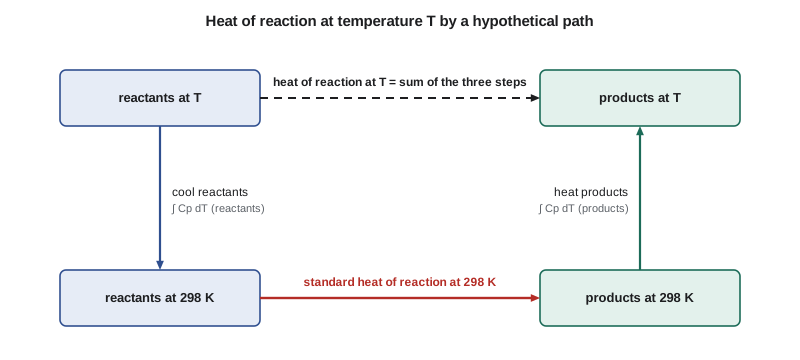
Reactors seldom run at 25 °C. The ammonia loop's catalyst works at about 400 to 500 °C. Because enthalpy is a state function, the heat of reaction at any temperature can be found by a hypothetical path: cool the reactants to 298 K, react them there, and heat the products back to the reaction temperature. Combining the three steps gives the heat of reaction at temperature \(T\) in terms of the standard value and the difference between product and reactant heat capacities, \(\Delta C_P^\circ = \sum\nu_iC_{P,i}^\circ\).
Worked problem
Heat of reaction for the ammonia loop at 450 °C
Using approximate heat capacity constants (\(C_P/R = A + BT + DT^{-2}\)) of NH₃: 3.578, \(3.020\times10^{-3}\), \(-0.186\times10^5\); N₂: 3.280, \(0.593\times10^{-3}\), \(0.040\times10^5\); H₂: 3.249, \(0.422\times10^{-3}\), \(0.083\times10^5\), find the heat of reaction for \(\text{N}_2 + 3\text{H}_2 \to 2\text{NH}_3\) at 450 °C.
Show solution
- \(\Delta A = 2(3.578) - 3.280 - 3(3.249) = -5.871\); \(\Delta B = 2(3.020) - 0.593 - 3(0.422) = 4.181\times10^{-3}\); \(\Delta D = 2(-0.186) - 0.040 - 3(0.083) = -0.661\times10^5\).
- Integral from 298.15 to 723.15 K: \(\Delta A(425) + \tfrac{\Delta B}{2}(723.15^2 - 298.15^2) - \Delta D(1/723.15 - 1/298.15) = -2495 + 907 - 130 = -1718\ \text{K}\).
- \(\Delta H^\circ_{723} = -92\,220 + 8.314 \times (-1718) = -106\,500\ \text{J} = -106.5\ \text{kJ}\) per mole of reaction.
Answer: The reaction is about 15 percent more exothermic at 450 °C than at 25 °C, because the products have a smaller total heat capacity than the reactants. A reactor heat balance that used the 25 °C value would underestimate the heat to be removed, and with it the size of the interstage coolers.
# Heat effects: latent heats from vapour pressure data and correlations, and a heat of reaction at temperature
import math
R = 8.314

# 1. Clausius-Clapeyron estimate for ammonia from two vapour pressures (approximate data)
T1, P1, T2, P2 = 263.15, 2.91, 273.15, 4.29          # K, bar
dH_cc = R * math.log(P2 / P1) / (1 / T1 - 1 / T2)   # J/mol, assumes ideal vapour, negligible liquid volume
dZ = 0.95                                            # typical Zv - Zl near 3 bar (approximate)
print(f"Ammonia, Clausius-Clapeyron: {dH_cc/17.03:.0f} kJ/kg; with dZ = {dZ}: {dH_cc*dZ/17.03:.0f} kJ/kg (tables give about 1290)")

# 2. Riedel at the normal boiling point, then Watson to other temperatures (ethanol)
Tc, Pc_bar, Tn = 513.9, 61.48, 351.4
Trn = Tn / Tc
dHn = R * Tn * 1.092 * (math.log(Pc_bar) - 1.013) / (0.930 - Trn)
print(f"Ethanol, Riedel at {Tn - 273.15:.1f} C: {dHn/1000:.2f} kJ/mol (measured about 38.6)")
for t in (25, 78.25, 120, 200):
    T = t + 273.15
    dH = 38.6e3 * ((1 - T / Tc) / (1 - Trn)) ** 0.38   # Watson, starting from the measured value
    print(f"   Watson from the measured value: {t:6.1f} C  {dH/1000:6.2f} kJ/mol  ({dH/46.07:5.0f} kJ/kg)")

# 3. Heat of reaction at 450 C for ammonia synthesis: N2 + 3 H2 -> 2 NH3
# Cp/R = A + B T + D/T^2 (approximate constants)
cp = {"NH3": (3.578, 3.020e-3, -0.186e5), "N2": (3.280, 0.593e-3, 0.040e5), "H2": (3.249, 0.422e-3, 0.083e5)}
nu = {"NH3": 2, "N2": -1, "H2": -3}
dA = sum(nu[s] * cp[s][0] for s in nu); dB = sum(nu[s] * cp[s][1] for s in nu); dD = sum(nu[s] * cp[s][2] for s in nu)
H298 = -92.22e3                                      # J per mol of reaction as written (2 NH3)
def dH_rxn(T, T0=298.15):
    integral = dA * (T - T0) + dB / 2 * (T ** 2 - T0 ** 2) - dD * (1 / T - 1 / T0)
    return H298 + R * integral
print(f"Delta A = {dA:.3f}, Delta B = {dB:.3e}, Delta D = {dD:.3e}")
for t in (25, 300, 450):
print(f"Ammonia synthesis at {t:3d} C: {dH_rxn(t + 273.15)/1000:7.2f} kJ per 2 mol NH3")Ammonia, Clausius-Clapeyron: 1362 kJ/kg; with dZ = 0.95: 1294 kJ/kg (tables give about 1290) Ethanol, Riedel at 78.2 C: 40.24 kJ/mol (measured about 38.6) Watson from the measured value: 25.0 C 42.99 kJ/mol ( 933 kJ/kg) Watson from the measured value: 78.2 C 38.60 kJ/mol ( 838 kJ/kg) Watson from the measured value: 120.0 C 34.48 kJ/mol ( 748 kJ/kg) Watson from the measured value: 200.0 C 22.82 kJ/mol ( 495 kJ/kg) Delta A = -5.871, Delta B = 4.181e-03, Delta D = -6.610e+04 Ammonia synthesis at 25 C: -92.22 kJ per 2 mol NH3 Ammonia synthesis at 300 C: -102.36 kJ per 2 mol NH3 Ammonia synthesis at 450 C: -106.50 kJ per 2 mol NH3
The program reproduces the three examples and extends the Watson table to 25 and 200 °C. At 200 °C, only 41 K below ethanol's critical temperature, the heat of vaporization has fallen to about 59 percent of its normal boiling point value. For the ammonia reaction, the heat of reaction changes by about 10 kJ between 25 and 300 °C and by another 4 kJ between 300 and 450 °C.
Heats of mixing and solution
Mixing real liquids also has a heat effect. Mixing ethanol and water releases heat, and dissolving sulphuric acid in water releases a great deal, enough to boil the water locally if acid is added too fast, which is why acid is always added to water and never the reverse. Heats of mixing come from measured enthalpy-concentration data, and Thermodynamics II treats them with solution models. For most of the Kingfisher calculations they are small beside latent and sensible heats, but in the beer column, where ethanol and water mix and separate continuously, they shift column temperature profiles slightly, and accurate process simulators include them.
Common mistakes
MistakeUsing one latent heat value over a wide temperature range.
InsteadCorrect with Watson's correlation; latent heat falls to zero at the critical point.
MistakeUsing Clausius-Clapeyron at high reduced pressure.
InsteadInclude ΔZ^lv, or use the exact Clapeyron equation with real volumes.
MistakeForgetting that standard heats of formation of elements are zero.
InsteadElements in their standard states have ΔH°f = 0 by definition.
MistakeUsing the 25 °C heat of reaction for a hot reactor.
InsteadCorrect to the reaction temperature with ΔCp along a hypothetical path.
MistakeMixing per-mole-of-reaction and per-mole-of-product bases.
InsteadState the stoichiometry: −92.22 kJ per 2 mol NH₃ is −46.11 kJ per mol NH₃.
Summary and key terms
- Sensible heat: ΔH = ∫Cp dT, or a mean heat capacity times ΔT.
- Clapeyron: dPsat/dT = ΔH^lv/(TΔV^lv); Clausius-Clapeyron assumes ideal vapour and negligible liquid volume.
- Riedel estimates ΔH at the normal boiling point; Watson carries it to other temperatures with exponent 0.38.
- Standard heats of reaction follow from heats of formation by Hess's law.
- Heats of reaction at other temperatures come from ΔH°298 plus ∫ΔCp dT along a hypothetical path.
- Heats of mixing matter for strong solutions such as acids; they are smaller for most organic mixtures.
- Sensible heat
- Enthalpy change from a temperature change without phase change or reaction.
- Latent heat
- Enthalpy change of a phase change at constant temperature and pressure.
- Clapeyron equation
- The exact relation between the slope of the vapour pressure curve and the heat of vaporization.
- Standard state
- A reference condition for each species, such as the pure ideal gas at 1 bar.
- Standard heat of formation
- The heat of reaction to form one mole of a compound from its elements in their standard states.
- Hess's law
- Heats of reaction combine like the reaction equations because enthalpy is a state function.
- Mean heat capacity
- The constant heat capacity that gives the correct enthalpy change over a stated temperature range.
Practice problems
Work each problem on paper first, then reveal the answer to check.
Find the mean heat capacity ratio ⟨Cp⟩/R for nitrogen between 298 K and 600 K.
Show answer
3.280 + 0.593×10⁻³(898)/2 + 0.040×10⁵/(298 × 600) = 3.280 + 0.266 + 0.022 = 3.568.
Water's heat of vaporization is 2257 kJ/kg at 100 °C. Estimate it at 180 °C with Watson (Tc = 647.1 K).
Show answer
2257 × ((1 − 453.15/647.1)/(1 − 373.15/647.1))^0.38 = 2257 × (0.2997/0.4234)^0.38 = 1979 kJ/kg; tables give about 2015, so the estimate is within 2 percent.
What is the standard heat of reaction per mole of NH₃ formed at 298 K?
Show answer
−46.11 kJ/mol.
According to the program, what is the heat of the ammonia synthesis reaction at 300 °C?
Show answer
About −102.4 kJ per 2 mol NH₃.
Why does the heat of vaporization fall to zero at the critical point?
Show answer
Liquid and vapour become identical, so there is no enthalpy difference between them.
Why is acid added to water rather than water to acid?
Show answer
The large heat of solution is then absorbed by the large mass of water, avoiding local boiling and spattering.
Lesson quiz · 5 questions
Score 60% or more to complete this lesson.
Create a free account to save your progress, take quizzes and earn a certificate.