
CHE-220 · Lesson 11 of 12 · 25 min
Power cycles: the Rankine cycle and combined heat and power
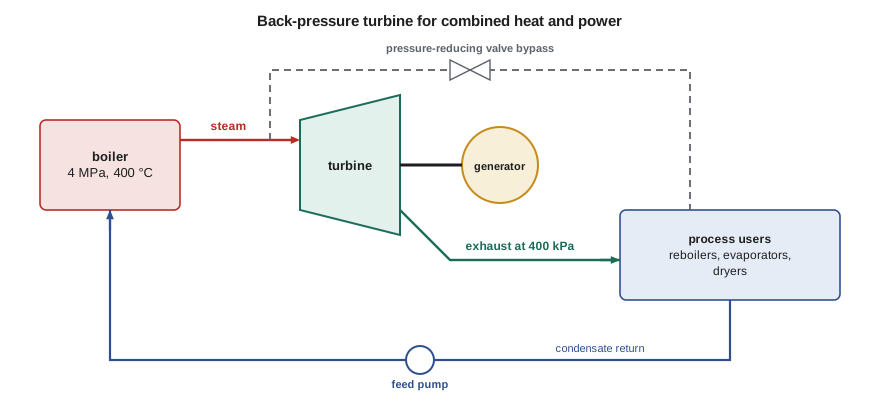
Kingfisher's boilers raise about 60 t/h of steam, and nearly all of it is used at 400 kPa to heat the distillation columns, evaporators and dryers. At the moment the boilers make steam at that low pressure directly. Ingrid's study asks whether the boilers should instead make high-pressure steam at 4 MPa and 400 °C, pass it through a back-pressure turbine to generate electricity, and send the turbine exhaust to the existing 400 kPa header. To answer, the team needs the thermodynamics of steam power cycles: what a conventional power plant achieves, why its efficiency is limited, and why combining power generation with process heating changes the economics completely.
Why not a Carnot cycle?
Lesson 7 showed that a Carnot cycle sets the upper limit for any engine between two temperatures. A Carnot cycle using steam would take in heat at constant temperature by boiling water, expand the vapour isentropically, condense it at constant temperature, and compress the wet mixture isentropically back to saturated liquid. Two steps are impractical. Compressing a two-phase mixture is very difficult for real pumps and compressors, and expanding wet steam to low quality erodes turbine blades. Also, holding all heat input at the boiling temperature wastes the high flame temperature available in a boiler. The practical alternative is the Rankine cycle.
The ideal Rankine cycle
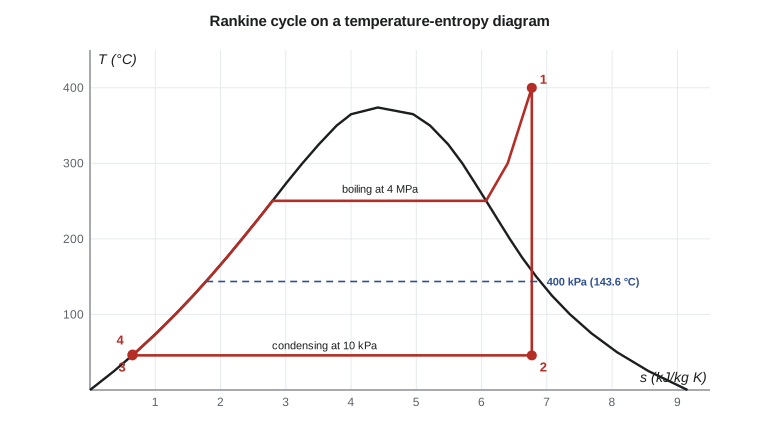
The Rankine cycle has four steps. Feedwater is pumped as a liquid from condenser pressure to boiler pressure, which takes little work because liquids have small volumes. The boiler heats it, boils it and superheats it at constant pressure. The turbine expands the steam to condenser pressure, ideally isentropically. The condenser turns the exhaust back to saturated liquid at constant pressure, rejecting heat to cooling water. Each step is a steady-flow process, so the energy balances of Lesson 10 apply to each one.
Worked problem
A conventional condensing cycle
Steam leaves the boiler at 4 MPa and 400 °C (\(H_1 = 3213.6\ \text{kJ/kg}\), \(S_1 = 6.7690\ \text{kJ/(kg·K)}\)) and is expanded to a condenser at 10 kPa, where saturated values are \(H^l = 191.83\), \(\Delta H^{lv} = 2392.8\ \text{kJ/kg}\), \(S^l = 0.6493\), \(\Delta S^{lv} = 7.5009\ \text{kJ/(kg·K)}\) and \(V^l = 0.001010\ \text{m}^3\text{/kg}\) (approximate table values). Find the efficiency of the ideal Rankine cycle.
Show solution
- Turbine exhaust: \(x_2 = (6.7690 - 0.6493)/7.5009 = 0.8159\); \(H_2 = 191.83 + 0.8159 \times 2392.8 = 2144.1\ \text{kJ/kg}\); \(W_{turbine} = 1069.6\ \text{kJ/kg}\).
- Pump: \(W_{pump} = 0.001010 \times (4000 - 10) = 4.03\ \text{kJ/kg}\); \(H_4 = 191.83 + 4.03 = 195.86\ \text{kJ/kg}\).
- Heat in: \(Q_{in} = 3213.6 - 195.86 = 3017.7\ \text{kJ/kg}\).
- \(\eta = (1069.6 - 4.03)/3017.7 = 0.353\).
Answer: Even the ideal cycle converts only about 35 percent of the boiler heat into work; the rest, about 1950 kJ/kg, goes to the cooling water in the condenser. The Carnot efficiency between 400 °C and 46 °C is about 53 percent. The Rankine cycle falls short mainly because most of its heat enters at the boiling temperature of about 250 °C, not at 400 °C. Adding a turbine efficiency of 0.85 and a pump efficiency of 0.80 lowers the efficiency to about 30 percent.
Improving the Rankine cycle
Three changes raise the average temperature at which heat is added or lower the temperature at which it is rejected, and each improves efficiency. Raising the boiler pressure raises the boiling temperature, though at fixed turbine inlet temperature it also makes the exhaust wetter. Superheating to a higher temperature adds heat at higher temperatures and dries the exhaust. Lowering the condenser pressure lowers the rejection temperature, down to the limit set by available cooling water. Large utility plants combine all three, with supercritical boiler pressures of 25 MPa or more and steam temperatures near 600 °C, reaching efficiencies of about 40 to 45 percent.
Reheating, in which partly expanded steam returns to the boiler for further heating before a second turbine stage, raises efficiency modestly and, more importantly, keeps the turbine exhaust dry enough to protect the blades. Modern turbines tolerate exhaust qualities down to about 0.88 to 0.90; the ideal cycle above, with an exhaust quality of 0.816, would be too wet in practice.
Regeneration with feedwater heaters
In the simple cycle, cold feedwater from the condenser enters the boiler and must be heated from about 46 °C using high-temperature heat. Regeneration heats the feedwater with steam extracted from the turbine part way through its expansion. That steam has already done some work, and its remaining latent heat preheats the feedwater, so the boiler adds heat at a higher average temperature. An open feedwater heater mixes the extracted steam directly with the feedwater; a closed heater transfers heat through tubes. Large plants use six to eight heaters in series.
Worked problem
One open feedwater heater at 400 kPa
Add an open feedwater heater at 400 kPa to the ideal cycle. Steam extracted at 400 kPa has the isentropic enthalpy \(H_6 = 2685.6\ \text{kJ/kg}\). At 400 kPa, saturated liquid has \(H^l = 604.74\ \text{kJ/kg}\) and \(V^l = 0.001084\ \text{m}^3\text{/kg}\). Find the fraction of steam extracted and the new cycle efficiency.
Show solution
- Condensate pump to 400 kPa: \(H_{p1} = 191.83 + 0.001010 \times 390 = 192.22\ \text{kJ/kg}\).
- Heater balance: \(y = (604.74 - 192.22)/(2685.6 - 192.22) = 0.1654\).
- Feed pump to 4 MPa: \(H_{p2} = 604.74 + 0.001084 \times 3600 = 608.64\ \text{kJ/kg}\); \(Q_{in} = 3213.6 - 608.64 = 2605.0\ \text{kJ/kg}\).
- Turbine work per kg of boiler steam: \((3213.6 - 2685.6) + (1 - 0.1654)(2685.6 - 2144.1) = 979.9\ \text{kJ/kg}\); pump work 4.23 kJ/kg; net 975.7 kJ/kg.
- \(\eta = 975.7/2605.0 = 0.375\).
Answer: One feedwater heater raises the ideal efficiency from 35.3 to 37.5 percent, a relative gain of about 6 percent, even though each kilogram of boiler steam now produces less work. The heater also serves as a deaerator, removing dissolved oxygen that would corrode the boiler.
Combined heat and power
A condensing power plant throws away about two thirds of its fuel energy in the condenser because the heat is rejected near room temperature, where it has little use. Many process plants, Kingfisher included, need large amounts of low-pressure steam anyway. Combined heat and power, or cogeneration, puts the turbine between the high-pressure boiler and the process: the turbine exhausts at the process steam pressure, and the process, not a condenser, uses the exhaust heat. Almost all the extra fuel burned to make high-pressure steam turns into electricity, because the heat that would have been rejected is already needed.
Worked problem
The Kingfisher combined heat and power case
All 60 t/h of process steam passes through the turbine from 4 MPa and 400 °C to 400 kPa, with an isentropic efficiency of 0.80 (work 422.4 kJ/kg from Lesson 10). The boiler efficiency is 0.84. Find the shaft power, the extra fuel compared with raising the steam directly at low pressure, and the fuel a condensing plant at 35 percent efficiency would need for the same power.
Show solution
- Steam flow \(= 60\,000/3600 = 16.67\ \text{kg/s}\); power \(= 16.67 \times 422.4 = 7.04\ \text{MW}\).
- The process receives essentially the same heat either way, since the turbine exhaust still condenses at 400 kPa. To a first approximation, the extra boiler output equals the turbine work, so the extra fuel is \(7.04/0.84 = 8.38\ \text{MW}\).
- A condensing plant at 35 percent would need \(7.04/0.35 = 20.1\ \text{MW}\) of fuel for the same electricity.
Answer: The combined heat and power arrangement turns extra fuel into electricity at about 84 percent efficiency, against about 35 percent for a condensing plant. That is why combined heat and power is attractive wherever a large, steady low-pressure steam demand exists. For Kingfisher, the remaining questions are economic: the cost of a new high-pressure boiler and turbine, the price of electricity versus natural gas, and any carbon pricing that rewards the lower total fuel use.
# Rankine cycles and combined heat and power for Kingfisher Bioenergy (approximate steam-table values)
h1, s1 = 3213.6, 6.7690                         # 4 MPa, 400 C superheated steam
sat = {10: (191.83, 2392.8, 0.6493, 7.5009, 0.001010),     # P (kPa): hf, hfg, sf, sfg, vf
       400: (604.74, 2133.8, 1.7766, 5.1193, 0.001084)}
P_boiler = 4000.0                               # kPa

def expand(P, s=s1):
    hf, hfg, sf, sfg, vf = sat[P]
    x = (s - sf) / sfg
    return hf + x * hfg, x

def simple_rankine(eta_t=1.0, eta_p=1.0, P_cond=10):
    hf, hfg, sf, sfg, vf = sat[P_cond]
    h2s, x2s = expand(P_cond)
    wt = eta_t * (h1 - h2s)
    wp = vf * (P_boiler - P_cond) / eta_p
    q_in = h1 - (hf + wp)
    return wt, wp, q_in, (wt - wp) / q_in, x2s

wt, wp, q, eta, x = simple_rankine()
print(f"Ideal Rankine 4 MPa/400 C to 10 kPa: x2 = {x:.4f}, turbine {wt:.1f}, pump {wp:.2f}, heat in {q:.1f} kJ/kg, efficiency {eta:.3f}")
wt, wp, q, eta, x = simple_rankine(0.85, 0.80)
print(f"Real Rankine (turbine 0.85, pump 0.80): net work {wt - wp:.1f} kJ/kg, efficiency {eta:.3f}")

# Regenerative cycle with one open feedwater heater at 400 kPa (ideal turbine and pumps)
h6, _ = expand(400)                              # extraction steam
h2s, _ = expand(10)
hf10, _, _, _, vf10 = sat[10]; hf400, _, _, _, vf400 = sat[400]
h_p1 = hf10 + vf10 * (400 - 10)                  # condensate pump outlet
y = (hf400 - h_p1) / (h6 - h_p1)                 # fraction extracted, from the heater energy balance
h_p2 = hf400 + vf400 * (P_boiler - 400)          # feed pump outlet
wt = (h1 - h6) + (1 - y) * (h6 - h2s)
wp = (1 - y) * vf10 * (400 - 10) + vf400 * (P_boiler - 400)
q_in = h1 - h_p2
print(f"Regenerative cycle: extraction fraction y = {y:.4f}, net work {wt - wp:.1f} kJ/kg, heat in {q_in:.1f} kJ/kg, efficiency {(wt - wp) / q_in:.3f}")

# Combined heat and power: back-pressure turbine exhausting to the 400 kPa process header
m = 60.0 / 3.6                                  # kg/s of process steam (60 t/h)
eta_t, eta_boiler = 0.80, 0.84
w = eta_t * (h1 - h6)
power = m * w
extra_fuel = power / eta_boiler                 # extra fuel energy compared with raising the steam at low pressure
print(f"CHP: {m:.2f} kg/s through the turbine gives {power/1000:.2f} MW of shaft power")
print(f"Extra boiler fuel about {extra_fuel/1000:.2f} MW, so fuel-to-power efficiency is about {power / extra_fuel:.2f}")
print(f"A condensing power plant at 35 % efficiency would burn {power / 0.35 / 1000:.1f} MW of fuel for the same power")Ideal Rankine 4 MPa/400 C to 10 kPa: x2 = 0.8159, turbine 1069.6, pump 4.03, heat in 3017.7 kJ/kg, efficiency 0.353 Real Rankine (turbine 0.85, pump 0.80): net work 904.1 kJ/kg, efficiency 0.300 Regenerative cycle: extraction fraction y = 0.1654, net work 975.7 kJ/kg, heat in 2605.0 kJ/kg, efficiency 0.375 CHP: 16.67 kg/s through the turbine gives 7.04 MW of shaft power Extra boiler fuel about 8.38 MW, so fuel-to-power efficiency is about 0.84 A condensing power plant at 35 % efficiency would burn 20.1 MW of fuel for the same power
The program confirms each result. It also shows that a real condensing cycle with turbine and pump efficiencies of 0.85 and 0.80 reaches only about 30 percent, which puts the combined heat and power figure of 84 percent in perspective.
Common mistakes
MistakeUsing closed-system work formulas for turbines and pumps.
InsteadEach Rankine step is a steady-flow process: work equals the enthalpy change.
MistakeForgetting pump work, or treating it as large.
InsteadPump work is small, a few kJ/kg, because liquid volumes are small, but it should be included.
MistakeComparing Rankine efficiency with Carnot at the turbine inlet temperature only.
InsteadMost heat enters at the boiling temperature, which is why Rankine falls well short of Carnot.
MistakeIgnoring exhaust quality.
InsteadVery wet turbine exhaust erodes blades; superheat or reheat to keep quality above about 0.88.
MistakeJudging combined heat and power by electrical efficiency alone.
InsteadCredit the useful heat; the marginal fuel-to-power efficiency is what matters.
Summary and key terms
- The Rankine cycle pumps liquid, boils and superheats it, expands it in a turbine and condenses it.
- η = (W_turbine − W_pump)/Q_in; ideal cycles between 4 MPa, 400 °C and 10 kPa reach about 35 percent.
- Higher boiler pressure and superheat, and lower condenser pressure, raise efficiency.
- Reheat keeps the turbine exhaust dry; regeneration with feedwater heaters raises the average heat-addition temperature.
- Feedwater heater balances give the extraction fraction y.
- Combined heat and power turns extra fuel into power at about the boiler efficiency when the exhaust heat is used.
- Rankine cycle
- The practical vapour power cycle: pump, boiler, turbine and condenser.
- Superheat
- Heating steam above its saturation temperature at a given pressure.
- Reheat
- Returning partly expanded steam to the boiler for further heating.
- Feedwater heater
- A heat exchanger or mixing vessel that preheats boiler feedwater with extracted steam.
- Back-pressure turbine
- A turbine that exhausts at a pressure above atmospheric, into a process steam header.
- Combined heat and power
- Generating electricity and useful process heat from the same fuel.
Practice problems
Work each problem on paper first, then reveal the answer to check.
An ideal Rankine cycle has turbine work 1000 kJ/kg, pump work 5 kJ/kg and heat input 3000 kJ/kg. Find η.
Show answer
(1000 − 5)/3000 = 0.332.
Using the program, what is the efficiency of the real cycle with turbine efficiency 0.85 and pump efficiency 0.80?
Show answer
About 0.300.
Why does adding a feedwater heater raise efficiency even though each kilogram of boiler steam does less work?
Show answer
Heat input falls more than work does, because the boiler no longer heats cold feedwater from about 46 °C.
What exhaust quality does the ideal cycle give, and is it acceptable?
Show answer
0.816, too wet for real turbine blades; reheat or more superheat is needed.
How much shaft power would 40 t/h through the Kingfisher turbine give?
Show answer
40 000/3600 × 422.4 = 4.69 MW.
Why must a combined heat and power plant keep a pressure-reducing valve bypass?
Show answer
The process still needs steam when the turbine is shut down for maintenance or trips.
Lesson quiz · 5 questions
Score 60% or more to complete this lesson.
Create a free account to save your progress, take quizzes and earn a certificate.