
BLR-220 · Lesson 5 of 12 · 19 min
Boiler components: drums, headers, superheaters and economizers
With the steam drum closed up, the Riverbend fall inspection moves on to the rest of the boiler. Peg Lindqvist's inspection plan lists the parts she wants to see: the superheater, where the tubes are measured for swelling and oxide; the economizer, where tubes near the sootblowers are checked for erosion; the headers, where she wants the hand-hole caps off so a camera can look inside; and the safety valves, which a valve shop will test while the unit is down. Ironbridge supplies the boilermakers who open everything up, build access and make repairs. Kiera works through the list with Dale, and for each part he asks her the same question: "What does this piece do, and what is it afraid of?"
This lesson goes around a large boiler part by part. Knowing each component's job and its usual failures is what lets a boilermaker understand an inspection plan, recognize damage and repair it correctly.
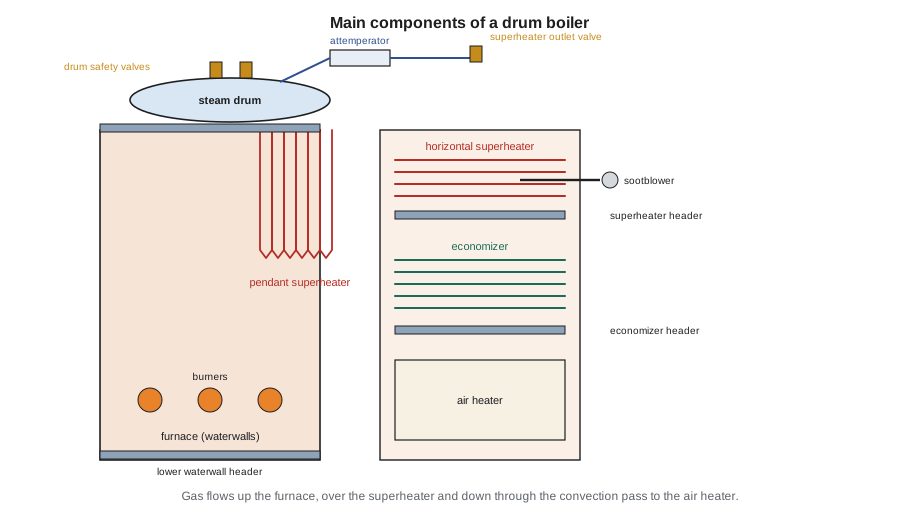
Drums
The steam drum is the largest pressure part on most drum boilers. Riverbend's is about 1.5 m (5 ft) in diameter and 12 m (40 ft) long, with a shell well over 100 mm (4 in) thick, and it holds the boiler's water at the full drum pressure. Its shell is pierced by hundreds of tube holes, the downcomer and riser nozzles, the steam outlets, the feedwater inlet, the safety valve nozzles and the manways at each end. Large drums are made of heavy forged or rolled plate, often thicker in the band where the tube holes are, because the holes weaken the shell. The strength of a row of holes is measured by its ligament efficiency, the fraction of metal left between the holes, which lesson 8 explains.
Drums are afraid of cracking at their nozzles and tube holes, of corrosion in the water space, and of rapid temperature changes. Heating or cooling a thick drum too fast puts large stresses between its inner and outer surfaces, so operators limit the rate at which they bring pressure up and down. Inspectors look at the tube seats for cracks, at the nozzle welds by magnetic particle testing and at the water line for pitting.
Headers
Headers distribute water to rows of tubes and collect the mixture or steam from them. Waterwall headers at the bottom of the furnace receive water from the downcomers. Superheater headers collect steam from many tubes and feed it to the next stage. Most headers are heavy pipe with tube stubs welded into them; older ones have tubes rolled into holes and access through hand holes closed by caps. Superheater outlet headers run at the highest steam temperature in the boiler and are afraid of creep, the slow stretching of metal at high temperature under stress, and of fatigue cracking at the ligaments between their tube holes and at the stub welds. Lower waterwall headers collect sludge and debris, and inspectors want them opened and flushed.
At Riverbend, Kiera cuts the seal welds on two hand-hole caps on the lower front waterwall header, removes the caps and helps Annika Sorensen push a video probe along the inside. They find a little loose scale and a weld rod stub, a piece of foreign material left behind by somebody's repair in the past. The stub comes out with a magnet on a rod, and Peg writes it up. Then the caps go back on with new gaskets and are seal welded by a qualified welder to the plant's procedure.
Superheaters
The superheater takes saturated steam from the drum and heats it to the final steam temperature. In a large boiler, it is split into stages. Pendant sections hang from the roof above the furnace exit, where they receive radiant heat and very hot gas; horizontal sections lie in the convection pass. Superheater tubes run hotter than any others, because steam does not cool a tube as well as boiling water does, and they are made of carbon steel in the cooler sections, chromium-molybdenum alloys in the hotter ones and sometimes stainless steel at the outlet.
Superheater tubes are afraid of creep and overheating. Over years at high temperature, a tube's metal slowly creeps and the tube swells. Steam also grows an oxide scale on the inside of the tube, and the scale insulates the tube from the steam, so the metal runs hotter still. Inspectors measure the outside diameter of selected tubes with a micrometer or a swell gauge and compare it with the original; a tube that has swelled by more than a set amount, often a couple of percent, is scheduled for replacement. Ultrasonic methods measure the internal oxide thickness and help estimate how much life is left. Exfoliated oxide that breaks off and collects in the bottoms of pendant loops can block steam flow and cause short-term overheating failures.
To control the final steam temperature, many boilers have an attemperator between superheater stages: a spray of clean water injected into the steam line, which cools the steam. The attemperator liner and spray nozzle are afraid of thermal shock, because cold water hits a hot pipe, and inspectors check them with a borescope.
Economizers and air heaters
The economizer heats the feedwater with flue gas leaving the convection pass. It is a bank of horizontal tubes, often finned in newer boilers, connected between an inlet header and an outlet header. Water flows upward through it, against the gas, so that any steam bubbles that form can rise and leave. Economizer tubes are afraid of erosion by fly ash in coal-fired boilers, of sootblower erosion where the steam jet from a sootblower hits the same tubes repeatedly, and of oxygen pitting on the water side if the feedwater is poorly deaerated. At the cold end, the outside of the tubes can see acid condensation if the gas or the water is too cold.
The air heater takes heat from the gas leaving the economizer and puts it into the combustion air. Riverbend has a tubular air heater, a large box of thin tubes with the gas inside and the air outside. Many large boilers use regenerative air heaters, slowly rotating drums packed with steel baskets that are heated by the gas on one side and give up their heat to the air on the other. Air heaters are afraid of cold-end corrosion and plugging. Boilermakers replace air heater tubes, baskets and seals at outages.
Heat that the economizer takes from the gas goes straight into the feedwater. The code below works out the economizer's duty at full load and, because Riverbend's safety valves are being tested this outage, checks the valve set pressures and capacities against example rules of the kind Section I applies.
# Riverbend Unit 2: economizer duty and a safety valve capacity check (metric)
steam = 180_000              # maximum continuous rating, kg/h
h_in, h_out = 990, 1_262  # feedwater into and out of the economizer, kJ/kg
q = steam * (h_out - h_in)
gas, cp = 200_000, 1.15       # flue gas flow kg/h and specific heat
t_gas_in = 610
print(f"Economizer duty: {q / 3600:,.0f} kW")
print(f"Flue gas cools from {t_gas_in:,} to {t_gas_in - q / (gas * cp):.0f} °C")

# Safety valves: (location, set pressure kPa, rated capacity kg/h)
mawp = 11_700
valves = [("superheater outlet", 11_100, 50_000), ("drum A", 11_700, 75_000), ("drum B", 12_000, 75_000)]
total = sum(c for _, p, c in valves)
drum = sum(c for n, p, c in valves if n.startswith("drum"))
drum_sets = [p for n, p, c in valves if n.startswith("drum")]
print(f"Total relieving capacity {total:,} vs MCR {steam:,}: {'OK' if total >= steam else 'SHORT'}")
print(f"Drum valves carry {drum / steam:.0%} of MCR (example rule: at least 75%): {'OK' if drum >= 0.75 * steam else 'SHORT'}")
print(f"Lowest drum set {min(drum_sets):,} at or below MAWP {mawp:,}: {'OK' if min(drum_sets) <= mawp else 'NO'}")
print(f"Highest drum set {max(drum_sets):,} within 3% above MAWP ({mawp * 1.03:,.0f}): {'OK' if max(drum_sets) <= mawp * 1.03 else 'NO'}")
sh = [p for n, p, c in valves if n.startswith("super")][0]
print(f"Superheater valve opens first ({sh:,} below {min(drum_sets):,}): {'OK' if sh < min(drum_sets) else 'NO'}")Economizer duty: 13,600 kW Flue gas cools from 610 to 397 °C Total relieving capacity 200,000 vs MCR 180,000: OK Drum valves carry 83% of MCR (example rule: at least 75%): OK Lowest drum set 11,700 at or below MAWP 11,700: OK Highest drum set 12,000 within 3% above MAWP (12,051): OK Superheater valve opens first (11,100 below 11,700): OK
Safety valves
Every boiler must have safety valves that can relieve all the steam it can make without the pressure rising above a limit, and their set pressures, capacities and arrangement follow ASME Section I. In outline, at least one drum valve is set at or below the maximum allowable working pressure, the others are set within a few percent above it, and the drum valves must carry a large share of the total capacity. On a boiler with a superheater, the superheater outlet valve is set to open first. If the drum valves opened first, the steam flow through the superheater would stop, and its tubes, which depend on the steam to keep them cool, would overheat. The example rules in the code above are of this kind; the actual values for any boiler come from the code and the boiler's design.
Safety valves are tested and reset only by organizations qualified to do so, which in practice means a valve repair shop holding the right certification, with its own seal on each valve. Boilermakers remove and reinstall the valves, but they never adjust a safety valve's spring or blowdown ring themselves.
Supports, casings and sootblowers
A large boiler hangs from steel at the top. The drum sits in slings or saddles, and the waterwalls, superheater and economizer hang from rods and hangers so they can grow downward when hot, as lesson 6 explains. Around the outside, buckstays, horizontal beams tied to the walls at intervals, hold the walls against the furnace pressure and pulsations while letting them grow. The casing seals the boiler, and the insulation and lagging keep the heat in. Sootblowers, retractable lances that blow steam or air jets across the tubes, keep the convection surfaces clean. A sootblower whose lance sags or whose nozzle points at the wrong place cuts tubes, and boilermakers check the clearances when they work near one.
| Component | What it is afraid of | What the inspector checks |
|---|---|---|
| Steam drum | Nozzle and tube seat cracking, water line pitting | Visual inside, magnetic particle at nozzles |
| Waterwall headers | Debris, sludge, ligament cracks | Video probe through hand holes |
| Superheater tubes | Creep, internal oxide, overheating | Diameter swell, oxide thickness, metallography |
| Superheater outlet header | Creep and fatigue cracking | Ligament and stub weld examination |
| Economizer tubes | Erosion, oxygen pitting, acid corrosion | Wall thickness readings, visual |
| Attemperator | Thermal shock of liner and nozzle | Borescope |
| Air heater | Cold-end corrosion, plugging | Visual, pressure drop |
Worked problem
Superheater tube swell
A superheater tube was installed with an outside diameter of 50.8 mm (2.000 in). At the inspection, it measures 51.9 mm (2.042 in). The plant's limit is 2 percent swell. Is the tube within the limit?
Show solution
- Swell: 51.9 − 50.8 = 1.1 mm.
- As a percentage: 1.1 ÷ 50.8 = 2.2 percent.
Answer: No. The tube has swelled more than 2 percent and should be scheduled for replacement.
Replacing a superheater tube section
One of the pendant superheater loops at Riverbend has swelled past the plant's limit, so Peg asks Ironbridge to replace a section of it before the boiler is closed. The loop is made of chromium-molybdenum tube, which means the welding procedure from BLR-210 applies: a GTAW root, preheat, controlled interpass temperature and postweld heat treatment with electric resistance heating bands. Before any cutting, the tube material is confirmed by positive material identification, a quick test with a handheld analyser, because a carbon steel tube welded into a superheater would fail in months. The old section is cut out mechanically, the ends prepared, the new section fitted with its spacers and alignment ties, and the welds made, heat treated and radiographed. The spacers matter as much as the welds: superheater loops that are not tied together at their design spacing swing in the gas flow, rub against each other and wear through.
Common mistakes
MistakeLeaving foreign material in a header after a repair.
InsteadCover openings, count tools and inspect headers before they are closed.
MistakeAdjusting a safety valve's spring to stop it simmering.
InsteadOnly a qualified valve shop sets and seals safety valves.
MistakeAssuming the superheater and drum valves can open in any order.
InsteadThe superheater valve opens first so steam keeps flowing through the superheater.
MistakeIgnoring a sootblower lance that sags.
InsteadA misaligned lance cuts tubes; report it so the plant can repair the blower.
Summary and key terms
- The steam drum holds the boiler water at full pressure; its nozzles and tube seats are inspected for cracks.
- Headers distribute and collect flow; outlet headers creep, lower headers collect debris.
- Superheater tubes run hottest and are checked for swelling and internal oxide.
- Economizers heat feedwater and are afraid of erosion and pitting; air heaters recover more heat into the combustion air.
- Safety valves are set and arranged by code; the superheater valve opens first.
- Hangers, buckstays, casings and sootblowers support, seal and clean the boiler.
- Header
- A large pipe that distributes flow to, or collects flow from, a row of tubes.
- Creep
- Slow, permanent stretching of metal at high temperature under stress.
- Attemperator
- A spray of water into the steam between superheater stages to control temperature.
- Air heater
- A heat exchanger that warms the combustion air with flue gas.
- Buckstay
- A horizontal beam that stiffens a furnace wall while letting it grow.
- Sootblower
- A lance that blows steam or air across tubes to remove deposits.
Practice problems
Work each problem on paper first, then reveal the answer to check.
Why do superheater tubes run hotter than waterwall tubes?
Show answer
Steam cools a tube less well than boiling water, and the superheater sits in very hot gas.
Why must the superheater safety valve open before the drum valves?
Show answer
So steam keeps flowing through the superheater and cools its tubes while the pressure is relieved.
A tube originally 63.5 mm is now 64.6 mm. What is the swell?
Show answer
1.1 mm, or 1.7 percent.
What does an economizer do with the heat it takes from the gas?
Show answer
It heats the feedwater before it enters the drum.
Lesson quiz · 5 questions
Score 60% or more to complete this lesson.
Create a free account to save your progress, take quizzes and earn a certificate.