
BLR-220 · Lesson 3 of 12 · 20 min
Water-tube and utility boilers
In late September, Kiera is back at Riverbend Generating Station. Unit 2 is down for its fall inspection, a two-week outage in which the plant's inspectors look inside the drums and headers, and contractors make the repairs they find. Ironbridge's scope includes removing and reinstalling the internals of the steam drum so Peg Lindqvist, Riverbend's owner's inspector, can see the drum shell, and replacing any damaged separators. Kiera has entered the drum before, during BLR-110's planning exercise, but this time she is there to understand what the parts do. Dale Whitford's advice before she goes in is to look at how the water moves. "Everything in that drum is there to move water and steam to the right place," he says. "If you know where the water is going, you'll know what each piece is for."
Water-tube boilers make most of the steam in power plants, refineries, pulp mills and large industrial sites. This lesson covers how they are built, how water circulates through them, what goes on in the steam drum, and the packaged water-tube boilers that boilermakers meet in smaller plants.
The parts of a water-tube boiler
A water-tube boiler is a system of drums, headers and tubes, with the fire outside the tubes. The steam drum, at the top, holds water and steam and separates them. Large boilers may also have a lower drum, called the mud drum because sludge settles there, connected to the steam drum by a bank of tubes. Headers are large pipes, round or square, that feed water to rows of tubes or collect the mixture from them. The tubes themselves form the walls of the furnace and the banks in the convection pass.
In older boilers, the furnace walls were rows of tubes with gaps between them, backed by refractory. Modern furnaces, including Riverbend's, are built of membrane walls: tubes joined side by side by steel bars welded between them, so the whole wall is a gas-tight steel panel with water inside its tubes. Membrane walls are lighter, keep the gas inside without heavy refractory, and can be shop-built as panels and lifted into place. BLR-210 showed how one is repaired; lesson 6 shows how one is erected.
| Part | What it does | What a boilermaker does to it |
|---|---|---|
| Steam drum | Holds water and steam, separates them, receives feedwater | Removes and installs internals, inspects, repairs nozzles and tube seats |
| Mud drum (lower drum) | Distributes water to tubes, collects sludge | Cleans, inspects, rolls tubes into it |
| Headers | Distribute or collect flow for rows of tubes | Cuts and welds tube stubs, inspects for cracks |
| Downcomers | Carry water from the drum to the lower headers | Inspects, repairs supports |
| Risers and waterwalls | Carry the heated mixture up to the drum | Replaces tubes and panels |
| Boiler bank | Tubes between drums in the convection pass | Replaces eroded tubes, rolls tube ends |
How water circulates
Most drum boilers use natural circulation. The water in the downcomers is outside the furnace and contains no steam, so it is dense. The water in the riser tubes is being heated and contains steam bubbles, so the mixture is lighter. The heavier column in the downcomers pushes the lighter mixture up the risers, and the water circulates without a pump. The harder the boiler is fired, the more steam forms in the risers and the stronger the circulation becomes, which is exactly what keeps the tubes cool when the heat is greatest.
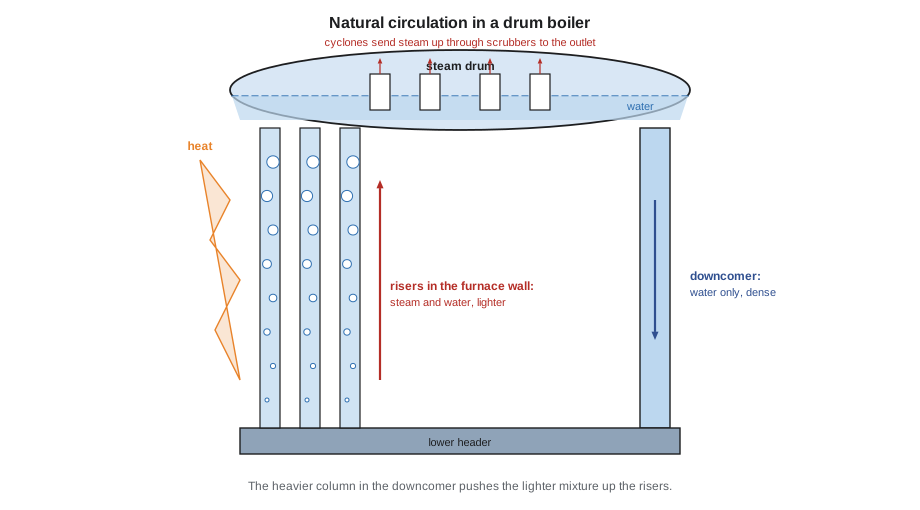
Only part of the water in the risers turns to steam in each trip round the circuit. The mass fraction that is steam at the top of the risers is the quality, and its inverse is the circulation ratio, the mass of water circulated for each unit of steam made. A natural circulation boiler at Riverbend's pressure might have a quality of about 20 percent at the riser outlets, a circulation ratio of about 5. At higher pressures, the difference in density between water and steam shrinks, natural circulation gets weaker, and some boilers use pumps to drive the flow; this is called forced or assisted circulation. Above the critical pressure, about 22,100 kPa (3,200 psi), water and steam can no longer be told apart, there is no drum, and the boiler is a once-through design in which the water is pumped through the tubes and comes out as steam.
Anything that blocks a tube interrupts circulation. A rag left in a header, a piece of slag from a careless cut, or a heavy scale deposit can starve a tube of water, and a starved furnace tube overheats and fails within hours. This is the reason for the cleanliness rules boilermakers follow: foreign material exclusion covers on every open tube and header, counting tools in and out, and a final inspection with lights or a camera before the drums are closed.
Inside the steam drum
The steam drum is where water and steam part company. The mixture from the risers enters the drum through the riser tube openings or through internal baffles that direct it into separators. In Riverbend's drum, the separators are cyclones: vertical cans in two rows along the drum, in which the mixture enters tangentially and spins, so the heavier water is thrown to the wall and drains down while the steam goes up the middle. Above the cyclones, the steam passes through scrubbers, banks of corrugated plates or mesh that catch the last droplets, before it leaves through the steam outlet nozzles on top of the drum. If water carries over with the steam, it takes dissolved solids into the superheater, where they deposit, and into the turbine, where they damage blades.
- Feedwater pipe. A perforated pipe running the length of the drum that spreads the incoming feedwater into the water space.
- Chemical feed pipe. A smaller perforated pipe that delivers water treatment chemicals.
- Continuous blowdown pipe. A collector just below the normal water level that draws off the most concentrated water to control dissolved solids.
- Baffles and the dry box. Plates that keep the riser mixture away from the downcomer openings and collect the dry steam before the outlets.
- Level connections. Nozzles for the gauge glass, level transmitters and low-level trips.
Kiera and Dale remove the scrubber panels and the cyclone cans one at a time, number each piece with a paint stick, and pass them out of the manway on a rope. Each cyclone is held by wedges or bolts so it can be taken out without tools that could damage the drum. With the internals out, Peg inspects the drum shell and the tube seats, and Annika Sorensen runs magnetic particle testing on the welds of the downcomer nozzles, where cracking is known to start. Two cyclone cans have eroded holes near their inlets, and Ironbridge replaces them from Riverbend's stock. Every piece goes back in its numbered position, the wedges are driven home, and the drum is inspected and swept before the manway covers go on.
Drum level and swell
The drum's water level is the most important thing the operators watch. Too low, and the downcomers can draw steam, circulation fails and tubes overheat. Too high, and water carries over with the steam. The level is controlled within a band of a few millimetres either side of the normal water level, usually at about the drum's centre line.
The level does something odd when the load changes. When the turbine suddenly takes more steam, the drum pressure falls a little. The water in the risers, which is at the saturation temperature, now finds itself above the new boiling point and flashes into more steam. The bubbles grow, the mixture swells and the drum level rises, even though the boiler is losing water faster. This is called swell. When the load drops, the opposite happens: the pressure rises, bubbles collapse and the level shrinks. A level controller that reacted only to the level would cut the feedwater just when more is needed, so drum level controls also use the steam and feedwater flows.
# Riverbend Unit 2: natural circulation and drum level swell (metric, illustrative)
import math

steam = 180_000              # steam leaving the drum, kg/h
x_riser = 0.20               # steam quality at the top of the risers (mass fraction)
cr = 1 / x_riser             # circulation ratio: mass circulated per mass of steam made
mix = steam * cr
print(f"Circulation ratio: {cr:.1f}")
print(f"Water and steam through the risers: {mix:,.0f} kg/h")

# Downcomers carry the water back down from the steam drum
n_dc = 4
dc_id = 0.30               # downcomer inside diameter, m
rho_w = 680                # saturated water at drum pressure, kg per m3
area = math.pi * dc_id ** 2 / 4
vel = (mix - steam) / rho_w / 3600 / (n_dc * area)    # water returning to the risers
print(f"Downcomer water velocity: {vel:.2f} m/s")

# Swell: a sudden load increase drops drum pressure, steam bubbles grow and the level rises
drum_len = 12.0            # steam drum length, m
drum_d = 1.5                # steam drum inside diameter, m
surface = drum_len * drum_d  # water surface near the drum centre line, m2
for dv in [1.0, 2.5, 4.0]:             # extra steam volume in the risers, m3
    rise = dv / surface * 1000
print(f"Bubble volume +{dv} m3 -> apparent level rise {rise:.0f} mm")Circulation ratio: 5.0 Water and steam through the risers: 900,000 kg/h Downcomer water velocity: 1.04 m/s Bubble volume +1.0 m3 -> apparent level rise 56 mm Bubble volume +2.5 m3 -> apparent level rise 139 mm Bubble volume +4.0 m3 -> apparent level rise 222 mm
The numbers are illustrative, but they show why the swell matters. A sudden extra 2.5 m3 (88 ft3) of bubbles in the risers lifts the level by about 140 mm (5 in) across the drum's surface, which is enough to approach the high-level alarm. Kiera notices that the downcomers' water velocity is low, about 1 m/s (3 ft/s): the downcomers are large so that circulation is not choked.
Packaged water-tube boilers
Many industrial plants use packaged water-tube boilers, shop-assembled and shipped on a skid or as a few large modules. They are named for the shape of their tube arrangement as seen from the end.
| Type | Arrangement | Where it is used |
|---|---|---|
| D-type | Steam drum and mud drum on one side, furnace on the other, tubes bent in a D | Industrial plants; easy access to the furnace |
| A-type | One steam drum on top, two mud drums below, furnace in the middle | Older packaged units |
| O-type | Steam drum above mud drum, tubes forming an O around a central furnace | Packaged units that must ship within a narrow width |
| Flex-tube and bent-tube designs | Tubes that can be replaced individually without welding | Small heating and process boilers |
Northgate has three D-type packaged boilers that back up its cogeneration plant, and Ironbridge maintains them. Their boiler bank tubes are rolled into both drums, just like the fire tubes at Larkspur, so the skills carry over. The furnace side is a membrane wall welded to the drums.
Worked problem
Circulation ratio
A boiler makes 60,000 kg/h (132,000 lb/h) of steam, and the quality at the top of the risers is 25 percent. What are the circulation ratio and the mass of water and steam passing up the risers?
Show solution
- Circulation ratio: 1 ÷ 0.25 = 4.
- Mixture through the risers: 4 × 60,000 = 240,000 kg/h.
- Of that, 180,000 kg/h is water that returns to the drum and comes back down the downcomers.
Answer: A circulation ratio of 4, with 240,000 kg/h passing up the risers.
Closing the drum
Closing a steam drum is a small job with a big consequence, so Riverbend has a written closing procedure. Before the manway covers go on, the last person out does a final sweep with a light, Peg Lindqvist inspects the internals in place, and the tool log is checked to show every tool that went in has come out. The manway gaskets are new, the cover seating faces are cleaned and checked for steam cuts, and the covers are fitted from the inside, because a drum manway cover is larger than its opening and is held in place by pressure. The crossbar nuts are snugged to the plant's value cold, then checked again when the boiler first comes up to a low pressure during start-up. Kiera signs the closing record with Dale and Peg, the last entry on the drum's traveller for this outage.
Common mistakes
MistakeLeaving an open tube or header uncovered at the end of a shift.
InsteadCover every opening and log it; a foreign object can block circulation and burn out a tube.
MistakeMixing up the drum internals on reassembly.
InsteadNumber every piece before it comes out and return it to the same place.
MistakeThinking a rising drum level means the boiler has more water.
InsteadDuring swell the level rises because bubbles grow, while the water inventory is falling.
MistakeAssuming every boiler has a drum.
InsteadOnce-through and supercritical boilers have no drum; the water passes through the tubes once.
Summary and key terms
- A water-tube boiler is a system of drums, headers and tubes, with membrane walls forming a gas-tight furnace.
- Natural circulation is driven by the density difference between the water in the downcomers and the steam and water mixture in the risers.
- The circulation ratio is the inverse of the riser outlet quality; anything that blocks a tube can starve it and cause a failure.
- The steam drum holds separators, scrubbers, the feedwater and chemical feed pipes and the continuous blowdown.
- Swell and shrink make the drum level move the wrong way when the load changes.
- Packaged water-tube boilers come in D, A and O arrangements.
- Membrane wall
- A furnace wall of tubes joined by welded bars into a gas-tight panel.
- Downcomer
- A large pipe carrying water from the steam drum to the lower headers.
- Riser
- A heated tube carrying steam and water up to the drum.
- Circulation ratio
- The mass of water circulated for each unit mass of steam made.
- Cyclone separator
- A drum internal that spins the mixture to separate water from steam.
- Swell
- A temporary rise in drum level when pressure falls and bubbles grow.
Practice problems
Work each problem on paper first, then reveal the answer to check.
What drives natural circulation?
Show answer
The heavier, steam-free water in the downcomers pushes the lighter steam and water mixture up the heated risers.
Why is carryover from the drum harmful?
Show answer
Water carried with the steam takes dissolved solids into the superheater and turbine, where they deposit and cause damage.
If the quality at the riser outlets is 0.2, what is the circulation ratio?
Show answer
1 ÷ 0.2 = 5.
Why are drum internals numbered before they are removed?
Show answer
So every piece goes back in the same position and nothing is left out or swapped.
Lesson quiz · 5 questions
Score 60% or more to complete this lesson.
Create a free account to save your progress, take quizzes and earn a certificate.