
BLR-220 · Lesson 10 of 12 · 19 min
Air coolers and other exchangers
On the second day of the turnaround, while E-1105's bundle is being pulled, Rosa sends Kiera up to the pipe rack. Along the top of the rack, above the pipes, sit Northgate's air coolers: long banks of finned tubes with big fans under them. One of them, E-1220, condenses the overhead vapour from a distillation column, and its operators have reported leaks at two plug headers and a fan that vibrates. Ironbridge's crew on the rack removes and inspects header plugs, replaces gaskets, and works with the plant's millwrights on the fan. Kiera's job is to learn the air cooler, and then, over the rest of the week, to see as many other kinds of exchanger as the turnaround offers.
Shell-and-tube exchangers are the most common, but not the only, heat exchangers boilermakers work on. This lesson covers air-cooled exchangers in detail and then the other types found in plants: plate, double pipe and spiral exchangers, kettle reboilers, and the feedwater heaters and condensers of power plants.
Air-cooled heat exchangers
An air-cooled heat exchanger, often called an air cooler or fin fan, cools or condenses a process fluid with outside air instead of water. It saves cooling water, which is expensive or scarce in many places, and it has no water side to foul or corrode. It is built of one or more tube bundles, each a set of finned tubes running between two headers, mounted in a steel structure with fans that move air across the fins. Most refinery air coolers are built to API Standard 661, whose current edition dates from 2013 and has been reaffirmed since.
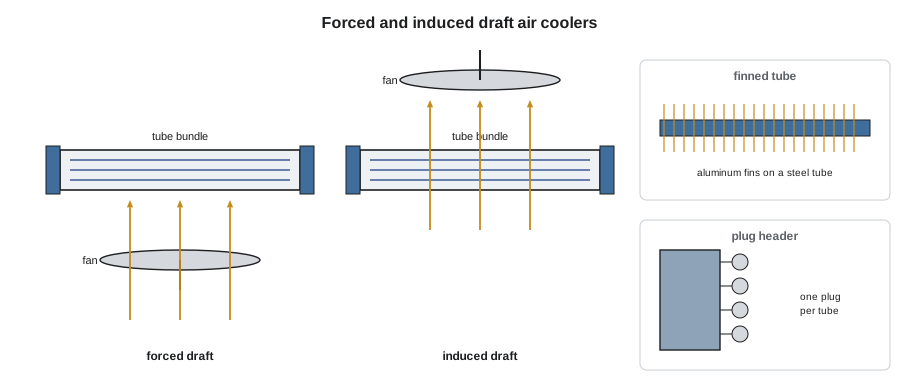
In a forced draft unit, the fans sit below the bundle and push air up through it. The fans and motors are in cool air, easy to reach for maintenance, and the bundle is easy to get at from above. In an induced draft unit, the fans sit above the bundle and pull air through it. The air is more evenly spread and the hot air is thrown up and away rather than drifting back into the inlet, but the fans run in the hot air leaving the bundle. Fans are driven by electric motors through belts or gearboxes, and many have variable-pitch blades or variable speed drives to control the process outlet temperature.
Finned tubes and headers
Air carries heat away far less well than water, so an air cooler needs a great deal of surface on the air side. The tubes are finned: thin aluminum fins, many per 25 mm of length, are wrapped or extruded onto a steel or alloy tube, multiplying the outside surface by fifteen to twenty-five times. Wrapped L-foot fins are cheap but can loosen; embedded fins are set into a groove in the tube; extruded fins are formed from an aluminum sleeve pressed onto the tube and give the best bond. Damaged or flattened fins block air and reduce performance, so boilermakers protect the fins when working on a bundle and never walk on them.
The headers at each end of the bundle are boxes into which the tubes are rolled or welded. The most common type in refineries is the plug header: a welded box with a threaded hole in the back plate opposite each tube end. The plugs, each with its own gasket, can be removed to clean, inspect, roll or plug each tube without taking the header apart. Cover plate headers have a whole bolted plate that comes off, and bonnet headers have a bolted cover over the whole tube sheet. Plug headers suit high pressures; cover plate headers make cleaning easier for fouling services.
On E-1220, the leaks are at two plugs on the inlet header. Kiera and Dale remove them with a large hex socket, inspect the threads and seating surfaces, and fit new plugs and gaskets. A plug is torqued to the value the header's maker gives, with its threads lubricated. Over-torqued plugs gall their threads or crush their gaskets; under-torqued ones leak. One of the plug holes has a damaged seat, which a machinist dresses with a seat cutter before the new plug goes in.
Air cooler performance and the weather
An air cooler's capacity depends on the outside air. Its design is based on a design air temperature, often a summer temperature that is exceeded only a few percent of the time. On hotter days, the air comes in warmer, can take less heat, and the process outlet temperature rises. In winter, the opposite problem appears: the air is so cold that a condensing fluid can be over-cooled, or water and wax in the process stream can freeze or thicken and block tubes. In the Alberta winter, this matters every year.
# E-1220 air-cooled condenser at Northgate: air needed and fan power (metric)
q = 6_000                      # duty to reject, kW
cp_air = 1.006                # kJ/kg K
t_air_in, t_air_out = 30, 55
rho_air = 1.165              # air density at the inlet temperature, kg/m3
fans = 4

m_air = q / (cp_air * (t_air_out - t_air_in))
vol = m_air / rho_air
print(f"Air mass flow: {m_air:,.1f} kg/s")
print(f"Air volume: {vol:,.0f} m3/s, {vol / fans:,.0f} per fan")

dp = 150                    # fan static pressure, Pa
eta = 0.65                   # fan and drive efficiency
power = vol / fans * dp / 1000 / eta
print(f"Shaft power per fan: {power:.1f} kW")

# On a hot afternoon the air comes in warmer and the same air carries less heat
for t_hot in (30, 35, 40):
    frac = (t_air_out - t_hot) / (t_air_out - t_air_in)
print(f"air in at {t_hot} °C: same air flow removes about {frac:.0%} of the design duty")Air mass flow: 238.6 kg/s Air volume: 205 m3/s, 51 per fan Shaft power per fan: 11.8 kW air in at 30 °C: same air flow removes about 100% of the design duty air in at 35 °C: same air flow removes about 80% of the design duty air in at 40 °C: same air flow removes about 60% of the design duty
The calculation shows how much air E-1220 must move at design, and why its performance falls off on hot days. With the same air flow, each extra 5 °C (9 °F) of inlet air temperature costs about a fifth of the duty, which is why operators run all the fans at full pitch in summer and why plants sometimes add water sprays or shades. In winter, Northgate uses steam coils under the bundles, shutters above them and recirculation of warm air through a duct around the unit to keep the tubes from freezing.
| Problem | Likely cause | What the crew checks |
|---|---|---|
| Process outlet too hot | Fouled or damaged fins, fan pitch too low, hot air recirculating | Fin condition, fan blade pitch and tip clearance, seals between bundles |
| Leaking plug | Damaged gasket, galled threads, wrong torque | Plug, gasket and seat; torque to the maker's value |
| Fan vibration | Unbalanced or damaged blade, loose hub, worn bearing, belt problems | With millwrights: blades, hub bolts, bearings, belts or gearbox |
| Tube freezing in winter | Too much cooling, stagnant tubes | Shutters, steam coils, recirculation and fan control |
| Tube leak | Corrosion, erosion at the inlet, vibration | Plug the tube both ends; map it |
Other exchangers in plants
| Type | How it is built | Where boilermakers meet it |
|---|---|---|
| Gasketed plate exchanger | Corrugated metal plates clamped in a frame, sealed by gaskets | Utilities and cooling water; replace gaskets and plates |
| Welded plate exchanger | Plates welded into packs, often in a shell | Higher pressures and temperatures |
| Double pipe or hairpin | A tube inside a pipe, bent into a U | Small duties; easy to clean and add sections |
| Spiral exchanger | Two long plates wound into a spiral | Slurries and fouling fluids |
| Kettle reboiler (TEMA K shell) | A U-tube bundle in an enlarged shell with vapour space above | Boiling the bottoms of distillation columns |
| Feedwater heater | U-tube bundle heated by turbine extraction steam | Power plants; tube plugging and retubing |
| Surface condenser | Large shell with thousands of tubes and cooling water inside them | Power plants; tube cleaning, plugging and retubing |
Plate exchangers are compact and efficient: corrugated plates make thin channels with high turbulence, so they need far less surface than a shell-and-tube exchanger for the same duty. Gasketed plate units can be opened by unbolting the frame and sliding the plates apart. Their limits are pressure, temperature and the gaskets themselves, which harden with age and leak. Spiral exchangers clean themselves to some extent, because any fouling narrows the single channel and increases the velocity that scours it.
Kettle reboilers are shell-and-tube exchangers with an oversized shell, so the liquid boiling on the outside of the tube bundle has a vapour space above it. The vapour goes back to the column. Boilermakers pull kettle bundles like any other U-tube bundle, but the bundle is often heavy and long and the shell large, so the lift and the bundle extractor are planned in advance.
In a power plant like Riverbend, the high-pressure feedwater heaters are large U-tube exchangers that heat the feedwater with steam extracted from the turbine. Their tube sides run at the full feedwater pressure, higher than the drum, so their tube-to-tube sheet joints are usually welded and expanded, and they are plugged with welded plugs. The surface condenser under the turbine is a huge exchanger with tens of thousands of thin tubes, cooled by river or cooling tower water. Condenser retubing is a large boilermaker job: old tubes are cut and pulled by the thousand, the tube sheets cleaned, and new copper alloy, stainless or titanium tubes expanded in with production rolling machines.
Worked problem
Air for an air cooler
An air cooler must reject 3,000 kW (10.2 MMBtu/h). The air will rise from 30 °C (86 °F) to 50 °C (122 °F), and its specific heat is 1.006 kJ/kg K (0.24 Btu/lb °F). How much air is needed?
Show solution
- Temperature rise: 20 °C.
- Air: 3,000 ÷ (1.006 × 20) = 149 kg/s.
Answer: About 149 kg/s of air.
Air cooler bundles at a turnaround
Not every air cooler repair can be done in place. When a bundle has many leaking tubes or its fins are badly damaged, the whole bundle is lifted out of its structure and replaced or sent to a shop. Air cooler bundles sit on the pipe rack, often 15 m (50 ft) or more above grade, so their replacement is a crane lift planned like any other, with the bundle weight, the rigging points on the side frames and the path between the other units on the rack. The bundle's side frames, not its tubes or headers, carry the lifting load. Before a bundle is lifted, its nozzles are disconnected and blinded, its fans are locked out, and the walkways and handrails in the way are removed.
Retubing an air cooler bundle is similar to retubing a shell-and-tube bundle, except that the tubes are finned and the tube sheets are the faces of the headers. Each tube is rolled through its plug hole with an extended expander, and the plug holes give access for measuring the rolled inside diameters. Finned tubes must be handled carefully so the fins are not crushed where the tube passes through the tube supports.
During the week, Kiera also helps open a gasketed plate exchanger in Northgate's utilities area. The crew slackens the frame bolts in the sequence on the maker's plate, slides the plates apart on their carrying bar and lifts them out one by one. Each plate is numbered and its gasket inspected. Twelve gaskets have hardened and lost their shape; they are replaced, the plates are put back in their numbered order, and the frame is closed to the plate pack dimension given on the nameplate, measured with a tape at several points so the pack closes evenly.
Common mistakes
MistakeWalking on or leaning ladders against an air cooler's fins.
InsteadProtect the fins; flattened fins block air and reduce capacity.
MistakeTorquing header plugs by feel.
InsteadClean and lubricate the threads and torque to the header maker's value.
MistakeWorking near an air cooler fan that is only switched off.
InsteadLock out the fan and secure the blades; wind can turn an unlocked fan.
MistakeAssuming a plate exchanger can take any pressure.
InsteadGasketed plate units have pressure and temperature limits set by their frames and gaskets.
Summary and key terms
- Air coolers use outside air and finned tubes to cool or condense process fluids, built in forced or induced draft arrangements.
- Fins multiply the air side surface; damaged fins reduce capacity.
- Plug headers allow each tube to be reached through its own plug; plugs need correct gaskets and torque.
- Hot weather reduces an air cooler's capacity; cold weather can freeze or over-cool the process.
- Plate, double pipe, spiral and kettle exchangers each suit particular duties.
- Power plant feedwater heaters and condensers are large exchangers that boilermakers plug and retube.
- Air-cooled heat exchanger
- An exchanger that cools a fluid in finned tubes with air moved by fans.
- Forced draft
- An arrangement in which the fans push air through the bundle from below.
- Induced draft
- An arrangement in which the fans pull air through the bundle from above.
- Plug header
- A header with a removable threaded plug opposite each tube end.
- Kettle reboiler
- A shell-and-tube exchanger with an enlarged shell in which liquid boils.
- Surface condenser
- A large exchanger that condenses turbine exhaust steam with cooling water in the tubes.
Practice problems
Work each problem on paper first, then reveal the answer to check.
Name one advantage of forced draft and one of induced draft.
Show answer
Forced: the fans and motors run in cool air and are easy to maintain. Induced: the air is spread more evenly and hot air is thrown away from the inlet.
Why do air coolers have finned tubes?
Show answer
Air carries heat poorly, so the outside surface must be multiplied many times.
Why does an air cooler lose capacity on a hot day?
Show answer
The air enters warmer, so with the same air flow it can take less heat before reaching its outlet temperature.
What is special about high-pressure feedwater heater tube joints?
Show answer
They run at full feedwater pressure, so they are usually welded and expanded and plugged with welded plugs.
Lesson quiz · 5 questions
Score 60% or more to complete this lesson.
Create a free account to save your progress, take quizzes and earn a certificate.