
BIOL-350 · Lesson 9 of 12 · 31 min
Respiration and gas exchange
Aerobic metabolism needs a continuous supply of oxygen and the removal of carbon dioxide. A resting mammal stores only enough oxygen to last a few minutes, so gas exchange cannot pause for long. Animals have solved the problem in remarkably varied ways: through the skin, through gills, through lungs of several designs and through networks of air-filled tubes that reach every cell. This lesson explains the physical principles of gas exchange, compares breathing in water and air, and examines the designs that make fish gills and bird lungs the most efficient gas exchangers known. Lesson 10 follows oxygen from the exchange surface to the tissues, carried by respiratory pigments, and examines life at high altitude and during diving.
Partial pressures and the gas laws
Gases move by diffusion from regions of higher to lower partial pressure. The partial pressure of a gas in a mixture is the total pressure multiplied by its fractional concentration. Dry air at sea level has a total pressure of about 101.3 kPa (760 mmHg) and contains 20.95 per cent oxygen, so the partial pressure of oxygen (PO₂) is about 21.2 kPa, or 159 mmHg. In the lungs, the air is saturated with water vapour at body temperature, which dilutes it, and oxygen is continually removed, so alveolar PO₂ in humans is about 13.3 kPa (100 mmHg). At the top of Mount Everest, where barometric pressure is about a third of sea level, inspired PO₂ is only about 43 mmHg.
In a liquid, a gas dissolves in proportion to its partial pressure, as Henry's law states. The amount dissolved at a given partial pressure depends on the gas's solubility, which differs among gases and falls with rising temperature and salinity. Carbon dioxide is about 25 times more soluble in water than oxygen. Physiologists describe gases in solution by their partial pressure, which drives diffusion, rather than by concentration, because two fluids at the same partial pressure are in equilibrium even if they contain very different amounts of gas.
Breathing water versus breathing air
Water is a much harder medium to breathe than air. Air-saturated water at 15 °C contains only about 7 to 10 mL of oxygen per litre, depending on salinity, compared with about 209 mL per litre in air. Water is also about 800 times denser and 50 times more viscous than air, so moving it over a gas exchange surface costs far more energy. Oxygen diffuses about 8,000 times more slowly in water than in air. Fish may spend 10 per cent or more of their resting metabolism just ventilating their gills, compared with 1 to 2 per cent for breathing in mammals. On the other hand, water supports delicate gill filaments, which collapse in air, and it keeps the exchange surface moist. Water-breathers also face a problem air-breathers do not: because carbon dioxide is so soluble in water, a fish can keep its blood PCO₂ very low, only a few mmHg, whereas air-breathers have blood PCO₂ around 40 mmHg. That difference shapes acid–base regulation in the two groups.
# Oxygen available in air and in water (approximate values)
# O2 solubility in fresh water (mL O2 per L per atm of O2), decreasing with temperature
solubility = {0: 49.1, 10: 38.0, 20: 31.0, 30: 26.1}
PO2_atm = 0.2095                     # partial pressure of O2 in air at sea level, atm
salinity_factor = 0.80               # sea water holds roughly 20% less O2

print("medium                        O2 content (mL/L)   mL of medium per mL O2")
air = 209.5
print(f"air                                 {air:6.1f}             {1/air*1000:6.2f}")
for T, beta in solubility.items():
    fw = beta * PO2_atm
    sw = fw * salinity_factor
    print(f"fresh water {T:2d} degC                  {fw:6.2f}            {1000/fw:7.1f}")
    if T in (0, 20):
        print(f"sea water   {T:2d} degC                  {sw:6.2f}            {1000/sw:7.1f}")
# volume a 1 kg trout must ventilate per minute at rest
vo2 = 1.5                          # mL O2 per min (about 90 mL per kg per h)
extraction = 0.6
print(f"trout at 10 degC: {vo2 / (solubility[10]*PO2_atm*extraction):.2f} L water per minute")medium O2 content (mL/L) mL of medium per mL O2 air 209.5 4.77 fresh water 0 degC 10.29 97.2 sea water 0 degC 8.23 121.5 fresh water 10 degC 7.96 125.6 fresh water 20 degC 6.49 154.0 sea water 20 degC 5.20 192.5 fresh water 30 degC 5.47 182.9 trout at 10 degC: 0.31 L water per minute
Warm water holds less oxygen than cold, and warm fish need more of it because their metabolic rate is higher. A trout at 20 °C must pump more water to obtain each millilitre of oxygen than at 10 °C, while its oxygen demand has roughly doubled. This squeeze between rising demand and falling supply is a central reason why many cold-water fish, including brook trout and Atlantic salmon, are sensitive to warming, as lesson 12 discusses.
Fick's law and the design of gas exchangers
Diffusion across an exchange surface follows Fick's law: the rate of transfer is proportional to the surface area and the partial pressure difference, and inversely proportional to the thickness of the barrier. A good gas exchanger therefore has a large area, a thin barrier and a steep partial pressure gradient, maintained by ventilation on one side and blood flow on the other. Human lungs have an alveolar surface area of about 70 to 100 m² separated from blood by a barrier only about 0.5 µm thick. The gills of fast-swimming tunas have surface areas per kilogram of body mass ten times those of sluggish bottom-dwelling fish, and the barrier between water and blood is thinner.
Gills and countercurrent exchange
A bony fish has four gill arches on each side, each bearing two rows of gill filaments, and each filament is covered with flat, plate-like lamellae where gas exchange occurs. Water is pumped over the gills by the coordinated action of the mouth and opercular cavities, or, in fast swimmers such as tunas and mackerel, by ram ventilation, simply swimming with the mouth open. The crucial feature is that blood flows through the lamellae in the opposite direction to the water flowing over them. This countercurrent arrangement maintains a partial pressure gradient along the whole length of the exchange surface: blood about to leave the lamella meets incoming water with the highest PO₂, and blood just entering meets water that has already given up much of its oxygen but still has a higher PO₂ than the blood. Fish can extract 70 to 80 per cent of the oxygen from the water passing over their gills, far more than a concurrent arrangement could achieve.
# Concurrent versus countercurrent gas exchange (teaching model)
# Water enters at PO2 = 150 mmHg, blood enters at 20 mmHg, equal capacity-flow rates.
# The exchanger is divided into N segments; in each, O2 moves in proportion to the local gradient.
N, k = 50, 0.08      # segments and transfer coefficient per segment

def concurrent():
    w, b = 150.0, 20.0
    for _ in range(N):
        flux = k * (w - b)
        w -= flux; b += flux
    return w, b

def countercurrent(iterations=4000):
    w = [150.0] * (N + 1)    # water flows from index 0 to N
    b = [20.0] * (N + 1)     # blood flows from index N to 0
    for _ in range(iterations):
        for i in range(N):
            flux = k * (w[i] - b[i + 1])
            w[i + 1] = w[i] - flux
        for i in range(N, 0, -1):
            flux = k * (w[i - 1] - b[i])
            b[i - 1] = b[i] + flux
    return w[N], b[0]

for name, (w_out, b_out) in (("concurrent", concurrent()), ("countercurrent", countercurrent())):
    print(f"{name:15s} water leaves at {w_out:5.1f} mmHg, blood leaves at {b_out:5.1f} mmHg, "
f"O2 extracted from water {100 * (150 - w_out) / 150:4.1f} %")concurrent water leaves at 85.0 mmHg, blood leaves at 85.0 mmHg, O2 extracted from water 43.3 % countercurrent water leaves at 44.3 mmHg, blood leaves at 125.7 mmHg, O2 extracted from water 70.5 %
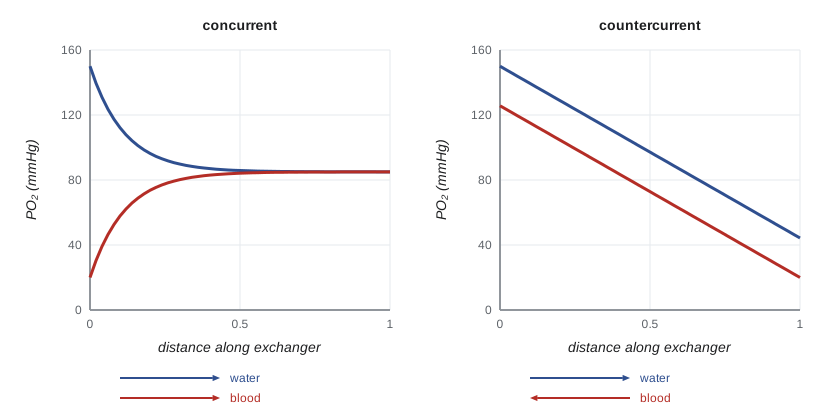
In the concurrent model, blood and water approach a common partial pressure, here 85 mmHg, and exchange stops; at best, blood leaves at the average of the two inlet values. In the countercurrent model, blood leaves at a partial pressure close to that of the incoming water and much higher than that of the water leaving the gill, which would be impossible in a concurrent system. The same principle is used for heat in the legs of birds (lesson 3), for salt and water in the mammalian kidney (lesson 11) and in the swim bladders of fish, where a countercurrent capillary network, the rete mirabile, concentrates gases to fill the bladder at high pressure, a process aided by the Root effect described in lesson 10.
Air breathing in fish and the evolution of lungs
Many fish breathe air, especially in warm, stagnant, oxygen-poor waters. Lungfish have true lungs homologous to those of tetrapods. Bowfins and gars, found in the lakes and rivers of eastern North America, gulp air into a vascularized swim bladder, which in gars can supply most of the oxygen in warm water. The swim bladder of other bony fish and the lungs of tetrapods are homologous structures that arose from an outpocketing of the gut; current evidence suggests that lungs came first and that the swim bladder of ray-finned fishes evolved from them. Air-breathing fish typically have reduced gills, because gills in oxygen-poor water can lose oxygen from the blood to the water.
Lungs of amphibians, reptiles and mammals
Lungs are internal sacs ventilated by tidal flow: air moves in and out through the same airways. Amphibians fill their lungs by buccal pumping, using the floor of the mouth as a force pump, and many exchange much of their carbon dioxide, and in some species most of their oxygen, through the skin. The lungless salamanders of the family Plethodontidae, the most species-rich salamander family and common in the forests of eastern North America, have no lungs at all and breathe entirely through their skin and the lining of the mouth. Reptiles and mammals use aspiration breathing, creating a negative pressure in the thorax to draw air in. Mammals have a muscular diaphragm and lungs subdivided into hundreds of millions of tiny alveoli, which give an enormous surface area.
Tidal ventilation has an inherent inefficiency. Each breath must first move air through the dead space of the airways, which does not exchange gas, and fresh air mixes with stale air remaining in the lungs, so alveolar PO₂ is always well below that of inspired air. Alveolar ventilation, the volume of fresh air reaching the alveoli per minute, equals tidal volume minus dead space, multiplied by breathing frequency. Shallow, rapid breathing wastes more of each breath on dead space, which panting animals exploit to lose heat without over-breathing (lesson 3).
The bird lung
Birds have the most efficient lungs of any air-breathing vertebrate. Their lungs are small, rigid and do not change volume during breathing. Instead, air is moved by a system of thin-walled air sacs, usually nine, which act as bellows and extend into the body cavity and even into some bones. Gas exchange occurs in parabronchi, tiny parallel tubes through the lung, from which even smaller air capillaries branch and intertwine with blood capillaries. Experiments with tracer gases and oxygen probes, notably by Knut Schmidt-Nielsen and colleagues, showed that air flows through the parabronchi in the same direction during both inspiration and expiration. During inspiration, most inhaled air passes into the posterior air sacs; during expiration, it moves from the posterior sacs through the lung; on the next inspiration it moves from the lung into the anterior sacs; and on the next expiration it leaves the body. The unidirectional flow is produced by the geometry of the airways, aerodynamic valving, rather than by mechanical valves.
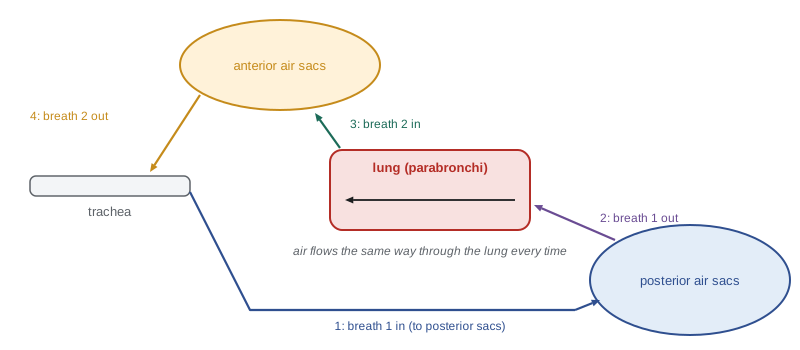
Blood flows across the parabronchi at right angles to the airflow, a crosscurrent arrangement. Crosscurrent exchange is less efficient than countercurrent but more efficient than the tidal mixing of mammalian lungs, and it allows the blood leaving the lung to have a PO₂ higher than that of the exhaled air. The bird lung's blood–gas barrier is also thinner than that of mammals of the same size. These features help explain why birds can fly at altitudes where mammals struggle, a topic for lesson 10. Studies since 2010 by Colleen Farmer and colleagues have found unidirectional airflow in the lungs of alligators, monitor lizards and iguanas, which lack air sacs, suggesting that unidirectional flow evolved early in reptiles, before the origin of birds, and possibly before the origin of dinosaurs.
| Exchanger | Arrangement | Can blood leave with PO₂ above that of exiting medium? | Examples |
|---|---|---|---|
| Gills | Countercurrent | Yes; can approach inflowing water PO₂ | Bony fish, sharks |
| Bird lung | Crosscurrent | Yes; above exhaled air | Birds |
| Mammalian lung | Tidal, well mixed (uniform pool) | No; at best equals alveolar gas | Mammals |
| Skin | Uniform pool or variable | No | Amphibians, lungless salamanders |
| Tracheal system | Direct delivery to tissues | Not applicable (no blood carrier) | Insects |
Insect tracheae
Insects deliver oxygen directly to their tissues through a branching system of air-filled tubes, the tracheae, which open to the outside through valved spiracles on the sides of the body. The finest branches, the tracheoles, less than 1 µm across, end next to or even inside individual cells, especially in flight muscle. Oxygen therefore travels most of the way in the gas phase, where diffusion is 200,000 times faster than in tissue, and the blood plays little part. Small insects rely mainly on diffusion along the tracheae; larger and active insects also ventilate their tracheal system by pumping movements of the abdomen, and some use air sacs as bellows. X-ray imaging at synchrotrons has revealed rhythmic compression of the tracheae in the head and thorax of beetles and ants.
Many insects at rest show discontinuous gas exchange, in which the spiracles stay closed for long periods, flutter partly open, and then open fully for a burst of carbon dioxide release. Why this pattern evolved is debated; hypotheses include reducing water loss, avoiding oxygen toxicity and coping with the high carbon dioxide levels of burrows. Because diffusion through tracheae becomes limiting as distances increase, the tracheal system may help explain why insects are small. The giant dragonfly-like insects of the late Carboniferous, with wingspans up to about 70 cm, lived when atmospheric oxygen may have been as high as 30 to 35 per cent, and experiments rearing insects under raised oxygen produce larger individuals in some species, supporting a link, though other factors, such as the absence of flying vertebrate predators, may also have mattered.
Control of breathing
In mammals, breathing is generated by a network of neurons in the brainstem, including the pre-Bötzinger complex, discovered by Jack Feldman and colleagues in 1991, which acts as a rhythm generator. Ventilation is adjusted mainly to keep arterial PCO₂ and pH constant. Central chemoreceptors near the surface of the medulla respond to the pH of the cerebrospinal fluid, which reflects arterial PCO₂, and peripheral chemoreceptors in the carotid bodies respond to low PO₂ as well as high PCO₂ and low pH. In air-breathers, a rise in PCO₂ is by far the strongest stimulus to breathe; ventilation increases sharply when PCO₂ rises by a few mmHg, whereas PO₂ must fall substantially before it stimulates breathing. Fish are the opposite: because their blood PCO₂ is always low, they regulate ventilation mainly in response to oxygen, sensed by chemoreceptors in the gills.
Worked problem
Alveolar ventilation and breathing pattern
A resting dog breathes 20 times per minute with a tidal volume of 300 mL and an anatomical dead space of 100 mL. While panting to cool down, it breathes 300 times per minute with a tidal volume of 110 mL. Calculate total and alveolar ventilation in each case. Why does panting not cause severe over-breathing?
Show solution
- Resting: total ventilation = 20 × 300 = 6,000 mL per minute; alveolar ventilation = 20 × (300 − 100) = 4,000 mL per minute.
- Panting: total ventilation = 300 × 110 = 33,000 mL per minute, more than five times higher.
- Panting alveolar ventilation = 300 × (110 − 100) = 3,000 mL per minute, no more than at rest.
- Most of the panting air moves in and out of the dead space, evaporating water from the moist airways without increasing gas exchange in the alveoli.
Answer: Panting raises total ventilation more than fivefold, mainly in the dead space, so evaporative heat loss rises while alveolar ventilation, and therefore blood CO₂, stays near normal. (In reality, dogs also route air in through the nose and out through the mouth, which enhances evaporation.)
Common mistakes
MistakeDescribing gases in solution only by their concentration.
InsteadPartial pressure drives diffusion; fluids at the same partial pressure are in equilibrium even if they contain different amounts of gas.
MistakeAssuming water-breathing is easier because water supports the gills.
InsteadWater holds about 30 times less oxygen than air and is denser and more viscous, so ventilation is costly.
MistakeThinking countercurrent exchange simply means fast flow.
InsteadIts advantage comes from opposite flow directions, which keep a gradient along the whole exchanger.
MistakeSaying bird lungs inflate and deflate like mammalian lungs.
InsteadBird lungs are rigid; air sacs act as bellows and air flows through the lung in one direction.
MistakeAssuming oxygen is the main stimulus for breathing in mammals.
InsteadArterial PCO₂ and pH are the main drivers; low PO₂ becomes important only when it falls substantially.
MistakeBelieving insects carry oxygen in their blood like vertebrates.
InsteadInsects deliver oxygen through tracheae directly to cells; the hemolymph has a minor role.
Summary and key terms
- Gases diffuse down partial pressure gradients; Henry's law relates dissolved gas to partial pressure and solubility.
- Water holds far less oxygen than air and is costlier to move; water-breathers have low blood PCO₂.
- Fick's law shows why exchangers need large areas, thin barriers and maintained gradients.
- Fish gills use countercurrent exchange to extract up to 70 to 80 per cent of the oxygen from water.
- Tidal lungs are limited by dead space and mixing; alveolar ventilation equals frequency times tidal volume minus dead space.
- Bird lungs combine air-sac bellows, unidirectional parabronchial airflow and crosscurrent exchange.
- Insect tracheae deliver oxygen in the gas phase directly to cells; breathing in mammals is controlled mainly by PCO₂ and in fish by PO₂.
- partial pressure
- The pressure a gas in a mixture would exert alone; it drives diffusion.
- Henry's law
- The amount of gas dissolved in a liquid is proportional to its partial pressure.
- Fick's law of diffusion
- Diffusion rate is proportional to area and gradient and inversely proportional to barrier thickness.
- lamella
- A thin plate on a fish gill filament where gas exchange occurs.
- countercurrent exchange
- Exchange between two fluids flowing in opposite directions, maintaining a gradient along the exchanger.
- ram ventilation
- Ventilation of the gills by swimming with the mouth open.
- tidal ventilation
- Breathing in which air moves in and out through the same airways.
- dead space
- The volume of the airways that does not take part in gas exchange.
- alveolar ventilation
- The volume of fresh air reaching the gas exchange surface per minute.
- parabronchus
- A tube in the bird lung through which air flows unidirectionally and from which air capillaries arise.
- crosscurrent exchange
- Exchange in which blood flows at right angles to the airflow, as in the bird lung.
- tracheal system
- The network of air-filled tubes that delivers oxygen directly to insect tissues.
Practice problems
Work each problem on paper first, then reveal the answer to check.
What is the PO₂ of dry air at a barometric pressure of 600 mmHg?
Show answer
0.2095 × 600 ≈ 126 mmHg.
Why do warm, still ponds often become hypoxic?
Show answer
Warm water holds less oxygen, organisms' oxygen demand is higher, and still water is poorly mixed.
Name three features of a good gas exchanger according to Fick's law.
Show answer
Large surface area, thin barrier, large partial pressure difference.
Why can blood leaving a fish gill have a higher PO₂ than the water leaving it?
Show answer
Countercurrent flow keeps a gradient along the exchanger, so blood meets progressively richer water.
A mammal breathes 12 times per minute, tidal volume 500 mL, dead space 150 mL. Calculate alveolar ventilation.
Show answer
12 × 350 = 4,200 mL per minute.
Describe the path of one breath of air through a bird's respiratory system.
Show answer
Inspiration 1: to posterior sacs; expiration 1: through the lung; inspiration 2: into anterior sacs; expiration 2: out through the trachea.
Why do air-breathing fish often have reduced gills?
Show answer
In oxygen-poor water, gills could lose oxygen from the blood to the water.
What is discontinuous gas exchange?
Show answer
A cycle in which insect spiracles stay closed, flutter, and then open fully for CO₂ release.
Why do fish regulate breathing mainly in response to oxygen?
Show answer
Their blood PCO₂ is always low because CO₂ is very soluble in water, so oxygen is the more informative signal.
What evidence suggests unidirectional airflow evolved before birds?
Show answer
It has been found in the lungs of alligators and some lizards, which lack bird-type air sacs.
Lesson quiz · 5 questions
Score 60% or more to complete this lesson.
Create a free account to save your progress, take quizzes and earn a certificate.