
BIOL-350 · Lesson 10 of 12 · 31 min
Oxygen transport, diving and high altitude
Oxygen dissolves poorly in water, and therefore in plasma. Human plasma at a normal arterial PO₂ of 100 mmHg holds only about 3 mL of oxygen per litre. To supply a resting metabolic rate of about 250 mL of oxygen per minute, the heart would have to pump more than 80 litres of plasma per minute, far beyond its capacity. Respiratory pigments, proteins that bind oxygen reversibly, solve the problem: human blood carries about 200 mL of oxygen per litre, almost all of it bound to hemoglobin. This lesson explains how respiratory pigments load oxygen at the gas exchanger and unload it in the tissues, how their properties are tuned to each animal's needs, and how animals cope with two extreme challenges, breath-hold diving and life at high altitude.
Respiratory pigments
Animals use three families of respiratory pigments. Hemoglobins, which contain iron in a heme group, are found in vertebrates and scattered across invertebrate groups, including some annelids, insects such as chironomid midge larvae, and crustaceans. Vertebrate hemoglobin is a tetramer of two α and two β chains, each binding one oxygen molecule, packed inside red blood cells. Hemocyanins, which bind oxygen between two copper atoms and turn blue when oxygenated, are dissolved in the hemolymph of many molluscs and arthropods, including octopuses, snails, crabs, lobsters and horseshoe crabs. Hemerythrins, also iron-based, occur in a few marine worms. Myoglobin, a single-chain relative of hemoglobin in muscle, stores oxygen and helps it diffuse within muscle fibres.
Packaging hemoglobin in red cells rather than dissolving it in plasma has advantages. A high concentration of a dissolved protein would raise the viscosity and oncotic pressure of the blood, and the red cell provides a controlled environment in which organic phosphates and enzymes such as carbonic anhydrase can regulate oxygen binding and carbon dioxide transport. The hemocyanin of an octopus, dissolved in plasma, is a huge molecule, which keeps its contribution to oncotic pressure manageable, but octopus blood still carries only about a quarter as much oxygen per litre as human blood.
The oxygen equilibrium curve
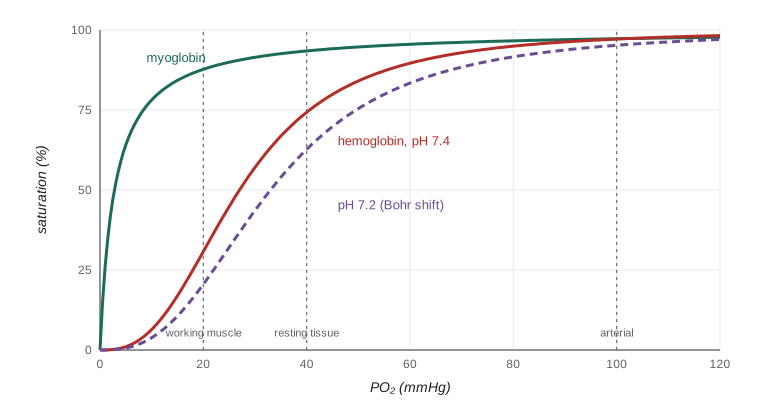
The relationship between PO₂ and the percentage saturation of a pigment is the oxygen equilibrium curve, often called the oxygen dissociation curve. For myoglobin, with a single binding site, the curve is hyperbolic. For vertebrate hemoglobin it is sigmoid, because binding is cooperative: the binding of oxygen to one subunit increases the affinity of the others, by shifting the tetramer from a low-affinity tense (T) state to a high-affinity relaxed (R) state. The curve is described empirically by the Hill equation, in which the Hill coefficient n measures cooperativity (about 2.7 to 3 for human hemoglobin, 1 for myoglobin) and the P50, the PO₂ at which the pigment is half saturated, measures affinity. A low P50 means high affinity.
The sigmoid shape is exactly what an oxygen carrier needs. On the flat upper part of the curve, around the PO₂ of the lungs, saturation changes little even if PO₂ falls somewhat, so loading is secure at altitude or in mild lung disease. On the steep middle part, around the PO₂ of active tissues, a small fall in PO₂ releases a large amount of oxygen. Cooperative binding therefore makes hemoglobin a better carrier than a non-cooperative pigment with the same P50.
The Bohr effect and other modulators
Hemoglobin's affinity for oxygen is not fixed. In 1904 Christian Bohr, father of the physicist Niels Bohr, found that carbon dioxide reduces the affinity of hemoglobin for oxygen. The Bohr effect, a rightward shift of the curve caused mainly by falling pH, helps unloading in active tissues, where carbon dioxide and acid accumulate, and helps loading in the lungs, where carbon dioxide is removed. Rising temperature also shifts the curve to the right, so warm, working muscles receive more oxygen. Inside mammalian red cells, 2,3-bisphosphoglycerate (2,3-BPG) binds to deoxygenated hemoglobin and lowers its affinity; birds use inositol pentaphosphate and many fish use ATP and GTP for the same purpose. Changing the concentration of these organic phosphates lets an animal adjust its blood oxygen affinity within hours to days.
# Oxygen delivery with the Hill equation and the Bohr effect (approximate human values)
def sat(P, P50, n=2.7):
    return P ** n / (P ** n + P50 ** n)

cap = 200.0              # oxygen capacity, mL O2 per L blood when fully saturated
art = 100.0              # arterial PO2, mmHg
cases = [("rest, pH 7.40", 27.0, 40.0),
         ("exercise, pH 7.40", 27.0, 20.0),
         ("exercise, pH 7.20 (Bohr shift)", 33.0, 20.0)]
print("condition                         Sa     Sv    O2 released (mL/L)")
for name, p50, tissue in cases:
    sa, sv = sat(art, p50), sat(tissue, p50)
    print(f"{name:32s} {sa*100:5.1f}  {sv*100:5.1f}   {cap * (sa - sv):6.1f}")

# a non-cooperative pigment with the same P50 gives less release over the same range
sa, sv = sat(art, 27.0, n=1.0), sat(40.0, 27.0, n=1.0)
print(f"{'non-cooperative, P50 27, rest':32s} {sa*100:5.1f} {sv*100:5.1f} {cap * (sa - sv):6.1f}")condition Sa Sv O2 released (mL/L) rest, pH 7.40 97.2 74.3 45.8 exercise, pH 7.40 97.2 30.8 132.8 exercise, pH 7.20 (Bohr shift) 95.2 20.6 149.3 non-cooperative, P50 27, rest 78.7 59.7 38.1
At rest, blood gives up only about a quarter of its oxygen, about 50 mL per litre, leaving a large venous reserve. During exercise, the fall in tissue PO₂ alone nearly triples the oxygen released, and the Bohr shift adds substantially more, so that most of the oxygen is unloaded. A non-cooperative pigment with the same P50 does worse at both ends: it would be only about 79 per cent saturated in the lungs and would release less oxygen even at rest, and the gap widens in exercise, because its curve is neither flat at high PO₂ nor steep in the range where tissues work.
In many fish, acid has a more drastic effect, the Root effect: low pH not only reduces affinity but also reduces the maximum saturation, so that hemoglobin cannot be fully saturated even at very high PO₂. Fish use the Root effect to deliver oxygen against large gradients. In the swim bladder, gas gland cells secrete lactic acid into the blood, driving oxygen off hemoglobin; the countercurrent rete mirabile (lesson 9) multiplies the resulting rise in PO₂ until it exceeds the pressure in the bladder, which can be many atmospheres in deep-sea fish. A similar system, the choroid rete, supplies the avascular retina of many fish with oxygen at very high partial pressures.
Carbon dioxide transport
Carbon dioxide is carried in blood in three forms: dissolved, bound to hemoglobin as carbamino compounds, and, mostly, as bicarbonate. In red cells, the enzyme carbonic anhydrase speeds the reaction of carbon dioxide with water to form carbonic acid, which dissociates into bicarbonate and hydrogen ions. Bicarbonate leaves the red cell in exchange for chloride, the chloride shift, and hydrogen ions are buffered by hemoglobin. Deoxygenated hemoglobin is a better buffer and binds more carbon dioxide than oxygenated hemoglobin, the Haldane effect, so unloading oxygen in the tissues helps blood pick up carbon dioxide, and loading oxygen in the lungs helps release it. The same reactions link breathing to acid–base balance, as the Henderson–Hasselbalch equation shows.
Matching affinity to the environment
The P50 of hemoglobin varies widely among species, and the variation makes adaptive sense. Small mammals, with high mass-specific metabolic rates, tend to have higher P50 values, lower affinity, which favours unloading in their tissues. Animals that live where oxygen is scarce, such as burrowing mammals, fish in hypoxic waters and animals at high altitude, tend to have lower P50 values, higher affinity, which favours loading. Fetal mammals have hemoglobin, or red cell conditions, with higher affinity than maternal blood, so oxygen passes from mother to fetus across the placenta.
Some of the best evidence that changes in hemoglobin are adaptive comes from studies of North American deer mice. Jay Storz and colleagues have shown that deer mice living above 3,000 m in the Rocky Mountains carry hemoglobin variants with higher oxygen affinity than lowland populations, caused by a small number of amino acid substitutions in the α and β chains, and that these variants improve aerobic performance under hypoxia. Similar changes have evolved independently in high-altitude birds, including the bar-headed goose and Andean geese and hummingbirds, often through different amino acid substitutions, a case of convergent evolution at the molecular level.
Life at high altitude
At 4,000 m, where communities live on the Tibetan Plateau and in the Andes, barometric pressure is about 60 per cent of sea level and inspired PO₂ about 85 mmHg. Lowlanders who travel to high altitude respond in stages. Within minutes, peripheral chemoreceptors detect the low arterial PO₂ and increase ventilation, which raises alveolar PO₂ but lowers PCO₂ and causes respiratory alkalosis. Over days, the kidneys excrete bicarbonate to correct the pH, allowing ventilation to rise further, and 2,3-BPG levels increase. Over weeks, the kidneys secrete more erythropoietin, which stimulates red cell production and raises hemoglobin concentration. Some people develop acute mountain sickness, and rarely life-threatening high-altitude pulmonary or cerebral edema.
Populations that have lived at high altitude for thousands of years show different patterns. Many Andean highlanders have high hemoglobin concentrations, sometimes excessively high, which can lead to chronic mountain sickness. Tibetan highlanders, by contrast, typically have hemoglobin concentrations near sea-level values, with higher ventilation and blood flow and higher levels of nitric oxide in their breath. Genome studies have found that variants of the EPAS1 gene, which encodes a transcription factor in the hypoxia-sensing pathway, are common in Tibetans and associated with lower hemoglobin levels. Emilia Huerta-Sánchez and colleagues reported in 2014 that the Tibetan EPAS1 haplotype was introduced into the ancestors of Tibetans by interbreeding with Denisovans, an extinct archaic human group, an example of adaptive introgression discussed in BIOL-321.
Birds are the champions of high-altitude flight. Bar-headed geese migrate between South and Central Asia, crossing the Himalayas. Satellite and logger studies by Lucy Hawkes, Charles Bishop and colleagues showed that most geese fly through passes and valleys at 5,000 to 6,000 m rather than over the highest peaks, but they do so by flapping flight, often at night when air is cooler and denser, and occasional records exceed 7,000 m. Their success depends on several features: hemoglobin with high oxygen affinity, a large lung and efficient crosscurrent gas exchange (lesson 9), a strong ventilatory response to hypoxia without disabling alkalosis, more capillaries in flight muscle and mitochondria positioned close to the capillaries.
import math

# Inspired PO2 versus altitude, using an approximate barometric formula
# P = 760 * exp(-h / 8000) (simplified isothermal atmosphere, h in m)
def baro(h):
    return 760.0 * math.exp(-h / 8000.0)

print("altitude (m)   barometric (mmHg)   inspired PO2 (mmHg)   place")
for h, place in ((0, "sea level"), (1600, "Denver, Colorado"),
                 (3000, "high Rocky Mountain valleys"), (4300, "Pikes Peak summit"),
                 (5500, "Himalayan passes (bar-headed geese)"), (8849, "Everest summit")):
    pb = baro(h)
    pio2 = 0.2095 * (pb - 47.0)     # humidified at 37 degC (saturated water at 47 mmHg)
print(f"{h:8d} {pb:7.0f} {pio2:7.0f} {place}")altitude (m) barometric (mmHg) inspired PO2 (mmHg) place
0 760 149 sea level
1600 622 121 Denver, Colorado
3000 522 100 high Rocky Mountain valleys
4300 444 83 Pikes Peak summit
5500 382 70 Himalayan passes (bar-headed geese)
8849 251 43 Everest summitFor Everest the simple formula happens to agree closely with measurements made on the summit, a barometric pressure of about 250 mmHg and an inspired PO₂ of about 43 mmHg, but in general real pressures depend on air temperature, latitude and season, and standard aviation atmospheres give somewhat lower values at the same altitude. Even so, the trend is clear, and it explains why the summit of Everest is near the limit of human tolerance without supplementary oxygen.
Breath-hold diving
Diving mammals and birds face the opposite problem from high-altitude animals: they cannot breathe at all while submerged, sometimes for over an hour. Weddell seals in the Antarctic routinely dive for 10 to 20 minutes and can stay down for more than an hour; northern elephant seals off California dive repeatedly for 20 minutes to depths of 400 to 600 m, spending almost 90 per cent of months at sea under water; and in 2020 Nicola Quick and colleagues reported a Cuvier's beaked whale off North Carolina that stayed submerged for 222 minutes. Diving mammals succeed by storing more oxygen and using it more slowly.
Diving mammals have large blood volumes, high hemoglobin concentrations and very high muscle myoglobin concentrations, often ten times those of terrestrial mammals, which colours their muscles almost black. Myoglobin of diving mammals carries a higher positive surface charge than that of land mammals, which, as Scott Mirceta and colleagues showed in 2013, lets it accumulate to high concentrations without aggregating. Seals store much of their oxygen in blood and muscle rather than in the lungs. They exhale before diving, and their lungs collapse at depth, which reduces the uptake of nitrogen into the blood and the risk of decompression sickness. Diving birds such as penguins and murres, by contrast, dive with air in their lungs and air sacs.
The dive response, first studied in detail by Per Scholander and Laurence Irving in the 1930s and 1940s, reduces oxygen use during a dive. Heart rate falls sharply, a diving bradycardia, and peripheral blood vessels constrict, so blood flow is reserved mainly for the brain and heart. Muscles, cut off from blood flow, rely on their myoglobin stores and then on anaerobic glycolysis, accumulating lactate that is washed into the circulation after surfacing. Gerald Kooyman's studies of Weddell seals in the Antarctic in the 1970s and 1980s showed that most natural dives are shorter than the aerobic dive limit, the longest dive possible without a rise in blood lactate after surfacing, which for adult Weddell seals is about 20 minutes. Dives beyond the limit are possible but require long recovery periods at the surface, so seals usually stay within it.
# Oxygen stores and aerobic dive limit (ADL) estimates (approximate values per kg body mass)
def stores(mass, blood_l_per_kg, hb_g_per_l, mb_g_per_kg_muscle, muscle_frac, lung_ml_per_kg):
    blood_o2 = mass * blood_l_per_kg * hb_g_per_l * 1.34 * 0.8      # mL O2; 1.34 mL per g Hb, 80% usable
    muscle_o2 = mass * muscle_frac * mb_g_per_kg_muscle * 1.34       # mL O2 bound to myoglobin
    lung_o2 = mass * lung_ml_per_kg * 0.15                            # 15% O2 usable from lung air
    return blood_o2, muscle_o2, lung_o2

animals = {
    #                      mass  blood Hb  Mb   muscle lung  diving VO2 (mL/kg/min)
    "Weddell seal":       (400, 0.15, 230, 50,  0.35,  20,   3.2),
    "human free-diver":   (75,  0.07, 150, 5,   0.40,  80,   4.5),
}
print("animal              blood   muscle   lung    total O2 (L)  ADL (min)")
for name, (m, bl, hb, mb, mf, lung, vo2) in animals.items():
    b, mu, lu = stores(m, bl, hb, mb, mf, lung)
    total = b + mu + lu
print(f"{name:18s} {b/1000:6.1f} {mu/1000:6.1f} {lu/1000:6.2f} {total/1000:6.1f} {total / (m * vo2):5.1f}")animal blood muscle lung total O2 (L) ADL (min) Weddell seal 14.8 9.4 1.20 25.4 19.8 human free-diver 0.8 0.2 0.90 1.9 5.8
Per kilogram, the seal stores two to three times as much oxygen as a human, and most of it is in blood and muscle rather than in the lungs. Using a diving metabolic rate somewhat below the seal's resting rate on land, as measured in freely diving Weddell seals, the estimated aerobic dive limit comes out near the 20 minutes measured by Kooyman; the human's is a few minutes. Trained human free-divers can hold their breath far longer than this estimate while resting, because their metabolic rate falls and they tolerate low oxygen, but they do so at real risk of blackout. The calculation shows why storage, not tolerance alone, is the key to long dives.
Worked problem
How much oxygen does a Bohr shift deliver?
A working muscle receives 0.5 L of blood per minute. Arterial blood is 97 per cent saturated, the oxygen capacity is 200 mL per litre, and venous PO₂ in the muscle is 25 mmHg. Using a Hill coefficient of 2.7, compare oxygen delivery if the P50 is 27 mmHg (no shift) and 33 mmHg (acidic, warm muscle).
Show solution
- Without shift: S at 25 mmHg = 25^2.7 / (25^2.7 + 27^2.7) ≈ 0.45.
- Oxygen released = 200 × (0.97 − 0.45) ≈ 104 mL per litre; × 0.5 L per minute ≈ 52 mL O₂ per minute.
- With shift: S at 25 mmHg = 25^2.7 / (25^2.7 + 33^2.7) ≈ 0.32.
- Oxygen released = 200 × (0.97 − 0.32) ≈ 130 mL per litre; × 0.5 ≈ 65 mL O₂ per minute.
Answer: The Bohr shift increases oxygen delivery by about 25 per cent at the same blood flow and venous PO₂. Arterial saturation is barely affected because the lung PO₂ lies on the flat part of the curve.
Common mistakes
MistakeThinking a low P50 means low affinity.
InsteadP50 is the PO₂ for half saturation; a low P50 means high affinity.
MistakeAssuming most oxygen in blood is dissolved in plasma.
InsteadIn vertebrates almost all oxygen is bound to hemoglobin; dissolved oxygen is only about 1.5 per cent of the total.
MistakeSaying that the Bohr effect impairs oxygen loading in the lungs.
InsteadLoading occurs on the flat part of the curve, and CO₂ removal in the lungs raises affinity, aiding loading.
MistakeBelieving high hemoglobin is always the best adaptation to altitude.
InsteadExcess hemoglobin raises blood viscosity; Tibetan highlanders keep near-normal levels and adapt in other ways.
MistakeAssuming diving seals rely mainly on their lungs for oxygen.
InsteadSeals exhale before diving; their oxygen is stored mainly in blood and muscle myoglobin.
MistakeTreating the Root effect as identical to the Bohr effect.
InsteadThe Root effect reduces maximum saturation as well as affinity and is used to secrete oxygen into the swim bladder and eye.
Summary and key terms
- Respiratory pigments, hemoglobins, hemocyanins and hemerythrins, greatly increase the oxygen-carrying capacity of blood.
- Cooperative binding gives hemoglobin a sigmoid equilibrium curve, ideal for secure loading and large unloading.
- The Bohr effect, temperature and organic phosphates shift affinity; the Root effect in fish lowers maximum saturation.
- Carbon dioxide travels mainly as bicarbonate, with carbonic anhydrase, the chloride shift and the Haldane effect.
- P50 is matched to metabolic rate and environment; high-altitude deer mice and birds show convergent high-affinity hemoglobins.
- High-altitude acclimatization involves ventilation, renal compensation and erythropoiesis; Tibetan EPAS1 variants came from Denisovans.
- Diving mammals store oxygen in blood and myoglobin, use a dive response and usually stay within their aerobic dive limit.
- respiratory pigment
- A protein that binds oxygen reversibly and increases the oxygen capacity of blood.
- hemocyanin
- A copper-containing respiratory pigment dissolved in the hemolymph of many molluscs and arthropods.
- myoglobin
- A single-chain oxygen-binding protein that stores oxygen in muscle.
- oxygen equilibrium curve
- The relationship between PO₂ and the percentage saturation of a respiratory pigment.
- P50
- The PO₂ at which a respiratory pigment is half saturated; a measure of affinity.
- cooperativity
- The increase in affinity of hemoglobin subunits as other subunits bind oxygen.
- Bohr effect
- The reduction in hemoglobin oxygen affinity caused by lower pH or higher CO₂.
- Root effect
- A reduction in maximum oxygen saturation of some fish hemoglobins at low pH.
- Haldane effect
- The greater capacity of deoxygenated hemoglobin to carry CO₂ and buffer H⁺.
- chloride shift
- The exchange of bicarbonate for chloride across the red cell membrane.
- dive response
- Bradycardia and peripheral vasoconstriction that conserve oxygen during a dive.
- aerobic dive limit
- The longest dive possible without a post-dive rise in blood lactate.
Practice problems
Work each problem on paper first, then reveal the answer to check.
Why does plasma alone carry too little oxygen for a mammal?
Show answer
Oxygen is poorly soluble; plasma holds only about 3 mL per litre at arterial PO₂.
What does a Hill coefficient of 1 mean?
Show answer
No cooperativity; the curve is hyperbolic, as for myoglobin.
State two advantages of the sigmoid oxygen equilibrium curve.
Show answer
Loading is secure over a range of high PO₂, and small falls in tissue PO₂ release much oxygen.
What is the effect of 2,3-BPG on hemoglobin affinity?
Show answer
It binds deoxyhemoglobin and lowers affinity, shifting the curve to the right.
Explain how the Root effect lets fish fill their swim bladders.
Show answer
Lactic acid from the gas gland drives O₂ off hemoglobin; the rete mirabile multiplies the PO₂ rise so oxygen diffuses into the bladder.
Why do small mammals tend to have higher P50 values?
Show answer
Their high mass-specific metabolic rate favours unloading oxygen in tissues.
Name two immediate and two long-term responses to high altitude in a lowlander.
Show answer
Immediate: increased ventilation, raised heart rate; long-term: renal bicarbonate excretion and increased red cell production.
What is notable about the Tibetan EPAS1 haplotype?
Show answer
It is associated with lower hemoglobin at altitude and was introduced from Denisovans.
Why do seals exhale before diving?
Show answer
Lungs collapse at depth, reducing nitrogen uptake and decompression risk; their oxygen is stored in blood and muscle.
What is the aerobic dive limit, and about how long is it for Weddell seals?
Show answer
The longest dive without a lactate rise afterward; about 20 minutes for adults.
Lesson quiz · 5 questions
Score 60% or more to complete this lesson.
Create a free account to save your progress, take quizzes and earn a certificate.