
BIOL-350 · Lesson 12 of 12 · 32 min
Capstone: digestion, locomotion and physiology in a changing world
The earlier lessons treated physiological systems one at a time. Real animals have to run them all at once, on a limited energy budget, in environments that change. This capstone lesson brings the course together around three linked themes. First, how animals obtain and process the energy and nutrients that pay for everything else. Second, what it costs to move, and how body size and mode of locomotion shape that cost. Third, how physiology determines where animals can live and how they respond to a warming, acidifying and oxygen-poor world, the field of conservation physiology. The lesson ends with the ethical and legal framework for research on animals, which every physiologist must understand.
Feeding and digestion
Animal guts are tubes through which food passes in one direction, broken down mechanically and chemically, absorbed, and the residue eliminated. Their design reflects diet. Carnivores, whose food is easy to digest and rich in protein, tend to have short, simple guts. Herbivores face a harder problem. Plant cell walls are made of cellulose and other polysaccharides that no animal enzyme can break down efficiently (BIOL-340 described their structure), so herbivores rely on symbiotic microbes, bacteria, archaea, protists and fungi, that ferment fibre into short-chain fatty acids such as acetate, propionate and butyrate, which the host absorbs and uses for energy.
Herbivores house their microbes in one of two places. Foregut fermenters, including ruminants such as cattle, deer, moose, caribou and bison, ferment food in a large, chambered stomach before it reaches the small intestine. The rumen is a fermentation vat that can hold over 100 litres in a cow. Ruminants regurgitate and rechew their food, chewing the cud, which breaks particles down further, and a filter between the rumen and the rest of the stomach holds back large particles until they are small enough to pass. Microbes that wash out of the rumen are themselves digested in the true stomach and small intestine, providing high-quality protein. Ruminants can even recycle urea to the rumen, where microbes use its nitrogen to make protein, an advantage on poor diets. The price is methane: rumen archaea convert hydrogen from fermentation to methane, wasting 2 to 12 per cent of the dietary energy and making ruminants a significant source of a potent greenhouse gas.
Hindgut fermenters, such as horses, rabbits, beavers and many rodents, ferment food in an enlarged caecum and colon after the small intestine. They can process large amounts of low-quality food quickly but lose the microbial protein in their feces, a problem rabbits and many rodents solve by coprophagy, eating special soft fecal pellets to pass them through the gut a second time. Herbivorous birds such as grouse and ptarmigan, which live through northern winters on buds and twigs, have long paired caeca. The hoatzin of South America is the only bird known to be a foregut fermenter.
| Feature | Foregut fermenter (ruminant) | Hindgut fermenter | Carnivore |
|---|---|---|---|
| Site of fermentation | Rumen, before the small intestine | Caecum and colon, after the small intestine | Little fermentation |
| Use of microbial protein | Digested in the small intestine | Lost in feces unless coprophagy | Not applicable |
| Digestive efficiency for fibre | High | Moderate | Low |
| Passage rate | Slow | Fast | Fast |
| Examples | Moose, caribou, deer, bison, cattle | Horse, rabbit, beaver, ptarmigan | Wolf, lynx, mink, owls |
Guts are flexible. When energy demand rises, during lactation, cold exposure or migration preparation, many animals enlarge their digestive organs and eat more. Meadow voles exposed to cold increase the mass and length of their intestines within weeks. Migratory shorebirds such as red knots and bar-tailed godwits do the reverse before long flights: they shrink their guts and livers, which are heavy and of no use in flight, and enlarge their flight muscles and hearts, then rebuild the gut after landing. Bar-tailed godwits fly non-stop from Alaska to New Zealand, more than 11,000 km in about eight to nine days, burning fat and some protein from their own organs. These changes illustrate phenotypic flexibility, the reversible adjustment of an adult's organs to current demands.
The cost of locomotion
Moving costs energy, and the cost depends on the mode of locomotion and on body size. Physiologists compare animals using the cost of transport, the energy needed to move one unit of body mass over one unit of distance, usually expressed in joules per kilogram per metre. For running, C. Richard Taylor and colleagues found in 1982 that the net cost of transport, the energy used above resting metabolism, is nearly independent of speed within a gait and falls with body mass to about the −0.3 power: a mouse uses more than twenty times as much energy per kilogram to cover a metre as a horse. Swimming is the cheapest form of locomotion, because water supports the body against gravity; flying is intermediate, more expensive per unit time but very cheap per unit distance because birds and bats travel fast.
# Cost of transport (COT) versus body mass for running, flying and swimming
# Approximate allometric equations from comparative compilations (Schmidt-Nielsen 1972;
# Taylor et al. 1982; later reviews). Values in J per kg per m; rounded, for illustration.
eqs = {"running": (10.7, -0.32), "flying": (3.6, -0.31), "swimming": (1.1, -0.38)}

def cot(mode, M):
    a, b = eqs[mode]
    return a * M ** b

print("mass (kg)    running   flying   swimming   (J/kg/m)")
for M in (0.01, 0.1, 1.0, 10.0, 100.0, 1000.0):
    print(f"{M:9.2f}   {cot('running', M):7.2f}  {cot('flying', M):7.2f}   {cot('swimming', M):7.2f}")

# energy for a 600 kg moose to walk 10 km and a 30 g mouse to run 1 km
for name, M, km in (("moose, 10 km", 600, 10), ("mouse, 1 km", 0.03, 1)):
    E = cot("running", M) * M * km * 1000
print(f"{name}: about {E / 1000:.0f} kJ above resting metabolism")mass (kg) running flying swimming (J/kg/m)
0.01 46.71 15.01 6.33
0.10 22.36 7.35 2.64
1.00 10.70 3.60 1.10
10.00 5.12 1.76 0.46
100.00 2.45 0.86 0.19
1000.00 1.17 0.42 0.08
moose, 10 km: about 8289 kJ above resting metabolism
mouse, 1 km: about 1 kJ above resting metabolism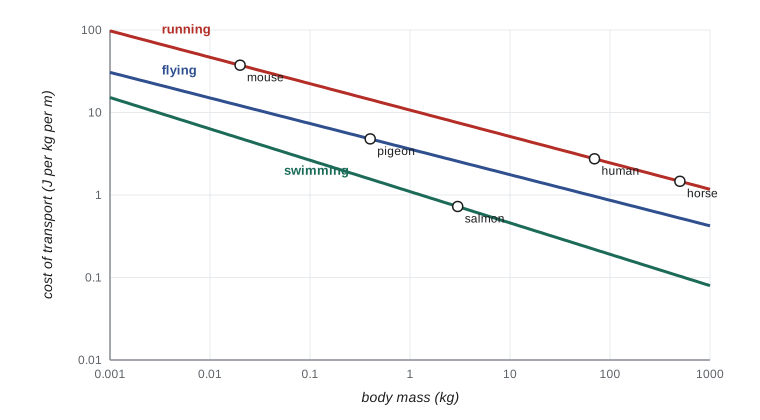
The equations give orders of magnitude, not precise values for any species, but they explain many patterns. Small animals pay dearly to travel and tend to have small home ranges; large animals can afford long migrations. Caribou of the Porcupine herd travel more than 1,000 km a year between wintering ranges and calving grounds on the Arctic coastal plain. Salmon migrate hundreds of kilometres upriver without feeding. Within a gait, animals choose speeds that minimize cost: horses on treadmills switch from walking to trotting to galloping at speeds that keep cost near its minimum, and freely moving horses choose those speeds. Elastic energy storage in tendons, as in the hopping of kangaroos and the running of horses, lowers the cost further, a theme introduced in lesson 6.
Physiology sets the limits of where animals live
Every species has a range of conditions within which it can survive, grow and reproduce, and its physiology largely sets that range. Thermal tolerance is the best studied. For ectotherms, performance, such as running speed, growth rate or aerobic scope, rises with temperature to an optimum and then falls steeply, giving a thermal performance curve. The critical thermal maximum (CTmax) is the temperature at which an animal loses coordinated movement in a standardized warming test; the critical thermal minimum (CTmin) is its cold equivalent. The difference between an animal's CTmax and the maximum temperature it experiences in its habitat is its warming tolerance, and the difference between its optimum and its habitat temperature is its thermal safety margin.
A broad pattern has emerged from comparative studies. Tropical ectotherms, which live in warm, stable climates, often have narrow thermal tolerances and are already living close to their upper limits; temperate ectotherms experience more variable temperatures and have wider tolerances and larger safety margins. Curtis Deutsch and colleagues argued in 2008 that, despite smaller expected warming in the tropics, tropical insects may suffer more from climate change than temperate ones because their safety margins are smaller. Marine ectotherms, which cannot easily escape to cooler microhabitats, tend to fill their potential thermal ranges more completely than terrestrial ones, and their ranges are shifting poleward faster.
# Warming tolerance and thermal safety margin for three invented ectotherms
# (all values illustrative, degrees Celsius)
species = [
    # name,                    CTmax, T_opt, habitat mean summer max
    ("tropical forest lizard",  38.0,  33.0,  32.0),
    ("temperate prairie lizard", 44.0, 35.0,  30.0),
    ("cold-water stream fish",  29.0,  16.0,  21.0),
]
print("species                     warming tolerance   safety margin   after +3 degC")
for name, ctmax, topt, hab in species:
    wt, tsm = ctmax - hab, topt - hab
    wt3, tsm3 = wt - 3.0, tsm - 3.0
    flag = "above optimum" if tsm3 < 0 else "below optimum"
print(f"{name:27s} {wt:8.1f} {tsm:6.1f} WT {wt3:4.1f}, TSM {tsm3:5.1f} ({flag})")species warming tolerance safety margin after +3 degC tropical forest lizard 6.0 1.0 WT 3.0, TSM -2.0 (above optimum) temperate prairie lizard 14.0 5.0 WT 11.0, TSM 2.0 (below optimum) cold-water stream fish 8.0 -5.0 WT 5.0, TSM -8.0 (above optimum)
In this illustrative comparison, the tropical lizard has only a small safety margin, and 3 °C of warming pushes its habitat temperature above its optimum. The temperate lizard retains a comfortable margin. The cold-water fish is already living above its optimum in summer and is closest to danger, a pattern that matches field observations of brook trout and Atlantic salmon, which seek cold-water refuges, such as groundwater seeps and tributary mouths, when rivers warm in summer, and suffer mortality in heat waves.
Oxygen, temperature and aquatic animals
Hans-Otto Pörtner proposed that the thermal tolerance of aquatic ectotherms is set by their capacity to supply oxygen, the hypothesis of oxygen- and capacity-limited thermal tolerance (OCLTT). As water warms, oxygen demand rises with metabolic rate (lesson 2) while oxygen content falls (lesson 9), so aerobic scope narrows and eventually disappears. Supporting evidence comes from Pacific salmon in the Fraser River of British Columbia: Erika Eliason, Anthony Farrell and colleagues showed in 2011 that the temperatures at which aerobic scope peaked in different sockeye populations matched the river temperatures each population historically encountered during its upstream migration, and that populations with tougher migrations had larger hearts and better cardiac performance. In unusually warm years, migrating salmon die in large numbers. The OCLTT hypothesis does not fit all animals equally well; some species maintain aerobic scope up to temperatures close to lethal limits, and the generality of the idea is debated.
Oxygen itself is declining in many waters. Warming reduces oxygen solubility and strengthens stratification, while nutrient runoff fuels algal blooms whose decomposition consumes oxygen. Seasonal dead zones form each summer in the northern Gulf of Mexico, at the mouth of the Mississippi, and the deep waters of the Gulf of St. Lawrence have lost a large share of their oxygen over the past century, with recent measurements showing levels low enough to harm cod and other bottom-dwelling species. Fish respond to hypoxia by increasing ventilation, raising hemoglobin oxygen affinity, reducing activity and, if they can, moving away; prolonged hypoxia reduces growth and reproduction.
Ocean acidification
About a quarter to a third of the carbon dioxide released by human activity has been absorbed by the oceans. Dissolved carbon dioxide forms carbonic acid, so ocean surface pH has fallen by about 0.1 units since pre-industrial times, roughly a 30 per cent increase in hydrogen ion concentration, and the concentration of carbonate ions has fallen. Animals that build shells or skeletons of calcium carbonate, such as oysters, mussels, corals, pteropods and sea urchins, find calcification harder when carbonate saturation falls, and larval stages are particularly vulnerable. In 2007 and 2008, oyster hatcheries in Oregon and Washington suffered mass larval die-offs that were traced to upwelling of corrosive, low-pH water; hatcheries now monitor seawater chemistry and buffer their intake water. Fish face acid–base challenges too, compensating for raised carbon dioxide by accumulating bicarbonate, and some studies have reported effects on behaviour and sensory function, although several high-profile results on reef fish behaviour have not been replicated, a reminder that physiological claims need careful, reproducible evidence.
Conservation physiology
Conservation physiology, a term formalized by Steven Cooke and colleagues in 2013, applies physiological knowledge and tools to conservation problems. Examples include using glucocorticoid measurements to assess the impact of human disturbance (lesson 7), designing fishways whose water velocities match the swimming abilities of migrating fish, setting temperature thresholds for fisheries closures, and predicting which species and populations are most vulnerable to climate change from their thermal tolerances. Cooke's group at Carleton University and colleagues have used physiology to reduce the mortality of fish caught and released by anglers and in commercial bycatch, for example by limiting air exposure and handling time. Physiological traits can also guide reintroductions, translocations and captive breeding programs.
Ethics and the law of animal research
Much of what is known about animal physiology comes from experiments on living animals, and some of it from experiments that caused pain or death. The ethics of animal research rest on the Three Rs, set out by William Russell and Rex Burch in 1959: replacement of animals with non-animal methods where possible, reduction in the number of animals used, and refinement of procedures to minimize pain and distress. Field physiology raises its own issues, from the stress of capture and tagging to the effects of devices on behaviour and survival. All research on vertebrates in Canadian and American universities and government laboratories must be reviewed and approved in advance by an animal care committee.
In Canada, oversight rests mainly on the Canadian Council on Animal Care (CCAC), an independent body founded in 1968 that sets national guidelines and policies and assesses institutions. CCAC certification is not itself a federal law, but compliance is a condition of funding from the federal research councils, CIHR, NSERC and SSHRC, so in practice all publicly funded research follows it. Each institution's animal care committee reviews protocols and assigns them to categories of invasiveness from A (no vertebrates) to E (procedures that cause severe pain near or above the pain tolerance threshold of unanesthetized conscious animals). Several provinces, including Ontario under its Animals for Research Act, have their own legislation. The CCAC's guidelines cover all vertebrates and cephalopods. According to CCAC figures published in October 2025, about 3.7 million animals were used in science at certified institutions in 2024, of which fish made up about 46 per cent and mice about 32 per cent. Federal amendments to the Food and Drugs Act in 2023 banned the testing of cosmetics on animals in Canada, and amendments to the Canadian Environmental Protection Act the same year committed the government to promoting alternatives to animal testing.
| Element | Canada (as of October 2026) |
|---|---|
| Main oversight body | Canadian Council on Animal Care (CCAC), independent; compliance required for federal research funding |
| Species covered by guidelines | All vertebrates and cephalopods |
| Local review | Institutional animal care committee; protocols assigned categories of invasiveness A to E |
| Legislation | Provincial laws in some provinces (for example Ontario's Animals for Research Act); federal cosmetics testing ban (2023) |
| Reported animal use | About 3.7 million animals in 2024 at CCAC-certified institutions (CCAC, October 2025) |
Worked problem
Planning a field physiology study
A graduate student plans to measure the thermal tolerance (CTmax) of brook trout from six streams with different summer temperatures, to predict which populations are most at risk from warming. Outline the physiological design and the ethical and practical points the animal care committee will expect to see addressed.
Show solution
- Question and prediction: populations from warmer streams may have higher CTmax through acclimatization or local adaptation; to separate the two, measure fish acclimated to a common temperature in the laboratory as well as fish tested soon after capture.
- Measurements: standardized CTmax tests with a fixed warming rate, together with aerobic scope by respirometry, since the ecological limit may lie below CTmax.
- Reduction: a power analysis to choose the smallest sample per population that can detect a meaningful difference; reuse fish for several non-lethal measurements where possible.
- Refinement: end tests at loss of equilibrium, the defined endpoint, and return fish immediately to cool water; minimize handling and air exposure; monitor recovery and release survivors where permitted.
- Permits and context: fishing and collection permits from the relevant provincial or state agency; consider whether any population is of conservation concern and whether stream temperature loggers alone could answer part of the question (replacement).
Answer: A sound design combines laboratory and field measurements to separate acclimatization from adaptation, uses aerobic scope as well as CTmax, justifies sample sizes, minimizes harm with clear endpoints and handling protocols, and obtains the necessary permits, all of which an animal care committee will review before approving the work.
Looking back over the course
The course began with the idea of homeostasis and the cost of regulation, and those two ideas run through every topic. Thermoregulation, osmoregulation, the control of breathing and circulation, and endocrine feedback are all ways of holding internal conditions steady, and each has a price in energy, water or risk. Body size, through scaling, shapes metabolic rate, heart rate, cost of transport and the feasibility of torpor. Physical laws, Fick's law of diffusion, Poiseuille's law, Henry's law, the Nernst equation and the principles of countercurrent exchange, constrain every design, and evolution has found remarkably similar solutions to them in unrelated animals, from the countercurrent exchangers of gills, kidneys and flippers to the convergent hemoglobins of high-altitude mice and birds. Understanding these principles lets physiologists predict how animals will respond to new conditions, which has never been more important than in a rapidly changing world.
Common mistakes
MistakeAssuming herbivores digest cellulose with their own enzymes.
InsteadHerbivores rely on symbiotic microbes to ferment cellulose into short-chain fatty acids.
MistakeComparing locomotor costs per unit time across animals.
InsteadCost of transport, energy per unit mass per unit distance, is the appropriate comparison for travel.
MistakeTreating CTmax as the temperature at which animals start to suffer.
InsteadPerformance and aerobic scope usually decline well below CTmax; thermal safety margins are measured from the optimum.
MistakeAssuming tropical animals are safe from warming because warming is smaller there.
InsteadTropical ectotherms often have small safety margins, so small increases can push them past their optimum.
MistakeTreating every published physiological result as settled.
InsteadSome prominent findings, such as certain reef-fish behaviour effects of acidification, have failed to replicate; evidence must be reproducible.
MistakeBelieving the US Animal Welfare Act covers all laboratory animals.
InsteadIt excludes purpose-bred birds, rats and mice; PHS Policy covers all vertebrates in PHS-funded research.
Summary and key terms
- Gut design reflects diet; herbivores depend on microbial fermentation in the foregut (ruminants) or hindgut.
- Digestive organs are flexible and are remodelled for lactation, cold and migration.
- Cost of transport falls with body size and is lowest for swimming, intermediate for flight and highest for running.
- Thermal performance curves, CTmax, warming tolerance and safety margins describe vulnerability to warming; tropical and cold-water species are often most at risk.
- Oxygen supply may limit thermal tolerance in aquatic animals (OCLTT); hypoxia and acidification add further stress.
- Conservation physiology applies physiological tools to management problems from fishways to bycatch.
- Animal research follows the Three Rs and is overseen by the CCAC in Canada and by the AWA, PHS Policy and IACUCs in the United States.
- foregut fermentation
- Microbial fermentation of food in a chambered stomach before the small intestine, as in ruminants.
- hindgut fermentation
- Microbial fermentation in the caecum and colon after the small intestine.
- short-chain fatty acids
- Products of microbial fermentation, such as acetate, absorbed and used for energy.
- phenotypic flexibility
- Reversible change in an adult animal's physiology or organ size in response to demand.
- cost of transport
- The energy needed to move one unit of body mass over one unit of distance.
- thermal performance curve
- The relationship between body temperature and a measure of performance.
- critical thermal maximum
- The temperature at which an animal loses coordinated movement in a standardized warming test.
- thermal safety margin
- The difference between an animal's optimal temperature and the temperature of its habitat.
- OCLTT
- Oxygen- and capacity-limited thermal tolerance, the hypothesis that oxygen supply sets thermal limits in aquatic ectotherms.
- ocean acidification
- The fall in ocean pH and carbonate concentration caused by absorption of atmospheric CO₂.
- conservation physiology
- The application of physiological knowledge to conservation problems.
- Three Rs
- Replacement, reduction and refinement, the guiding principles for the ethical use of animals in research.
Practice problems
Work each problem on paper first, then reveal the answer to check.
Why can ruminants thrive on diets low in protein?
Show answer
They recycle urea to the rumen, where microbes use its nitrogen, and then digest the microbial protein.
Why do rabbits eat some of their fecal pellets?
Show answer
To digest microbial protein and vitamins produced by hindgut fermentation that would otherwise be lost.
What changes do shorebirds make to their organs before long migratory flights?
Show answer
They shrink the gut and liver and enlarge flight muscles and heart.
Using COT = 10.7 M^−0.32 J/kg/m, estimate the net energy for a 70 kg person to run 10 km.
Show answer
COT ≈ 10.7 × 70^−0.32 ≈ 2.7 J/kg/m; energy ≈ 2.7 × 70 × 10,000 ≈ 1,900 kJ.
Why is swimming the cheapest mode of locomotion per unit distance?
Show answer
Water supports the body against gravity and streamlined bodies reduce drag at moderate speeds.
Define warming tolerance and thermal safety margin.
Show answer
Warming tolerance = CTmax minus habitat temperature; safety margin = optimum temperature minus habitat temperature.
What evidence supports the OCLTT hypothesis in Fraser River sockeye salmon?
Show answer
Each population's temperature for peak aerobic scope matched the river temperatures it historically encountered during migration.
Why are oyster larvae vulnerable to ocean acidification?
Show answer
Lower carbonate saturation makes it harder to build their first calcium carbonate shells.
State the Three Rs.
Show answer
Replacement, reduction and refinement.
Which body oversees animal research in Canada, and how is compliance enforced?
Show answer
The CCAC; compliance with its guidelines is a condition of federal research funding, with provincial laws in some provinces.
Lesson quiz · 5 questions
Score 60% or more to complete this lesson.
Create a free account to save your progress, take quizzes and earn a certificate.