
BIOL-201 · Lesson 5 of 12 · 27 min
Gene interaction and epistasis
Lesson 4 looked at interactions between alleles of a single gene. This lesson looks at interactions between different genes that affect the same trait. When two genes contribute to one phenotype, the familiar 9 : 3 : 3 : 1 ratio of a dihybrid cross is often modified into ratios such as 9 : 3 : 4, 9 : 7, 12 : 3 : 1 or 15 : 1. These modified ratios are not exceptions to Mendel's laws. The genes still segregate and assort independently, giving the same 16 equally likely genotype combinations; what changes is how those genotypes map onto phenotypes. Reading the modified ratio backwards tells us how the genes work together, which is why geneticists have used crosses like these for a century to work out biochemical and developmental pathways.
Genes in pathways
Most traits result from a series of steps, each controlled by a different gene. Pigment in a flower, for example, may be made from a colourless precursor by two enzymes acting in sequence. If either enzyme is missing, the pathway stops and no pigment forms. Thinking in terms of pathways makes epistasis intuitive.
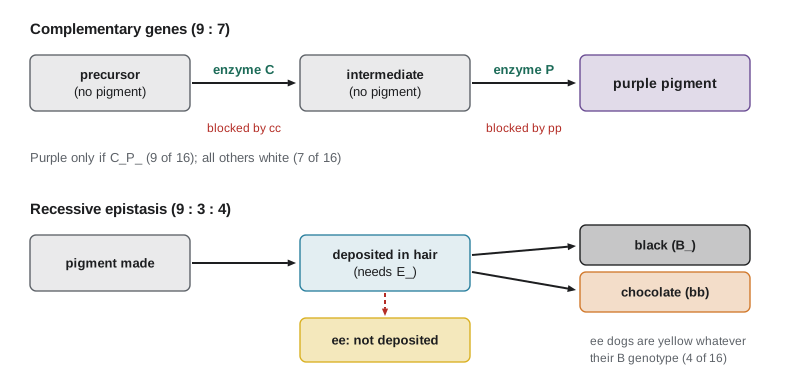
Epistasis, from Greek words meaning “standing upon”, is the situation in which the genotype at one gene masks or modifies the phenotypic effect of another gene. The masking gene is called epistatic; the gene whose effect is masked is hypostatic. Epistasis is different from dominance: dominance is a relationship between alleles of the same gene, whereas epistasis is a relationship between different genes.
Complementary gene action: 9 : 7
In 1905 Bateson and Punnett crossed two true-breeding white-flowered varieties of sweet pea and, to their surprise, obtained all purple F1 plants. When the F1 self-pollinated, the F2 contained purple and white in a ratio of 9 : 7. The explanation is two genes in one pathway, as in the top half of the figure. Purple appears only when the plant has at least one functional allele of both genes (C_P_). The two white parents were blocked at different steps (CCpp and ccPP), so their F1 offspring (CcPp) had one working copy of each enzyme and made pigment. In the F2, the 9 C_P_ plants are purple, while the 3 C_pp, 3 ccP_ and 1 ccpp plants, totalling 7, are white.
This kind of cross is the logic of the complementation test, one of the most important experiments in genetics. If two recessive mutants with the same phenotype are crossed and the offspring are normal, the mutations are in different genes: each parent supplies the working copy the other lacks, so the mutations complement each other. If the offspring are mutant, both mutations are in the same gene. Complementation tests are still used to sort large collections of mutants into genes.
Worked problem
A complementation test
Five independently isolated white-eyed fruit fly mutants (1 to 5), all recessive, are crossed in pairs. Crosses 1 × 2, 1 × 4 and 2 × 4 give white-eyed offspring; 3 × 5 gives white-eyed offspring; all other pairs give red-eyed offspring. How many genes are represented?
Show solution
- Mutants that fail to complement (give mutant offspring) are in the same gene.
- 1, 2 and 4 fail to complement each other: one gene.
- 3 and 5 fail to complement each other: a second gene.
- Crosses between the two groups give red eyes, so the groups are different genes.
Answer: Two genes: one defined by mutants 1, 2 and 4, and another by mutants 3 and 5.
Recessive epistasis: 9 : 3 : 4
Coat colour in Labrador retrievers shows recessive epistasis. One gene (B) controls the type of pigment: B_ gives black and bb gives brown (called chocolate). A second gene (E) controls whether pigment is deposited in the hair at all: dogs with genotype ee cannot deposit dark pigment in hair and are yellow, whatever their B genotype. The ee genotype is epistatic to the B gene. Crossing two BbEe dogs gives 9 B_E_ black, 3 bbE_ chocolate and 4 yellow (3 B_ee plus 1 bbee): a 9 : 3 : 4 ratio. A similar pattern occurs in mouse coat colour (the albino gene is epistatic to the agouti gene) and in the human Bombay phenotype.
The Bombay phenotype, first described in Mumbai (then Bombay) in 1952, shows how epistasis can mislead. People homozygous for a rare recessive allele of the FUT1 gene (hh) cannot make the H antigen, the molecule to which the ABO enzymes attach their sugars (lesson 4). Without H, no A or B antigen can be made, so these people test as type O even if they carry I^A or I^B alleles. A Bombay mother who appears to be type O can therefore have a type AB child, which would be impossible from ABO genotypes alone.
Dominant epistasis: 12 : 3 : 1
In dominant epistasis a dominant allele at one gene masks the other gene. In summer squash, the dominant allele W of one gene prevents colour formation, giving white fruit regardless of the second gene. When the plant is ww, the second gene determines colour: Y_ gives yellow and yy gives green. A dihybrid cross gives 12 white (9 W_Y_ + 3 W_yy), 3 yellow (wwY_) and 1 green (wwyy): 12 : 3 : 1.
A related pattern, 13 : 3, arises when a dominant allele of one gene suppresses the effect of another gene. In chickens, the dominant allele C is needed for colour, but the dominant allele I of a second gene inhibits colour; only birds that are C_ii, with the colour allele and without the inhibitor, are coloured. That is 3 of the 16 combinations, giving 13 white : 3 coloured.
Duplicate genes: 15 : 1
When two genes do the same job, a working allele of either is enough, and only the double homozygous recessive shows the mutant phenotype. In shepherd's purse, a small weed, seed capsules are triangular if the plant has at least one dominant allele at either of two duplicate genes; only the aabb plants have ovoid capsules, giving 15 triangular : 1 ovoid. Duplicate genes are common in plants, many of which carry extra genome copies from ancient polyploidy (BIOL-108).
| F2 ratio | Name | Genotype classes combined | Example |
|---|---|---|---|
| 9 : 3 : 3 : 1 | No interaction | None | Pea seed shape and colour |
| 9 : 3 : 4 | Recessive epistasis | A_bb and aabb | Labrador coat colour; Bombay phenotype |
| 9 : 7 | Complementary genes (duplicate recessive epistasis) | A_bb, aaB_ and aabb | Sweet pea flower colour |
| 12 : 3 : 1 | Dominant epistasis | A_B_ and A_bb | Summer squash fruit colour |
| 13 : 3 | Dominant suppression | A_B_, A_bb and aabb | Chicken feather colour |
| 15 : 1 | Duplicate genes (duplicate dominant epistasis) | A_B_, A_bb and aaB_ | Shepherd’s purse capsule shape |
| 9 : 6 : 1 | Additive (cumulative) effects | A_bb and aaB_ | Summer squash fruit shape |
The pattern in the table is worth memorizing in a different way: every modified ratio adds up to 16, because the 16 genotype combinations of a dihybrid cross are still present. A ratio with fewer than four classes means some genotype classes share a phenotype. Identifying which classes have been combined tells you the type of interaction.
Generating the ratios
The program below enumerates all 16 combinations of a dihybrid cross and applies a different genotype-to-phenotype rule for each type of interaction, reproducing every ratio in the table from the same Mendelian genotypes.
from itertools import product
from collections import Counter

def f2():
    """All 16 equally likely F2 combinations of AaBb x AaBb as (A present?, B present?)."""
    gam = ["AB", "Ab", "aB", "ab"]
    for e, s in product(gam, gam):
        yield ("A" in e[0] + s[0], "B" in e[1] + s[1])

rules = {
    "no interaction":      lambda a, b: ("A" if a else "a") + ("B" if b else "b"),
    "recessive epistasis": lambda a, b: ("aa (masked)" if not a else ("A_B_" if b else "A_bb")),
    "complementary":       lambda a, b: "coloured" if (a and b) else "white",
    "dominant epistasis":  lambda a, b: "white" if a else ("yellow" if b else "green"),
    "duplicate genes":     lambda a, b: "triangular" if (a or b) else "ovoid",
    "additive":            lambda a, b: {2: "disc", 1: "sphere", 0: "long"}[a + b],
}
for name, rule in rules.items():
    counts = Counter(rule(a, b) for a, b in f2())
    ratio = " : ".join(str(n) for n in sorted(counts.values(), reverse=True))
print(f"{name:20s} {ratio:12s} {dict(counts)}")no interaction 9 : 3 : 3 : 1 {'AB': 9, 'Ab': 3, 'aB': 3, 'ab': 1}
recessive epistasis 9 : 4 : 3 {'A_B_': 9, 'A_bb': 3, 'aa (masked)': 4}
complementary 9 : 7 {'coloured': 9, 'white': 7}
dominant epistasis 12 : 3 : 1 {'white': 12, 'yellow': 3, 'green': 1}
duplicate genes 15 : 1 {'triangular': 15, 'ovoid': 1}
additive 9 : 6 : 1 {'disc': 9, 'sphere': 6, 'long': 1}Recognizing epistasis in data
In practice, a geneticist starts with counts and has to infer the ratio. The approach is to divide the counts by the total and multiply by 16, then compare with the candidate ratios. A chi-square test (lesson 3) can confirm the choice. Consider an F2 from a cross of two true-breeding white varieties that gave a coloured F1.
Worked problem
Inferring the interaction from counts
An F2 contains 279 coloured and 221 white plants (total 500). Which ratio fits, and what does it suggest about the genes?
Show solution
- Scale to 16: coloured 279/500 × 16 = 8.9; white 221/500 × 16 = 7.1.
- This is close to 9 : 7.
- Expected for 9 : 7: 281.25 coloured and 218.75 white; χ² = (279 − 281.25)²/281.25 + (221 − 218.75)²/218.75 ≈ 0.04, df = 1, P ≈ 0.84.
- A 9 : 7 ratio means colour requires dominant alleles at two genes: complementary gene action.
Answer: The data fit 9 : 7 very well: the two white parents had mutations in different genes of the colour pathway.
from scipy.stats import chisquare
obs = [279, 221]
n = sum(obs)
candidates = {"3:1": [3, 1], "9:7": [9, 7], "13:3": [13, 3], "15:1": [15, 1]}
for name, r in candidates.items():
    exp = [n * x / sum(r) for x in r]
    stat, p = chisquare(obs, exp)
print(f"{name:5s} expected {[round(e, 1) for e in exp]} chi-square = {stat:7.2f} P = {p:.3g}")3:1 expected [375.0, 125.0] chi-square = 98.30 P = 3.59e-23 9:7 expected [281.2, 218.8] chi-square = 0.04 P = 0.839 13:3 expected [406.2, 93.8] chi-square = 212.58 P = 3.76e-48 15:1 expected [468.8, 31.2] chi-square = 1228.97 P = 3.08e-269
Epistasis beyond Mendelian ratios
The term epistasis is also used more broadly in quantitative genetics and evolution to mean any case in which the effect of one gene depends on the alleles present at another. In this sense epistasis is very common. A mutation that is harmful in one genetic background can be harmless or even beneficial in another, which affects how populations evolve and why the same disease allele can cause severe illness in one person and mild illness in another. Genes that modify the expression of another gene, often called modifier genes, are one source of the variable expressivity described in lesson 4. Large studies in yeast, in which pairs of genes have been deleted together across most of the genome, have mapped millions of such interactions and revealed how genes are organized into functional networks.
Gene interaction in medicine
Gene interactions matter in human health. In sickle-cell disease, people who also inherit variants that keep fetal hemoglobin production switched on after birth tend to have milder disease, because fetal hemoglobin does not sickle. This observation led directly to the first approved CRISPR-based therapy, exagamglogene autotemcel (Casgevy), which edits a patient's own blood stem cells to disable BCL11A, a gene that normally shuts down fetal hemoglobin. The therapy was approved in the United Kingdom and the United States in late 2023 and by Health Canada in September 2024. It treats the disease by deliberately exploiting an interaction between two genes, and it edits body cells only, not eggs or sperm (lesson 12).
Common mistakes
MistakeEpistasis is the same as dominance.
InsteadDominance is between alleles of one gene; epistasis is between different genes.
MistakeA 9 : 7 ratio means Mendel’s law of independent assortment has broken down.
InsteadThe genes still assort independently; 9 : 7 arises because three of the four genotype classes share a phenotype.
MistakeIf two white-flowered mutants give white offspring when crossed, the mutations are in different genes.
InsteadFailure to complement (mutant offspring) means the mutations are in the same gene.
MistakeModified ratios can add up to any number.
InsteadDihybrid ratios always total 16 because the 16 genotype combinations are unchanged.
MistakeA Bombay-phenotype person who types as O cannot pass on an A or B allele.
InsteadThey may carry I^A or I^B; the alleles are masked by the hh genotype and can be expressed in their children.
Summary and key terms
- Epistasis occurs when the genotype at one gene masks or modifies the effect of another gene.
- Modified dihybrid ratios (9 : 3 : 4, 9 : 7, 12 : 3 : 1, 13 : 3, 15 : 1, 9 : 6 : 1) arise from the same 16 genotype combinations grouped differently.
- Pathway thinking explains epistasis: a block at an early step masks later steps.
- Complementation tests classify recessive mutants into genes: normal offspring mean different genes.
- Recessive epistasis (for example Labrador coat colour and the Bombay phenotype) gives 9 : 3 : 4.
- Duplicate genes give 15 : 1; dominant epistasis gives 12 : 3 : 1.
- Gene interactions modify disease severity, as fetal hemoglobin does in sickle-cell disease, inspiring new therapies.
- epistasis
- Interaction in which one gene masks or modifies the phenotypic effect of another gene.
- epistatic gene
- The gene whose genotype masks the effect of another gene.
- hypostatic gene
- The gene whose effect is masked.
- complementation test
- A cross between two recessive mutants to determine whether their mutations are in the same gene.
- complementary genes
- Two genes that must both have functional alleles for a phenotype to appear.
- duplicate genes
- Genes with the same function, so that a functional allele of either is sufficient.
- recessive epistasis
- A homozygous recessive genotype at one gene masks another gene.
- dominant epistasis
- A dominant allele at one gene masks another gene.
- Bombay phenotype
- Absence of H antigen (hh) that masks ABO alleles and makes a person type as O.
- modifier gene
- A gene that alters the expression of another gene.
Practice problems
Work each problem on paper first, then reveal the answer to check.
In Labradors, what are the coat colours of BbEe × bbee offspring and their ratio?
Show answer
Black (BbEe), chocolate (bbEe) and yellow (Bbee and bbee): 1 : 1 : 2.
Two white sweet pea varieties produce purple F1 plants. What ratio is expected in the F2?
Show answer
9 purple : 7 white.
An F2 has 151 white, 37 yellow and 12 green squash. What ratio and type of interaction is this?
Show answer
About 12 : 3 : 1 (150 : 37.5 : 12.5), dominant epistasis.
Two recessive mutants with crumpled wings are crossed and the offspring have normal wings. What do you conclude?
Show answer
The mutations are in different genes; they complement each other.
Why might a type O mother have a type AB child?
Show answer
She may have the Bombay phenotype (hh), masking I^A or I^B alleles that her child expresses.
In shepherd’s purse, what fraction of the F2 from AaBb × AaBb has ovoid capsules?
Show answer
1/16 (aabb only).
Scale 360 purple and 280 white to a ratio out of 16.
Show answer
360/640 × 16 = 9 and 280/640 × 16 = 7: a 9 : 7 ratio.
What is the difference between an epistatic and a hypostatic gene?
Show answer
The epistatic gene masks the other; the hypostatic gene is the one masked.
Why do modified dihybrid ratios always total 16?
Show answer
Because the 16 equally likely genotype combinations from independent assortment are unchanged; only phenotypes are grouped.
How does fetal hemoglobin illustrate gene interaction?
Show answer
Variants that keep fetal hemoglobin on reduce the severity of sickle-cell disease caused by a different gene.
Lesson quiz · 5 questions
Score 60% or more to complete this lesson.
Create a free account to save your progress, take quizzes and earn a certificate.