
BIOL-201 · Lesson 10 of 12 · 29 min
Gene mutation, DNA repair and transposable elements
A mutation is any heritable change in the DNA sequence. Mutations are the ultimate source of all genetic variation: every allele that geneticists study, from Mendel's wrinkled peas to the alleles that cause cystic fibrosis, began as a mutation. Most mutations are harmless or harmful, a few are beneficial, and their effects depend on where they occur and what they change. This lesson classifies gene mutations, explains how they arise and how cells repair DNA damage, introduces the classic experiments that showed mutations are random, and describes the mobile DNA sequences, transposable elements, that make up a large part of many genomes. The molecular details of how genes are transcribed and translated are left to BIOL-207; here we need only the idea that a gene's DNA sequence is read in three-base codons that specify amino acids.
Somatic and germ-line mutations
Where a mutation occurs determines whether it is inherited. A germ-line mutation occurs in cells that give rise to eggs or sperm and can be passed to offspring, appearing in every cell of the child. A somatic mutation occurs in a body cell and is passed only to that cell's descendants; it is not inherited, but it can produce a patch of mutant tissue or, if it disrupts genes controlling growth, contribute to cancer. Each of us accumulates thousands of somatic mutations as we age; most have no visible effect.
Each human newborn carries on average about 60 to 70 new germ-line point mutations (de novo mutations) that neither parent had, the great majority in non-coding DNA. Most come from the father, and their number rises with paternal age, by roughly one or two additional mutations for each year of the father's age at conception, because spermatogonial stem cells keep dividing throughout adult life and each division risks a copying error. Eggs, which complete their divisions before birth, contribute fewer new point mutations, though maternal age matters greatly for chromosome errors (lesson 9).
import numpy as np
rng = np.random.default_rng(201)
# Illustrative model of de novo point mutations per child (values approximate, from large family studies)
def expected_dnm(father_age, mother_age):
    paternal = 10 + 1.5 * father_age            # rises by about 1.5 per year of father's age
    maternal = 3.4 + 0.37 * mother_age          # smaller maternal age effect
    return paternal, maternal

for f_age, m_age in [(20, 20), (30, 30), (40, 35), (50, 35)]:
    p, m = expected_dnm(f_age, m_age)
    sample = rng.poisson(p + m, size=10_000)
    print(f"father {f_age}, mother {m_age}: expected {p + m:5.1f} new mutations "
          f"({p:4.1f} paternal, {m:4.1f} maternal); simulated 95% range "
f"{np.percentile(sample, 2.5):.0f}-{np.percentile(sample, 97.5):.0f}")father 20, mother 20: expected 50.8 new mutations (40.0 paternal, 10.8 maternal); simulated 95% range 37-65 father 30, mother 30: expected 69.5 new mutations (55.0 paternal, 14.5 maternal); simulated 95% range 54-86 father 40, mother 35: expected 86.3 new mutations (70.0 paternal, 16.3 maternal); simulated 95% range 69-105 father 50, mother 35: expected 101.3 new mutations (85.0 paternal, 16.3 maternal); simulated 95% range 82-122
Types of point mutation
A point mutation changes a single base pair. A transition swaps one purine for another (A ↔ G) or one pyrimidine for another (C ↔ T); a transversion swaps a purine for a pyrimidine or vice versa. Transitions are more common, partly because of the chemistry of DNA damage. Small insertions and deletions (indels) add or remove one or a few bases. The effect of a mutation in a protein-coding region depends on how it changes the codons.
| Type | Change at the DNA level | Effect on the protein | Example |
|---|---|---|---|
| Silent (synonymous) | Base substitution giving a codon for the same amino acid | None, usually | GAA → GAG (both glutamic acid) |
| Missense | Substitution giving a codon for a different amino acid | Ranges from harmless to severe | GAG → GTG in HBB: glutamic acid to valine, causing sickle-cell disease |
| Nonsense | Substitution creating a stop codon | Shortened (truncated) protein, usually non-functional | Many cystic fibrosis and Duchenne alleles |
| Frameshift | Insertion or deletion of bases not a multiple of three | Changes every codon downstream and usually creates an early stop | The four-base insertion common in Tay–Sachs disease among Ashkenazi Jewish people |
| In-frame indel | Insertion or deletion of a multiple of three bases | Adds or removes amino acids | ΔF508 in CFTR: deletion of three bases removing one phenylalanine |
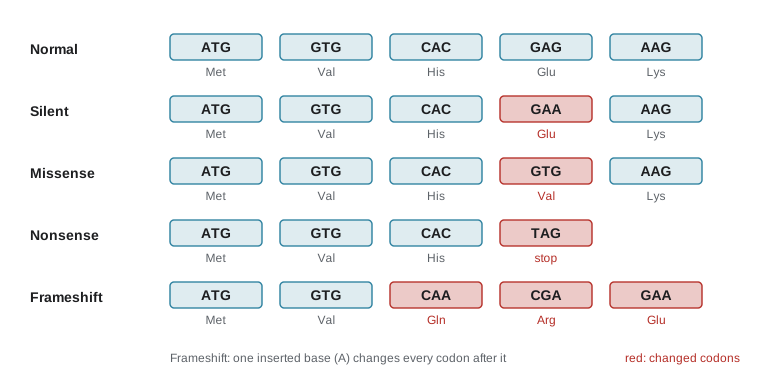
The program below applies each type of mutation to a short invented coding sequence and translates the result using the standard genetic code. It shows why frameshifts are usually so damaging: a single inserted base scrambles every codon that follows.
bases = "TCAG"
codons = [a + b + c for a in bases for b in bases for c in bases]
aas = "FFLLSSSSYY**CC*WLLLLPPPPHHQQRRRRIIIMTTTTNNKKSSRRVVVVAAAADDEEGGGG"
CODE = dict(zip(codons, aas))

def translate(dna):
    protein = ""
    for i in range(0, len(dna) - 2, 3):
        aa = CODE[dna[i:i + 3]]
        protein += aa
        if aa == "*":
            break
    return protein

normal = "ATGGTGCACCTGACTCCTGAGGAGAAGTCT"      # start of an invented coding sequence
mutants = {
    "normal":     normal,
    "silent":     normal[:20] + "A" + normal[21:],   # codon 7 GAG -> GAA (Glu -> Glu)
    "missense":   normal[:19] + "T" + normal[20:],   # codon 7 GAG -> GTG (Glu -> Val)
    "nonsense":   normal[:18] + "T" + normal[19:],   # codon 7 GAG -> TAG (stop)
    "frameshift": normal[:10] + "A" + normal[10:],   # one base inserted in codon 4
}
for name, seq in mutants.items():
print(f"{name:10s} {translate(seq)}")normal MVHLTPEEKS silent MVHLTPEEKS missense MVHLTPVEKS nonsense MVHLTP* frameshift MVHHDS*
Mutations outside coding sequences can matter too. Changes in promoters and enhancers can alter how much of a protein is made, or where and when; changes at the boundaries between exons and introns can disrupt splicing. Many of the variants linked to common diseases lie in such regulatory regions.
Loss-of-function and gain-of-function mutations
Geneticists also classify mutations by their effect on gene function. Loss-of-function mutations reduce or abolish activity; a complete loss is called a null or amorphic allele. Most are recessive (lesson 4). Gain-of-function mutations increase activity or give the protein a new property and are usually dominant. Some mutations are conditional: they show their effect only under certain conditions, such as high temperature. Temperature-sensitive mutations, like the Himalayan rabbit allele from lesson 4, have been invaluable for studying essential genes, because the organism can be grown at a permissive temperature and then shifted to a restrictive one to see what the gene does.
Expanding repeats
An unusual class of mutation involves short sequences repeated many times in tandem. In Huntington disease, the HTT gene contains a run of CAG triplets encoding a string of glutamines. Normal alleles have fewer than 27 repeats; alleles with 40 or more cause the disease with full penetrance, and 36 to 39 repeats give incomplete penetrance. The repeat is unstable and tends to expand when passed on, especially through the father, so the disease often begins earlier in successive generations, a phenomenon called anticipation. Fragile X syndrome, the most common inherited cause of intellectual disability, involves expansion of a CGG repeat in the FMR1 gene, here mainly through the mother.
How mutations arise
Spontaneous mutations arise from the normal chemistry and biology of the cell. DNA polymerases occasionally insert the wrong base; proofreading and repair catch most errors, leaving roughly one uncorrected error per billion bases copied. Bases also change spontaneously: cytosine can lose an amino group (deamination) and become uracil, and the methylated cytosine common in mammalian DNA deaminates to thymine, which is why CG sites are mutation hotspots. Each human cell loses thousands of bases a day from depurination, the breaking of the bond between a purine base and the sugar.
Induced mutations are caused by mutagens, physical or chemical agents that increase the mutation rate. Hermann Muller showed in 1927 that X-rays cause mutations in Drosophila, work that won a Nobel Prize and shaped radiation safety standards.
| Mutagen | Mechanism | Typical mutation |
|---|---|---|
| Ultraviolet light | Links adjacent pyrimidines into dimers that distort DNA | C → T transitions at pyrimidine pairs (a signature of sun-induced skin cancer) |
| Ionizing radiation (X-rays, gamma rays) | Breaks DNA strands and damages bases | Deletions, rearrangements, double-strand breaks |
| Base analogues (5-bromouracil) | Incorporated in place of a normal base and mispairs | Transitions |
| Alkylating agents (mustard gas, EMS) | Add chemical groups to bases, altering their pairing | Transitions, especially G → A |
| Intercalating agents (acridine dyes) | Slip between base pairs and distort the helix | Frameshifts |
| Benzo[a]pyrene (tobacco smoke, charred food) | Metabolized into compounds that bind to guanine | G → T transversions, common in smokers’ lung tumours |
Are mutations random? The fluctuation test
Before 1943, many biologists thought bacteria might develop resistance in response to a challenge, such as a virus or antibiotic: that the environment directed the useful mutation. Salvador Luria and Max Delbrück tested this with an elegant experiment. They grew many small, separate cultures of E. coli and spread each on a plate containing a virus that kills sensitive bacteria. If resistance were induced by contact with the virus, every culture should give a similar small number of resistant colonies. If resistance mutations arise at random during growth, before exposure, then the number should fluctuate wildly: a mutation early in a culture's growth produces a large clone of resistant cells (a jackpot), while most cultures have few or none.
import numpy as np
rng = np.random.default_rng(1943)

def culture(generations=20, mu=2e-7):
    """Grow one culture from 1 cell by doubling; mutants arise at random each division."""
    normal, mutant = 1, 0
    for _ in range(generations):
        new_mut = rng.binomial(normal, mu)       # mutations during this round of division
        normal = 2 * normal - 2 * new_mut
        mutant = 2 * mutant + 2 * new_mut
    return mutant

random_model = np.array([culture() for _ in range(50)])
induced_model = rng.poisson(random_model.mean(), size=50)    # same average, induced on the plate
for name, x in [("random (Luria-Delbruck)", random_model), ("induced", induced_model)]:
    print(f"{name:24s} mean {x.mean():6.2f}  variance {x.var():8.2f}  "
f"cultures with 0: {np.sum(x == 0):2d} largest: {x.max()}")random (Luria-Delbruck) mean 1.32 variance 25.54 cultures with 0: 42 largest: 32 induced mean 1.44 variance 1.13 cultures with 0: 8 largest: 5
Luria and Delbrück observed the jackpots: the variance among cultures was far larger than the mean, as the random-mutation model predicts. Later, Joshua and Esther Lederberg confirmed the result by replica plating, showing that resistant colonies were already present on a plate before it was ever exposed to the selective agent. Mutation is random with respect to need; selection then sorts the variation, the principle at the heart of evolution (BIOL-108) and of the spread of antibiotic resistance.
Testing chemicals for mutagenicity: the Ames test
Because many mutagens also cause cancer, detecting mutagens is important for public health. The Ames test, developed by Bruce Ames in the 1970s, uses strains of Salmonella that carry a mutation making them unable to synthesize the amino acid histidine. They can grow on a medium without histidine only if a new mutation reverses the original one. Bacteria are exposed to the test chemical and plated on histidine-free medium; a large increase in revertant colonies compared with an untreated control indicates that the chemical is mutagenic. Because some chemicals become mutagenic only after being processed by liver enzymes, the test includes an extract of rat liver (called S9) to mimic metabolism in the body.
Worked problem
Interpreting an Ames test
Plates of a histidine-requiring Salmonella strain give these mean revertant colony counts: control without S9, 22; control with S9, 25; chemical X without S9, 24; chemical X with S9, 310. What do you conclude?
Show solution
- Spontaneous reversion gives about 22 to 25 colonies.
- Chemical X without liver extract gives about the same: not directly mutagenic.
- With S9, revertants increase more than twelvefold.
- Chemical X is converted by liver enzymes into a mutagen, like benzo[a]pyrene.
Answer: Chemical X is a promutagen: harmless itself but mutagenic after metabolic activation. It would be flagged for further testing as a possible carcinogen.
DNA repair
Cells devote enormous effort to repairing DNA. Without repair, the thousands of damaging events that hit each cell every day would quickly be fatal. Different systems handle different kinds of damage.
| Repair system | What it fixes | Human disease when defective |
|---|---|---|
| Direct reversal | Removes specific chemical changes, such as some alkyl groups | Not a major disease cause, but affects tumour response to some drugs |
| Base excision repair | Single damaged bases, such as uracil from cytosine deamination | Some inherited colorectal polyp syndromes (MUTYH) |
| Nucleotide excision repair | Bulky lesions that distort the helix, including UV-induced dimers | Xeroderma pigmentosum: extreme sun sensitivity and skin cancer |
| Mismatch repair | Replication errors missed by proofreading | Lynch syndrome: high risk of colorectal and other cancers |
| Homologous recombination | Double-strand breaks, using the sister chromatid as a template | Hereditary breast and ovarian cancer (BRCA1, BRCA2) |
| Non-homologous end joining | Double-strand breaks, by rejoining ends directly (error-prone) | Some immunodeficiencies |
The link between repair and cancer is direct: defects in repair genes raise the mutation rate, making it more likely that a cell will accumulate the combination of mutations that drives uncontrolled growth. The same knowledge is exploited in treatment. Tumours with defective BRCA genes depend on other repair pathways, and drugs called PARP inhibitors block one of them, killing the tumour cells while largely sparing normal cells, an example of synthetic lethality. Double-strand break repair is also central to genome editing with CRISPR, which works by cutting DNA at a chosen site and letting the cell's own repair machinery make the change.
Transposable elements
Transposable elements are DNA sequences that can move from one location in the genome to another. Barbara McClintock discovered them in the 1940s while studying unstable kernel colours in maize, where pieces of DNA jumping into and out of pigment genes produced speckled kernels. Her work was met with doubt for decades, partly because it conflicted with the view of the genome as stable, and she received the Nobel Prize in 1983. Transposons have since been found in nearly every organism studied.
There are two main classes. DNA transposons move by a cut-and-paste mechanism using an enzyme called transposase. Retrotransposons are copied into RNA and then reverse-transcribed back into DNA at a new site, a copy-and-paste mechanism that can greatly increase their numbers. About 45 per cent of the human genome consists of transposable element sequences, most of them ancient and no longer able to move. The most abundant, an element called Alu, is present in over a million copies. A few elements remain active and occasionally cause disease by inserting into genes: new LINE-1 insertions have been found to cause cases of hemophilia A and Duchenne muscular dystrophy. Over evolutionary time, transposons have also supplied raw material for new genes and regulatory sequences.
Common mistakes
MistakeAll mutations are harmful.
InsteadMost mutations are neutral, many are harmful and a few are beneficial; their effect depends on location and environment.
MistakeSomatic mutations are passed on to offspring.
InsteadOnly germ-line mutations are inherited; somatic mutations affect only the descendants of the mutated body cell.
MistakeBacteria mutate in response to antibiotics to become resistant.
InsteadThe fluctuation test and replica plating showed resistance mutations arise at random before exposure; the antibiotic selects them.
MistakeA deletion of three bases always causes a frameshift.
InsteadRemoving a multiple of three bases keeps the reading frame, removing or changing amino acids rather than scrambling the sequence.
MistakeTransposable elements are rare curiosities.
InsteadThey make up about 45 per cent of the human genome and have shaped genome evolution.
Summary and key terms
- Germ-line mutations are inherited; somatic mutations are not but can cause cancer; each newborn has about 60 to 70 de novo mutations, mostly paternal.
- Point mutations in coding DNA can be silent, missense or nonsense; insertions and deletions not in multiples of three cause frameshifts.
- Mutations may cause loss or gain of function; expanding repeats such as the HTT CAG repeat cause anticipation.
- Mutations arise spontaneously from replication errors and base damage, or are induced by mutagens such as UV light, radiation and chemicals.
- The Luria–Delbrück fluctuation test showed that mutations arise randomly, not in response to need.
- The Ames test detects mutagens, using liver enzymes to reveal promutagens.
- Multiple DNA repair pathways protect the genome; their defects cause diseases such as xeroderma pigmentosum and Lynch syndrome; transposable elements make up much of our genome.
- germ-line mutation
- A mutation in cells that give rise to gametes, which can be inherited.
- somatic mutation
- A mutation in a body cell, not passed to offspring.
- de novo mutation
- A new mutation present in a child but not in either parent.
- missense mutation
- A base substitution that changes one amino acid.
- nonsense mutation
- A base substitution that creates a stop codon.
- frameshift mutation
- An insertion or deletion that shifts the reading frame.
- mutagen
- An agent that increases the mutation rate.
- anticipation
- Increasing severity or earlier onset of a disease in successive generations, often from repeat expansion.
- mismatch repair
- A repair system that corrects base-pairing errors left after DNA replication.
- transposable element
- A DNA sequence that can move from one site in the genome to another.
Practice problems
Work each problem on paper first, then reveal the answer to check.
A codon changes from TGG (tryptophan) to TGA. What type of mutation is this?
Show answer
Nonsense (TGA is a stop codon).
Why do frameshift mutations usually destroy protein function?
Show answer
They change every downstream codon and usually create an early stop codon.
Distinguish a transition from a transversion.
Show answer
A transition swaps purine for purine or pyrimidine for pyrimidine; a transversion swaps purine for pyrimidine or vice versa.
Why does the number of de novo mutations rise with paternal age?
Show answer
Sperm precursor cells keep dividing throughout life, and each division carries a risk of copying errors.
What would the fluctuation test have shown if mutations were induced by the virus?
Show answer
Similar small numbers of resistant colonies in every culture, with variance close to the mean.
Why is liver extract added in the Ames test?
Show answer
Some chemicals become mutagenic only after being metabolized by liver enzymes.
Which repair pathway is defective in xeroderma pigmentosum?
Show answer
Nucleotide excision repair.
What is anticipation, and in which disease is it seen?
Show answer
Earlier onset or greater severity in successive generations; Huntington disease (CAG expansion).
Name the two classes of transposable elements and how they move.
Show answer
DNA transposons (cut and paste) and retrotransposons (copy via RNA and paste).
How do PARP inhibitors exploit DNA repair defects?
Show answer
Tumour cells lacking BRCA function depend on PARP-related repair; blocking it kills them (synthetic lethality).
Lesson quiz · 5 questions
Score 60% or more to complete this lesson.
Create a free account to save your progress, take quizzes and earn a certificate.