
BIOL-201 · Lesson 1 of 12 · 27 min
Genetics: its history and the questions it asks
Genetics is the science of heredity and variation: why offspring resemble their parents, why they are never exact copies, and how the information that builds an organism is stored, copied, changed and passed on. It is one of the few sciences that reaches from the chemistry of a single molecule to the history of whole populations, and it touches daily life in more ways than almost any other part of biology, from the crops we eat and the medicines we take to the tests offered to every newborn. This course builds on the cell biology of BIOL-107 and the evolutionary thinking of BIOL-108. It concentrates on transmission genetics (how genes pass between generations), chromosome genetics, mutation and the genetics of populations and quantitative traits. The molecular machinery of DNA replication, transcription and translation is covered in BIOL-207, and whole-genome analysis in BIOL-410.
The questions genetics asks
Almost every problem in genetics can be framed as one of four questions. Keeping them in mind helps organize a field that can otherwise look like a long list of rules and exceptions.
| Question | Branch of genetics | Typical tools |
|---|---|---|
| How are traits passed from parents to offspring? | Transmission (classical) genetics | Controlled crosses, pedigrees, probability, chi-square tests |
| Where are genes, and how are they arranged? | Chromosome and cytogenetics | Karyotypes, linkage mapping, microscopy |
| What is a gene, and how does it work and change? | Molecular genetics | DNA sequencing, mutation analysis, model organisms |
| How do genes behave in groups of organisms? | Population and quantitative genetics | Allele frequencies, heritability, statistical models |
These branches are not separate subjects. A single disease, such as cystic fibrosis, is studied by all four: transmission genetics shows it is inherited as an autosomal recessive trait; cytogenetic and linkage studies located the gene on chromosome 7; molecular genetics identified the protein and the mutations; and population genetics explains why the main disease allele is common in people of northern European ancestry. We will meet this example several times.
Ideas about heredity before Mendel
People have bred plants and animals for at least ten thousand years, selecting the best seeds of wheat, rice and maize and the most docile or productive animals. That practice showed that traits are inherited, but explanations were vague. A common idea was blending inheritance: the hereditary material of the two parents mixes like paint, so offspring are intermediate. Blending fails a simple test. If it were true, variation would shrink every generation until a population became uniform, and traits that skip a generation, such as a grandparent's eye colour reappearing in a grandchild, would be impossible.
Another long-lived idea, held by Darwin among others, was pangenesis: every part of the body sheds tiny particles that collect in the reproductive organs and carry information about that part. Pangenesis implied that acquired characteristics, such as a blacksmith's strong arms, could be inherited. In the 1880s August Weismann argued instead that the germ line (the cells that give rise to eggs and sperm) is set apart early in development and that changes to body cells are not passed on. Weismann famously cut the tails off mice for several generations and found no shortening in their offspring; more importantly, he reasoned clearly about why acquired traits should not be inherited.
Mendel and the particulate theory
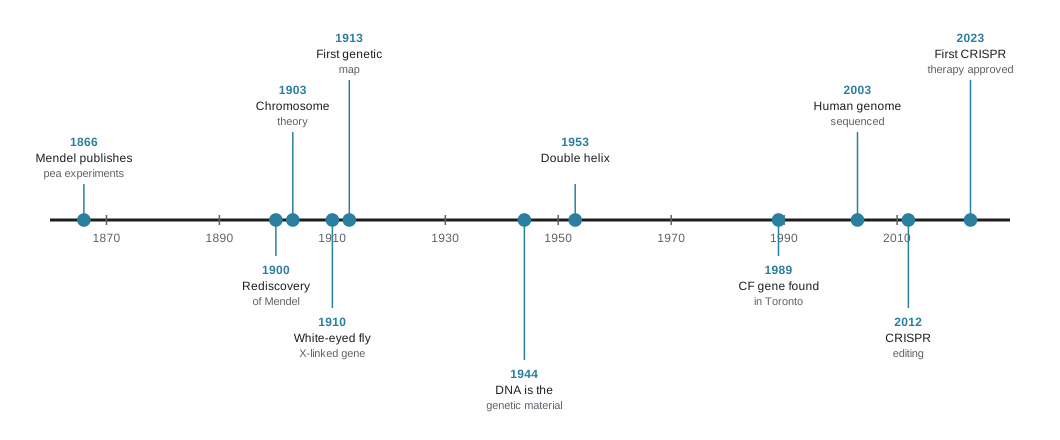
Gregor Mendel, a monk working in the Augustinian monastery in Brno in what is now the Czech Republic, published his experiments on garden peas in 1866. His success came from good choices rather than luck. He studied traits that came in two clear forms (tall or short plants, round or wrinkled seeds), he began with true-breeding lines, he controlled pollination by hand, he counted large numbers of offspring, and he analysed the counts mathematically. From the ratios he inferred that each plant carries two hereditary factors for each trait, one from each parent, that the factors do not blend, and that they separate again when gametes form. We now call his factors genes and their alternative forms alleles. Lesson 2 works through his experiments and laws in detail.
Mendel's paper was largely ignored for 34 years. In 1900 three botanists, Hugo de Vries, Carl Correns and Erich von Tschermak, independently reached similar conclusions and found his work. Within a few years the English biologist William Bateson championed Mendelism, coined the word genetics in 1905, and with Reginald Punnett showed that Mendel's rules applied to animals as well as plants.
Chromosomes and the fly room
Meanwhile microscopists had described chromosomes and their careful division during mitosis and meiosis. In 1902 and 1903 Walter Sutton and Theodor Boveri pointed out that chromosomes behave exactly as Mendel's factors should: they come in pairs, one member of each pair goes into each gamete, and different pairs sort independently. This chromosome theory of inheritance was proven in the fruit fly Drosophila melanogaster by Thomas Hunt Morgan and his students at Columbia University. In 1910 Morgan found a white-eyed male fly and showed that the white-eye trait was inherited together with sex, which meant the gene was on the X chromosome (lesson 7). His student Alfred Sturtevant realized in 1913 that the frequency of recombination between linked genes could be used to build the first genetic map (lesson 8).
What is the gene made of?
By the 1940s geneticists knew that genes sit on chromosomes, but chromosomes contain both protein and DNA, and most scientists assumed that only protein was complex enough to carry information. Three lines of evidence changed that view. In 1928 Frederick Griffith showed that a harmless strain of pneumonia bacteria could be transformed into a deadly one by something released from heat-killed deadly bacteria. In 1944 Oswald Avery, Colin MacLeod and Maclyn McCarty, working in New York, purified that transforming principle and showed that it was DNA; MacLeod was a Canadian-born physician trained at McGill University. In 1952 Alfred Hershey and Martha Chase showed that when a virus infects a bacterium, its DNA, not its protein, enters the cell and directs the production of new viruses.
In 1953 James Watson and Francis Crick proposed the double-helix structure of DNA, relying heavily on X-ray diffraction images made by Rosalind Franklin and on data from Maurice Wilkins. The structure immediately suggested how DNA could be copied (each strand serves as a template) and how it could store information (in the sequence of its four bases). The decades that followed worked out the genetic code and the flow of information from DNA to RNA to protein, which BIOL-207 develops in full.
| Year | Discovery | Who |
|---|---|---|
| 1866 | Laws of segregation and independent assortment | Gregor Mendel |
| 1902–1903 | Chromosome theory of inheritance | Walter Sutton, Theodor Boveri |
| 1910 | A gene on the X chromosome (white eye) | Thomas Hunt Morgan |
| 1913 | First linkage map | Alfred Sturtevant |
| 1927 | X-rays cause mutations | Hermann Muller |
| 1944 | DNA is the transforming principle | Avery, MacLeod and McCarty |
| 1949 | Sex chromatin (Barr body) in female cells | Murray Barr and Ewart Bertram, University of Western Ontario |
| 1950s | Transposable elements in maize | Barbara McClintock |
| 1953 | Double-helix structure of DNA | Watson, Crick, Franklin and Wilkins |
| 1989 | Cystic fibrosis gene (CFTR) identified | Lap-Chee Tsui and colleagues at the Hospital for Sick Children, Toronto, with Francis Collins and John Riordan |
| 2003 | Human genome sequence essentially completed | International Human Genome Project |
| 2012 | CRISPR–Cas9 as a programmable editing tool | Jennifer Doudna, Emmanuelle Charpentier and colleagues |
Model organisms
Much of what we know about human genetics was first learned in other species. A good model organism is small, cheap to keep, has a short generation time and many offspring, and can be crossed in controlled ways. Today most of them also have complete genome sequences and large collections of mutant strains shared among laboratories.
| Organism | Generation time | Why it is useful |
|---|---|---|
| Escherichia coli (bacterium) | About 20 minutes | Haploid, so every mutation is visible; foundation of molecular genetics |
| Saccharomyces cerevisiae (baker’s yeast) | About 90 minutes | Simple eukaryote; can grow as haploid or diploid; tetrad analysis of meiosis |
| Arabidopsis thaliana (thale cress) | About 6 weeks | Small flowering plant with a compact genome |
| Caenorhabditis elegans (nematode worm) | About 3 days | Every cell lineage is known; transparent body |
| Drosophila melanogaster (fruit fly) | About 10 days | Classic transmission genetics, development and behaviour |
| Mus musculus (house mouse) | About 10 weeks | Mammal; genes can be knocked out to model human disease |
| Danio rerio (zebrafish) | About 3 months | Transparent embryos develop outside the mother |
Why should a fly tell us anything about people? Because of common descent (BIOL-108). Humans share many genes with flies and even yeast, inherited from common ancestors, and those genes often do similar jobs. Roughly three-quarters of genes known to be involved in human disease have recognizable counterparts in Drosophila.
Probability in genetics: a first look
Genetics is quantitative from the start. Mendel's insight came from counting, and nearly every problem in this course involves probability. Two rules do most of the work. The product rule says that the probability that two independent events both happen is the product of their separate probabilities. The sum rule says that the probability that one or the other of two mutually exclusive events happens is the sum of their probabilities. Lesson 3 develops these ideas and the statistical tests that go with them; here is a first taste.
Worked problem
Two coins and two gametes
A pea plant is heterozygous Aa. Each of its gametes carries A or a with equal probability. If two such plants are crossed, what is the probability that an offspring is aa, and what is the probability that it carries at least one A?
Show solution
- The egg carries a with probability 1/2, and so does the pollen, independently.
- Product rule: P(aa) = 1/2 × 1/2 = 1/4.
- Carrying at least one A means not being aa, so P(at least one A) = 1 − 1/4 = 3/4.
- Equivalently, by the sum rule over the mutually exclusive genotypes AA (1/4) and Aa (1/2): 1/4 + 1/2 = 3/4.
Answer: One-quarter of offspring are expected to be aa and three-quarters to carry at least one A, the source of Mendel’s famous 3 : 1 ratio when A is dominant.
Expected ratios are probabilities, not guarantees. A family of four children from two carriers may have no affected children or several. The short simulation below shows how real counts scatter around the expected 3 : 1 ratio, and how the scatter shrinks as the sample grows, which is exactly why Mendel counted thousands of peas.
import random
random.seed(201)
# Cross Aa x Aa repeatedly and record the share of offspring showing the dominant trait
def cross(n):
    dominant = 0
    for _ in range(n):
        egg = random.choice("Aa")
        pollen = random.choice("Aa")
        if "A" in egg + pollen:
            dominant += 1
    return dominant / n

for n in (8, 80, 800, 8000):
print(f"{n:5d} offspring: {cross(n):.3f} dominant (expected 0.750)")8 offspring: 0.625 dominant (expected 0.750) 80 offspring: 0.775 dominant (expected 0.750) 800 offspring: 0.751 dominant (expected 0.750) 8000 offspring: 0.757 dominant (expected 0.750)
Genetics and society
Genetics has a dark chapter that every student should know. In the early twentieth century the eugenics movement used a crude and often false understanding of heredity to argue that society should prevent people judged unfit from having children. Tens of thousands of people were sterilized without meaningful consent, most often poor people, people with disabilities, and racialized and Indigenous people. Today's debates about genetic testing, embryo selection and gene editing (lesson 12) take place in the shadow of that history, and modern genetics rejects both its science and its ethics.
In Canada, Alberta's Sexual Sterilization Act (1928–1972) and British Columbia's similar law (1933–1973) led to thousands of sterilizations; in Alberta the decisions were made by a provincial board, and Indigenous and Métis people were sterilized at disproportionate rates. Leilani Muir successfully sued the Alberta government in 1996 for her wrongful sterilization as a teenager, and coerced sterilization of Indigenous women continued to be reported into the twenty-first century. A Senate committee reported in 2022 that forced and coerced sterilization was not only historical, and recommended stronger legal protections.
The lesson for geneticists is not that their science is dangerous, but that it must be done and applied carefully: with attention to evidence, to consent, to the difference between a genetic contribution and destiny, and to who benefits and who bears the risks.
Common mistakes
MistakeMendel’s results showed that parental traits blend in their offspring.
InsteadMendel showed that hereditary factors are particles that do not blend; recessive traits can reappear unchanged in later generations.
MistakeA 3 : 1 ratio means every family of four will have exactly one recessive child.
InsteadRatios are probabilities; actual counts vary, especially in small families.
MistakeWatson and Crick discovered that DNA is the genetic material.
InsteadAvery, MacLeod and McCarty (1944) and Hershey and Chase (1952) showed DNA is the genetic material; Watson and Crick, using Franklin’s data, worked out its structure in 1953.
MistakeResults from fruit flies or yeast do not apply to humans.
InsteadBecause of common descent, many genes and processes are shared, so model organisms reveal much about human genetics.
MistakeAcquired characteristics, like muscles built by exercise, are passed to offspring through the genes.
InsteadChanges to body cells are not transmitted through the germ line; some epigenetic marks can occasionally pass between generations, but this is limited (lesson 12).
Summary and key terms
- Genetics studies heredity and variation across four connected questions: transmission, chromosomes, molecular mechanism and populations.
- Blending inheritance and pangenesis were replaced by Mendel’s particulate theory, rediscovered in 1900.
- The chromosome theory linked Mendel’s factors to chromosomes, proven by Morgan’s work on X-linked genes in Drosophila.
- Griffith, Avery, MacLeod and McCarty, and Hershey and Chase showed DNA is the genetic material; its structure was solved in 1953.
- Model organisms such as E. coli, yeast, Drosophila and mice reveal shared genetic mechanisms.
- Probability, using the product and sum rules, underlies genetic predictions, and real counts vary around expected ratios.
- The history of eugenics is a reminder that genetic knowledge must be applied with evidence, consent and fairness.
- gene
- A unit of heredity; a segment of DNA that contributes to a trait.
- allele
- One of the alternative forms of a gene.
- blending inheritance
- The disproven idea that parental traits mix irreversibly in offspring.
- germ line
- The cells that give rise to gametes and pass genetic information to the next generation.
- chromosome theory of inheritance
- The theory that genes are located on chromosomes, whose behaviour in meiosis explains Mendel’s laws.
- model organism
- A species studied intensively because findings can be generalized to others.
- product rule
- The probability that independent events all occur is the product of their probabilities.
- sum rule
- The probability that one of several mutually exclusive events occurs is the sum of their probabilities.
- transformation
- Uptake of DNA by a cell that changes its genetic characteristics.
- eugenics
- A discredited movement that sought to improve populations by controlling reproduction.
Practice problems
Work each problem on paper first, then reveal the answer to check.
Name the four central questions of genetics and the branch that addresses each.
Show answer
Transmission (classical genetics), location and arrangement (chromosome genetics), what genes are and how they work (molecular genetics), and genes in groups (population and quantitative genetics).
Why does blending inheritance fail to explain traits that skip a generation?
Show answer
If traits blended irreversibly, a hidden trait could never reappear unchanged in grandchildren.
List three features of Mendel’s method that made his experiments successful.
Show answer
Any three of: true-breeding lines, two-form traits, controlled pollination, large sample sizes, mathematical analysis.
What did Sutton and Boveri notice about chromosomes?
Show answer
That chromosome pairs separate in meiosis and different pairs sort independently, just as Mendel’s factors do.
What did Hershey and Chase demonstrate?
Show answer
That viral DNA, not protein, enters bacterial cells and directs production of new viruses.
Give two reasons Drosophila is a useful model organism.
Show answer
Short generation time and many offspring; easy to keep and cross; many visible mutants; well-studied genome.
Two independent events have probabilities 0.5 and 0.25. What is the probability both occur?
Show answer
0.5 × 0.25 = 0.125.
A die is rolled. What is the probability of a 1 or a 6?
Show answer
Mutually exclusive outcomes: 1/6 + 1/6 = 1/3.
Why did Mendel need large numbers of offspring?
Show answer
Because chance causes counts to scatter around the expected ratios, and large samples reduce that scatter.
What principle did Weismann propose?
Show answer
That the germ line is separate from body cells, so acquired characteristics are not inherited.
Lesson quiz · 5 questions
Score 60% or more to complete this lesson.
Create a free account to save your progress, take quizzes and earn a certificate.