
BIOL-107 · Lesson 7 of 12 · 27 min
Membrane transport
A cell must constantly take in nutrients and ions and get rid of wastes, yet its membrane blocks most of them (lesson 6). The solution is a set of transport mechanisms, some requiring no energy and some driven by ATP, that let the cell choose what crosses and in which direction. Membrane transport underlies nerve impulses, kidney function, nutrient absorption, plant water balance and the action of many drugs. This lesson moves from simple diffusion through osmosis and protein-mediated transport to the bulk movement of material in vesicles.
Diffusion: random motion with a direction
Molecules in a liquid jostle randomly, colliding billions of times a second. If a substance is more concentrated in one place than another, random motion alone will, on average, carry more molecules from the crowded region to the less crowded one, until the concentration is even. This net movement down a concentration gradient is diffusion. It needs no energy input beyond the heat that keeps molecules moving; the gradient itself is a form of stored energy that diffusion spends.
Diffusion is fast over short distances and hopelessly slow over long ones. The average time for a molecule to diffuse a distance \(x\) grows with the square of the distance, roughly \(t \approx x^2 / 2D\), where \(D\) is the diffusion coefficient. For a small molecule in water, \(D\) is about \(10^{-9}\) m² per second.
# Time for a small molecule (D about 1e-9 m^2/s in water) to diffuse a distance x
D = 1e-9
def fmt(seconds):
    if seconds < 1: return f"{seconds*1000:.3g} ms"
    if seconds < 3600: return f"{seconds:.3g} s"
    if seconds < 86400 * 2: return f"{seconds/3600:.3g} h"
    return f"{seconds/86400/365:.3g} years"

for label, x in [("1 um (bacterium)", 1e-6), ("10 um (animal cell)", 1e-5),
                 ("100 um (large cell)", 1e-4), ("1 mm", 1e-3), ("1 cm", 1e-2), ("1 m (nerve length)", 1.0)]:
print(f"{label:<22} {fmt(x**2 / (2*D))}")1 um (bacterium) 0.5 ms 10 um (animal cell) 50 ms 100 um (large cell) 5 s 1 mm 500 s 1 cm 13.9 h 1 m (nerve length) 15.9 years
A small molecule crosses a bacterium in half a millisecond and an animal cell in about 50 milliseconds, but would take about 15 years to diffuse a metre, the length of a nerve cell running from your spine to your toes. That is why multicellular organisms need circulatory systems, why plant leaves are thin, and why long cells transport materials actively along their cytoskeleton (lesson 11). It is also another reason cells stay small (lesson 1).
Several factors speed diffusion across a membrane: a steeper concentration gradient, higher temperature, a larger surface area, a thinner membrane, and smaller, less polar molecules. The lungs maximize area and minimize thickness: their alveoli give a surface of about 70 square metres separated from blood by barriers less than a micrometre thick.
Osmosis: the diffusion of water
Water crosses membranes too, partly through the bilayer but mostly through channel proteins called aquaporins, discovered by Peter Agre, who shared the 2003 Nobel Prize in Chemistry for the work. The net movement of water across a selectively permeable membrane, from a region of lower solute concentration to a region of higher solute concentration, is osmosis. Put another way, water moves toward where there is relatively less free water.
Biologists describe solutions relative to a cell. A hypertonic solution has a higher concentration of non-penetrating solutes than the cell, so water leaves the cell. A hypotonic solution has a lower concentration, so water enters. An isotonic solution has the same, so there is no net movement. The effects differ depending on whether a cell has a wall.
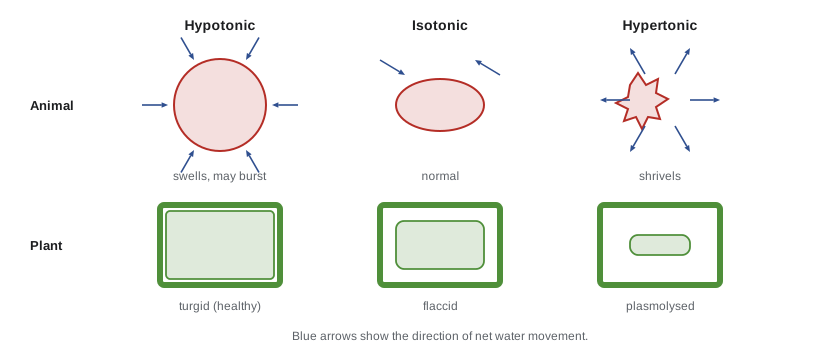
| Solution relative to cell | Net water movement | Animal cell (no wall) | Plant cell (with wall) |
|---|---|---|---|
| Hypotonic (fewer solutes outside) | Into the cell | Swells and may burst (lysis) | Swells against the wall and becomes turgid, the healthy state |
| Isotonic (equal solutes) | No net movement | Normal | Flaccid (limp); plants wilt |
| Hypertonic (more solutes outside) | Out of the cell | Shrivels (crenation) | Membrane pulls away from the wall (plasmolysis) |
Medical solutions given intravenously must be isotonic with blood. Normal saline, 0.9 per cent sodium chloride, is about 154 mM NaCl, which gives about 308 milliosmoles per litre because each NaCl dissolves into two particles, close to the roughly 290 mOsm/L of blood plasma. Giving pure water intravenously would burst red blood cells. Freshwater protists live in a permanently hypotonic world and pump water out with contractile vacuoles; saltwater fish drink seawater and excrete salt through their gills.
Water potential
Plant biologists describe water movement with water potential (Ψ, the Greek letter psi), measured in megapascals (MPa). Water always moves from higher (less negative) to lower (more negative) water potential. Pure water at atmospheric pressure has Ψ = 0. Water potential has two main components: solute potential (Ψs), which is always zero or negative because solutes reduce free water, and pressure potential (Ψp), which is positive when a cell pushes against its wall.
In the solute potential formula, \(i\) is the number of particles each solute molecule dissolves into (1 for sucrose, about 2 for NaCl), \(C\) the molar concentration, \(R\) the gas constant (0.00831 L·MPa per mol per kelvin) and \(T\) the temperature in kelvin.
Worked problem
Which way will water move?
A plant cell has a solute potential of −0.70 MPa and a pressure potential of +0.30 MPa. It is placed in a 0.20 M sucrose solution at 20 °C (293 K) in an open beaker. Will the cell gain or lose water?
Show solution
- Cell water potential: Ψ = Ψs + Ψp = −0.70 + 0.30 = −0.40 MPa.
- Solution solute potential: Ψs = −iCRT = −1 × 0.20 × 0.00831 × 293 = −0.49 MPa.
- The open beaker has no pressure, so Ψp = 0 and Ψ(solution) = −0.49 MPa.
- Water moves from higher to lower water potential: from the cell (−0.40) to the solution (−0.49).
Answer: The cell loses water until its pressure potential falls and the two water potentials become equal.
# Water potential: psi = psi_s + psi_p, psi_s = -i C R T
R = 0.00831     # L MPa / (mol K)
def solute_potential(i, molar, temp_c):
    return -i * molar * R * (temp_c + 273.15)

cell = -0.70 + 0.30
for name, i, c in [("pure water", 1, 0.0), ("0.10 M sucrose", 1, 0.10),
                   ("0.20 M sucrose", 1, 0.20), ("0.15 M NaCl", 2, 0.15)]:
    psi = solute_potential(i, c, 20)
    direction = "into cell" if psi > cell else ("out of cell" if psi < cell else "none")
print(f"{name:<15} psi = {psi:6.2f} MPa water moves {direction}")pure water psi = -0.00 MPa water moves into cell 0.10 M sucrose psi = -0.24 MPa water moves into cell 0.20 M sucrose psi = -0.49 MPa water moves out of cell 0.15 M NaCl psi = -0.73 MPa water moves out of cell
Passive transport with proteins: channels and carriers
Ions and polar molecules cross membranes with the help of transport proteins. When they move down their gradient, no energy is needed, and the process is called facilitated diffusion. There are two kinds of proteins involved.
Channel proteins form water-filled pores through the membrane. They are highly selective: a potassium channel lets potassium ions through about 10,000 times more readily than the slightly smaller sodium ions, because its narrow filter is shaped to fit a potassium ion stripped of its water. Channels are fast, passing up to tens of millions of ions per second. Many are gated, opening only in response to a voltage change, a binding molecule or mechanical stretch. Gated sodium and potassium channels produce nerve impulses, a subject for neurobiology (BIOL-420).
Carrier proteins bind a specific molecule on one side, change shape, and release it on the other. They are slower than channels, typically hundreds to thousands of molecules per second, and they saturate: once all carriers are busy, adding more substrate does not speed transport, just as an enzyme reaches a maximum rate (lesson 8). The GLUT family of glucose transporters are carriers; GLUT4 in muscle and fat cells is moved to the cell surface when insulin signals, which is how insulin lowers blood sugar.
Active transport: pumping uphill
To move a substance against its gradient, from low to high concentration, a cell must spend energy. In primary active transport, the energy comes directly from ATP. The most important example is the sodium–potassium pump (Na+/K+-ATPase), discovered by Jens Christian Skou, who shared the 1997 Nobel Prize in Chemistry. In each cycle it uses one ATP to pump three sodium ions out of the cell and two potassium ions in.
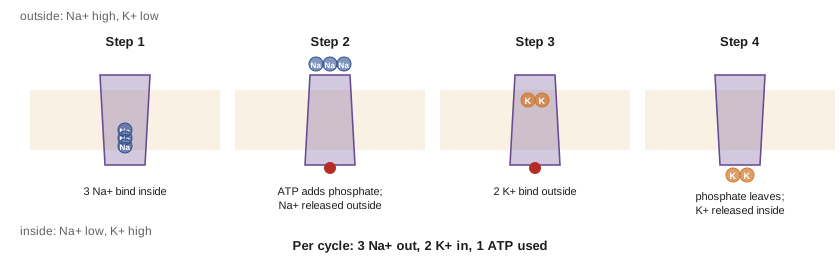
The pump keeps sodium about ten times more concentrated outside the cell than inside, and potassium about thirty times more concentrated inside. Because it moves more positive charge out than in, it also helps make the inside of the cell negative, typically about −70 millivolts. In neurons the pump can use a large share of the cell's ATP, and the brain as a whole uses about 20 per cent of the body's resting energy, much of it to restore ion gradients.
# Energy budget of the sodium-potassium pump (illustrative numbers)
pumps_per_cell = 1_000_000       # a typical order of magnitude
cycles_per_second = 100          # each pump at moderate activity
atp_per_second = pumps_per_cell * cycles_per_second
print(f"ATP used per second by pumps: {atp_per_second:.1e}")
print(f"Na+ exported per second:      {3 * atp_per_second:.1e}")
print(f"K+ imported per second:       {2 * atp_per_second:.1e}")
print("Net positive charges moved out per cycle:", 3 - 2)ATP used per second by pumps: 1.0e+08 Na+ exported per second: 3.0e+08 K+ imported per second: 2.0e+08 Net positive charges moved out per cycle: 1
The gradients the pump builds are themselves a store of energy, which cells spend in secondary active transport. Here a transporter couples the downhill movement of one substance, usually sodium flowing back into the cell, to the uphill movement of another. In symport (cotransport), both move the same way: the sodium–glucose cotransporter (SGLT1) in the intestine uses sodium flowing in to drag glucose into cells even when glucose is more concentrated inside. In antiport (exchange), they move in opposite directions: the sodium–calcium exchanger in heart cells uses sodium entry to push calcium out.
That coupling has saved millions of lives. Oral rehydration solution, a simple mixture of salts and glucose in water, treats the severe dehydration caused by cholera and other diseases that cause severe diarrhea. It works because the sodium–glucose cotransporter keeps working during cholera, so glucose and sodium are absorbed together and water follows by osmosis. It has been estimated to have saved tens of millions of lives since the 1970s.
| Mechanism | Direction relative to gradient | Energy source | Protein needed? | Example |
|---|---|---|---|---|
| Simple diffusion | Down | None (the gradient) | No | Oxygen, carbon dioxide, steroid hormones |
| Osmosis | Water moves toward higher solute concentration | None | Aquaporins speed it | Water entering a root cell |
| Facilitated diffusion (channel) | Down | None | Yes, channel | Potassium leaving through potassium channels |
| Facilitated diffusion (carrier) | Down | None | Yes, carrier | Glucose entering cells by GLUT transporters |
| Primary active transport | Up | ATP directly | Yes, pump | Sodium–potassium pump; proton pumps in lysosomes |
| Secondary active transport | Up (for one substance) | Another ion’s gradient | Yes, cotransporter | Sodium–glucose cotransporter in the intestine |
| Endocytosis and exocytosis | Bulk movement | ATP | Yes, vesicle machinery | Hormone secretion; uptake of cholesterol |
Bulk transport: vesicles in and out
Large molecules such as proteins and polysaccharides, and even whole bacteria, are too big for transporters. Cells move them in membrane-bound vesicles. In exocytosis, a vesicle from the Golgi fuses with the plasma membrane and releases its contents outside; neurons release neurotransmitters this way, and the pancreas releases insulin. In endocytosis, the plasma membrane folds inward and pinches off a vesicle containing material from outside.
There are three forms of endocytosis. In phagocytosis (cell eating), cells such as macrophages and amoebas extend their membrane around a large particle, such as a bacterium, and engulf it; the vesicle then fuses with a lysosome. In pinocytosis (cell drinking), cells take in droplets of extracellular fluid with whatever is dissolved in it. In receptor-mediated endocytosis, specific receptors on the cell surface bind particular molecules, cluster into pits coated with the protein clathrin, and pull in their cargo efficiently. Cells take up cholesterol this way, carried in blood as low-density lipoprotein (LDL). People with familial hypercholesterolemia have faulty LDL receptors, so cholesterol stays in their blood and they develop heart disease early, a discovery that won Michael Brown and Joseph Goldstein the 1985 Nobel Prize in Physiology or Medicine.
Common mistakes
MistakeOsmosis is the movement of solutes across a membrane.
InsteadOsmosis is the net movement of water across a selectively permeable membrane, toward the side with higher solute concentration.
MistakeDiffusion stops when molecules stop moving.
InsteadAt equilibrium, molecules keep moving randomly; only the net movement stops because movement in each direction is equal.
MistakeFacilitated diffusion uses ATP because it needs a protein.
InsteadFacilitated diffusion is passive: proteins provide a path, but molecules still move down their gradient without energy input.
MistakeThe sodium–potassium pump moves equal numbers of ions each way.
InsteadIt moves three sodium ions out and two potassium ions in per ATP, so it also creates a charge difference.
MistakeA plant cell in an isotonic solution is in its ideal state.
InsteadPlant cells are healthiest when turgid in a slightly hypotonic environment; in isotonic solution they become flaccid.
Summary and key terms
- Diffusion is net movement down a concentration gradient by random motion; its time grows with distance squared (t ≈ x²/2D), so it works only over short distances.
- Osmosis is the net movement of water across a selectively permeable membrane, largely through aquaporins, toward higher solute concentration.
- In hypotonic solutions animal cells swell or burst and plant cells become turgid; in hypertonic solutions animal cells shrivel and plant cells plasmolyse.
- Water moves from higher to lower water potential; Ψ = Ψs + Ψp and Ψs = −iCRT.
- Channels and carriers allow facilitated diffusion of ions and polar molecules down their gradients without energy input.
- Active transport moves substances against gradients using ATP directly (sodium–potassium pump) or another ion’s gradient (cotransport).
- Large materials enter and leave by endocytosis (phagocytosis, pinocytosis, receptor-mediated) and exocytosis.
- diffusion
- Net movement of particles from higher to lower concentration through random motion.
- osmosis
- Net movement of water across a selectively permeable membrane toward higher solute concentration.
- aquaporin
- A channel protein that lets water cross membranes rapidly.
- hypertonic
- Having a higher concentration of non-penetrating solutes than the cell, so water leaves the cell.
- water potential
- A measure of the tendency of water to move, in megapascals; water moves from higher to lower water potential.
- facilitated diffusion
- Passive transport of a substance down its gradient through a channel or carrier protein.
- active transport
- Movement of a substance against its concentration gradient using energy.
- sodium–potassium pump
- An ATP-driven pump that moves three Na+ out and two K+ into the cell per cycle.
- cotransport
- Secondary active transport coupling the downhill flow of one ion to the uphill movement of another substance.
- receptor-mediated endocytosis
- Uptake of specific molecules bound to surface receptors in clathrin-coated vesicles.
Practice problems
Work each problem on paper first, then reveal the answer to check.
Using t ≈ x²/2D with D = 10^−9 m²/s, how long does it take a molecule to diffuse 20 µm?
Show answer
t = (2 × 10^−5)² / (2 × 10^−9) = 0.2 s.
Why do large multicellular organisms need circulatory systems?
Show answer
Diffusion is far too slow over distances of millimetres or more, so bulk flow is needed to deliver oxygen and nutrients.
A red blood cell is placed in distilled water. What happens and why?
Show answer
Water enters by osmosis because the solution is hypotonic; the cell swells and bursts (lysis).
Why do plants wilt when soil water becomes salty?
Show answer
The soil becomes hypertonic, so water leaves root cells (or stops entering), and cells lose turgor.
Calculate the solute potential of 0.30 M sucrose at 25 °C.
Show answer
Ψs = −1 × 0.30 × 0.00831 × 298 ≈ −0.74 MPa.
A cell with Ψ = −0.6 MPa is placed in a solution with Ψ = −0.3 MPa. Which way does water move?
Show answer
Into the cell, from higher (−0.3) to lower (−0.6) water potential.
Contrast channel proteins and carrier proteins.
Show answer
Channels form pores and pass ions very fast; carriers bind, change shape and release, are slower, and saturate.
What does the sodium–potassium pump move in one cycle, and what powers it?
Show answer
Three Na+ out and two K+ in, powered by hydrolysis of one ATP.
Explain how oral rehydration solution works.
Show answer
The sodium–glucose cotransporter absorbs sodium and glucose together in the intestine, and water follows by osmosis.
Why do people with faulty LDL receptors have high blood cholesterol?
Show answer
Their cells cannot take up LDL particles by receptor-mediated endocytosis, so cholesterol remains in the blood.
Lesson quiz · 5 questions
Score 60% or more to complete this lesson.
Create a free account to save your progress, take quizzes and earn a certificate.