
BIOL-107 · Lesson 10 of 12 · 27 min
Photosynthesis
Almost all the energy that flows through living things begins as sunlight captured by photosynthesis. Plants, algae and cyanobacteria use light energy to turn carbon dioxide and water into sugar, releasing oxygen as a by-product. That sugar feeds the photosynthesizers themselves and, directly or indirectly, nearly every other organism, including you. The oxygen in every breath you take, and the fossil fuels that power much of the economy, are products of photosynthesis. This lesson explains how chloroplasts capture light, how they use it to make ATP and NADPH, how the Calvin cycle builds sugar, and how some plants adapt to heat and drought.
The overall reaction
Photosynthesis is, in broad terms, respiration run backwards, driven by light:
Where does the oxygen come from: the carbon dioxide or the water? Experiments in the 1940s using water labelled with the heavy isotope oxygen-18 settled it: the labelled oxygen appeared in the oxygen gas released, so the O2 comes from splitting water. The carbon dioxide's oxygen ends up in the sugar and in new water molecules. Photosynthesis is a redox process: water is oxidized (it loses electrons) and carbon dioxide is reduced (it gains electrons, with hydrogen) to sugar. Because reducing CO2 requires a lot of energy, the reaction is strongly endergonic, the reverse of respiration's ΔG of about −2,870 kJ per mole of glucose. Light supplies that energy.
The chloroplast
In plants, photosynthesis takes place in chloroplasts, concentrated in the mesophyll cells inside leaves; a single leaf cell may contain 30 to 40 of them. Carbon dioxide enters the leaf through pores called stomata, and water arrives from the roots through the xylem. Each chloroplast has a double envelope membrane surrounding a fluid called the stroma. Suspended in the stroma is a third membrane system, the thylakoids: flattened sacs often stacked into grana. The thylakoid membranes hold the light-capturing pigments and the electron transport chain; the stroma holds the enzymes of the Calvin cycle.
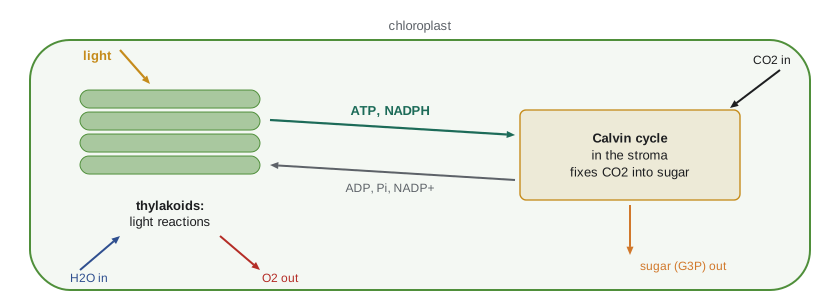
Photosynthesis has two linked stages. The light-dependent reactions (light reactions) in the thylakoid membranes capture light energy, split water, release oxygen and produce ATP and NADPH. The Calvin cycle in the stroma uses that ATP and NADPH to fix carbon dioxide into sugar. The two stages are coupled: the Calvin cycle returns ADP, phosphate and NADP+ for the light reactions to recharge.
Light and pigments
Light travels as particles of energy called photons, and the energy of each photon depends on its wavelength: shorter wavelengths carry more energy. Visible light runs from violet (about 400 nm) to red (about 700 nm). The energy of a photon is \(E = hc/\lambda\), where \(h\) is Planck's constant and \(c\) the speed of light.
# Energy of photons of different colours: E = h c / wavelength
h, c, NA = 6.626e-34, 2.998e8, 6.022e23
for band, nm in [("blue", 450), ("green", 550), ("red", 680), ("far red", 700)]:
    E = h * c / (nm * 1e-9)                     # joules per photon
print(f"{band:<8} {nm} nm: {E:.2e} J per photon, {E * NA / 1000:5.0f} kJ per mole of photons")blue 450 nm: 4.41e-19 J per photon, 266 kJ per mole of photons green 550 nm: 3.61e-19 J per photon, 218 kJ per mole of photons red 680 nm: 2.92e-19 J per photon, 176 kJ per mole of photons far red 700 nm: 2.84e-19 J per photon, 171 kJ per mole of photons
Pigments are molecules that absorb particular wavelengths. The main photosynthetic pigment is chlorophyll a, with a ring structure containing a magnesium atom at its centre. Chlorophyll b and carotenoids (yellow and orange pigments) are accessory pigments that absorb other wavelengths and pass the energy on, broadening the range of light a plant can use; carotenoids also protect against damage from excess light. Chlorophylls absorb blue and red light strongly and reflect green, which is why leaves look green. In autumn, as chlorophyll breaks down, the yellow and orange carotenoids that were there all along become visible, and some trees make new red pigments called anthocyanins.
An absorption spectrum shows which wavelengths a pigment absorbs; an action spectrum shows which wavelengths drive photosynthesis. In 1883 Theodor Engelmann produced an early action spectrum with a beautiful experiment: he shone a spectrum of light across a strand of alga and added bacteria that gather where oxygen is plentiful. The bacteria clustered in the blue and red regions, exactly where chlorophyll absorbs.
The light reactions
Chlorophyll and accessory pigments are organized with proteins into large complexes called photosystems in the thylakoid membrane. Each photosystem has an antenna of hundreds of pigment molecules that collect light energy and funnel it to a reaction centre containing a special pair of chlorophyll a molecules. When the special pair receives the energy, one of its electrons is boosted to a high energy level and passed to an electron acceptor. That transfer converts light energy into chemical energy.
Plants have two photosystems, named in the order they were discovered: photosystem II (whose reaction centre absorbs best at 680 nm, P680) and photosystem I (P700). They work in series in what is called linear electron flow:
| Step | What happens |
|---|---|
| 1. Photosystem II absorbs light | An excited electron leaves P680 and passes to the electron transport chain |
| 2. Water is split | An enzyme splits water to replace P680’s lost electrons: 2 H2O → 4 H+ + 4 electrons + O2. Oxygen is released |
| 3. Electron transport and proton pumping | Electrons pass along a chain (plastoquinone, the cytochrome b6f complex, plastocyanin); the energy pumps protons into the thylakoid space |
| 4. Photosystem I absorbs light | Electrons arriving at P700 are boosted again to a higher energy level |
| 5. NADP+ is reduced | The electrons pass through ferredoxin to NADP+ reductase, which makes NADPH |
| 6. ATP is made by chemiosmosis | Protons flow from the thylakoid space back to the stroma through ATP synthase, making ATP |
This closely resembles the mitochondrion (lesson 9). Both use an electron transport chain to pump protons across a membrane and an ATP synthase to make ATP as protons flow back. The differences are the source and destination of the electrons: in respiration, electrons flow from food to oxygen, releasing energy; in photosynthesis, light energy pushes electrons from water uphill to NADP+. The proton gradient in chloroplasts is huge: the thylakoid space reaches about pH 5 while the stroma is near pH 8, a thousandfold difference in hydrogen ion concentration.
The Calvin cycle
The ATP and NADPH from the light reactions power the Calvin cycle, worked out by Melvin Calvin, Andrew Benson and James Bassham in the 1950s by feeding algae radioactive carbon-14 dioxide and tracking where the label went (Calvin received the 1961 Nobel Prize in Chemistry). The cycle has three phases:
| Phase | What happens (per 3 CO2) | Energy used |
|---|---|---|
| Carbon fixation | The enzyme rubisco attaches each CO2 to a five-carbon sugar, RuBP; the unstable products split into 6 three-carbon molecules (3-phosphoglycerate) | None |
| Reduction | The 6 three-carbon molecules are phosphorylated and reduced to 6 G3P (glyceraldehyde 3-phosphate) | 6 ATP and 6 NADPH |
| Regeneration | One G3P leaves as product; the other 5 are rearranged to regenerate 3 RuBP | 3 ATP |
For every three turns, fixing three CO2, the cycle produces one G3P as net output and uses 9 ATP and 6 NADPH. Two G3P are needed to make one glucose, so building one glucose takes 6 turns, 18 ATP and 12 NADPH. G3P is used to make glucose, sucrose (the sugar plants transport), starch (for storage), cellulose (for walls), and the carbon skeletons of amino acids and fats.
# Calvin cycle bookkeeping
def calvin(co2_fixed):
    turns = co2_fixed                 # one CO2 per turn
    return {"G3P made (net)": co2_fixed // 3,
            "ATP used": 3 * turns,
            "NADPH used": 2 * turns}

for n in [3, 6, 12]:
    print(f"{n:>2} CO2 fixed:", calvin(n))

# Light reactions: about 8 photons per O2 released (4 electrons, each excited twice)
glucose = 1
o2 = 6 * glucose
print("Photons needed per glucose (at least):", 8 * o2) 3 CO2 fixed: {'G3P made (net)': 1, 'ATP used': 9, 'NADPH used': 6}
6 CO2 fixed: {'G3P made (net)': 2, 'ATP used': 18, 'NADPH used': 12}
12 CO2 fixed: {'G3P made (net)': 4, 'ATP used': 36, 'NADPH used': 24}
Photons needed per glucose (at least): 48Rubisco (ribulose-1,5-bisphosphate carboxylase/oxygenase) is probably the most abundant protein on Earth, making up as much as half of the soluble protein in leaves. It needs to be abundant because it is remarkably slow, fixing only a few CO2 molecules per second, and because it makes mistakes: it sometimes grabs O2 instead of CO2. That side reaction, called photorespiration, wastes energy and releases previously fixed carbon. It becomes worse in hot, dry conditions, when plants close their stomata to save water and oxygen builds up inside the leaf relative to carbon dioxide.
Worked problem
How much light energy ends up in sugar?
Making one glucose stores about 2,870 kJ/mol and needs at least 48 photons. Using red photons at 680 nm (about 176 kJ per mole of photons), what is the maximum efficiency of converting absorbed light into sugar?
Show solution
- Energy absorbed = 48 mol photons × 176 kJ/mol = 8,448 kJ per mole of glucose.
- Efficiency = 2,870 / 8,448 ≈ 0.34.
- Real leaves need more than 8 photons per O2, lose energy to photorespiration and respiration, and reflect or fail to absorb much sunlight; only about half of sunlight is in the usable wavelength range.
Answer: At most about one third of absorbed red light is stored in sugar. In the field, crops typically convert only about 1 to 2 per cent of the solar energy falling on them over a season into stored biomass, and the best C4 crops reach a little more.
C4 and CAM plants: adapting to heat and drought
Some plants have evolved ways to reduce photorespiration. C4 plants, such as corn (maize), sugar cane and many tropical grasses, first fix CO2 in outer mesophyll cells using a different enzyme, PEP carboxylase, which does not react with oxygen. The four-carbon product is pumped into inner bundle-sheath cells, where CO2 is released at high concentration around rubisco. The pump costs extra ATP but pays off in hot, bright conditions. CAM plants, such as cacti, pineapples and jade plants, separate the steps in time instead of space: they open their stomata only at night, fixing CO2 into organic acids, and close them during the day, releasing the CO2 for the Calvin cycle while saving water.
| Feature | C3 plants | C4 plants | CAM plants |
|---|---|---|---|
| Examples | Wheat, rice, canola, soybeans, most trees | Corn, sugar cane, sorghum, switchgrass | Cacti, pineapple, agave, jade plant |
| First CO2-fixing enzyme | Rubisco | PEP carboxylase (then rubisco) | PEP carboxylase at night (then rubisco by day) |
| Separation of steps | None | In space (mesophyll and bundle-sheath cells) | In time (night and day) |
| Photorespiration | Significant in heat | Very low | Very low |
| Best suited to | Cool, moist climates | Hot, sunny climates | Hot, dry climates |
Most crops in Canada, including wheat, barley, canola and soybeans, as well as the boreal forest's spruce, pine and fir, are C3 plants suited to cool growing seasons. Corn, a C4 plant, is grown mainly in southern Ontario, Quebec and Manitoba, where summers are warm enough. Researchers worldwide are trying to engineer C4 features or faster rubisco into C3 crops such as rice to raise yields.
Photosynthesis and the planet
Photosynthesis transformed Earth. Cyanobacteria began releasing oxygen more than 2.5 billion years ago, and by about 2.4 billion years ago oxygen started to accumulate in the atmosphere (the Great Oxidation Event), eventually making aerobic respiration, and complex life, possible. Today, photosynthesis by land plants and ocean phytoplankton together fixes on the order of 100 billion tonnes of carbon each year, roughly half on land and half in the oceans. The balance between photosynthesis, which removes CO2 from the air, and respiration and combustion, which return it, governs atmospheric carbon dioxide and therefore climate. Burning fossil fuels, the stored products of ancient photosynthesis, releases carbon far faster than photosynthesis currently removes it.
Common mistakes
MistakeThe oxygen released in photosynthesis comes from carbon dioxide.
InsteadIsotope labelling shows the oxygen gas comes from splitting water in photosystem II.
MistakeThe Calvin cycle is the dark reaction and happens only at night.
InsteadThe Calvin cycle does not use light directly but depends on ATP and NADPH from the light reactions, and several of its enzymes are activated by light; it runs mainly in daytime.
MistakePlants get their mass from the soil.
InsteadMost of a plant’s dry mass comes from carbon dioxide fixed from the air; soil supplies water and minerals.
MistakeLeaves are green because they absorb green light.
InsteadChlorophyll reflects (and transmits) green light most and absorbs red and blue.
MistakePhotosynthesis replaces respiration in plants.
InsteadPlants photosynthesize in the light but respire all the time, using the sugars they make.
Summary and key terms
- Photosynthesis converts CO2 and water into sugar using light, releasing O2; water is oxidized and CO2 is reduced.
- Chloroplasts contain thylakoid membranes (light reactions) surrounded by stroma (Calvin cycle).
- Chlorophylls absorb blue and red light; accessory pigments widen the range of usable light; photon energy E = hc/λ.
- In the light reactions, photosystems II and I boost electrons from water to NADP+, releasing O2 and building a proton gradient that drives ATP synthase.
- The Calvin cycle fixes CO2 with rubisco and uses 9 ATP and 6 NADPH per G3P (18 ATP and 12 NADPH per glucose).
- Rubisco also reacts with O2 (photorespiration); C4 and CAM plants concentrate CO2 to reduce it in hot or dry climates.
- Photosynthesis oxygenated the early Earth and today fixes about 100 billion tonnes of carbon a year, balancing respiration and combustion.
- photosynthesis
- The process by which light energy is used to convert CO2 and water into sugar, releasing oxygen.
- chloroplast
- The organelle of photosynthesis in plants and algae.
- thylakoid
- A flattened membrane sac in the chloroplast where the light reactions occur.
- stroma
- The fluid inside the chloroplast where the Calvin cycle occurs.
- chlorophyll
- The green pigment that absorbs light for photosynthesis.
- photosystem
- A complex of pigments and proteins that captures light and transfers excited electrons.
- NADPH
- An electron carrier made in the light reactions and used to reduce CO2 in the Calvin cycle.
- Calvin cycle
- The cycle in the stroma that fixes CO2 into sugar using ATP and NADPH.
- rubisco
- The enzyme that fixes CO2 to RuBP in the Calvin cycle; it also reacts with O2.
- photorespiration
- A wasteful process in which rubisco fixes O2 instead of CO2, releasing fixed carbon.
Practice problems
Work each problem on paper first, then reveal the answer to check.
Write the overall equation for photosynthesis.
Show answer
6 CO2 + 6 H2O + light → C6H12O6 + 6 O2.
How did isotope experiments show that oxygen comes from water?
Show answer
When water was labelled with oxygen-18, the label appeared in the oxygen gas released, not when CO2 was labelled.
Name the two stages of photosynthesis and where each occurs.
Show answer
The light reactions in the thylakoid membranes and the Calvin cycle in the stroma.
What are the products of the light reactions that are used in the Calvin cycle?
Show answer
ATP and NADPH.
Calculate the energy of one mole of photons at 450 nm.
Show answer
E = hc/λ × NA ≈ 266 kJ per mole of photons.
Why do leaves change colour in autumn?
Show answer
Chlorophyll breaks down, revealing yellow and orange carotenoids; some trees also make red anthocyanins.
How many ATP and NADPH are needed to fix 6 CO2 into one glucose?
Show answer
18 ATP and 12 NADPH.
Compare chemiosmosis in chloroplasts and mitochondria.
Show answer
Both use an electron transport chain to pump protons and ATP synthase to make ATP; in chloroplasts light drives electrons from water to NADP+, in mitochondria food electrons flow to oxygen.
What is photorespiration and why is it worse in hot, dry weather?
Show answer
Rubisco fixes O2 instead of CO2, wasting energy and carbon; stomata close to save water, so O2 rises relative to CO2 inside the leaf.
How do CAM plants save water?
Show answer
They open stomata only at night to fix CO2 into organic acids and keep them closed during the hot day while running the Calvin cycle.
Lesson quiz · 5 questions
Score 60% or more to complete this lesson.
Create a free account to save your progress, take quizzes and earn a certificate.