
BAS-340 · Lesson 11 of 12 · 23 min
Testing interfaces safely
▶ Video coming soon A video version of this lesson is on the way.
The thickest folder in the 17 Marlow Lane job file was not the front end or the programs. It was the interface test, held on the morning of Wednesday, October 28, the day before the burn-in week began. Ivo Bartek had replaced the building's controls over the summer and early fall, and the new AHU-1 controller, its wiring and its program all sat next to the fire alarm system's shutdown and monitoring contacts. Before the building could rely on them, the interfaces had to be tested with the fire alarm contractor, in a planned way, with everyone who could be affected told in advance. Prakash gave Callie the folder and said that the most dangerous thing in it was what wasn't in it: no step anywhere in which a controls technician operated a fire alarm device.
Why interface tests need care
Testing an interface means making one system do something and watching what the other systems do. When one of those systems is the fire alarm system, the something can be dramatic.
- The monitoring station may dispatch the fire department.
- Occupants may hear the alarm and evacuate, or worse, learn to ignore it.
- Air handlers stop, which in an occupied building in winter can freeze coils if the low-temperature protection is not working.
- Door locks and hold-open devices release, leaving the building open to anyone.
- Elevators recall and stop serving the floors.
- Smoke control fans start, and pressures change across doors.
- BAS programs see equipment stop and may raise floods of alarms, or restart everything at once on reset.
Each of these is the system working correctly, which is the point of the test. The test plan exists so that each of them happens on purpose, at a known time, with the right people watching, and is put back afterward.
Integrated testing
Ontario's building code has required integrated testing of fire protection and life safety systems in new buildings since 2020, following CAN/ULC-S1001, Integrated Systems Testing of Fire Protection and Life Safety Systems. The standard calls for an Integrated Testing Coordinator, an integrated testing plan reviewed by the design professionals, testing that proves each interconnection works as intended (fire alarm to air handlers, dampers, door hardware, elevators, generators, smoke control fans and the rest), and an integrated testing report. When existing systems are modified, the affected functions are verified again, and owners and their consultants often use S1001's structure for that work too.
Marlow Lane is a three-storey office, and the job was a controls replacement, not a new building. Halvern's consulting engineer still asked for an integrated test of every function the new controls touched, and named Philippa Quaid from the engineer's office as the coordinator. Signalpoint Fire Systems, which maintains Marlow Lane's fire alarm system as well as Ninefield's, sent Dorian Strathy.
The cause-and-effect matrix
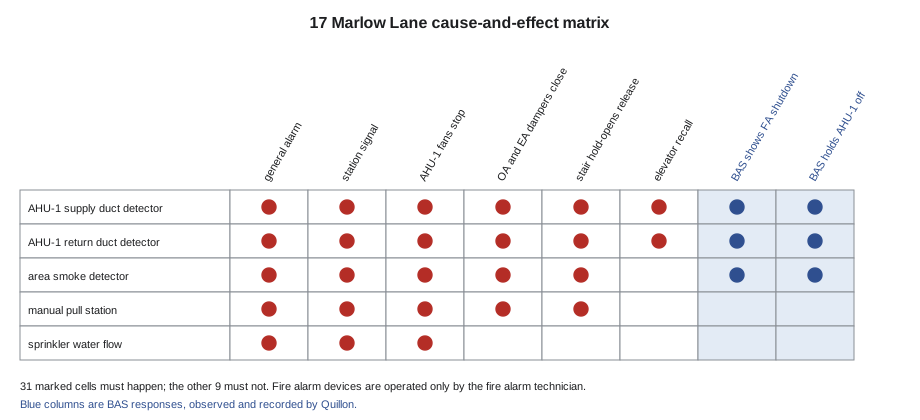
The core of an integrated test plan is a cause-and-effect matrix: initiating events down the side, responses across the top, and a mark wherever an event should produce a response. The fire alarm contractor's programming and the design documents define it; the test proves it.
Worked problem
Counting the test points
The Marlow Lane matrix has 5 initiating event rows and 9 response columns. 31 cells are marked. Each marked cell is one observation to record; each row is tested once by operating one device of that type. Unmarked cells must also be checked: the response must not happen. How many observations are recorded in all?
Show solution
- Total cells = 5 × 9 = 45.
- Marked cells (response must happen) = 31.
- Unmarked cells (response must not happen) = 45 − 31 = 14.
- Every cell is an observation: 31 + 14 = 45.
Answer: 45 observations from 5 device operations. Checking the unmarked cells matters as much as the marked ones: a duct detector that also released the stair doors, when the design says it should not, is a fault too.
Before the test
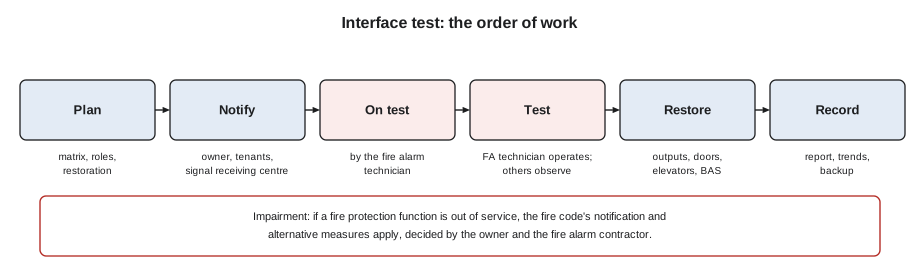
Philippa's plan, which Ivo had annotated, followed the same steps that every interface test should.
- Write the plan: the matrix, the order of steps, who operates each device (always the fire alarm technician for fire alarm devices), who observes each response, what pass means, and how each system is restored.
- Agree the date and time window with the owner, the fire alarm contractor and every trade involved.
- Notify: the building owner and manager, the occupants and tenants, the signal receiving centre that monitors the fire alarm system, security, the elevator contractor, and the fire department where the fire safety plan or the local fire department requires it.
- Arrange for the doors that will release: someone at each entrance while the locks are released, or the test done outside occupied hours.
- Protect the equipment: check that the air handlers' low-temperature protection works before stopping them in cold weather, and that no process or tenant load will be harmed.
- Prepare the BAS: trends on every affected point at a short interval, screenshots ready, and an operator at the front end.
Worked problem
Planning the monitoring station's test window
The Marlow Lane plan had 5 device operations, each followed by observing and resetting, estimated at 12 minutes each, plus 30 minutes of setup and 20 minutes of restoration and checks. Philippa adds 50 in 100 for the unexpected. How long a test window should the fire alarm technician request from the monitoring station?
Show solution
- Steps = 5 × 12 = 60 min.
- Subtotal = 30 + 60 + 20 = 110 min.
- With margin = 110 × 1.5 = 165 min, about 2 hours 45 minutes.
Answer: About two hours and forty-five minutes; Dorian asked for 8:00 to 11:00. When a test runs past its window, signals start reaching the monitoring station as real alarms, so the technician watches the clock and extends the window by phone before it closes, never after.
Putting systems on test, and impairments
Placing a fire alarm system on test is the fire alarm technician's job. They call the monitoring station, identify the account, state the time window, and confirm what signals the station will ignore. If the test requires any fire alarm output to be disabled, for example to test a detector without stopping an air handler that must keep running, the technician disables it using the panel's own controls under their procedures, records it, and restores it.
Any time a fire protection system, or part of one, is out of service, the building has an impairment, and the fire code sets out what must happen: the owner or their delegate is told, the fire department and the monitoring station are notified when the code requires it, and alternative measures such as a fire watch are put in place when a system will be out of service for longer than a short period. In Ontario the building's fire safety plan includes the procedures to follow when fire protection systems are shut down. Either way, the decisions belong to the owner and the fire alarm contractor, not to the controls technician.
What the controls technician must never do is short-cut any of it. Prakash listed the things he had seen others do over the years, each of which can leave a building unprotected without anyone knowing: jumpering a fire alarm shutdown contact in a starter to keep a fan running during BAS work; lifting a fire alarm wire off a terminal in a BAS panel to stop nuisance shutdowns; covering a duct detector during a filter change instead of asking for it to be bypassed by the fire alarm technician; and operating a duct detector's test switch to see what the BAS would do. All four are fire alarm work, and the first two can defeat the fire alarm function entirely.
The test on October 28
The Marlow Lane test began at 8:10 with the building empty except for the test team. Dorian put the system on test with the monitoring station and confirmed the window. He then operated each device in the plan's order, starting with AHU-1's supply duct detector, while Philippa called out the expected responses from the matrix and each observer confirmed or failed them. Ivo watched the BAS front end and the AHU-1 graphic, and the trend logs recorded fan status, damper positions, FA status and the program's mode at 5-second intervals.
Two findings came out of it. The first was in Quillon's program. The design's sequence said that after a fire alarm shutdown, AHU-1 should stay off until an operator restarted it from the front end, so that someone would look at the unit before air moved again. Ivo's program, copied from a template, restarted the unit automatically 60 s after FA status cleared. The matrix column BAS holds AHU-1 off until operator restart failed on the first row. Ivo corrected the program during the test (a latch that only an operator command at priority 8 clears), and the row was retested at the end and passed.
The second was a procedure finding. The test ran long because of the retest, and at 10:45 Philippa noticed the time. Dorian phoned the monitoring station and extended the window to 11:30 before it closed. Without that call, the retest's alarm would have reached the station as a real alarm. The finding went into Signalpoint's own notes for the next test, and Philippa's report recommended that the window be set at three hours rather than two and three quarters.
17 Marlow Lane - integrated test, Wed Oct 28 2026 (extract from the report)
Row 1  AHU-1 supply duct detector (operated by FA technician)
  General alarm ................................. PASS
  Monitoring station signal (on test) ........... PASS
  AHU-1 supply and return fans stop ............. PASS  (hardwired, 3 s)
  OA and EA dampers close ....................... PASS  (spring return, 21 s)
  Stair door hold-opens release ................. PASS
  Elevator recall ............................... PASS  (elevator contractor present)
  BAS shows fire alarm shutdown ................. PASS
  BAS holds AHU-1 off until operator restart .... FAIL -> program corrected -> RETEST PASS
Restoration: FA reset 10:20; BAS restart by operator 10:24; window extended 10:45
Signatures: coordinator, fire alarm contractor, controls contractor, owner
After the test
A test is not finished when the last device is reset. Restoration is a step in its own right: every system back to normal, every disabled output re-enabled and checked, the monitoring station told that the test is over and a test signal confirmed, the doors locked again, the elevators back in service, and the BAS back in automatic with no operator holds left behind. Then the records: the signed report, the deficiency list with who will fix each item, and the BAS trends and screenshots filed with the job.
For the controls contractor, three records matter most. The BAS trends show exactly when each fan stopped and when each program reacted, which settles any argument about timing. The program change log shows what was changed during the test and why, as BAS-210 recommended. And the backup taken after the test is the one that goes into the job folder, so that the program the building relies on is the one that passed.
Testing interfaces that are not life safety
Interfaces with lighting, access control, meters and drives need testing too, with less ceremony but the same method: a list of what should happen, a way to make it happen, someone watching each side, and a record. At Marlow Lane, Ivo had tested the meter and drive points by comparing each value with the device's own display, and the after-hours request page by making requests and watching the AHU start. On the Ninefield fourth floor, the lighting occupancy mapping will be tested zone by zone: someone walks into each zone and the lighting contractor and Quillon both confirm that the right lighting zone and the right VAV box respond.
One rule carries over from the fire alarm work. Test with the owner of the other system, not on it. A controls technician who wants to see an access control after-hours event does not borrow a card and walk through a door; the security contractor generates the event with a numbered test card, and both sides record it.
Common mistakes
MistakeOperating a fire alarm device to see what the BAS does.
InsteadOnly the fire alarm technician operates fire alarm devices, in a planned test.
MistakeJumpering a fire alarm shutdown contact to keep a fan running during BAS work.
InsteadAsk the fire alarm contractor; never defeat a fire alarm function.
MistakeLetting a test run past the monitoring station's window.
InsteadWatch the clock and extend the window before it closes.
MistakeChecking only the responses that should happen.
InsteadCheck the unmarked cells too: responses that must not happen.
MistakeLeaving an operator hold or a disabled output after a test.
InsteadMake restoration a step with its own checks and signatures.
Summary and key terms
- Interface tests make life-safety systems act on purpose, so each step is planned, notified, observed and restored.
- Ontario requires integrated testing to CAN/ULC-S1001 for new buildings, with a coordinator, plan and report; modified systems are verified again.
- A cause-and-effect matrix lists initiating events, expected responses and responses that must not happen.
- The fire alarm technician puts the system on test, operates devices and handles impairments; the controls technician observes and records.
- Impairments trigger the fire code's notification and alternative measures, decided by the owner and fire alarm contractor.
- Restoration, signed reports, BAS trends, change logs and a post-test backup complete the test.
- Non-life-safety interfaces are tested the same way, with the owner of the other system.
- Integrated testing
- Testing that proves interconnected fire protection and life safety systems work together as intended.
- Integrated Testing Coordinator
- The person who plans, leads and reports integrated testing under CAN/ULC-S1001.
- Cause-and-effect matrix
- A table of initiating events and the responses each should, and should not, produce.
- On test
- The state in which a monitoring station knows a fire alarm system is being tested and does not dispatch.
- Impairment
- A condition in which a fire protection system or part of it is out of service.
- Fire watch
- People assigned to patrol a building for fire while a fire protection system is impaired.
- Restoration
- Returning every system to normal after a test, with checks and records.
Practice problems
Work each problem on paper first, then reveal the answer to check.
A matrix has 6 rows and 8 columns with 20 marked cells. How many must-not-happen observations are there?
Show answer
48 − 20 = 28.
7 steps at 10 min, 30 min setup and 20 min restoration, plus 50 in 100. What window is needed?
Show answer
120 × 1.5 = 180 min.
Who places the fire alarm system on test with the monitoring station?
Show answer
The fire alarm technician.
Name two items to check during restoration.
Show answer
Disabled outputs re-enabled; doors locked; elevators in service; BAS back in automatic; station told.
How should an access after-hours event be generated for a test?
Show answer
By the security contractor with a numbered test card.
Lesson quiz · 5 questions
Score 60% or more to complete this lesson.
Create a free account to save your progress, take quizzes and earn a certificate.