
BAS-340 · Lesson 1 of 12 · 25 min
The integrated building
▶ Video coming soon A video version of this lesson is on the way.
Callie had read the minutes of the Ninefield tenant kickoff, held on the morning of Wednesday, November 4, three times before she asked Prakash about them. Declan and Sophie had met the tenant's engineer, the fit-out contractor and Tegan Farrow from Kelso Electric to plan the fourth floor for a new tenant, Thistledown Analytics. The minutes ran to four pages, and less than one page was about heating and cooling. The rest was lighting zones, card readers, a tenant electricity meter, a server room cooling unit, the fire alarm devices the fit-out would add, and who would test what. "I thought we were a controls company," she said. Prakash took a work order from the pile on the shop bench, turned it over and started a list. "We are," he said. "But in a building like Ninefield the controls system is the one place where all the other systems can meet. This course is about how they meet, and about the places where they must never meet."
What integration means
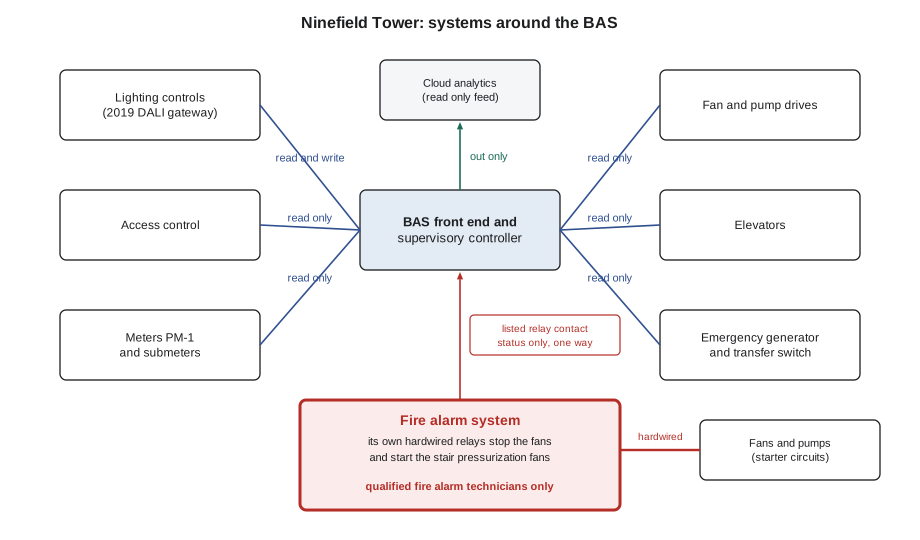
A building automation system (BAS) controls heating, ventilation and air conditioning. An integrated building is one in which the BAS also exchanges information with the building's other systems: lighting controls, access control, electrical meters, variable frequency drives, elevators, generators, the fire alarm system and, more and more often, cloud platforms and wireless sensors. Integration does not mean that one system runs everything. It means that each system keeps doing its own job, and that chosen pieces of information cross the boundaries between them, in chosen directions, for chosen reasons.
Prakash's list on the back of the work order had three columns: what the BAS reads from the other system, what it writes to it, and what must never cross. He filled it in for Ninefield as he talked, and it became the table below. The third column is the one that makes integration work a trade rather than a hobby.
| System | What the BAS reads | What the BAS may write | What never crosses |
|---|---|---|---|
| Lighting controls (2019 DALI system) | Zone status, occupancy, override state, floor power | Schedules, after-hours overrides | Emergency lighting functions |
| Access control | Door status, after-hours entries (by suite, not by person) | Nothing at Ninefield | Door locking and release decisions |
| Main meter PM-1 and submeters | kW, kWh, power factor, voltage, current | Nothing | Revenue meter seals and settings |
| Drives on fans and pumps | Speed, kW, kWh, run hours, fault codes | Speed and start where designed | Safety shutdowns, which are hardwired |
| Elevators | In service, out of service, fire service active | Nothing | Any elevator control |
| Emergency generator | Running, common alarm, transfer switch position, fuel level | Nothing | Starting, stopping or testing the generator |
| Fire alarm system | Alarm, trouble and supervisory status through listed relay or interface modules | Nothing | Every fire alarm function, including fan shutdown and smoke control |
Read down the last column and a pattern appears. The BAS reads a great deal and writes very little. Where it writes, it writes to systems whose job is comfort and energy. It never writes to a system whose job is to keep people alive. That pattern, rather than any one protocol, is the core of this course.
Levels of integration
Integrations come in levels, and it helps to name the level before arguing about the details.
- Monitoring only. The BAS reads status and alarms from another system and shows them on its graphics and in its alarm list. The generator at Ninefield is monitored this way: four points, read only.
- Coordinated operation. The BAS uses information from another system to make better decisions about its own equipment. Using lighting occupancy sensors to put a VAV box into occupied standby is coordinated operation: the lighting system does not control the HVAC, and the HVAC does not control the lights; they share a fact.
- Supervisory command. The BAS sends schedules, setpoints or commands to another system, which carries them out within its own rules. Sending the building's holiday calendar to the lighting system is supervisory command.
- Shared platform. Several systems run on the same network or software, with a common user interface and shared data model. This is what many vendors mean by a smart building platform, and it brings both convenience and shared risk.
Most real buildings mix levels. Ninefield has monitoring of the generator and elevators, coordinated operation planned between lighting and HVAC for the spring 2027 retro-commissioning, supervisory command of lighting schedules through the 2019 gateway, and nothing at all at the fourth level. That is a sensible arrangement for a 1979 tower that has had its systems replaced one at a time.
Hardwired and network connections
There are two ways for information to cross between systems. A hardwired connection uses a physical signal: a relay contact, a dry contact input, a 0 to 10 V or 4 to 20 mA signal. A network connection uses a protocol such as BACnet or Modbus, usually through a gateway when the other system speaks something else. BAS-310 covered the protocols; here the question is which kind of connection to use for which job.
| Hardwired | Network | |
|---|---|---|
| Speed | Immediate | Seconds to a minute, depending on polling and gateways |
| Amount of data | One fact per pair of wires | Hundreds of values on one cable |
| Failure mode | Usually obvious: an open circuit can be supervised or made fail-safe | Can be silent: a gateway may hold the last value |
| Cost per point | High: wire, terminals, labour | Low once the link exists |
| Listing for life safety | Relay and interface modules can be listed for the purpose | Only through equipment listed for the purpose |
| Best for | Safeties, interlocks, life-safety interfaces, a few critical facts | Monitoring, energy data, schedules, diagnostics |
The rule Quillon follows is simple: anything that must happen even if every network in the building is down is hardwired, and wired so that a broken wire fails safe. Fan shutdown on a fire alarm signal, a freezestat stopping a fan, a high static pressure switch tripping a drive: these are hardwired, and the BAS gets a separate status input so it knows what happened. Everything else can go over the network, which is cheaper and carries far more information.
Sometimes both are used for the same equipment. At Ninefield, Prakash and Sophie integrated the chillers over BACnet in August but kept the hardwired enable, status and alarm points as a backup, as BAS-310 described. The drives on the penthouse fans are the same: hardwired start and speed for control, a network link for the dozens of values a drive can report.
Why integrate at all
Every integration point costs money to install, test, document and maintain, and every one is a place where something can go wrong. So each needs a reason. Prakash gave Callie four.
- Energy. Systems that share facts waste less. A lighting occupancy sensor already knows that a meeting room is empty; letting the VAV box know too costs a few points in a gateway rather than a new sensor.
- Operations. Operators who see generator alarms, elevator status and meter readings on the same front end as the HVAC find problems sooner. One alarm list is easier to watch than five.
- Tenant service. A card swipe after hours can start the HVAC for the tenant's suite and record the hours for billing, without a phone call.
- Information. Meter data, drive data and occupancy data are the raw material of energy analytics, which BAS-330 covered. A drive that reports its own kW is a free meter.
An integration that serves none of these reasons is a liability. Prakash's example was a building he had worked in where every light fixture had been mapped into the BAS as its own point, 4,000 points that no operator ever opened, which made the front end slow and the licence expensive. Mapping zones, not fixtures, would have served every real purpose.
Worked problem
Sizing a lighting integration by purpose
Sophie's draft for occupied standby at Ninefield needs one occupancy fact for each VAV box. The office floors have about 140 VAV boxes in all, and each office floor has 12 DALI-2 occupancy and daylight sensors and 150 fixtures. How many lighting points would the BAS need if it mapped every fixture, every sensor, or one occupancy value per VAV box?
Show solution
- Every fixture: 150 fixtures × 10 floors = 1,500 points, each at least on/off and level, so 3,000 or more.
- Every sensor: 12 sensors × 10 floors = 120 occupancy points.
- One value per VAV box: 140 points, each a combination (logical OR) of the sensors that cover that box's zone, built in the lighting system or the gateway.
Answer: About 120 to 140 points do the job. Mapping the fixtures would add some 3,000 points that serve no HVAC purpose. The mapping table (which sensors cover which box) is the real engineering work.
The risks
Integration also connects failures. Prakash wrote the risks down the side of the work order.
- A fault spreads. A gateway that freezes can make the BAS act on stale values. A lighting system that reports every zone vacant could put 140 VAV boxes into standby at 10:00 on a weekday. Every coordinated action needs a sensible behavior on loss of data, and a limit on how much it can change.
- Life safety gets tangled. If a BAS program can restart a fan that the fire alarm system has stopped, the integration has made the building less safe. This is the most serious risk and gets its own lesson.
- Security widens. Each system connected to the BAS network is another way in. A cloud connection is a door to the internet. Security is the subject of BAS-430; this course points to it wherever it matters.
- Ownership blurs. When a light stays on, is it a lighting problem, a gateway problem or a BAS schedule problem? Without clear boundaries, every contractor can blame another.
- Privacy appears. Access control and occupancy data are about people. Using them for HVAC is reasonable; using them to track individuals is not, and may break the law.
Worked problem
What happens on loss
The Ninefield lighting gateway's heartbeat check, described in BAS-310, raises an alarm when the floor controllers' seconds counter stops changing for 90 s. If occupied standby uses lighting occupancy, what should the VAV boxes do when the alarm comes in during occupied hours, and how long could they be wrong before the BAS knows?
Show solution
- Normal worst-case age of a value is 45 s (15 s gateway poll + 30 s BAS read).
- The heartbeat alarm adds up to 90 s, so the boxes could act on stale data for about 45 + 90 = 135 s, a little over two minutes.
- On the alarm, every box using lighting occupancy should treat its zone as occupied, which is the safe and comfortable state.
Answer: Boxes revert to occupied mode within about two and a quarter minutes of a gateway failure. A wrong standby decision for two minutes costs nothing; a wrong one for a week costs comfort and complaints. The fallback must be written into the sequence, not left to the gateway.
A ladder of priorities
When several systems can influence the same equipment, something must decide which one wins. BACnet does this with the priority array, which BAS-310 described: sixteen levels, with 1 the highest. The standard names level 1 for manual life safety and level 2 for automatic life safety. Quillon's own convention, used at Ninefield and Harcastle, puts smoke control at 2, equipment protection at 5, operator commands at 8, supervisory and demand limiting at 10, and normal program control at 16.
Two points about that ladder matter for this course. First, a priority array only governs commands that go through the BAS. At Ninefield, the fire alarm system stops the air handlers through its own hardwired relays in the motor control circuits; no BACnet priority is involved, and nothing at any priority in the BAS can override it. Second, where a BAS does carry smoke control commands, as some newer buildings do, the controllers, the network and the firefighter's control panel must all be listed for smoke control, and the commands go in at priority 2 so that no program or operator can override them. Lesson 5 covers both arrangements.
| Priority | Quillon use | Example |
|---|---|---|
| 1 and 2 | Life safety only; 2 for smoke control through listed equipment | A listed smoke control panel commanding a damper open |
| 5 | Equipment protection | Low temperature protection opening a heating valve |
| 8 | Operator | A technician holding a box at minimum for a test |
| 10 | Supervisory and demand limiting | The demand limiter of BAS-330 trimming setpoints |
| 16 | Normal program control | The VAV box program setting its airflow |
Integration starts on paper
Prakash's last point was that every good integration he had seen began as a document, not a cable. The document is usually called an integration points list or an interface schedule. For each point it says what it is, which system owns it, which way it goes, how often it updates, and what happens when it stops. Ninefield's lighting gateway list from 2019 was a good start, and it is still the reference for the gateway. The fourth-floor fit-out will begin with one too.
Ninefield Tower - integration points list (extract)
Point                 Source system      Direction    Update     On loss
GEN-RUN               Generator panel    read only    COV        alarm, show unknown
GEN-ALM               Generator panel    read only    COV        alarm
ATS-EMERG             Transfer switch    read only    COV        alarm, show unknown
ELEV-1-FIRESVC        Elevator ctrl      read only    COV        show unknown
FA-ALARM              Fire alarm relay   read only    hardwired  supervised by FA panel
LTG-F06-Z03-OCC       Lighting gateway   read only    30 s       treat as occupied
LTG-F06-SCHED         BAS schedule       write        on change  lighting keeps last
PM1-KW                Main meter         read only    15 s       alarm, gap in trend
Callie noticed that the fire alarm line said supervised by the fire alarm panel rather than by the BAS. Prakash nodded. The fire alarm system supervises its own wiring to its own relay. The BAS input on the other side of the relay contact is just a contact to the BAS, and if it fails, the fire alarm system still works. That is the right way round.
Common mistakes
MistakeMapping every fixture, device or register into the BAS because the gateway allows it.
InsteadMap what serves a purpose: zones rather than fixtures, values someone will use.
MistakeLeaving the response to lost data unwritten.
InsteadWrite the fallback for every coordinated action into the sequence, and test it.
MistakePutting a life-safety function on a network link because it is cheaper.
InsteadLife-safety functions stay in the life-safety system, hardwired or on listed equipment; the BAS monitors.
MistakeAssuming a BACnet priority can protect a fire alarm function.
InsteadFire alarm shutdowns at Ninefield are hardwired; the priority array only governs BAS commands.
MistakeTreating integration as a wiring job.
InsteadStart with an integration points list: what, who, which way, how often, on loss.
Summary and key terms
- An integrated building shares chosen information between its systems; each system keeps its own job.
- Integration comes in levels: monitoring, coordinated operation, supervisory command and shared platforms.
- Hardwire what must work with every network down; use the network for data, schedules and diagnostics.
- Every integration point needs a reason: energy, operations, tenant service or information.
- Risks include spreading faults, tangled life safety, wider security exposure, blurred ownership and privacy.
- The BAS may monitor the fire alarm system, but it never controls or overrides a fire alarm function.
- Every integration starts with an integration points list.
- Integrated building
- A building whose systems exchange chosen information, usually through the BAS.
- Coordinated operation
- Using another system's information to make better decisions about one's own equipment.
- Supervisory command
- Sending schedules, setpoints or commands to another system that carries them out under its own rules.
- Hardwired interface
- A connection made with physical signals such as relay contacts or analog signals.
- Network interface
- A connection made with a communication protocol such as BACnet or Modbus.
- Integration points list
- A document listing each shared point with its source, direction, update rate and behavior on loss.
- Fail-safe
- Designed so that a failure, such as a broken wire, leaves the system in its safe state.
Practice problems
Work each problem on paper first, then reveal the answer to check.
A tower has 8 office floors with 10 lighting occupancy sensors each. How many occupancy points would the BAS need if it mapped every sensor?
Show answer
8 × 10 = 80 points.
A gateway polls every 20 s and the BAS reads it every 60 s. What is the normal worst-case age of a value?
Show answer
20 + 60 = 80 s.
Name one Ninefield system the BAS should only monitor.
Show answer
The generator, the elevators or the fire alarm system.
What should a VAV box in occupied standby do if the lighting gateway fails?
Show answer
Revert to occupied mode, the safe and comfortable state.
At what BACnet priority does Quillon put smoke control commands carried by listed equipment?
Show answer
Priority 2.
Lesson quiz · 5 questions
Score 60% or more to complete this lesson.
Create a free account to save your progress, take quizzes and earn a certificate.