
AWS-114 · Lesson 10 of 12 · 18 min
Governance frameworks and AI regulation
▶ Video coming soon A video version of this lesson is on the way.
The board meeting in December would ask the question Lorraine had been dreading: "Are we compliant?" She asked Noor and Hannah for an answer in advance. Hannah's reply was careful. "There isn't one AI law that tells us yes or no. There are privacy laws that already apply, consumer protection rules, professional rules for veterinarians, a fast-moving set of AI-specific laws and proposals, and several respected frameworks. Governance is how we turn all of that into decisions we can defend."
This lesson covers AI governance: the layers of law, frameworks and internal policy; the current regulatory picture in Canada and internationally; the AWS Generative AI Security Scoping Matrix; the AWS services that help with governance and compliance; and the processes that keep governance working. Laws in this area change quickly, so the lesson gives the position as of late 2026 and the habits for staying current.
Three layers of AI governance
Noor drew governance as three layers. At the top is law and regulation: rules an organization must follow, with penalties for breaking them. In the middle are frameworks and standards: structured, widely recognized guidance that organizations adopt voluntarily or because customers and regulators expect it. At the base is the organization's own policy: its approved uses, risk tiers, review steps, training and records. The own-policy layer is where the other two become concrete decisions.
For the exam, governance is about policies, review cadence, review strategies, governance frameworks, transparency standards and team training requirements, all named in the exam guide's governance task statement. It is less about memorizing laws, which differ by country, and more about knowing how an organization stays in control of its AI use.
The regulatory picture in Canada
Canada does not yet have a comprehensive federal AI law. The Artificial Intelligence and Data Act (AIDA), proposed in 2022 as part of Bill C-27, died when Parliament was prorogued in January 2025. In June 2026 the federal government released a refreshed national AI strategy that favours targeted measures over one broad law, together with funding for AI safety work and plans for trusted AI certification. Meanwhile, existing laws apply in full: federal and provincial private-sector privacy laws, human rights laws, consumer protection and competition law, and professional regulation. The federal government also has a voluntary code of conduct for organizations developing and managing advanced generative AI systems, published in 2023, and its own Directive on Automated Decision-Making for federal institutions, which requires an algorithmic impact assessment and is a useful model for private organizations. Quebec's privacy law adds specific duties when decisions about people are made exclusively by automated processing.
Hannah's summary for the board was that none of Cascade Ridge's planned uses made fully automated decisions about people, none were used for credit, employment or housing, and all kept clinical decisions with veterinarians. That placed them at the lower-risk end of every framework she had read. But privacy law applied to all of them, and the documentation and oversight already built would be what any regulator asked to see.
International rules
Many organizations also watch the EU AI Act, the first comprehensive AI law, which entered into force in 2024. It sorts AI uses into risk levels: practices that are prohibited, uses classified as high risk with strict requirements such as risk management, data governance, documentation and human oversight, uses with transparency obligations such as telling people they are interacting with an AI system, and minimal-risk uses with no new obligations. A 2026 amendment that entered into force on July 27, 2026 moved the main high-risk deadlines to December 2027 and August 2028. The Act matters beyond Europe because companies that serve European customers must follow it, and because its risk-based approach influences other rules. Cascade Ridge has no European clients, so it does not apply directly, but its risk levels gave the governance group a useful vocabulary.
Frameworks and standards
Two frameworks were most useful to Cascade Ridge.
- The NIST AI Risk Management Framework (AI RMF), published by the US National Institute of Standards and Technology in 2023, is voluntary and widely used in both countries. It organizes AI risk management into four functions: Govern (culture, policies and roles), Map (understand the context and the risks), Measure (analyze and track the risks) and Manage (prioritize and act on them). NIST has also published a profile applying the framework to generative AI.
- ISO/IEC 42001, published in 2023, is an international standard for an AI management system: the policies, processes and records an organization uses to manage AI responsibly. Organizations can be certified against it, much as they are certified against ISO/IEC 27001 for information security.
Noor mapped her existing work onto the NIST functions and found it fitted well. The governance group and the roles table from lesson 1 were Govern. The risk screen and the framing questions were Map. The fairness measures, Clarify reports and evaluations were Measure. The guardrails, oversight design, off switches and quarterly reviews were Manage.
The Generative AI Security Scoping Matrix
AWS publishes the Generative AI Security Scoping Matrix to help organizations work out which security and governance controls apply to a generative AI use. It sorts uses into five scopes by how much of the model and its data the organization owns.
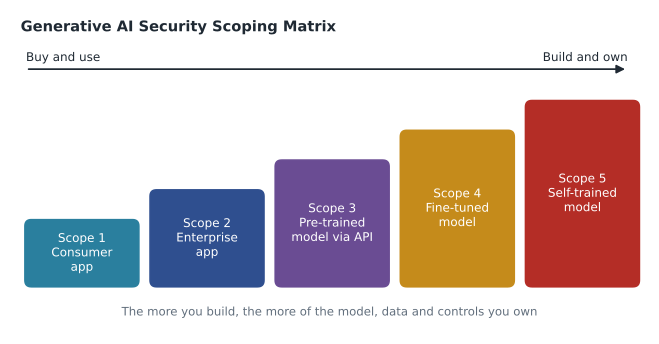
| Scope | Description | Cascade Ridge example |
|---|---|---|
| 1 Consumer app | Using a public generative AI service as an ordinary user | Staff using a public chatbot on their own; the policy forbids pasting client data into one |
| 2 Enterprise app | Using a third-party business application with generative AI features, under an enterprise agreement | AI features inside the office software suite, under the company's agreement |
| 3 Pre-trained model | Building your own application on a third-party foundation model through an API | The call-note summarizer and website assistant using models in Amazon Bedrock |
| 4 Fine-tuned model | Adapting a third-party model with your own data | A possible future summarizer tuned on confirmed call notes |
| 5 Self-trained model | Training a model from scratch on your own data | Not planned |
The matrix also names the security disciplines to consider for each scope: governance and compliance, legal and privacy, risk management, controls and resilience. In scope 1, the main controls are policies and training for staff. In scope 3, the organization owns its application, prompts, data and guardrails. In scope 4, it also owns a custom model and the training data embedded in it, which raises the stakes for poisoning, leakage and documentation.
AWS services for governance and compliance
The exam guide names several AWS services that help with governance and regulatory compliance for AI systems. None is specific to AI, which is the point: AI systems are governed with the same tools as everything else.
| Service | How it helps govern AI |
|---|---|
| AWS Config | Records resource configurations over time and checks them against rules, such as requiring encryption on buckets holding training data |
| Amazon Inspector | Finds software vulnerabilities and unintended network exposure in the compute running AI applications |
| AWS Artifact | Provides AWS's own compliance reports and agreements, for audits and vendor reviews |
| AWS CloudTrail | Records API activity, including who invoked which model and who changed which guardrail |
| AWS Trusted Advisor | Checks accounts against best practices for security, cost, performance and resilience |
| AWS Audit Manager | Collects evidence against control frameworks to prepare for audits; AWS provides prebuilt frameworks, including one for generative AI practices |
Making governance work
Noor's written policy, approved by the governance group, had six parts, matching the processes the exam guide describes.
- Approved uses and prohibited uses. For example: AI may assist with scheduling, documentation and client communication; it may not make clinical decisions or decide access to services; staff may not paste client data into public AI tools.
- Risk tiers. The screen from lesson 1 sorts each use into low, medium or high, and the tier decides the review needed.
- Review strategies. Low tier: owner sign-off with a model card. Medium: governance group review, privacy assessment and evaluation. High: all of that plus an external review.
- Review cadence. Every AI system in production is reviewed each quarter, and immediately after any incident or significant change, such as a new model version.
- Transparency standards. Users and clients are told when AI is involved, in plain language; each system has a model card.
- Team training. Everyone who builds, approves or uses an AI system completes training on its intended use and limits, and builders complete responsible AI training each year.
# Map a use's risk tier to the reviews it needs and its review cadence.
policy = {
    "low":    (["owner sign-off", "model card"], "every 6 months"),
    "medium": (["governance review", "privacy assessment", "evaluation", "model card"], "quarterly"),
    "high":   (["governance review", "privacy assessment", "evaluation", "external review", "model card"], "quarterly"),
}
uses = {"no-show reminders": "low", "call-note summarizer": "medium", "website assistant": "medium"}
for use, tier in uses.items():
    reviews, cadence = policy[tier]
print(f"{use}: {tier} tier -> {', '.join(reviews)}; review {cadence}")no-show reminders: low tier -> owner sign-off, model card; review every 6 months call-note summarizer: medium tier -> governance review, privacy assessment, evaluation, model card; review quarterly website assistant: medium tier -> governance review, privacy assessment, evaluation, model card; review quarterly
What this code does
It looks up each AI use's risk tier in a policy table to find which reviews it needs and how often it must be re-reviewed. The output lists, for each use, the required reviews and the review schedule.
Staying current
AI law and guidance changed more in 2025 and 2026 than in the previous decade, and Hannah expected that to continue. Governance therefore needs a way to notice change, not just a snapshot of today's rules. She set up three habits.
First, a regulatory watch: once a month she spent an hour reviewing updates from the federal and provincial privacy commissioners, the federal department responsible for AI policy, and the veterinary regulators in Alberta and British Columbia, plus a law firm newsletter. Anything relevant went on the governance group's agenda.
Second, change triggers: certain events automatically reopen a system's review, whatever the calendar says. These include a new law or guidance that might apply, a new model version, a new use of an existing model, a significant incident, and a large change in the data, such as a new clinic joining the group.
Third, evidence by default: because the documentation, logs and evaluations from the earlier lessons are produced as part of normal work, answering a new requirement usually means finding existing evidence rather than creating it in a rush. When the cyber insurer added AI questions to its questionnaire, the answers took an afternoon.
Lorraine got her answer for the board. Cascade Ridge could not honestly say it was "compliant with AI law", because there was no single law to be compliant with. It could say that it followed a recognized framework, that its uses were low or medium risk, that privacy law was being met with assessments and controls, and that it had the records to prove it. The board minuted that, and asked for the same report each quarter.
Common mistakes
MistakeWaiting for an AI-specific law before setting up governance.
InsteadExisting privacy, consumer protection and sector laws already apply; govern now with a recognized framework.
MistakeTreating the NIST AI RMF or ISO/IEC 42001 as laws.
InsteadThey are a voluntary framework and a certifiable standard, adopted by choice or expectation.
MistakeUsing the same controls for every generative AI use.
InsteadUse the Scoping Matrix: controls grow as you move from consumer apps to fine-tuned and self-trained models.
MistakeWriting a policy once and never reviewing it.
InsteadSet a review cadence, and review after incidents and significant changes.
Worked problem
Which scope?
Classify each use with the Generative AI Security Scoping Matrix: (a) a receptionist using a free public chatbot to draft a holiday-hours notice; (b) the website assistant built on a Bedrock model with a knowledge base; (c) a future summarizer tuned on 10,000 confirmed call notes.
Show solution
- (a) A public consumer service used as an ordinary user is scope 1; the control is policy and training, including not entering client data.
- (b) An application built on a third-party foundation model through an API is scope 3; the organization owns the application, prompts, data and guardrails.
- (c) Adapting a third-party model with the organization's own data is scope 4; the custom model and the sensitive training data add obligations.
Answer: Scope 1, scope 3 and scope 4.
Summary and key terms
- AI governance has three layers: law and regulation, frameworks and standards, and the organization's own policy.
- Existing privacy, consumer protection, human rights, professional and sector laws already apply to AI; AI-specific laws are developing quickly, so positions must be checked.
- The EU AI Act sorts uses into prohibited, high-risk, transparency and minimal-risk levels.
- The NIST AI RMF organizes risk management into Govern, Map, Measure and Manage, and ISO/IEC 42001 defines a certifiable AI management system.
- The AWS Generative AI Security Scoping Matrix sorts uses into five scopes from consumer apps to self-trained models.
- AWS Config, Inspector, Artifact, CloudTrail, Trusted Advisor and Audit Manager support governance.
- Policies, risk tiers, review strategies, review cadence, transparency standards and training make it work.
- AI governance
- The policies, roles and processes that keep an organization in control of its AI use.
- NIST AI RMF
- A voluntary framework organizing AI risk management into Govern, Map, Measure and Manage.
- ISO/IEC 42001
- An international standard for an AI management system, against which organizations can be certified.
- Generative AI Security Scoping Matrix
- An AWS model sorting generative AI uses into five scopes by ownership of the model and data.
- Review cadence
- How often AI systems and policies are reviewed.
- AWS Artifact
- A service providing AWS compliance reports and agreements.
Practice problems
Work each problem on paper first, then reveal the answer to check.
Name the four NIST AI RMF functions.
Show answer
Govern, Map, Measure and Manage.
Which Scoping Matrix scope covers fine-tuning a third-party model?
Show answer
Scope 4.
Which AWS service provides AWS's own compliance reports for an audit?
Show answer
AWS Artifact.
Lesson quiz · 5 questions
Score 60% or more to complete this lesson.
Create a free account to save your progress, take quizzes and earn a certificate.