
AWS-114 · Lesson 1 of 12 · 19 min
Principles of responsible AI
▶ Video coming soon A video version of this lesson is on the way.
By the second week of November, Cascade Ridge Veterinary Partners had three AI ideas on the table. The no-show prediction model from the autumn assessment was heading for a pilot in February 2027. The after-hours call-note summarizer for the emergency hospital was being designed. And Jonah Petrakis, the scheduling analyst who planned to sit the AWS Certified AI Practitioner exam in April 2027, had been asked by the board a question that no spreadsheet answered: "How do we know these tools will treat our clients fairly, keep their data safe, and not embarrass us?"
Noor Siddiqui, the data scientist running the group's AI assessment, turned the question into a series of Tuesday-afternoon governance sessions. "Building a model is the easy half," she told Jonah at the first one. "The hard half is deciding what the model is allowed to do, proving it does that for everyone, protecting the data it touches, and being able to show someone else how you know. That second half is what responsible AI means."
This course follows those sessions. It covers the two parts of the exam that deal with this second half: guidelines for responsible AI, and security, compliance and governance for AI solutions. On the AIF-C01 exam each of those domains carries a weight of 14 out of 100 scored points. This first lesson sets out the vocabulary: what responsible AI is, the dimensions AWS uses to describe it, why it matters to a business, and how it fits into every stage of building and running an AI system.
What responsible AI means
Responsible AI is the practice of designing, building and operating AI systems so that their benefits are delivered while their risks to people, organizations and society are identified and kept under control. It is not a single tool or a single check. It is a set of habits applied across the whole life of a system, from the first idea to the day it is switched off.
It helps to say what responsible AI is not. It is not a promise that a system will never make mistakes: every model makes errors, and a responsible design plans for them. It is not a public relations statement written after launch. And it is not only the data scientist's job. At Cascade Ridge the people in Noor's sessions included Jonah, Hannah Weiss from privacy and security, Dr. Simone Kaur as medical director, Andre Leclerc from clinic operations, and sometimes Lorraine Beaudry, the CFO. Each of them saw risks the others missed.
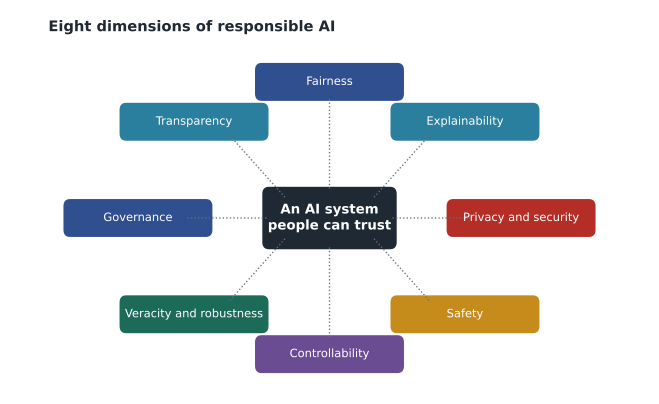
The eight dimensions AWS describes
AWS describes responsible AI using a set of core dimensions. The exact wording on AWS pages changes from time to time, so treat the list below as a study aid rather than a quotation, but these eight ideas appear consistently in AWS material and in the exam guide.
| Dimension | The question it asks | A Cascade Ridge example |
|---|---|---|
| Fairness | Does the system work well for different groups of people, and avoid unjust differences in outcomes? | Does the no-show model flag rural clients as accurately as city clients? |
| Explainability | Can people understand why the system produced a particular output? | Can a receptionist see which factors raised a booking's no-show score? |
| Privacy and security | Is data collected, used and protected appropriately, and is the system protected from misuse? | Are client phone numbers kept out of prompts that do not need them? |
| Safety | Does the system avoid harmful outputs and harmful use? | Does the summarizer avoid inventing a medication dose that was never said? |
| Controllability | Can people monitor and steer the system, and stop it when needed? | Can the emergency team switch the summarizer off in one step? |
| Veracity and robustness | Are outputs correct, and does the system behave reliably when inputs are unusual or adversarial? | Does the summary stay accurate when a caller is distressed and the audio is poor? |
| Governance | Are there policies, roles and processes that make all of this happen and keep happening? | Who approves a model for use, and who reviews it each quarter? |
| Transparency | Do people know when AI is being used, and what it can and cannot do? | Are clients told when a reminder call is produced with a synthetic voice? |
The exam guide also names several closely related features that you should recognize: bias, fairness, inclusivity, robustness, safety and veracity. Inclusivity means designing so that the system serves the full range of people who will use it or be affected by it, including people with disabilities, people who speak other languages and people the original data barely represents. Veracity means truthfulness: the output matches the facts.
Noor drew the diagram on the whiteboard and then rubbed out the lines between the boxes. "In real projects these are not separate," she said. "Explaining a prediction helps you find bias. Privacy limits what you can log, which affects controllability. Safety and transparency trade off sometimes. You look at all of them together."
Why it matters to a business
Responsible AI is sometimes presented as a cost or a brake. Noor presented it to the board as risk management, because the exam guide lists exactly the risks a careless generative AI project can create:
- Intellectual property infringement claims. A model might reproduce protected text or images, or be trained on material the organization had no right to use.
- Biased outputs. A model that treats groups differently can cause real harm and legal exposure, and can be hard to detect without deliberate testing.
- Hallucinations. Generative models can produce fluent, confident statements that are false. In a clinical setting a false statement about a drug or a dose is dangerous.
- Loss of customer trust. One widely shared bad answer from a chatbot can undo years of goodwill.
- End-user risk. People may act on an output, so a wrong answer can harm the person who relied on it, or their animal.
Each of these risks has a cost: refunds, complaints, legal fees, regulatory attention, or clients who quietly take their pets elsewhere. Lorraine, who had joined the session for this part, put it in her own terms. "So responsible AI is the insurance we buy before we need it," she said. Noor agreed, with one change: "It's also the quality control. A fair, explainable, well-monitored model is usually a better model."
Responsible AI across the life cycle
Because risks arise at different moments, responsible AI questions belong at every stage of a project, not just at the end. Noor's version of the life cycle had six stages.
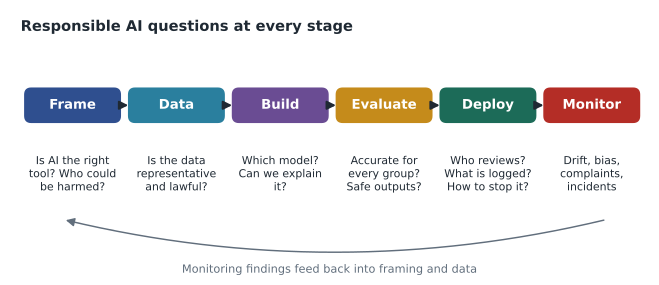
Frame the problem. Is AI the right tool at all? In the autumn assessment the team had rejected using machine learning to set vaccine due dates, because a fixed protocol already decides them and a simple rule is more reliable and easier to explain. Framing also means asking who could be harmed and how badly. A model that suggests which clients get an extra reminder text is low risk. A model that decided who could book at all would be far riskier.
Data. Is the data representative of the people the system will serve? Was it collected lawfully, and is its use consistent with what clients were told? Lesson 2 covers bias in data, and lesson 8 covers privacy.
Build. Which model, and why? A simpler model that people can understand may be preferable to a slightly more accurate one that nobody can explain. The exam guide also mentions environmental considerations and sustainability when selecting a model: a smaller model that meets the need uses less energy and costs less to run than the largest model available.
Evaluate. Does the model perform well overall and for each group that matters? Are generative outputs safe and accurate? Lessons 2 to 4 cover the measures and tools.
Deploy. Who reviews outputs? What is logged? How can the system be paused? Lessons 6, 7 and 11 cover oversight, security and records.
Monitor. Data and conditions change after launch. Monitoring watches for drift in accuracy and fairness, collects complaints, and handles incidents. What it finds feeds back into the next round of framing and data work.
Shared responsibility for AI
Mateo Ruiz and Gwen Halvorsen had already taught Jonah the AWS shared responsibility model for infrastructure: AWS secures the cloud, and the customer secures what they put in it. The same idea applies to AI. When Cascade Ridge uses a foundation model through Amazon Bedrock, AWS and the model provider are responsible for how that model was built, trained and hosted. Cascade Ridge is responsible for how it uses the model: which data it sends, what the application does with the output, who can access it, what guardrails are applied, and whether the use itself is appropriate.
AWS publishes AI Service Cards for some of its own AI services, describing their intended uses, limitations and design choices, and model providers publish documentation for their models. Reading these is part of the customer's side of the bargain. Lesson 5 returns to documentation in detail.
# A simple first-pass risk screen Noor uses when a new AI idea arrives.
# Each answer is 0 (no), 1 (somewhat) or 2 (yes). Higher totals need more review.
questions = {
    "affects a person's access to a service": 0,
    "touches clinical decisions": 2,
    "uses personal information": 2,
    "produces text people may act on": 2,
    "runs without a human checking outputs": 0,
}
score = sum(questions.values())
tier = "high" if score >= 7 else "medium" if score >= 4 else "low"
print("Call-note summarizer score:", score, "-> review tier:", tier)Call-note summarizer score: 6 -> review tier: medium
What this code does
It scores a new AI idea on five yes, somewhat or no questions, worth 2, 1 or 0, and adds the answers. A total of 7 or more means high review, 4 to 6 medium, and below 4 low. The call-note summarizer scores 6, so it goes to medium review.
The screen is deliberately crude. Its job is not to decide anything, only to route an idea to the right amount of review. The call-note summarizer scored 6, a medium tier, mostly because it handles personal information and produces clinical text that people may act on. The no-show model, run through the same screen, scored 3. Lesson 10 turns these tiers into a formal policy.
Responsible AI is everyone's job
Noor closed the first session with a list of who owns what at Cascade Ridge. It was not long, but it was specific.
| Role | Responsible AI duties |
|---|---|
| Business owner (Andre for the no-show model; Dr. Kaur for the summarizer) | Defines the purpose and limits of use; accepts the residual risk; decides when to pause |
| Builder (Noor, with Kwame for BookVet changes) | Chooses data and models; tests for bias and safety; documents the model |
| Privacy and security (Hannah) | Reviews data use, access, encryption and logging; leads incident response |
| Users (receptionists, emergency veterinarians) | Use outputs as intended; report errors and concerns |
| Governance group (the four above plus Lorraine) | Approves high and medium tier uses; reviews each quarter |
"If everybody owns it, nobody owns it," Hannah said, which is why every row has a name.
Common mistakes
MistakeTreating responsible AI as a final check before launch.
InsteadAsk responsible AI questions at every stage, from framing the problem to monitoring in production.
MistakeAssuming a highly accurate model is automatically fair.
InsteadOverall accuracy can hide poor performance for a smaller group. Measure results for each group that matters.
MistakeBelieving the model provider is responsible for how you use the model.
InsteadUnder shared responsibility, the customer is responsible for its data, its application and whether its use is appropriate.
MistakeChoosing the largest available model by default.
InsteadChoose the smallest model that meets the need; it is cheaper, faster and uses less energy.
Worked problem
Matching risks to dimensions
The summarizer, in a test, wrote that a caller's dog had "eaten two tablets of ibuprofen" when the caller had said "two tablets, maybe, we're not sure what". Which responsible AI dimensions does this touch, and what is the business risk?
Show solution
- The summary states something more certain than the source, so veracity is affected.
- A veterinarian might act on the false certainty, so safety and end-user risk are involved.
- If staff cannot tell the summary is uncertain, transparency and explainability are weak.
- If it happened in production and became known, client trust and legal exposure would follow.
Answer: Veracity and safety are the main dimensions, with transparency close behind. The business risks are harm to an animal, liability and loss of trust. The fix, explored in later lessons, combines grounding the summary in the transcript, flagging uncertainty and keeping a veterinarian in the loop.
Summary and key terms
- Responsible AI is the practice of delivering an AI system's benefits while identifying and controlling its risks across its whole life.
- AWS describes it with dimensions such as fairness, explainability, privacy and security, safety, controllability, veracity and robustness, governance and transparency.
- The exam guide also names bias, inclusivity and sustainability considerations when choosing a model.
- Generative AI brings legal and business risks including intellectual property claims, biased outputs, hallucinations, loss of trust and end-user harm.
- Responsible AI questions belong at every stage, and the customer is responsible for how it uses a model, even one hosted by AWS.
- Responsible AI
- Designing, building and running AI so its benefits are delivered and its risks are controlled.
- Fairness
- A system working well for different groups and avoiding unjust differences in outcomes.
- Veracity
- Truthfulness: outputs that match the facts.
- Controllability
- The ability to monitor, steer and stop an AI system.
- Inclusivity
- Designing so the system serves the full range of people who use it or are affected by it.
- Hallucination
- A fluent but false or unsupported output from a generative model.
Practice problems
Work each problem on paper first, then reveal the answer to check.
Name four of the eight responsible AI dimensions.
Show answer
For example fairness, explainability, safety and transparency.
Give two legal or business risks of generative AI.
Show answer
For example intellectual property claims and hallucinations; also biased outputs and loss of customer trust.
Why might a smaller model be the responsible choice?
Show answer
It can meet the need with lower cost and energy use, and is often easier to evaluate.
Lesson quiz · 5 questions
Score 60% or more to complete this lesson.
Create a free account to save your progress, take quizzes and earn a certificate.