
AUTO-230 · Lesson 11 of 12 · 19 min
Emissions and inspection rules in Canada
Kiran's term is nearly over, and Marty spends an afternoon on the rules behind all of it. He starts with a question from Harold Kemp. Harold has bought a used SUV in Montana for his daughter, who is starting university, and he wants Ridgeline to do the out-of-province inspection so he can register it in Alberta. He also mentions that the seller left a small performance tuner plugged into the diagnostic connector and said it adds power. "Two different questions," Marty tells Kiran. "What the law requires to register it here, and what that box is doing to its emission controls. You need to understand both."
This lesson covers how vehicle emissions are regulated in Canada: the federal standards that apply to new vehicles, how they line up with the US standards, what happened to provincial inspection programs, what the rules say about tampering, and why on-board diagnostics matter to customers and shops even where no one tests them.
Federal standards for new vehicles
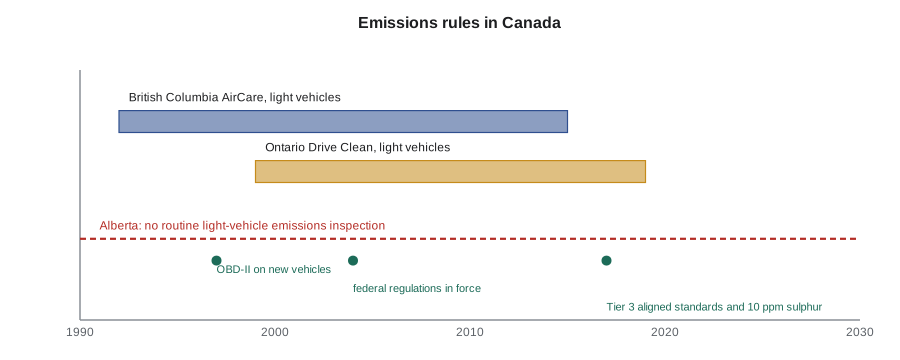
In Canada, the federal government regulates emissions from new vehicles and engines under the Canadian Environmental Protection Act, 1999. The On-Road Vehicle and Engine Emission Regulations, made in 2003 and in force from 2004, set the standards that new light-duty vehicles, light trucks, motorcycles and heavy-duty engines must meet when they are manufactured in or imported into Canada. Environment and Climate Change Canada administers them. Companies that make or import vehicles must show that each vehicle conforms, and vehicles carry a national emissions mark or a label stating that they meet the standards.
Because Canada and the US share one integrated vehicle market, the Canadian standards are deliberately aligned with the US Environmental Protection Agency's. In 2015, Canada adopted standards matching the US Tier 3 program for new cars and light trucks, phased in over the 2017 to 2025 model years, along with a limit on the sulphur content of gasoline of 10 parts per million on average from 2017, the same as in the US; low-sulphur fuel matters because sulphur poisons catalytic converters. The regulations also bring in the on-board diagnostic requirements, so a vehicle sold in Canada has the same OBD-II system as its US twin. Separate regulations set greenhouse gas standards for new vehicles. The federal rules also prohibit a vehicle or engine from being equipped with a defeat device, defined as a device that reduces the effectiveness of the emission control system under conditions that can reasonably be expected in normal use, with narrow exceptions such as protecting the engine from damage.
Importing a vehicle from the US
Harold's SUV is a US vehicle, so it comes into Canada through the federal Registrar of Imported Vehicles program, which handles vehicles imported from the US that were not originally sold in Canada. Transport Canada decides which vehicles are admissible for safety, and because the emission standards are aligned, a vehicle certified to the US EPA standards can generally meet Canada's requirements too. The importer has to clear any outstanding safety recalls and pass a federal inspection of the vehicle, and then, in Alberta, the vehicle needs a provincial out-of-province inspection at a licensed facility before it can be registered. Ridgeline holds that licence, and Marty is a certified inspection technician. The out-of-province inspection is a safety inspection of brakes, steering, lights, tires and other equipment; it is not an emissions test.
Provincial inspection programs
Federal rules cover vehicles when they are new. What happens to them in service is mostly provincial, and in light vehicles, routine emissions inspection has largely disappeared from Canada. British Columbia's AirCare program, which tested light vehicles in the Lower Fraser Valley from 1992, ended at the end of 2014, because newer vehicles with OBD-II and better emission controls were failing so rarely that the program cost more than it achieved. Ontario's Drive Clean program, which tested light vehicles in southern Ontario from 1999, ended its light-vehicle testing in 2019 for the same reasons, while the province kept an emissions program focused on heavy-duty vehicles. Alberta has never had a routine light-vehicle emissions inspection program. Some provinces have rules about smoking vehicles and programs aimed at heavy trucks, and Alberta's commercial vehicles go through regular safety inspections, but a car or pickup in Calgary is not emissions-tested at registration or renewal.
That does not make emissions faults unimportant. A check-engine lamp that is left on hides the next fault that comes along, because the lamp is already lit. An engine running rich, misfiring or with a failed converter uses more fuel, damages parts that are expensive to replace, and pollutes many times more than it should. Vehicles that are exported, sold or moved to a region with testing must pass when they get there. And a malfunction lamp can be the warning that saves an engine or a catalyst. Ridgeline treats every lit lamp as a fault to diagnose, inspection program or not.
Tampering in Canada
Tampering means removing, bypassing or disabling any emission control device or its software, or modifying a vehicle so that it emits more than it was certified to. The federal regulations make it an offence for companies to sell new vehicles that do not conform or that carry defeat devices, and many provinces have vehicle equipment rules, but the law on tampering after a vehicle has been sold is uneven across the country. A 2026 multi-stakeholder study of heavy-truck tampering in Alberta, for example, found that the province has no dedicated anti-tampering regulation and no heavy-truck emissions inspection program, and it recommended stronger inspections and roadside testing; there is growing pressure for federal anti-tampering legislation with penalties like those in the US.
None of that makes tampering acceptable. A tampered vehicle can emit tens of times more NOx and hydrocarbons than an intact one; the code below gives a rough idea. Manufacturers refuse warranty coverage on tampered engines and emission parts. A tampered vehicle cannot be legally sold into the US market, where removal is a federal offence, and buyers and insurers increasingly check. Delete kits and tunes often cause driveability problems, damage engines and transmissions, and leave the shop that installed them exposed to liability. And it is simply wrong to sell a customer something whose purpose is to make the air dirtier for everyone else. Ridgeline's policy is the same on both sides of the border: the shop will not remove, bypass or disable emission equipment, will not sell or install defeat parts or tunes, and will explain the legal repair to anyone who asks.
# Why tampering matters: rough emissions of one vehicle per year, intact versus tampered (illustrative)
distance = 20000                 # km per year
grams_per = {"intact": {"NOx": 0.04, "HC": 0.05, "CO": 0.6},      # g/km, typical in-use values
             "converter removed": {"NOx": 1.2, "HC": 1.5, "CO": 12.0}}
for state, g in grams_per.items():
    totals = {k: v * distance / 1000 for k, v in g.items()}
    print(f"{state:<18} " + "  ".join(f"{k} {t:6.1f} kg" for k, t in totals.items()))
ratio = grams_per["converter removed"]["NOx"] / grams_per["intact"]["NOx"]
print(f"NOx from the tampered vehicle is about {ratio:3.0f} times the intact vehicle's")intact NOx 0.8 kg HC 1.0 kg CO 12.0 kg converter removed NOx 24.0 kg HC 30.0 kg CO 240.0 kg NOx from the tampered vehicle is about 30 times the intact vehicle's
Harold's SUV and its tuner
Kiran plugs the shop scan tool in after removing the tuner, with Harold's permission. The calibration verification number in the engine computer does not match the manufacturer's listing for the calibration identification, which means the software has been changed. The tuner's own documentation, which Harold finds in the glovebox, advertises that it turns off the rear oxygen sensors' catalyst checks. The engine computer's monitor status shows everything complete, but the catalyst monitor's Mode 6 results are blank. Harold had no idea. With his agreement, Ridgeline restores the manufacturer's software through the manufacturer's service website, and after a drive cycle the computer sets P0420 and P0430: both converters are worn out, and the tuner had been hiding it. The out-of-province safety inspection passes; the converters are replaced with the correct parts before Harold's daughter takes the SUV to university, and the tuner goes back to Harold in a box, uninstalled.
Whatever the rules, a vehicle's readiness status, permanent codes and software identity tell the technician whether its emission systems have actually been tested by its own computer since the last repair. The code below is Ridgeline's pre-delivery check. It uses the guidance many inspection programs follow: vehicles from the 1996 to 2000 model years may have up to two non-continuous monitors not ready, and 2001 and newer vehicles one, provided the MIL is off and no permanent codes are stored. The calibration verification number, read from the vehicle information service, shows whether the engine computer's software is the manufacturer's.
# Pre-inspection check: MIL, permanent codes, readiness and software identity
def check(model_year, mil_on, permanent, monitors, cvn_ok):
    allowed = 2 if model_year <= 2000 else 1          # incomplete non-continuous monitors (the common EPA-guidance rule, used here as a quality check)
    not_ready = [m for m, done in monitors.items() if not done]
    issues = []
    if mil_on: issues.append("MIL commanded on")
    if permanent: issues.append("permanent codes: " + ", ".join(permanent))
    if len(not_ready) > allowed: issues.append(f"{len(not_ready)} monitors not ready ({', '.join(not_ready)}), {allowed} allowed")
    if not cvn_ok: issues.append("calibration verification number does not match the manufacturer's")
    return issues
vehicles = {
    "Lindqvist minivan, day after EVAP repair": (2017, False, [], {"catalyst": False, "EVAP": False, "O2 sensor": True, "O2 heater": True, "EGR/VVT": True}, True),
    "Lindqvist minivan, after a week of driving": (2017, False, [], {"catalyst": True, "EVAP": True, "O2 sensor": True, "O2 heater": True, "EGR/VVT": True}, True),
    "SUV with aftermarket tuner": (2016, False, [], {"catalyst": True, "EVAP": True, "O2 sensor": True, "O2 heater": True, "EGR/VVT": True}, False),
}
for name, args in vehicles.items():
    issues = check(*args)
print(f"{name}: " + ("ready for delivery" if not issues else "not ready -> " + "; ".join(issues)))Lindqvist minivan, day after EVAP repair: not ready -> 2 monitors not ready (catalyst, EVAP), 1 allowed Lindqvist minivan, after a week of driving: ready for delivery SUV with aftermarket tuner: not ready -> calibration verification number does not match the manufacturer's
Emissions work without an inspection program
Because no one tests light vehicles in Alberta, Ridgeline sets its own standard for emissions repairs, and Marty explains it to Kiran as three habits. First, every lit malfunction lamp is diagnosed and explained to the customer, even when the customer would rather not pay for it; if the customer declines the repair, the repair order records the code, the freeze frame and the advice given. Second, after any repair that clears codes, the vehicle is not called finished until its monitors have run, or the customer has been told exactly what driving will complete them. Third, the shop checks the software identity whenever a vehicle arrives with an aftermarket device plugged into its diagnostic connector, because tuners and so-called performance chips are common on trucks in Alberta, and many of them disable emission controls without the owner understanding what they do.
Those habits also protect the customer's pocket. A vehicle that will one day be sold to a buyer in another province, exported to the US or traded in at a dealer gets a scan, and lit lamps, permanent codes and altered software all reduce what it is worth. Fleet customers like Hal Osei, whose vans cross into British Columbia and sometimes the US, need vehicles that would pass anywhere.
Worked problem
Does it need an emissions test?
A customer is moving from Calgary to a US state with an emissions inspection program and asks whether the lit check-engine lamp on her 2018 car matters, since Alberta does not test. What should she be told?
Show solution
- Alberta does not test light vehicles, but the destination state probably does.
- Inspection programs usually fail a vehicle with the MIL on, permanent codes stored, or too many incomplete monitors.
- Diagnosing and repairing the fault now, and driving enough to complete the monitors, avoids a failed test after the move.
- The fault may also be costing fuel or damaging parts, whatever the inspection rules.
Answer: Yes, it matters: fix the fault and let the monitors complete before the move.
Common mistakes
MistakeThinking Alberta's lack of an inspection program makes emissions faults unimportant.
InsteadLit lamps hide new faults, waste fuel, damage parts and raise pollution.
MistakeTreating the out-of-province inspection as an emissions test.
InsteadIt is a safety inspection; emissions faults still need diagnosis.
MistakeAssuming a tuner is harmless because the lamp is off.
InsteadCheck the calibration verification number and Mode 6; tuners can hide failed monitors.
MistakeRemoving emission parts because no one will test the vehicle.
InsteadTampering is wrong and exposes the shop to liability; Ridgeline refuses.
MistakeTelling a customer that a US vehicle cannot be imported because of emissions.
InsteadStandards are aligned; the federal import program and provincial inspection decide admissibility.
Summary and key terms
- New-vehicle emissions in Canada are regulated federally under CEPA by the On-Road Vehicle and Engine Emission Regulations.
- Canadian standards are aligned with US EPA standards, including Tier 3 and 10 ppm gasoline sulphur.
- The federal rules prohibit defeat devices on vehicles sold in Canada.
- BC's AirCare ended in 2014 and Ontario's light-vehicle Drive Clean testing ended in 2019; Alberta has never had routine light-vehicle testing.
- Imports from the US go through the federal import program, then a provincial inspection.
- Tampering rules after sale are uneven in Canada, but tampering is never an acceptable repair.
- Readiness, permanent codes and the calibration verification number show whether the emission systems are really working.
- CEPA
- The Canadian Environmental Protection Act, 1999, under which federal vehicle emission regulations are made.
- Tier 3
- The US vehicle emission and fuel standards phased in from 2017, which Canada matched.
- Defeat device
- A device that reduces the effectiveness of emission controls in normal use.
- Out-of-province inspection
- Alberta's safety inspection for vehicles registered from outside the province.
- Calibration verification number (CVN)
- A number computed from the engine computer's software that shows whether it has been altered.
- Tampering
- Removing, bypassing or disabling emission controls or their software.
- Registrar of Imported Vehicles
- The federal program for importing vehicles into Canada from the US.
Practice problems
Work each problem on paper first, then reveal the answer to check.
Which level of government sets emission standards for new vehicles in Canada?
Show answer
The federal government, under CEPA.
Why did BC end AirCare?
Show answer
Newer vehicles with OBD-II failed so rarely that the program cost more than it achieved.
A tuner is removed and the calibration verification number does not match the manufacturer's. What does that mean?
Show answer
The engine computer's software has been altered and should be restored.
Is the Alberta out-of-province inspection an emissions test?
Show answer
No, it is a safety inspection.
Lesson quiz · 5 questions
Score 60% or more to complete this lesson.
Create a free account to save your progress, take quizzes and earn a certificate.