
AUTO-230 · Lesson 2 of 12 · 21 min
Fuel delivery: tanks, pumps and lines
Hal Osei's courier vans are back. Van 2, the one that had its brakes rebuilt last autumn, has a new complaint: on the highway with a full load it loses power on long grades, as if someone had pressed the brake, and the check-engine lamp comes on. Its driver says it is fine around town. Simone writes it up with the code the driver's own scan app showed, P0087, fuel rail pressure too low, and Marty assigns it to Kiran with Theo Banks to help. "Before you touch anything," Marty tells her, "remember that this system holds a tank full of gasoline under pressure. We do it safely or we don't do it."
This lesson covers how fuel is stored and delivered to the engine: fuel safety, tanks and pump modules, the types of fuel supply systems, filters and lines, fuel quality, and the pressure, volume and current tests that tell a technician whether the supply side is doing its job. Lesson 3 follows the fuel into the injectors.
Fuel system safety
Gasoline vapour is heavier than air, flows along the floor, and ignites from a spark, a pilot light or a hot surface. A fuel system can hold several hundred kilopascals of pressure even with the engine off, and direct-injection rails hold many megapascals while running. Ridgeline's fuel rules are written on the wall beside bay 5. Work in a ventilated bay away from drains and ignition sources. Keep a charged Class B fire extinguisher within reach. Relieve system pressure by the method in the service information before opening any line, and wrap the fitting with a shop towel to catch what is left. Disconnect the battery negative, or follow the procedure for vehicles where that is not allowed, before working on the pump. Drain fuel only into approved, labelled containers. Never use a drop light with an exposed bulb near fuel, and never smoke anywhere in the shop.
Direct-injection systems need extra care. The high-pressure side, from the engine-driven pump to the injectors, runs at 5 to 35 MPa (700 to 5,000 psi), enough to cut skin or inject fuel under it, so it is never opened until the pressure sensor or service procedure shows it has bled down. Its lines and fittings are usually designed to be used once: many manufacturers require new high-pressure lines whenever the old ones are removed, because the sealing faces deform on first tightening.
Tanks, pump modules and level senders
Modern fuel tanks are usually moulded from high-density polyethylene in several layers, including a barrier layer that keeps fuel from soaking through the plastic, because evaporative emission rules count fuel that escapes through the tank walls. Older and some heavy-duty vehicles use steel tanks. The tank holds baffles to stop fuel sloshing away from the pump, a filler neck with a check valve to stop fuel spitting back, and vent and vapour lines that connect to the evaporative emission system covered in Lesson 8.
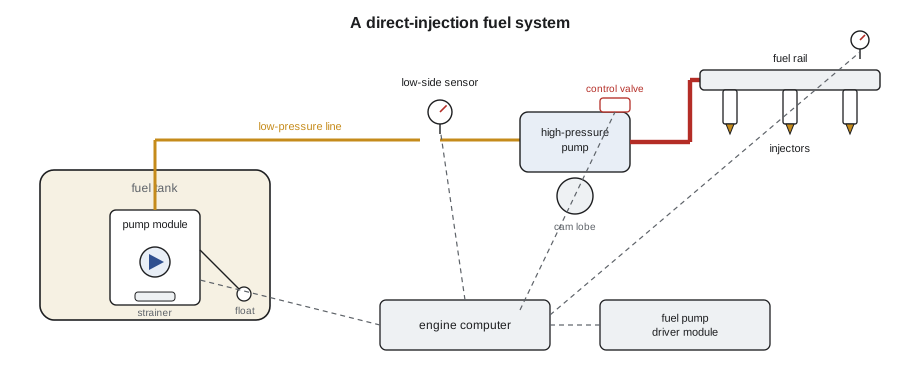
Inside the tank sits the fuel pump module: an electric pump, usually a turbine-type pump driven by a small permanent-magnet DC motor, mounted in a reservoir or bucket that a jet pump or the return flow keeps full so that the pump does not suck air on corners or when fuel is low. The module also carries the inlet strainer, called a sock, the fuel level sender, and on many vehicles the pressure regulator and fine filter. Fuel flowing through the pump cools and lubricates it, which is why pumps fail sooner on vehicles that are often run nearly empty. The level sender is a variable resistor on a float arm, which AUTO-220 tested; on saddle tanks, such as some all-wheel-drive cars, there are two senders and a transfer jet pump to move fuel from one side to the other.
Types of fuel supply systems
On older port-injected engines, a return system pumped fuel to the rail on the engine, where a vacuum-referenced pressure regulator held pressure at a set amount above manifold pressure and sent the excess back to the tank. Returning hot fuel from the engine bay heated the tank and increased evaporative emissions, so manufacturers moved to returnless systems. In a mechanical returnless system, the regulator sits in the tank module and holds a fixed pressure, typically about 380 to 410 kPa (55 to 60 psi), with one line to the engine. In an electronic returnless system, there is no mechanical regulator at all: a pressure sensor on the line or rail reports to the engine computer or a separate fuel pump driver module, which varies the pump's speed with a pulse-width-modulated supply to deliver only the fuel the engine needs. That saves electrical energy and keeps the tank cooler.
Direct-injection engines add a second stage. The in-tank pump supplies the low-pressure side, usually 300 to 600 kPa (45 to 90 psi) and often electronically controlled. A mechanical high-pressure pump, driven by a lobe on a camshaft, raises it to the injection pressure. A solenoid control valve on the high-pressure pump, commanded by the engine computer, sets how much of each stroke is delivered, and a rail pressure sensor closes the loop. A pressure relief valve protects the rail. If the low-pressure side cannot supply enough fuel, the high-pressure pump starves and rail pressure falls under load, which is exactly what van 2's code describes.
Filters, lines and fittings
Fuel is filtered twice: by the coarse strainer on the pump inlet and by a fine filter, typically rated around 10 micrometres, either in the module, where it is a lifetime part replaced with the module, or in the line under the vehicle, where it is a maintenance item. A plugged filter shows up as low volume before it shows up as low pressure, especially under load. Fuel lines are now mostly multi-layer nylon with quick-connect fittings, plus steel or flexible sections near the engine. Quick connects need the correct release tool and should be inspected for damaged O-rings and retainers each time; many come with a new retainer in the repair kit. Nylon lines must not be heated, kinked or pinched with clamps, and a damaged line is replaced with the manufacturer's part or an approved repair kit, never with rubber hose and hose clamps, which cannot hold returnless or direct-injection pressures and will leak.
Fuel quality
Fuel itself causes problems. Gasoline in Canada and the US is sold in grades by anti-knock index, and engines designed for premium can lose power and fuel economy on regular, because the knock sensor retards the timing to protect the engine. Most gasoline contains up to 10 percent ethanol; some stations sell E15, which is approved in the US for 2001 and newer light vehicles, and flex-fuel vehicles can use E85. Ethanol absorbs water, and fuel left for months can separate into a water and ethanol layer at the bottom of the tank. Refiners also change the blend with the seasons: winter gasoline is more volatile so engines start in the cold, and summer gasoline is less volatile to cut evaporation. Detergent additives keep injectors and intake valves clean; US rules set a minimum level for all gasoline, and some brands in both countries advertise a higher additive level under the Top Tier program. Fuel sulphur is now limited to an average of 10 parts per million in both countries, which protects catalytic converters.
Contaminated fuel is diagnosed by draining a sample into a clear container from the test port or the line. Water settles to the bottom, debris is visible, and an alcohol content tester measures the ethanol percentage. Diesel fuel put in a gasoline vehicle by mistake, or gasoline in a diesel, needs the tank drained and the system flushed by the manufacturer's procedure.
Pressure, volume and current tests
A fuel supply system is tested for three things. Pressure is measured with a gauge on the service port, or on a returnless system by reading the pressure sensor on the scan tool and confirming with a gauge when in doubt. It is checked at key-on prime, at idle, at higher engine speed and, most importantly, under load, and the system should hold pressure for several minutes after shutdown; a fast drop points to a leaking injector, a check valve or a regulator. Volume is measured by diverting the pump's output into a graduated container for a set time, usually 15 seconds, and comparing it with specification, or by working out what the engine needs at full power. A pump can make normal pressure at idle and still be unable to keep up when the engine needs ten times as much fuel.
Current is measured with a low-amps clamp around the pump's power or ground wire. A healthy pump draws a steady current, typically 4 to 8 amps, and on a lab scope its current shows a regular ripple from the commutator segments. High current suggests a pump working against a restriction or a dragging motor; low current with low output suggests a worn pump or a voltage problem; irregular ripple with dropouts suggests worn brushes or a bad commutator segment. Before condemning the pump, though, the technician checks the voltage at the pump connector while it runs, because a voltage drop in the feed or ground, which AUTO-220 taught Kiran to find, slows a good pump.
# Low-pressure fuel supply: does measured volume cover what the engine needs at full power?
power = 210                # engine power at full load, kW
bsfc = 0.30                  # brake specific fuel consumption, kg/kWh (typical gasoline)
density = 0.745               # fuel density, kg/L
need_mass_h = power * bsfc     # kg per hour
need_vol_h = need_mass_h / density
print(f"fuel needed at full power: {need_mass_h:5.1f} kg/h = {need_vol_h:5.1f} L/h")
need_15s = need_vol_h / 3600 * 15
measured_15s = 0.38          # volume collected in 15 s at the test port
print(f"needed in 15 s: {need_15s:5.2f} L; measured: {measured_15s:5.2f} L")
margin = measured_15s / need_15s
print(f"supply margin: {margin:4.2f} x" + (" (pump cannot keep up under load)" if margin < 1.5 else " (adequate)"))fuel needed at full power: 63.0 kg/h = 84.6 L/h needed in 15 s: 0.35 L; measured: 0.38 L supply margin: 1.08 x (pump cannot keep up under load)
Van 2: finding the restriction
Kiran starts by repeating the complaint safely. With the van loaded with sandbags to its normal weight, Theo drives the long hill on the highway east of the shop while Kiran watches the scan tool. Commanded rail pressure on the hill is about 14 MPa (2,000 psi), but actual rail pressure sags to under 6 MPa (870 psi), and the low-side pressure sensor, which should hold about 450 kPa (65 psi), falls to 260 kPa (38 psi). The high-pressure pump is not the first suspect; it is starving. Back in the bay, she checks voltage at the pump connector under load: 12.9 volts with the engine running and a 0.3-volt drop on the ground side, which is acceptable. Pump current on the scope is about 9.5 amps, higher than the 6 to 7 amps listed in the diagnostic procedure, with a smooth ripple: a healthy motor working against something.
The volume test settles it. With a test hose on the service port and the pump commanded on at full duty, she collects only 0.38 L (0.10 gal) in 15 seconds, against a needed flow at full power, worked out above, of about 0.35 L (0.09 gal), which leaves almost none of the margin the procedure requires. On this van, the fine filter is in the pump module. When the module comes out, the inlet sock is coated with brown sludge, and a sample from the bottom of the tank holds a layer of water and fine debris. Hal remembers that van 2 was fuelled for a month at a small rural station while it covered a route near Strathmore. Kiran drains and cleans the tank by the manufacturer's procedure, fits a new pump module, and checks the low-side pressure on the same hill: 455 kPa (66 psi), with rail pressure following its command and pump current down to 6.4 amps.
Worked problem
Pressure drop after shutdown
A returnless port-injection system reads 400 kPa (58 psi) at idle. Two minutes after shutdown it reads 150 kPa (22 psi), and the specification is that it should stay above 275 kPa (40 psi) for five minutes. What could cause the drop, and how would you narrow it down?
Show solution
- The pressure is leaking back to the tank or into the engine.
- Possible causes: a leaking check valve in the pump, a leaking regulator, or a leaking injector.
- Repeat the test with the supply line pinched or blocked with the proper tool near the rail: if pressure now holds, the leak is back through the pump or regulator.
- If it still drops with the line blocked, an injector is leaking; a leak-down test on each injector or an exhaust gas reading at start-up finds it.
Answer: A check valve, regulator or injector leak; blocking the supply line separates the tank side from the engine side.
Common mistakes
MistakeMeasuring pressure only at idle.
InsteadTest under load and measure volume; a weak pump can make idle pressure and fail on a hill.
MistakeCondemning the pump before checking its voltage and ground.
InsteadMeasure voltage at the pump connector while it runs; a voltage drop slows a good pump.
MistakeRepairing a nylon fuel line with rubber hose and clamps.
InsteadUse the manufacturer's line or an approved repair kit rated for the pressure.
MistakeOpening a direct-injection high-pressure line while the engine is warm and pressurized.
InsteadLet the pressure bleed down as the service information directs, and replace one-use lines.
MistakeReplacing a pump without looking at why it failed.
InsteadCheck the sock, the filter and the fuel itself; contamination will kill the new pump too.
Summary and key terms
- Fuel work starts with ventilation, an extinguisher, pressure relief and no ignition sources.
- Pump modules carry the electric pump, strainer, level sender and often the regulator and filter.
- Return, mechanical returnless and electronic returnless systems control pressure in different places.
- Direct injection adds a cam-driven high-pressure pump fed by the low-pressure in-tank pump.
- Fuel quality, water and ethanol content can cause driveability faults and kill pumps.
- Test pressure under load, volume against what the engine needs, and pump current with an amp clamp.
- A starving high-pressure pump sets rail-pressure-low codes even when the high-pressure side is good.
- Returnless fuel system
- A system with one supply line to the engine and pressure controlled in the tank or by pump speed.
- Fuel pump module
- The in-tank assembly holding the pump, strainer, level sender and often the regulator and filter.
- Inlet strainer (sock)
- A coarse filter on the pump inlet.
- High-pressure pump
- A cam-driven pump that raises fuel to direct-injection pressure.
- Volume test
- Measuring how much fuel the pump delivers in a set time.
- Fuel pump driver module
- A module that varies pump speed with a pulse-width-modulated supply.
- Anti-knock index
- The octane rating posted on North American pumps, the average of two test methods.
Practice problems
Work each problem on paper first, then reveal the answer to check.
A pump delivers 0.45 L in 15 s. How much is that per hour?
Show answer
0.45 × 240 = 108 L/h.
A port-injection system should hold above 275 kPa for 5 min after shutdown and falls to 100 kPa in 1 min. Name two possible causes.
Show answer
A leaking pump check valve, a leaking regulator or a leaking injector.
Pump current reads 11 A with low volume, and the pump voltage is normal. What does that suggest?
Show answer
The pump is working against a restriction such as a plugged sock or filter.
Why are returnless systems used instead of return systems?
Show answer
They do not send hot fuel back to the tank, which cuts evaporative emissions.
Lesson quiz · 5 questions
Score 60% or more to complete this lesson.
Create a free account to save your progress, take quizzes and earn a certificate.