
AUTO-230 · Lesson 9 of 12 · 22 min
Exhaust aftertreatment: catalysts, EGR and particulate filters
Hal Osei's van 1 has covered more kilometres than any other vehicle in Ridgeline's files: it runs two shifts a day. Its check-engine lamp is on with P0420, catalyst system efficiency below threshold, bank 1. Hal's first question to Simone is whether it is one of those catalytic converter thefts he has read about; it is not, because the van would be roaring. His second question is whether he can just have the code turned off. Marty answers that one himself, kindly and firmly. "No," he says. "We'll tell you exactly what's wrong and what the legal repair costs. Nobody in this shop disables emissions equipment, for anybody."
This lesson covers the devices that clean up the exhaust after combustion and reduce pollutants before they form: the three-way catalytic converter, how OBD-II monitors it, exhaust gas recirculation, secondary air injection, gasoline particulate filters and, in outline, the diesel systems that some customers' trucks carry. It also covers what makes a catalyst replacement legal.
The three-way catalytic converter
A catalytic converter is a stainless-steel shell containing a ceramic or metal substrate formed into thousands of thin-walled channels, coated with a washcoat that gives a huge surface area, and on that washcoat tiny amounts of precious metals: platinum and palladium, which help oxidize hydrocarbons and carbon monoxide, and rhodium, which helps reduce oxides of nitrogen. A catalyst speeds up a chemical reaction without being used up itself. In a three-way converter, three reactions happen at once: HC and CO are oxidized to carbon dioxide and water, and NOx is reduced to nitrogen and oxygen. Those reactions pull in opposite directions, oxidation needing spare oxygen and reduction needing its absence, which is why the converter works well only in the narrow window around lambda 1.00 that Lesson 1 described.
The washcoat also contains cerium oxide, which can store oxygen when the exhaust is slightly lean and release it when the exhaust is slightly rich. That oxygen storage capacity smooths out the small swings of closed-loop control, so the converter sees a steady average of lambda 1 even though the mixture is constantly moving a little either side. A converter does almost nothing until it reaches its light-off temperature, roughly 250 to 300 °C (480 to 570 °F), which is why manufacturers mount close-coupled converters right at the exhaust manifold, retard spark timing on cold starts, and, on some engines, inject air into the exhaust. Converters can be damaged by overheating from misfires, which melts the substrate; by contamination from coolant, oil, silicone sealants or fuel additives; and by physical damage or age, which slowly reduces the active surface.
How OBD-II monitors the catalyst
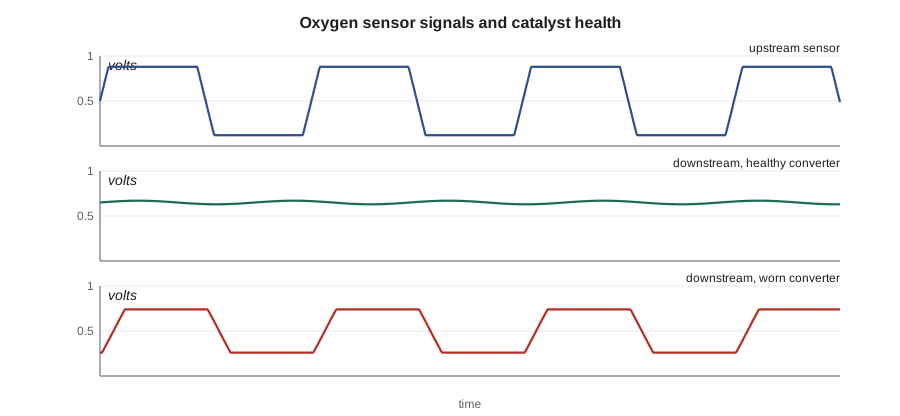
The engine computer cannot measure HC, CO and NOx directly, so it judges the converter by its oxygen storage. There is an oxygen sensor before the converter, either a narrow-band sensor or a wide-band air-fuel sensor, and a narrow-band sensor after it. Upstream, the closed-loop control makes the oxygen content swing constantly. Downstream of a healthy converter, which stores and releases oxygen to smooth those swings, the sensor reads a fairly steady voltage, usually around 0.6 to 0.7 volts. As a converter ages and loses its storage capacity, the swings pass through, and the downstream sensor begins to switch like the upstream one. On narrow-band systems, the computer compares the switching of the two sensors; on newer systems, it often runs an active test, deliberately driving the mixture rich and then lean and timing how long the downstream sensor takes to respond, which measures how much oxygen the converter can store.
The catalyst monitor is non-continuous and runs once per drive cycle under steady warm conditions. When the converter's measured efficiency falls below the calibrated threshold, which corresponds to the point where tailpipe emissions would exceed the standard by the allowed margin, the computer sets P0420 for bank 1 or P0430 for bank 2. A P0420 is a statement about the converter's oxygen storage, measured using two sensors, a healthy engine and a sealed exhaust. Anything else that upsets those measurements can set the code on a good converter.
# Catalyst monitor, narrow-band style: compare switching of the upstream and downstream sensors
def switches(trace, low=0.30, high=0.60):
    n, state = 0, None
    for v in trace:
        s = "rich" if v > high else ("lean" if v < low else state)
        if state is not None and s != state:
            n += 1
        state = s
    return n
upstream   = [0.1, 0.8, 0.2, 0.85, 0.15, 0.8, 0.1, 0.82, 0.2, 0.8, 0.12, 0.84]
good_down  = [0.65, 0.66, 0.64, 0.67, 0.66, 0.65, 0.64, 0.66, 0.65, 0.67, 0.66, 0.65]
worn_down  = [0.25, 0.7, 0.28, 0.72, 0.22, 0.7, 0.26, 0.71, 0.24, 0.73, 0.2, 0.72]
up = switches(upstream)
for name, trace in (("healthy converter", good_down), ("worn converter", worn_down)):
    ratio = switches(trace) / up
    print(f"{name:<18} upstream {up} switches, downstream {switches(trace)}, ratio {ratio:4.2f}"
+ (" -> efficiency below threshold" if ratio > 0.7 else " -> storing oxygen normally"))healthy converter upstream 11 switches, downstream 0, ratio 0.00 -> storing oxygen normally worn converter upstream 11 switches, downstream 11, ratio 1.00 -> efficiency below threshold
Before condemning the converter
Converters are expensive, so Ridgeline's procedure for a P0420 or P0430 starts by proving the rest of the system. Are there other codes, especially misfire, oxygen sensor or fuel trim codes? They are fixed first, because they can cause both the code and the converter damage. Is the engine running well, with trims within about ±10 percent, no misfire counts and normal coolant temperature? Is the exhaust sealed? An exhaust leak ahead of or between the sensors lets outside air reach them and upsets both the trims and the catalyst test. Is the downstream sensor responding? It is tested by forcing the mixture rich with a propane enrichment tool or the scan tool's own test, and lean with a small vacuum leak, and checking that it reaches above 0.8 volts and below 0.2 volts quickly. Has the manufacturer released a software update or a technical service bulletin for the code? Some P0420s are fixed by a revised calibration. Only then is the converter itself judged, by its monitor data in Mode 6, which show the measured value and the threshold, by a temperature check, and where needed by a tailpipe gas reading.
A temperature check uses an infrared thermometer or thermocouple on the shell. A working converter is generally hotter at its outlet than at its inlet once it is warm, because the reactions inside release heat, though the difference is small on a modern, very clean-running engine and is not proof by itself. A converter that rattles, has a melted or broken substrate, or restricts flow enough to choke the engine is condemned on sight; a restriction shows up as high exhaust back-pressure at the upstream sensor port and loss of power at high speed.
Exhaust gas recirculation
Exhaust gas recirculation (EGR) sends a controlled amount of exhaust back into the intake. The exhaust is mostly carbon dioxide, water and nitrogen, which do not burn, so it dilutes the fresh charge, slows the burn and lowers the peak combustion temperature by a few hundred degrees. Because NOx forms fastest at the highest temperatures, EGR cuts NOx sharply. It also reduces pumping losses at part throttle and lowers the tendency to knock, so modern engines use it for efficiency as well as emissions. Older engines used a vacuum-operated valve; current external systems use an electrically driven valve with a position sensor, often with a cooler that lowers the gas temperature further. Many engines with variable valve timing achieve the same effect internally, by holding the exhaust valve open slightly while the intake opens so that some exhaust is drawn back in; these engines may have no EGR valve at all.
EGR is shut off at idle, where it would make the engine run roughly, at full throttle, where power matters, and when the engine is cold. Faults are common on engines with external EGR because carbon builds up in the valve and passages. A valve stuck open causes rough idle, stalling and hesitation; a valve stuck closed or a blocked passage causes higher NOx, knocking under load and code P0401, insufficient flow. The computer tests the system by briefly opening the valve under suitable conditions and watching for a change in manifold pressure, mass airflow or fuel trim. Testing it means commanding the valve with a scan tool while watching engine speed at idle, which should stumble when the valve opens, and inspecting the passages for carbon.
# How EGR dilution lowers peak flame temperature and NOx (very simplified, illustrative)
import math
t_flame_no_egr = 2600.0            # K, peak burned gas temperature without EGR
for egr_pct in (0, 5, 10, 15, 20):
    t = t_flame_no_egr - 16.0 * egr_pct      # about 16 K lower per percent of EGR (rule of thumb)
    nox_rel = math.exp(-38000 / t) / math.exp(-38000 / t_flame_no_egr)
print(f"EGR {egr_pct:2d} %: peak temperature about {t:5.0f} K, NOx about {nox_rel * 100:4.0f} % of the no-EGR level")EGR 0 %: peak temperature about 2600 K, NOx about 100 % of the no-EGR level EGR 5 %: peak temperature about 2520 K, NOx about 63 % of the no-EGR level EGR 10 %: peak temperature about 2440 K, NOx about 38 % of the no-EGR level EGR 15 %: peak temperature about 2360 K, NOx about 23 % of the no-EGR level EGR 20 %: peak temperature about 2280 K, NOx about 13 % of the no-EGR level
Secondary air and particulate filters
Some engines have a secondary air injection system: an electric air pump that blows fresh air into the exhaust ports for the first minute or two after a cold start. The rich cold-start exhaust burns with the extra oxygen in the exhaust manifold, heating the converter quickly and cutting HC and CO. Pumps and their check valves fail from water and exhaust getting back into them, setting codes such as P0410; the monitor checks the system by watching the upstream sensor read lean when the pump runs.
Gasoline particulate filters (GPFs), fitted to some direct-injection engines, trap soot in a ceramic substrate whose channels are blocked at alternate ends, forcing the exhaust through the porous walls. A gasoline engine's exhaust is hot and contains spare oxygen during deceleration fuel cut-off, so the soot usually burns off during normal driving, a process called passive regeneration; some vehicles also run active regeneration strategies. A differential pressure sensor across the filter tells the computer how loaded it is. Short trips in cold weather, of the kind many city vehicles make, can let soot build up, and the vehicle may need a highway drive or a scan-tool-commanded regeneration.
Diesel trucks and vans carry a full aftertreatment system that Ridgeline services on some customers' vehicles: a diesel oxidation catalyst, a diesel particulate filter (DPF) that regenerates by burning soot at high temperature, and selective catalytic reduction (SCR), which sprays diesel exhaust fluid (DEF), a solution of urea in water, into the exhaust to convert NOx to nitrogen and water over a special catalyst. These systems are more complex than gasoline aftertreatment and have their own sensors, codes and procedures, but the same rule applies to them: they are diagnosed and repaired, never removed or disabled.
Tampering is never the repair
Removing a converter, installing a hollow pipe, fitting a defeat device, or reprogramming a computer to ignore an oxygen sensor or a missing DPF, often marketed as a delete kit or delete tune, is illegal. In the US, the Clean Air Act prohibits anyone from removing or rendering inoperative an emission control device, and prohibits selling or installing parts whose principal effect is to defeat one; the Environmental Protection Agency has brought large civil and criminal cases against shops and tuners, with penalties counted per vehicle and per device. In Canada, federal regulations under the Canadian Environmental Protection Act control how vehicles are built and sold and prohibit defeat devices, and tampering after sale is addressed unevenly by provincial rules; that patchwork is not permission, and it does not protect a shop from liability, warranty disputes or harm to its customers. Tampered vehicles pollute many times more, can damage engines when the calibration is wrong, are refused at inspection stations, and in most US states cannot be legally registered or sold. Ridgeline's written policy, posted beside the service counter, is that the shop will not remove, bypass or disable emissions equipment, sell delete parts, or install tunes that do either.
Van 1's converter
Kiran follows the procedure. There are no other codes, and the van's misfire counters are clean. Fuel trims are +3 and +2 percent. Smoke in the exhaust, with the tailpipe blocked by the proper plug at very low pressure, shows no leaks. The downstream sensor snaps above 0.8 volts with propane added and below 0.15 volts with a small vacuum leak opened, so it is working. There is no software update for the code. Mode 6 shows the bank 1 catalyst test value at 0.86 against a maximum of 0.75, and the downstream sensor on a road test switches almost as fast as the upstream one, exactly the worn pattern in the figure above. Two shifts a day of stop-and-go delivery work have simply worn it out.
The repair is a new converter. Marty explains the rules for replacement converters. In Alberta there is no state-style approval list, but Ridgeline uses the original-equipment part or an aftermarket converter that the maker states is designed and certified for this exact vehicle and its emission standard, never a universal or used unit, because an underperforming converter will simply set the code again and pollute more. The van is well past its warranty. Kiran installs the correct converter with new gaskets and fasteners, clears the code, and completes the drive cycle; the catalyst monitor passes with a test value of 0.18. Hal is not pleased with the price, but he signs the repair order.
Worked problem
Is the converter really bad?
A car has P0420 and P0171. Total fuel trim is +19 percent at idle, and a smoke test finds a cracked intake hose. What should be done first, and why?
Show solution
- Repair the intake leak first.
- The lean mixture affects the oxygen sensors and the converter's oxygen storage test.
- Clear codes, check that trims return to normal, and complete the drive cycle.
- Only if P0420 returns with the engine running correctly should the converter be judged.
Answer: Fix the vacuum leak and recheck; the P0420 may be a result of the lean condition, not a failed converter.
Common mistakes
MistakeReplacing the converter as soon as P0420 appears.
InsteadProve the engine, the exhaust seal and the sensors first; check for software updates.
MistakeFitting a universal or used converter to save money.
InsteadUse the OEM part or a new converter certified for that vehicle.
MistakeRemoving a converter, or installing a delete tune, at a customer's request.
InsteadTampering is illegal and harmful; refuse and explain the legal repair.
MistakeCleaning EGR passages without finding why they clogged.
InsteadCheck for oil consumption, PCV faults and driving patterns.
MistakeDriving a misfiring engine to get it to the shop under load.
InsteadRaw fuel in the converter can melt the substrate; drive gently or tow.
Summary and key terms
- A three-way converter oxidizes HC and CO and reduces NOx, but only near lambda 1.00.
- Oxygen storage in the washcoat smooths the mixture swings of closed-loop control.
- OBD-II judges the converter by comparing upstream and downstream sensor activity or by an active test.
- Before replacing a converter, rule out misfires, trims, exhaust leaks, sensor faults and software updates.
- EGR lowers peak combustion temperature and NOx; carbon buildup is its common failure.
- Particulate filters trap soot and burn it off by regeneration.
- Removing or disabling emission equipment is illegal and is never the repair.
- Three-way catalytic converter
- A converter that oxidizes HC and CO and reduces NOx at the same time.
- Oxygen storage capacity
- The converter's ability to store and release oxygen, used to judge its health.
- Light-off temperature
- The temperature at which a converter begins to work effectively.
- Exhaust gas recirculation (EGR)
- Returning some exhaust to the intake to lower combustion temperature and NOx.
- Gasoline particulate filter (GPF)
- A filter that traps soot from a direct-injection gasoline engine.
- Selective catalytic reduction (SCR)
- A diesel system that uses DEF to convert NOx into nitrogen and water.
- Defeat device
- Any part or software that bypasses, disables or reduces the effect of emission controls.
Practice problems
Work each problem on paper first, then reveal the answer to check.
The downstream oxygen sensor on a warm engine switches as fast as the upstream sensor. What does that suggest?
Show answer
The converter has lost its oxygen storage capacity.
Why is an EGR valve closed at idle?
Show answer
Exhaust dilution at idle would make the engine run roughly or stall.
A customer asks for a DPF delete. What is the correct response?
Show answer
Refuse: it is illegal tampering. Diagnose the DPF problem and quote the legal repair.
Name two things that can damage a catalytic converter.
Show answer
Misfire overheating, coolant or oil contamination, silicone sealants or physical damage.
Lesson quiz · 5 questions
Score 60% or more to complete this lesson.
Create a free account to save your progress, take quizzes and earn a certificate.