
AUTO-230 · Lesson 11 of 12 · 19 min
EPA and state emissions inspections
Kiran's term is nearly over, and Marty spends an afternoon on the rules behind all of it. He starts with two customers. The Lindqvists' 2017 minivan, fresh from its EVAP repair in Lesson 8, is due for its emissions inspection next week for registration renewal. And Harold Kemp has bought a used SUV out of state for his daughter, with a small performance tuner left plugged into the diagnostic connector by the seller, who said it adds power. "Two different questions," Marty tells Kiran. "Will the minivan pass, and what is that box doing to the SUV's emission controls? You need to understand both."
This lesson covers how vehicle emissions are regulated in the US: the federal Clean Air Act and EPA standards, California's role, emission warranties, how state inspection programs work, using the Colorado program as the example, what the law says about tampering, and how a shop prepares a vehicle to pass.
Federal standards and California
The Clean Air Act gives the Environmental Protection Agency authority to set emission standards for new motor vehicles. Manufacturers must certify each engine family before it can be sold, and each vehicle carries an emission control information label under the hood stating the standards it meets. The current light-duty standards, Tier 3, were phased in over the 2017 to 2025 model years and treat the vehicle and its fuel as one system: they tightened tailpipe and evaporative limits and cut gasoline sulfur to an average of 10 parts per million from 2017, because sulfur poisons catalytic converters. EPA's rules also require OBD-II, as Lesson 10 described, on all light vehicles since the 1996 model year.
California, which had vehicle standards before the federal government, is allowed under the Act to set its own stricter standards with a federal waiver, and other states may adopt California's standards instead of EPA's. Colorado is one of the states that has adopted California's standards for new vehicles. The California Air Resources Board (CARB) also approves aftermarket parts that affect emissions, which is why Lesson 9's converter in Colorado had to be CARB-approved, and why performance parts in many states need a CARB executive order number to be legal on the road.
Federal law also requires an emissions warranty on new vehicles. Under it, the manufacturer covers emission-related parts for 2 years or 24,000 miles, and specified major emission control components, including the catalytic converter and the engine computer, for 8 years or 80,000 miles, whichever comes first. California and states that follow its rules have longer coverage for some parts. A technician who finds an emission fault on a newer vehicle checks the warranty before quoting a repair.
State inspection programs
The Clean Air Act requires inspection and maintenance (I/M) programs in areas that do not meet the national air quality standards, such as the ozone standard, and some other states run them by choice. Each state designs its own program within EPA rules. Most now rely on the vehicle's own OBD-II system: the inspector plugs into the diagnostic connector, checks that the MIL works and is not commanded on, reads codes, checks readiness and, in many programs, reads the vehicle's software identity, without measuring the tailpipe at all. Older vehicles may get a tailpipe test on a dynamometer or at idle.
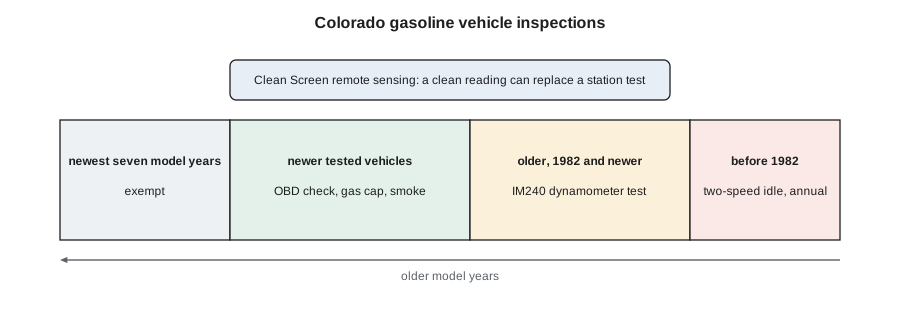
In Colorado, the state's Automobile Inspection and Readjustment program, run by the Department of Public Health and Environment with inspections at Air Care Colorado stations, covers gasoline vehicles registered in the Denver metro and northern Front Range area, including all or parts of Adams, Arapahoe, Boulder, Broomfield, Denver, Douglas, Jefferson, Larimer and Weld counties. The newest seven model years are exempt; after that, 1982 and newer vehicles are tested every two years at registration renewal. Newer light vehicles get an OBD check with a fuel cap test and a visible smoke check; older vehicles get a dynamometer test called IM240 or an idle test. Many vehicles never visit a station at all: roadside remote-sensing units, called Clean Screen, measure the exhaust plume of passing vehicles and photograph their plates, and a clean result lets the owner renew without an inspection. From 2026, the state is adding self-service OBD kiosks open around the clock, and heavier gasoline trucks have moved to OBD testing too.
What an OBD inspection checks
An OBD inspection fails a vehicle if the MIL is commanded on, if it cannot communicate, or if too many monitors are not ready, and in many programs if permanent codes are stored or the software has been altered. That is why the order of work at Ridgeline matters. The Lindqvists' EVAP repair was finished last week, and clearing the code reset every monitor to not ready; by the next day, the oxygen sensor, heater and valve timing monitors had run, but the catalyst and EVAP monitors had not. Most programs follow EPA guidance allowing up to two incomplete monitors on 1996 to 2000 vehicles and one on 2001 and newer vehicles, so the minivan cannot go for its test until its monitors, including the slow EVAP monitor, have run. Kiran gives Erik the manufacturer's drive cycle and the EVAP monitor's conditions in plain words: keep the tank between a quarter and three-quarters, let it sit overnight, and drive normally for a few days. A week later, the scan tool shows all monitors complete, and the minivan passes.
Whatever the rules, a vehicle's readiness status, permanent codes and software identity tell the technician whether its emission systems have actually been tested by its own computer since the last repair. The code below is Ridgeline's pre-delivery check. It uses the guidance many inspection programs follow: vehicles from the 1996 to 2000 model years may have up to two non-continuous monitors not ready, and 2001 and newer vehicles one, provided the MIL is off and no permanent codes are stored. The calibration verification number, read from the vehicle information service, shows whether the engine computer's software is the manufacturer's.
# Pre-inspection check: MIL, permanent codes, readiness and software identity
def check(model_year, mil_on, permanent, monitors, cvn_ok):
    allowed = 2 if model_year <= 2000 else 1          # incomplete non-continuous monitors (the common EPA-guidance rule)
    not_ready = [m for m, done in monitors.items() if not done]
    issues = []
    if mil_on: issues.append("MIL commanded on")
    if permanent: issues.append("permanent codes: " + ", ".join(permanent))
    if len(not_ready) > allowed: issues.append(f"{len(not_ready)} monitors not ready ({', '.join(not_ready)}), {allowed} allowed")
    if not cvn_ok: issues.append("calibration verification number does not match the manufacturer's")
    return issues
vehicles = {
    "Lindqvist minivan, day after EVAP repair": (2017, False, [], {"catalyst": False, "EVAP": False, "O2 sensor": True, "O2 heater": True, "EGR/VVT": True}, True),
    "Lindqvist minivan, after a week of driving": (2017, False, [], {"catalyst": True, "EVAP": True, "O2 sensor": True, "O2 heater": True, "EGR/VVT": True}, True),
    "SUV with aftermarket tuner": (2016, False, [], {"catalyst": True, "EVAP": True, "O2 sensor": True, "O2 heater": True, "EGR/VVT": True}, False),
}
for name, args in vehicles.items():
    issues = check(*args)
print(f"{name}: " + ("ready to test" if not issues else "not ready -> " + "; ".join(issues)))Lindqvist minivan, day after EVAP repair: not ready -> 2 monitors not ready (catalyst, EVAP), 1 allowed Lindqvist minivan, after a week of driving: ready to test SUV with aftermarket tuner: not ready -> calibration verification number does not match the manufacturer's
Tampering under the Clean Air Act
The Clean Air Act prohibits any person from removing or rendering inoperative any emission control device or element of design installed on a vehicle, and prohibits making, selling or installing any part whose principal effect is to bypass, defeat or render inoperative an emission control. That includes physical parts such as hollow converters and delete pipes, and software: tunes and tuners that disable monitors, change calibrations to defeat controls, or turn off diesel particulate filters and SCR. EPA treats each vehicle and each device as a separate violation, with civil penalties of thousands of dollars per violation for shops and individuals and much larger ones for manufacturers and sellers; it has made aftermarket defeat devices a national enforcement priority, and federal prosecutors have brought criminal cases against people who installed defeat devices and tampered with OBD systems. States add their own rules: Colorado's catalytic converter regulation, for example, carries civil penalties for each day of violation.
Beyond the law, tampering makes a vehicle emit far more than it should, as the code below shows roughly, voids warranty coverage, can damage the engine, and makes the vehicle impossible to register in any state that inspects it. Ridgeline's policy, posted beside the service counter, is that the shop will not remove, bypass or disable emission equipment, will not sell or install defeat parts or tunes, and will explain the legal repair to anyone who asks.
# Why tampering matters: rough emissions of one vehicle per year, intact versus tampered (illustrative)
distance = 12400                 # mi per year
grams_per = {"intact": {"NOx": 0.064, "HC": 0.08, "CO": 0.97},      # g/mi, typical in-use values
             "converter removed": {"NOx": 1.93, "HC": 2.4, "CO": 19.3}}
for state, g in grams_per.items():
    totals = {k: v * distance / 1000 for k, v in g.items()}
    print(f"{state:<18} " + "  ".join(f"{k} {t:6.1f} kg" for k, t in totals.items()))
ratio = grams_per["converter removed"]["NOx"] / grams_per["intact"]["NOx"]
print(f"NOx from the tampered vehicle is about {ratio:3.0f} times the intact vehicle's")intact NOx 0.8 kg HC 1.0 kg CO 12.0 kg converter removed NOx 23.9 kg HC 29.8 kg CO 239.3 kg NOx from the tampered vehicle is about 30 times the intact vehicle's
Harold's SUV and its tuner
Kiran plugs the shop scan tool in after removing the tuner, with Harold's permission. The calibration verification number in the engine computer does not match the manufacturer's listing for the calibration identification, which means the software has been changed, and an OBD inspection station would see the same mismatch. The tuner's own documentation, which Harold finds in the glovebox, advertises that it turns off the rear oxygen sensors' catalyst checks. The monitor status shows everything complete, but the catalyst monitor's Mode 6 results are blank. Harold had no idea. With his agreement, Ridgeline restores the manufacturer's software through the manufacturer's service website, and after a drive cycle the computer sets P0420 and P0430: both converters are worn out, and the tuner had been hiding it. The converters are replaced with CARB-approved parts listed for the vehicle, the monitors complete, and the SUV is ready for its first Colorado inspection. The tuner goes back to Harold in a box, uninstalled.
Repair cost limits and waivers
Many inspection programs, including Colorado's, have a repair waiver for vehicles that fail even after the owner has spent a set minimum on genuine emission repairs at a qualified shop; the details and amounts change, so Ridgeline checks the program's current rules before advising a customer. A waiver is never available for tampering, and repairs to remove tampering do not count toward it. Ridgeline's repair orders for emission failures therefore list each emission-related repair, its cost and the test result, so that the customer has the records a waiver application needs.
Worked problem
Ready for the test?
A 2015 car had a misfire repaired yesterday and its codes cleared. Today the scan tool shows the MIL off, a permanent P0302 still stored, and the catalyst and EVAP monitors not ready. Will it pass an OBD inspection today?
Show solution
- The MIL is off, which is required.
- A permanent code is still stored; it will clear only when the misfire monitor passes.
- Two monitors are not ready; for a 2001 or newer vehicle, programs following EPA guidance allow one.
- The car should be driven through its drive cycle until the permanent code clears and the monitors complete.
Answer: No: it should be driven until the permanent code clears and no more than one monitor is incomplete.
Common mistakes
MistakeClearing codes the day before an emissions test.
InsteadClearing resets readiness; the vehicle will be turned away until the monitors complete.
MistakeAssuming a CARB-approved part is legal for any vehicle.
InsteadCheck that the approval covers that specific vehicle.
MistakeTreating a tuner as harmless because the MIL is off.
InsteadCheck the calibration verification number and Mode 6; tuners can hide failed monitors.
MistakeInstalling a delete kit for an off-road claim on a registered road vehicle.
InsteadRemoving emission controls from a road vehicle is illegal tampering.
MistakeQuoting a converter replacement on a newer vehicle without checking the warranty.
InsteadConverters and engine computers are covered for 8 years or 80,000 miles.
Summary and key terms
- EPA sets new-vehicle emission standards under the Clean Air Act; Tier 3 phased in from 2017 with 10 ppm gasoline sulfur.
- California can set stricter standards that other states, including Colorado, may adopt; CARB approves emission-related aftermarket parts.
- The federal emissions warranty covers major emission parts for 8 years or 80,000 miles.
- Colorado tests gasoline vehicles in the Front Range area every two years after the seven newest model years, mostly by OBD or remote sensing.
- OBD inspections check the MIL, codes, readiness and, often, software identity.
- Removing or defeating emission controls, by part or by software, violates the Clean Air Act.
- Repairs must be followed by driving that completes the monitors before an inspection.
- Clean Air Act
- The federal law under which EPA regulates vehicle emissions and prohibits tampering.
- Tier 3
- The EPA vehicle and fuel standards phased in from the 2017 model year.
- CARB executive order
- California's approval of an aftermarket part as legal for specified vehicles.
- I/M program
- A state inspection and maintenance program for vehicles in service.
- Clean Screen
- Colorado's roadside remote-sensing program that can replace a station inspection.
- Calibration verification number (CVN)
- A number computed from the engine computer's software that shows whether it has been altered.
- Tampering
- Removing, bypassing or disabling emission controls or their software.
Practice problems
Work each problem on paper first, then reveal the answer to check.
How long does the federal emissions warranty cover a catalytic converter?
Show answer
8 years or 80,000 miles, whichever comes first.
Which Colorado vehicles are exempt from inspection because of their age?
Show answer
The newest seven model years.
A 2019 vehicle shows two monitors not ready. Under common EPA guidance, will it pass an OBD inspection?
Show answer
No; one incomplete monitor is allowed on 2001 and newer vehicles.
What does Clean Screen do?
Show answer
It measures passing vehicles' exhaust by remote sensing so that clean vehicles can skip the station test.
Lesson quiz · 5 questions
Score 60% or more to complete this lesson.
Create a free account to save your progress, take quizzes and earn a certificate.